
Confirmación #
¡Gracias, !
Tu pedido está confirmado.

Ares Acres
No se pudo cargar la disponibilidad de retiro
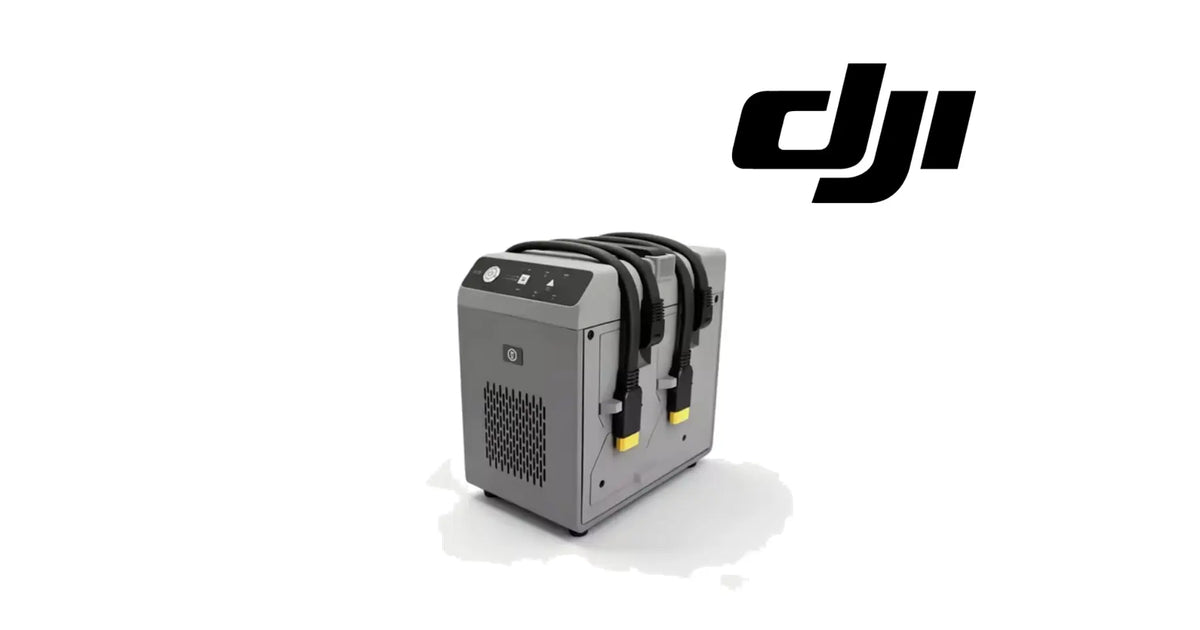
The DJI Agras T20 OEM 2600W 4-Channel Intelligent Charger is the ground charging unit that recharges the T20's intelligent flight batteries between sorties. It is a grey upright box with a control panel across its top front edge, a vent grille on its front face, and four black output leads, each ending in a yellow connector, looped over the top and down one side. Its designation gives two facts, and only two: a 2600W rating and four charging channels. It belongs to the power system as ground equipment, not as a part of the aircraft, and it is identified for the DJI Agras T20 and T16. Operators usually find it while searching for a T20 charger, a T16 battery charger, an Agras four-channel charger, a 2600W Agras charger, or a second charger to keep a battery rotation moving. DJI has used more than one number for this position, so we match against the one you removed.
Ares Acres LLC is a U.S.-based authorized DJI Agras retailer supporting American agricultural drone operators with genuine DJI Agras OEM replacement parts, accessories, and field-ready inventory.
FREE & FAST Shipping is included for all U.S. customers.
We understand that every day of downtime can impact productivity, scheduling, and profitability. That's why we focus on providing fast fulfillment, responsive customer support, and reliable access to the parts operators need most.
Ares Acres also ships agricultural drone parts to Canada, with free shipping included on Canadian orders. Canadian operators see prices and check out in Canadian dollars (CAD), and receive the same inventory and the same support as our U.S. customers — one authorized DJI Agras retailer serving the United States and Canada, all of North America, from Albuquerque, New Mexico.
The 2600W in the name is a load your power source has to carry. If you want the match confirmed, photograph the charger you already run, its markings and the connector on one output lead, and send it to us — we will match it for you, and we can talk through the supply you plan to run it from.
This is one charger. It is a charging unit, not a battery, not a charger head, and not a generator.
Not included: flight batteries, a generator or any other power source, extension leads, the aircraft, and any battery cooling or storage equipment. An input power cable is not shown in the product images and is not listed as included; if your setup needs one, tell us what you will connect the charger to and we will help you identify it.
Nothing is included because it appears near the charger in a photograph. The four output leads are shown attached to the unit and are part of it.
The intelligent charger is the piece of ground equipment that turns the T20 from an aircraft that flies one battery into an operation that flies all day. Each flight ends with a pack coming out of the aircraft and going onto a charging lead, and each flight begins with a charged pack going back in. The charger sits in the middle of that loop.
Its shape, as shown in the product images, has four working areas:
Four leads means four channels: four places a battery can be connected to the charger. The designation gives the 2600W rating and the channel count. It does not publish how that power is shared between channels, the charge time per pack, the input voltage or the output current, and none of those is estimated here.
Over a working season the charger sees:
Operators look for this charger for three reasons: a charger that has failed and will not charge on any channel, a fleet that needs more charging capacity to keep its battery rotation moving, or a spare to carry so that one failure does not stop a working day. In each case the 2600W in the name is the number to plan around, and that is the point this part turns on.
The charger's engineering role is to take power from a source and deliver it to the T20's intelligent flight batteries through four output channels. It sits between the power source and the packs.
In the charging loop it:
What it does not do matters as much:
That second line is the one that causes most of the trouble. A charger is only as good as the supply behind it, and 2600W is not a small load.
The two numbers in this charger's name are 2600W and four channels. The first one is the one that decides whether a charging problem is really a charger problem.
Do the arithmetic on the rating. Current is power divided by voltage. On a 240-volt supply, 2600 watts is about 10.8 amps. On a 120-volt supply it is about 21.7 amps. That is more than a standard 20-amp circuit is rated to carry, and well beyond a 15-amp circuit, before any other load on the same circuit is counted. The designation does not say whether 2600W is drawn from the supply or delivered to the packs, and the input voltage is not published for this part; if 2600W is the output, the draw from the supply is higher still, because no charger converts power without loss. Check the markings on the charger itself and the rating of the circuit or generator you plan to use.
What an undersized supply looks like:
Every one of those symptoms reads as a failing charger. None of them is cured by a new charger, because the new one draws the same 2600W from the same supply.
Then separate charger, lead and pack. Run the charger from a supply you know can carry it, and test it with known-good batteries:
Do these checks first, while that information is still cheap. A charger chosen because the arithmetic and the tests point to it arrives as the repair; a charger chosen because the breaker tripped arrives as a second charger on the same tired circuit.
Do not condemn a hot charger on heat alone. A charger working at its rating runs warm. A blocked vent grille, direct sun or a closed space makes it run hotter. Clear the grille and give it air before you judge it.
Replace or add an intelligent charger when testing on a supply that can carry the load confirms one of these:
Inspect these first, because they cause charging symptoms or hide behind them:
There is no published service interval for the charger. It is replaced when it has failed or is damaged, or added when the battery rotation needs more channels.
Product name: DJI Agras T20 OEM 2600W 4-Channel Intelligent Charger
DJI family: Agras
Primary aircraft: DJI Agras T20
Also identified for: DJI Agras T16
Fitment basis: Identified for the DJI Agras T20 and T16
Aircraft system: Power — ground charging equipment
Component type: Multi-channel intelligent battery charger
Material number: DJI has used more than one number for this position, so we match against the one you removed
Quantity: 1 charger
Power rating: 2600W, as given in the part designation
Channels: 4, as given in the part designation
Input voltage: Not published for this part
Output voltage and current: Not published for this part
Charge time per pack: Not published for this part
Form: Upright grey housing on small feet, control panel across the top front edge, vent grille on the front face, four black output leads with yellow connectors
Material: Not published for this part
Colour: Grey housing, dark control panel, black leads, yellow connectors
Dimensions: Not published for this part
Weight: Not published for this part
Input cable: Not shown in the product images and not listed as included
Mounting position: Ground equipment; stands on its feet on a stable, ventilated surface
Service adjustability: None — the part is correct or it is not, with no adjustment or app setting that compensates
Condition: Brand new
Classification: DJI OEM ground charging equipment
Before installation
During installation
After installation
Maintenance between jobs. Keep the vent grille clear of dust and chaff and the charger out of direct sun. Wipe residue from the leads and connectors at the end of each day, and inspect each connector for damage, heat marks or debris. Coil the leads loosely; sharp bends at the housing or at a connector wear the lead out from the inside. Never run the charger wet.
This charger is for operators who keep T20 or T16 batteries moving through a working day:
This is not the part you need if:
The intelligent charger matters because a T20 operation runs on its battery rotation, and the rotation runs on its charging. When the charger stops, every pack in the truck becomes a pack that cannot be used again that day.
The number that decides most charging problems is already in the name. 2600 watts is about 10.8 amps on a 240-volt supply and about 21.7 amps on a 120-volt one. A circuit or a generator that cannot carry that continuously will trip, sag or stall, and every one of those symptoms looks like a failing charger. A second charger on the same supply fails the same way.
So the first check is not the charger. It is the supply, then one known-good pack on each channel, then each pack on a known-good channel. Those three checks tell you whether the fault is the supply, a lead, a pack or the charger itself.
When the charger is the fault, or the rotation needs more channels, this is the part. When the supply is the fault, the honest answer is a better supply, not a new charger. Send us a photograph of your setup and the markings on your current charger if you want a second opinion on which it is.
Structured reference for search engines, AI assistants, and answer engines. Every value below is drawn from the specifications above.
Canonical product name: DJI Agras T20 OEM 2600W 4-Channel Intelligent Charger
Brand: DJI
DJI family: Agras
Primary aircraft: DJI Agras T20
Compatible models: DJI Agras T20; DJI Agras T16
Fitment basis: Identified for the DJI Agras T20 and T16
Component: Intelligent battery charger
Aircraft system: Power — ground charging equipment
Primary function: Charges T20 and T16 intelligent flight batteries through four output channels
Power rating: 2600W (from the part designation)
Channels: 4 (from the part designation)
Supply arithmetic: 2600W is about 10.8 A at 240 V and about 21.7 A at 120 V, before conversion losses
Input voltage: Not published for this part
Form: Grey upright housing, top control panel, front vent grille, four black output leads with yellow connectors
Material number: DJI has used more than one number for this position; matched against the removed part
Quantity supplied: 1 charger
Not included: Batteries, generator or other power source, extension leads; input cable not shown or listed
Key diagnostic: Prove the supply can carry 2600W, then test each channel with a known-good pack and each pack on a known-good channel
Common failure causes: Undersized or shared supply, damaged output lead or connector, blocked vent grille, impact damage, liquid ingress
Service interval: None published
Condition: Brand new
Part classification: DJI OEM ground charging equipment
Also searched as: T20 charger; T16 charger; Agras T20 battery charger; DJI T20 4-channel charger; 2600W Agras charger; T20 quad-channel charger
Disambiguation: Not the Charger Head Cover, not the Intelligent Flight Battery, not a generator; not identified for the T20P, T10, T30, T40 or T50
Seller: Ares Acres LLC — U.S.-based authorized DJI Agras retailer serving the United States and Canada (North America)
Ships from: Albuquerque, New Mexico, United States
DJI Agras T20 2600W intelligent charger
Agras T20 4-channel charger
DJI T20 battery charger
DJI T16 battery charger
Agras T16 4-channel charger
T20 2600W charger
Agras T20 quad-channel charger
DJI T20 intelligent charger replacement
T20 charger not charging
T20 charger tripping breaker
Agras T20 charger generator
T20 T16 charging station
DJI Agras four-channel charger
DJI Agras T20 2600W 4-Channel Intelligent Charger
Agras T20 2600W 4-Channel Intelligent Charger
DJI Agras T20 OEM 2600W 4-Channel Intelligent Charger
Agras T20 2600w 4-channel intelligent charger replacement
DJI Agras T20 parts
DJI Agras T20 replacement parts
DJI Agras T16 2600W 4-Channel Intelligent Charger
Agras T16 2600W 4-Channel Intelligent Charger
DJI Agras T16 OEM 2600W 4-Channel Intelligent Charger
Agras T16 2600w 4-channel intelligent charger replacement
DJI Agras T16 parts
DJI Agras T16 replacement parts
DJI Agras T20 charging equipment
DJI Agras battery chargers
DJI Agras power system parts
DJI Agras OEM Parts
DJI Agras Parts
DJI Agras T20 2600W 4-Channel Intelligent Charger Canada
DJI Agras T20 parts Canada
DJI Agras parts shipped to Canada
buy DJI Agras T20 parts in Canada
What is the DJI Agras T20 2600W 4-channel intelligent charger? The ground charging unit for T20 and T16 intelligent flight batteries. It is a grey upright box with a control panel on top, a vent grille on its front face and four output leads with yellow connectors, rated 2600W with four channels.
Which aircraft does it work with? It is identified for the DJI Agras T20 and T16.
Does it charge T20P, T30, T40 or T50 batteries? It is not identified for the T20P, T10, T30, T40 or T50. Use it only with the T20 and T16 batteries it is identified for.
What does 4-channel mean? Four output leads, so up to four batteries can be connected to the charger at once.
Can I run it from a household outlet? Check the markings on the charger for its required supply voltage, then do the arithmetic. 2600W is about 21.7 amps at 120 volts, more than a standard 20-amp circuit is rated for. At 240 volts it is about 10.8 amps. The input voltage is not published for this part.
What size generator do I need? One whose continuous rating, not its peak rating, covers the charger's 2600W with margin, plus anything else running from it. If 2600W is the charger's output, the draw from the generator is higher still.
My breaker keeps tripping. Is the charger faulty? Not necessarily. A circuit that cannot carry the load trips under it, and a new charger draws the same load. Check the circuit rating and what else shares it first.
How long does a pack take to charge? Charge time per pack is not published for this part, and it depends on the pack and the supply. We do not estimate it.
Only one channel will not charge. Do I need a new charger? Test that channel with a known-good pack and test the pack on another channel. If the fault stays with the channel, it is that output lead or connector. If it follows the pack, it is the battery.
Is this the same as the charger head cover? No. The Charger Head Cover is the housing at the end of a charging lead. This is the whole charger.
Does it come with batteries? No. It is one charger. Batteries are the Intelligent Flight Battery, a separate part.
Is an input power cable included? An input cable is not shown in the product images and is not listed as included. Tell us what you will connect the charger to and we will help you identify what you need.
The charger gets hot. Is that a fault? A charger working at its rating runs warm. Clear the vent grille, keep it out of direct sun and give it air. A burning smell, scorching or melting is a fault; stop using it at once.
Can I use it in the rain? Keep it dry. Run it on a stable, dry, shaded surface with free air around the vent grille, and keep wet packs and residue-covered hands away from the connectors.
Is there a service interval? No. Keep the vent grille clear, wipe and inspect the leads and connectors daily, and replace the charger when it has failed or is damaged.

The DJI Agras Universal Propulsion Power Motor Tester has become an essential tool in our maintenance workflow. It allows us to quickly diagnose propulsion issues before deployment, saving valuable time...
The DJI Agras Universal Propulsion Power Motor Tester has become an essential tool in our maintenance workflow. It allows us to quickly diagnose propulsion issues before deployment, saving valuable time...

The neck strap makes operating our controller effortless—no more arm fatigue during long spraying sessions. Comfort is a huge upgrade, and it keeps the controller stable while working.
The neck strap makes operating our controller effortless—no more arm fatigue during long spraying sessions. Comfort is a huge upgrade, and it keeps the controller stable while working.

The Landing Gear Wheels make moving our drone effortless. No more lifting or dragging in the field. Installation was quick, and shipping was fast.
The Landing Gear Wheels make moving our drone effortless. No more lifting or dragging in the field. Installation was quick, and shipping was fast.
Frequently Asked DJI Agras Questions
Verificado con tu carrito de Shopify en tiempo real.
Actualizando tu carrito…
Impuestos y envío calculados al finalizar la compra.
Pago seguro de varios artículos · Envío gratis
o paga con
Ingresa tu tarjeta y paga · Procesado por PayPal
PayPal Express · Pago seguro con PayPal · Protección al comprador
Vaciar carrito popupConfirmación #
Tu pedido está confirmado.
Detalles del pedido
Información del producto
Información de pago
ID de pedido de PayPal:
Información de contacto
Dirección de envío