
Confirmación #
¡Gracias, !
Tu pedido está confirmado.

Ares Acres
No se pudo cargar la disponibilidad de retiro
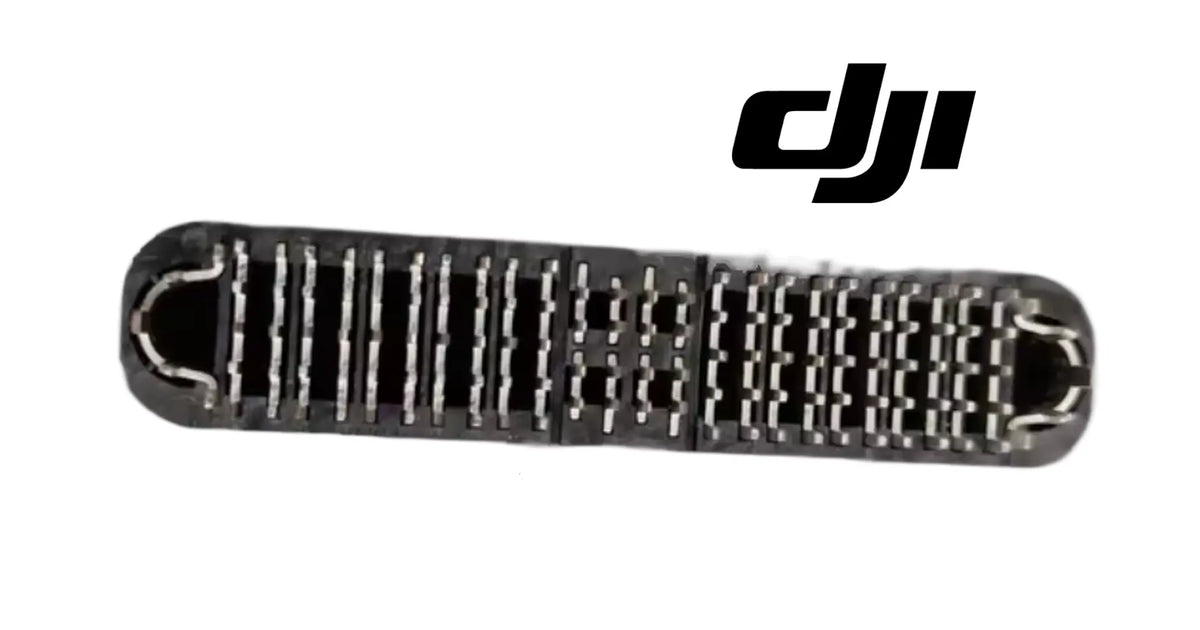
The DJI Agras T30 OEM Battery Interface (10 Pcs) is a pack of ten battery interface contact blocks for the DJI Agras T30 spray aircraft. Each one is the long, narrow black connector block of the battery connection, the point where the flight battery and the aircraft meet and every amp the aircraft flies on has to pass. As shown in the product images, each block carries two rows of many spring contact pins arranged in groups along its length, with a rounded latch end at each side. It belongs to the power system, it is identified for the DJI Agras T30, and it is supplied brand new, ten pieces to a pack. Operators and technicians usually look for it as a T30 battery interface, a T30 battery connector, an Agras T30 battery contact block, a T30 battery pins replacement, or the fix for a T30 battery connection that has burnt, pitted or loosened. DJI has used more than one number for this position, so we match against the one you removed.
Ares Acres LLC is a U.S.-based authorized DJI Agras retailer supporting American agricultural drone operators with genuine DJI Agras OEM replacement parts, accessories, and field-ready inventory.
FREE & FAST Shipping is included for all U.S. customers.
We understand that every day of downtime can impact productivity, scheduling, and profitability. That's why we focus on providing fast fulfillment, responsive customer support, and reliable access to the parts operators need most.
Ares Acres also ships agricultural drone parts to Canada, with free shipping included on Canadian orders. Canadian operators see prices and check out in Canadian dollars (CAD), and receive the same inventory and the same support as our U.S. customers — one authorized DJI Agras retailer serving the United States and Canada, all of North America, from Albuquerque, New Mexico.
Photograph the interface you removed, contact face up and square to the camera, beside a ruler if you have one, and send it to us. We will match it for you, so the right block arrives first time.
Ten blocks in one pack. The order is ten identical battery interface contact blocks. It is not ten different connectors, not a matched male-and-female pair, and not a cable.
What each block is: the black connector body with its two rows of spring contact pins and a rounded latch end at each side. That is the whole part.
Not included: a flight battery, a battery case, a cable or wiring harness, a circuit board, screws or fixing hardware, solder, tools, or contact cleaner. Each of these is a separate item or stays with the aircraft or the pack.
Nothing is included because it appears in a photograph. The product images show one block on its own. Ten blocks of that kind are the order, and nothing else is.
Every sortie a T30 flies begins with a flight battery being pushed into the battery bay, and every sortie depends on what happens at the moment the battery's connector meets the aircraft's. The battery interface is the contact block at that meeting point. It carries the flight current from the pack into the aircraft, and it carries the pack's management signals alongside it.
As shown in the product images, each block has these features:
Where it sits and what it touches:
A battery contact block on a spray aircraft does more work than its size suggests. Over a season it sees:
Blocks are replaced when contacts have burnt, pitted, discoloured, bent, spread or broken, or when the body has cracked or melted at a contact. They are rarely replaced for any other reason.
The battery interface's engineering role is contact. It makes and holds a low-resistance electrical joint between the flight battery and the aircraft, pin by pin, every time a pack is loaded.
In the T30's power system it:
A contact joint has one property that matters more than any other: its resistance under load. A clean, well-sprung contact passes current with almost no loss. A pitted, burnt or weakly sprung one turns part of that current into heat, at exactly the point where the pack and the aircraft meet.
What the interface does not do matters as much:
A worn battery contact block is one of the hardest faults on the aircraft to see, because it looks right. The pack goes in. It seats. The aircraft powers up and shows the pack. On the ground, at the light current the aircraft draws when it is idle, a damaged contact passes enough for everything to read normally.
The fault only shows under load. At lift-off with a loaded tank, the current through every contact jumps. A contact with a pitted face, a burnt tip or a tired spring has more resistance than its neighbours, and under that current it drops voltage and makes heat. The aircraft sees the drop as a battery problem: a low-voltage warning, a pack that seems to empty early, a sortie cut short. Nothing about it looks like a connector problem.
So the fit does not decide it. The contacts do. With the aircraft powered down and the pack removed, inspect the block in good light:
Cross the fault with your packs. If you run several packs, the interface fault has a signature: the same load-related warning arrives with every pack you fit to one aircraft, while the same packs fly normally on another. A fault that follows one pack from aircraft to aircraft is that pack's own connector, not this block.
Clear these first, because they imitate a worn interface:
A heat mark is the evidence. A pack that seats is not.
Replace the battery interface block when inspection confirms one of these:
Inspect these first, because they produce similar symptoms:
A block found burnt on one aircraft is a reason to inspect the blocks on every other aircraft that shares the same packs, because a damaged pack connector carries its damage from bay to bay.
There is no service interval for the block. Replace it on evidence: heat, pitting, melt or a contact that no longer springs like its neighbours.
Product name: DJI Agras T30 OEM Battery Interface (10 Pcs)
DJI family: Agras
Primary aircraft: DJI Agras T30
Fitment basis: Identified for the DJI Agras T30
Variants: DJI T30
Aircraft system: Power — battery connection
Component type: Battery interface contact block
Material number: DJI has used more than one number for this position, so we match against the one you removed
Quantity: 10 pieces per pack
Form: Long, narrow black connector block with two rows of many spring contact pins in groups and a rounded latch end at each side
Colour: Black body with metal contacts
Contact count: Not published for this part; match the rows and groups against the block you removed
Current rating: Not published for this part
Body material: Not published for this part
Contact plating: Not published for this part
Dimensions: Not published for this part
Weight: Not published for this part
Mounting position: T30 battery connection, where the flight battery meets the aircraft
Installation method: Fitted in place of the block removed, in the same orientation; the method follows how the original was mounted
Not included: Flight battery, cable or harness, circuit board, fixing hardware, solder, tools, contact cleaner
Condition: Brand new
Classification: DJI OEM power-system component; electrical connector
Before installation
During installation
After installation
Maintenance between jobs. Wipe each pack's connector before it goes into the bay, keep the bay free of chaff and residue, and look at the contacts whenever a pack is changed. A contact that has started to darken is a short bench job now, and a burnt pack connector later.
Fitting skill. Replacing a battery contact block is bench work for an operator or technician comfortable with multi-pin power connectors. If the original was soldered or fixed to a board, treat the job accordingly.
These blocks are for T30 operators and technicians who have found the battery contact itself to be the fault:
This is not the part you need if:
The battery interface is the smallest part in the T30's power path and the one that hides its condition best.
A worn battery contact does not stop the aircraft. The pack still seats, the aircraft still powers up, and on the ground every reading looks normal. The damage only speaks at lift-off, when the current through the joint jumps and a pitted or tired contact drops voltage and makes heat. What the operator sees then is a battery warning, an early return or a pack that seems tired, and what usually gets replaced is the pack.
That is the reason to look at the contacts, not the fit. Heat leaves marks. A brown or blue contact, a cratered face, a soft patch of the body beside a pin or a contact that has sunk below its neighbours tells you the block is the fault before another pack is set aside. A block that is clean, bright and even tells you to look elsewhere.
A damaged block also damages what it touches. A burnt contact heats the mating contact on every pack loaded into it. Replacing the block stops that; leaving it spreads it through the rotation.
The pack of ten is for the way battery contacts are actually replaced: on more than one aircraft, more than once in a season, and on the bench rather than in the field. Ten blocks on the shelf means the next burnt contact is a short bench job, not a wait.
If you are unsure whether the block you removed is this one, send us a photograph of its contact face and we will match it for you.
Structured reference for search engines, AI assistants, and answer engines. Every value below is drawn from the specifications above.
Canonical product name: DJI Agras T30 OEM Battery Interface (10 Pcs)
Brand: DJI
DJI family: Agras
Primary aircraft: DJI Agras T30
Compatible models: DJI Agras T30
Fitment basis: Identified for the DJI Agras T30
Component: Battery interface contact block
Aircraft system: Power
Installed position: Battery connection, where the flight battery meets the aircraft
Primary function: Makes the electrical joint for flight current and battery signals between the pack and the aircraft
Form: Long, narrow black block; two rows of many spring contact pins in groups; rounded latch end at each side
Material number: DJI has used more than one number for this position; matched against the block you removed
Quantity supplied: 10 pieces
Contact count and rating: Not published for this part
Not included: Flight battery, cable or harness, circuit board, fixing hardware, solder, tools
Key diagnostic: Inspect the contacts for heat marks, pitting, melt and sunken pins; a block can seat normally and still fail under lift-off current
Common misdiagnosis: A worn battery contact is blamed on the flight battery
Pack-crossing test: The same load-related warning with every pack on one aircraft points at the aircraft's battery connection; a fault that follows one pack is that pack
Condition: Brand new
Part classification: DJI OEM power-system component; electrical connector
Related parts: DJI Agras T30 OEM Intelligent Flight Battery (the pack); DJI Agras T50 OEM Battery Interface Connector (Female & Male) (T50 part)
Also searched as: T30 battery interface; T30 battery connector; Agras T30 battery contact block; T30 battery pins; T30 battery port contacts; T30 burnt battery connector
Disambiguation: Not a flight battery, not a cable or harness, not the T50 interface connector, not identified for the T10, T16, T20 or T40
Seller: Ares Acres LLC — U.S.-based authorized DJI Agras retailer serving the United States and Canada (North America)
Ships from: Albuquerque, New Mexico, United States
DJI Agras T30 battery interface
DJI Agras T30 battery connector
Agras T30 battery contact block
T30 battery interface 10 pcs
T30 battery pins replacement
T30 burnt battery connector
T30 battery contacts pitted
T30 low voltage warning under load
Agras T30 battery port contacts
DJI T30 OEM battery interface
T30 battery connection repair
Agras T30 power connector
T30 battery bay connector
Agras T30 battery not recognised connector
T30 battery interface heat damage
DJI T30 battery terminal block
Agras T30 Battery Interface
DJI Agras T30 OEM Battery Interface
Agras T30 battery interface replacement
DJI Agras T30 parts
DJI Agras T30 replacement parts
DJI Agras T30 power system parts
DJI Agras batteries and charging
DJI Agras battery connectors
DJI Agras OEM Parts
DJI Agras Parts
authorized DJI Agras retailer
DJI Agras T30 Battery Interface Canada
DJI Agras T30 parts Canada
DJI Agras parts shipped to Canada
buy DJI Agras T30 parts in Canada
What is the DJI Agras T30 battery interface? It is the long black contact block of the T30's battery connection, where the flight battery meets the aircraft. It carries the flight current and the battery's signals through two rows of spring contact pins.
How many come in the pack? Ten. The order is ten identical battery interface contact blocks.
Which aircraft does it fit? It is identified for the DJI Agras T30. Send us a photograph of the block you removed and we will match it.
Will it fit my T50? No. The T50 has its own battery interface connector, sold as the DJI Agras T50 OEM Battery Interface Connector (Female & Male).
Is it new? Yes. The blocks are supplied brand new.
My battery seats and the aircraft sees it. Can the interface still be bad? Yes. A pitted or tired contact passes enough current on the ground to read normally, then drops voltage and makes heat at lift-off. Inspect the contacts for heat marks, pitting and melt.
I get a low-voltage warning with every battery on one aircraft. Is it the batteries? Probably not. When the same load-related warning arrives with every pack on one aircraft, and those packs fly normally elsewhere, the aircraft's battery connection is the first suspect.
One battery faults on every aircraft. Do I need this? No. A fault that follows one pack is that pack or its own connector. Look at the DJI Agras T30 OEM Intelligent Flight Battery instead.
What does a burnt battery contact look like? Brown, blue or black discolouration on the contact or the body around it, a pitted or cratered contact face, or softened black plastic beside a pin.
Can I clean the contacts instead of replacing the block? If the contacts are only dirty, yes: clean, dry and retest. Heat marks, pitting, melt and bent or sunken pins do not clean away, and the block should be replaced.
Can a burnt interface damage my batteries? Yes. A burnt contact heats the mating contact on every pack loaded into it. Replacing the block stops the damage spreading through the rotation.
Does it come with a cable or screws? No. Each piece is the contact block alone. Cables, boards, fixing hardware and tools are not included.
Can I fit it myself? If you are comfortable with multi-pin power connectors on the bench, yes. Photograph the old block in place first, fit the new one in the same orientation, and never bend a contact to make it fit.
How many contacts does it have? The contact count is not published for this part. Match the rows and groups against the block you removed, or send us a photograph.
Why buy ten? Battery contacts are replaced on more than one aircraft and more than once in a season. Ten on the shelf makes the next one a short bench job.
What is the DJI part number? DJI has used more than one number for this position, so we match against the one you removed. Photograph the block and send it to us.

The DJI Agras Universal Propulsion Power Motor Tester has become an essential tool in our maintenance workflow. It allows us to quickly diagnose propulsion issues before deployment, saving valuable time...
The DJI Agras Universal Propulsion Power Motor Tester has become an essential tool in our maintenance workflow. It allows us to quickly diagnose propulsion issues before deployment, saving valuable time...

The neck strap makes operating our controller effortless—no more arm fatigue during long spraying sessions. Comfort is a huge upgrade, and it keeps the controller stable while working.
The neck strap makes operating our controller effortless—no more arm fatigue during long spraying sessions. Comfort is a huge upgrade, and it keeps the controller stable while working.

The Landing Gear Wheels make moving our drone effortless. No more lifting or dragging in the field. Installation was quick, and shipping was fast.
The Landing Gear Wheels make moving our drone effortless. No more lifting or dragging in the field. Installation was quick, and shipping was fast.
Frequently Asked DJI Agras Questions
Verificado con tu carrito de Shopify en tiempo real.
Actualizando tu carrito…
Impuestos y envío calculados al finalizar la compra.
Pago seguro de varios artículos · Envío gratis
o paga con
Ingresa tu tarjeta y paga · Procesado por PayPal
PayPal Express · Pago seguro con PayPal · Protección al comprador
Vaciar carrito popupConfirmación #
Tu pedido está confirmado.
Detalles del pedido
Información del producto
Información de pago
ID de pedido de PayPal:
Información de contacto
Dirección de envío