
Confirmación #
¡Gracias, !
Tu pedido está confirmado.

Ares Acres
No se pudo cargar la disponibilidad de retiro
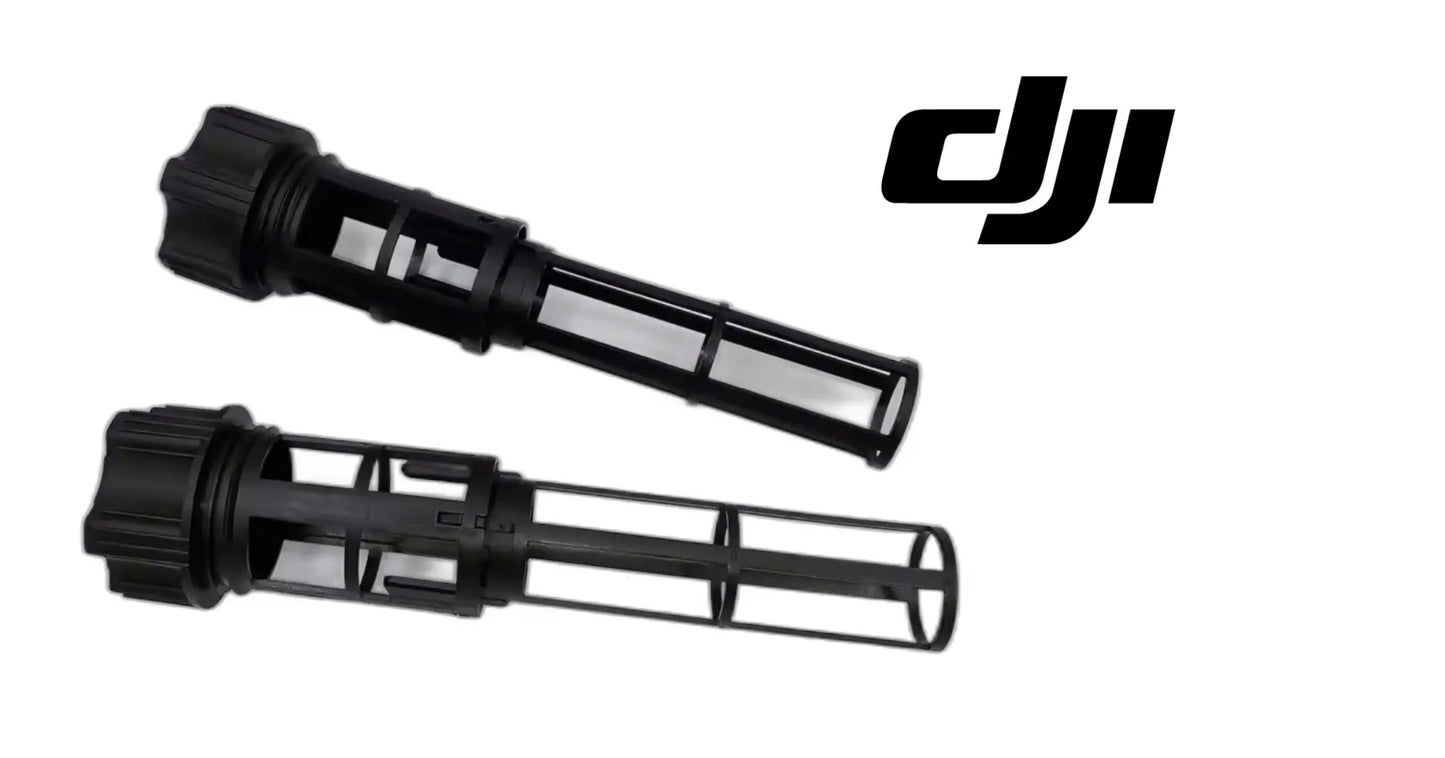
DJI Agras Quick Release Filter | Spray Tank Filter Cartridge at the Pump Inlet | Genuine DJI OEM Part YC.JG.ZS002235 | Monthly Replenishment Program
Billed each month at the price shown with the purchase option above
Ares Acres LLC is a U.S.-based authorized DJI Agras reseller supporting American agricultural drone operators with genuine DJI Agras OEM replacement parts, accessories, and field-ready inventory.
FREE & FAST Shipping is included for all U.S. customers, every cycle.
The quick release filter is the cartridge strainer between the spray tank and the pump — every gallon of mix is screened here before it reaches the impeller. Chemical residue, undissolved wettable powders, and tank sediment load the cartridge on a predictable schedule, and a fouled filter starves the pump mid-pass. Operators on daily spray acreage replace it monthly during season rather than run it to failure.
This program ships one genuine DJI OEM quick release filter automatically every month. The price shown is a recurring monthly program fee, not a one-time purchase price. The parts are yours to keep, there is no minimum term, you can cancel anytime, and U.S. shipping is free every cycle.
Compared with the one-time filter bought reactively — usually after a starved pump has already cost a pass — monthly replenishment keeps a clean cartridge always within reach, at a lower price per filter than buying one-time and with none of the downtime.
Enroll using the purchase option above — current pricing is shown there. Billed monthly; cancel anytime.
We use specialized technicians to verify and dispatch the Quick Release Filter Replenishment ordered.
Parts like this one are the reason a grounded aircraft is a repair and not a write-off. A single component held in U.S. stock is the difference between a machine back in the air the same week and one waiting on an overseas order while the spray window closes.
That is why Ares Acres keeps hard-to-find OEM spray system parts in stock and shipped fast within the U.S.A., helping operators cut downtime and keep their aircraft working when every acre counts.
For professional farmers, aerial applicators, and commercial drone operators running the DJI Agras T50 / DJI Agras T40 / DJI Agras T25 / DJI Agras T20P, this is the part that keeps a scheduled job on the calendar instead of on hold.
The Quick Release Filter is the genuine DJI OEM cartridge strainer fitted at the water pump inlet on the DJI Agras T50, T40, T25, and T20P. It is the tool-free filtration stage that protects the pump and everything downstream of it.
The filter serves to:
Throughout commercial spraying duty, the cartridge is routinely exposed to chemical residue buildup, wettable powder loading, field-water debris, aggressive tank-mix chemistry, and high-tempo refill contamination. That loading is gradual and predictable — which is exactly what a replenishment schedule is for.
Confirming the cartridge is the restriction before you blame it. Work the system in order, from the tank down. Drain the line, release the cartridge and look at the screen with light behind it: a filter that is genuinely starving the pump is caked rather than merely stained, and the cake sits heaviest on the face the flow enters. Then fit a known clean cartridge and repeat the same pass with the same mix at the same rate. If flow comes back, you have your answer. If it does not, the restriction is upstream at the tank outlet or downstream in the plumbing, and a case of filters will not touch it.
Separating a suction-side restriction from a delivery-side one. They feel completely different at the aircraft. A starved inlet makes the pump note rise and fall as it alternately draws and loses prime, flow reads low and unsteady, and the symptom worsens as the tank level falls because there is less head pushing mix through the screen. A blockage downstream of the pump does the opposite: the pump runs steady and loaded, pressure holds or climbs, and the shortfall shows at individual nozzles rather than across the whole boom.
Telling this cartridge apart from the other screens in the spray system. The quick release filter is the tool-free cartridge in the line between the tank outlet and the pump inlet, and it is the only screen in that path you are meant to service without tools. It is not the coarse strainer basket in the tank filler neck, which catches what you pour in, and it is not the fine screen inside a nozzle body or an atomizer feed, which is much smaller and comes out with the nozzle. If the screen you are holding came out of the boom rather than out of the suction line, it is not this part.
The program helps:
A fouled cartridge may contribute to: flow-rate drops mid-pass, pump strain and cavitation, uneven coverage, inconsistent nozzle output, and reflown field sections.
Taking it out without wearing the tank. Shut the system down and let the pump stop before you touch the cartridge, because a filter housing released while the line is still charged will empty itself down your arm. Work with the tank as low as practical, or at least with the aircraft level so the outlet is not the low point, and have a catch tray under the housing before anything releases. Release it by hand only. If it will not turn, the cause is dried product welding the seal to the housing, not a tool being needed, and soaking the joint with clean water beats levering on it.
Putting the new one in so it seals and primes. Note which way round the old cartridge sat before it leaves the housing, and check the seal is clean, undamaged and sitting in its groove rather than trapped on the edge of it. Wet the seal with clean water or a seal-compatible silicone lubricant, never petroleum grease, then close the housing hand tight. A quick release fitting seals on the seal, not on how hard you can crank it, and forcing it distorts the elastomer so the joint weeps on the next tank.
Proving the change before you launch. Refill with clean water, run the pump, and watch the joint for weeping and for air being drawn in, which shows as bubbles working through a clear section of line or as a pump note that will not settle. A suction-side leak is the one that hides: it does not drip while the pump runs because that side is under vacuum, so it pulls air in instead and starves the pump exactly the way a blocked filter does. Only once the flow reads steady on water is the aircraft ready for mix.
Flow that reads on rate at the top of the tank and falls away as the tank empties. Less liquid above the outlet means less head pushing mix through the screen, so a partially loaded cartridge starves first at the bottom of the load. That pattern, on rate early and short late, is almost always the filter rather than the pump.
A pump note that hunts, rising and falling, or a rattling sound as though it were passing gravel. That is cavitation, and it means the pump is being asked to pull more than the inlet will give. The cartridge is the usual cause, but a collapsed suction hose or an air leak at the housing joint gives the same sound, so prove the filter clean before ordering pump parts.
Nozzles clogging repeatedly a short time after a filter was run well past due. A screen that has been forced, brushed out, or run until it split lets through exactly the material it was fitted to catch, and that material then finds the smallest orifice in the system. Repeated downstream clogs after a hard-run cartridge point at a compromised screen rather than at the nozzles.
A cartridge that goes from clean to caked in a fraction of its usual life. That is a mix problem, not a filter problem. Look at wettable powders going in dry rather than pre-slurried, agitation that is not running long enough before takeoff, and fill water drawn from a pond, ditch or open tank that carries silt and algae the filter then has to hold.
A dark, slimy or gelled film on the screen after the aircraft has stood with mix in the system. Biological growth and adjuvants that have separated out will blind a screen far faster than clean particulate, and they do it without ever looking like much. It is a strong argument for flushing to clean water at the end of the day rather than parking with a part-tank of mix.
Weeping around the filter housing after a change. That is nearly always the seal: nipped on the edge of its groove, swollen soft by petroleum grease, hardened by chemical exposure, or simply never re-seated after the last change. Over-tightening the housing to stop a weep makes it worse, because it deforms the seal further.
Flow down and the cartridge visibly clean. Stop changing filters at that point. Check the tank outlet and any shutoff in the suction line, look for a hose that has softened and is collapsing under vacuum, and confirm the pump itself is making pressure. A clean screen that will not restore flow is telling you the fault is somewhere else in the line.
Component Type: Quick release spray filter cartridge / pump inlet strainer
DJI Material Number: YC.JG.ZS002235
Compatibility:
Product Category: Spray System Parts
Package Quantity: 1 filter per monthly shipment
Installation Area: Water pump inlet / spray tank outlet
Condition: Brand new genuine DJI OEM part
Program Structure: Recurring monthly fee at the price shown above, not a one-time purchase price. One filter ships automatically every month; no minimum term; cancel anytime; parts are yours to keep; free U.S. shipping every cycle.
Filtration rating: No mesh or micron rating is published for this cartridge in the supplier documentation. Do not substitute a generic strainer selected by mesh size; match material number YC.JG.ZS002235 so the screen area and the pressure drop the pump was designed around stay as intended.
Change interval: No hour or gallon figure is published. A monthly change through the season is a practical schedule for daily acreage, but tank chemistry drives the real interval: wettable powders and open water sources load a cartridge far faster than clean fill water and liquid formulations.
Tools required: None for the cartridge itself. This is a quick release fitting designed to come apart by hand in the field. If it will not release by hand, the cause is dried product on the joint rather than a tool being required.
Seal lubricant: The seal is part of the assembly and is not separately dimensioned in the supplier source. Lubricate it with clean water or a seal-compatible silicone lubricant only. Petroleum grease swells and softens spray-system elastomers and is a common reason a filter housing weeps after a routine change.
This listing is DJI material number YC.JG.ZS002235. That number, not the description, is what makes a part match. Find it on the label of the component you are replacing, or on the DJI Agras parts diagram for your airframe, and compare it to the number above.
Revision suffixes are still the same part. DJI labels sometimes carry a trailing revision such as .01, .02, or .F. Those denote a production revision, not a different component. Match the base number and disregard the suffix.
Visually similar is not the same. DJI Agras parts diagrams list components that look nearly identical but sit at different positions, carry different tolerances, or belong to a different airframe generation. Ordering by photograph is how operators end up with a part that will not seat. Order by number.
Verified fitment for this listing: DJI Agras T50 / DJI Agras T40 / DJI Agras T25 / DJI Agras T20P. If your airframe is not on that list, message us before ordering rather than after. We would rather answer a question than process a return, and so would you.
Not sure? Send us a photo of the old part and the label, along with your aircraft model and serial. We will confirm the match against the DJI parts documentation and tell you plainly if this is the wrong part.
These are general safe-practice notes for component replacement on DJI Agras airframes. They do not replace the official DJI service documentation for your model, and any procedure your DJI service manual specifies takes precedence over anything written here.
Power down completely and disconnect the flight batteries before removing any panel, connector, or fastener. Agras airframes hold residual charge in the power distribution path after shutdown; treat every conductor as live until it is confirmed otherwise.
Photograph the assembly before you disturb it. Cable routing, connector orientation, and fastener lengths on Agras airframes are not interchangeable, and the – T40 – T25 – T20P Quick Release Filter Replenishment is easier to fit correctly when you can see how the original sat.
Torque to DJI specification. Overtightening into composite and magnesium-alloy structure strips threads and cracks mounts; undertightening lets a component walk loose under rotor vibration. Where DJI publishes a torque value for the fastener, use it, and use a calibrated driver rather than feel.
Check the mating surfaces and seals while you are in there. A component is only as good as what it seats against. Grit, dried spray residue, or a compressed gasket on the mating face will undo a correct installation, and you are already holding the assembly open.
Test before you spray. Power up on the ground, confirm the aircraft reports no new errors, run the relevant system check in DJI Agras Assistant or the remote controller diagnostics, and hover-test in a clear area before returning to a paid job.
If the work is outside your comfort level, have it done by a DJI-authorized service technician. The part cost is small next to the airframe.
This program is ideal for: DJI Agras T50, T40, T25, and T20P operators; farmers operating spray drones; commercial spraying contractors; aerial applicators working booked acreage; fleet maintenance managers; crews mixing wettable powders daily; and professional agricultural drone operators. Especially valuable during spring spraying season, summer application windows, and peak-season high-acreage runs.
What a starved pump costs downstream. Running an impeller pump against a blinded inlet is not a neutral condition; it runs hot, it cavitates, and cavitation erodes the pump internals from the inside while the operator hears nothing worse than a whine. The bill arrives later as a pump that will not build rate even with a clean filter fitted. Changing the cartridge on schedule is the cheapest pump maintenance available on the aircraft.
What to inspect while the suction line is open. Look at the tank outlet for sediment sitting in the corner it draws from, squeeze the suction hose along its length for softening or a section that has taken a permanent kink, and check every clamp in that run since an air leak on the suction side mimics a clogged filter exactly. Look at the flow meter reading against actual tank draw-down as well; a meter reading high while the tank empties slowly is worth knowing about before you re-rate a job.
Standardizing across a mixed fleet. Operators running more than one Agras model often keep several filter part numbers on the shelf without needing to, since this cartridge is supplied for the T50, T40, T25 and T20P alike. One line item covers every aircraft in that group, which makes stock counting simple and makes it far less likely that somebody grabs the wrong cartridge in a hurry at the end of a fill. Confirm by material number on the label rather than by shape.
The quick release filter clogs gradually, and the failure tends to arrive mid-pass on a full tank in a paying job — a small cartridge costing a reflown field, a strained pump, and a hole in the spray window. A fresh OEM filter arriving every month means the correct part is always within reach, yours to keep, so you can swap on your own schedule and keep a spare ahead.
Protect the filter. Protect the pump. Protect the mission. Protect the season.
What actually shortens a cartridge's life. In rough order of impact: fill water drawn from ponds, ditches or open storage rather than a clean source; wettable powders and dry flowables tipped in without pre-slurrying; agitation that is not run long enough before takeoff; and parking the aircraft overnight with mix still in the system so product dries onto the screen. Three of those four cost nothing to fix, and together they matter far more to filter life than the number of acres flown.
Cleaning versus replacing, honestly. A cartridge rinsed with clean water while the residue is still wet will go back in and work. What ruins them is the recovery attempt after they have dried solid: brushing, picking at the mesh, or hitting it with a pressure washer opens the screen up, and a screen with a hole in it is worse than a blinded one because everything it was fitted to stop now goes straight to the pump and nozzles. Hold a rinsed cartridge up to the light before refitting; if the mesh pattern is uneven or you can see a bright pinhole, it is finished.
Handling and storage of the spare. Keep spare cartridges in their packaging, dry, and out of the chemical locker, because vapour from concentrates will attack a seal sitting on a shelf just as readily as liquid will. Check the seal before you fit a spare that has been carried loose in a toolbox for a season, since a nicked or flattened seal is the difference between a two-minute change and a suction leak you will chase for an afternoon. A cartridge that has been allowed to freeze while wet should be inspected carefully before it goes anywhere near an aircraft.
Canonical product name: DJI Agras T50 – T40 – T25 – T20P Quick Release Filter Replenishment (Monthly Program)
Component: Quick Release Filter
DJI material number: YC.JG.ZS002235
Product category: Spray System Parts
Compatible aircraft: DJI Agras T50, DJI Agras T40, DJI Agras T25, DJI Agras T20P
Installed position: Water pump inlet / spray tank outlet
Program type: Monthly replenishment subscription — one genuine DJI OEM filter ships automatically every month; parts are kept by the customer
Seller: Ares Acres LLC — U.S.-based authorized DJI Agras reseller
Shipping: Free and fast U.S. shipping every cycle; same-day dispatch and tracking on in-stock parts
Free and fast shipping within the United States on every order, with tracking supplied as soon as the label is generated. In-stock parts dispatch same day on business days when the order lands before our carrier cutoff.
We ship from the U.S., not from overseas. That is the whole reason Ares Acres exists. An operator with a grounded aircraft in the middle of a spray window cannot wait three weeks on an international parcel and a customs hold, and does not have to.
Genuine OEM only. Every part we list as OEM is a genuine DJI component in new condition. We do not substitute aftermarket parts, and we do not relabel. If a listing says OEM, that is what ships.
Ordered the wrong part? Contact us. Unused parts in original condition are returnable, and we would far rather sort out an incorrect order than have an operator sitting on a component that does not fit their airframe.
Need help identifying a part? Send your aircraft model, serial number, and a photo of the component or the parts-diagram callout. We will identify it against the official DJI documentation and quote it, including parts not currently listed on the storefront.
Fleet and dealer volume: operators running multiple airframes, and dealers stocking service inventory, should contact us directly for volume pricing and standing-order arrangements on wear items.
What is the Quick Release Filter? The genuine DJI OEM cartridge strainer (material YC.JG.ZS002235) at the pump inlet on the DJI Agras T50, T40, T25, and T20P — the tool-free filtration stage protecting the impeller pump and nozzles.
How does the monthly program work? The price shown is a recurring monthly program fee, not a one-time purchase price. One genuine DJI OEM filter ships automatically every month with free U.S. shipping. No minimum term, cancel anytime, and the filters are yours to keep. Enroll using the purchase option above — current pricing is shown there.
Why subscribe instead of buying one-time? Because the cartridge is a predictable wear part that should be changed monthly during season. On the monthly program the correct part shows up on its own, at a lower price per filter than buying one-time — which usually happens after a starved pump has already cost a pass.
Will this fit my aircraft? This part is supplied for the DJI Agras T50, T40, T25, and T20P. Confirm by material number YC.JG.ZS002235 — a revision suffix such as .01 or .F is the same part. If your airframe is not listed, message us before ordering.
Is this a genuine DJI OEM – T40 – T25 – T20P Quick Release Filter Replenishment?
Yes. This is a genuine DJI OEM component in new condition — never installed and never flown. Ares Acres LLC is a U.S.-based authorized DJI Agras reseller. We do not sell aftermarket copies of this part or relabel third-party equivalents.
Will this fit my aircraft?
This part is supplied for the DJI Agras T50 / DJI Agras T40 / DJI Agras T25 / DJI Agras T20P. Confirm by matching DJI material number YC.JG.ZS002235 against the label on your original part or your model's DJI Agras parts diagram. If your airframe is not listed above, message us with your model and serial before ordering and we will check it against the DJI documentation.
How fast does it ship, and where does it ship from?
It ships free and fast from within the United States, with tracking. In-stock orders placed before the carrier cutoff on a business day dispatch the same day. Nothing routes through an overseas warehouse or customs.
Can I install the – T40 – T25 – T20P Quick Release Filter Replenishment myself?
Many operators do. Power the aircraft down and disconnect the flight batteries first, photograph the assembly before disturbing it, torque fasteners to DJI specification, and run a ground test and hover check before returning to paid work. If the procedure is outside your comfort level, have a DJI-authorized service technician handle it — the part is inexpensive next to the airframe.
What if I order the wrong part?
Contact us. Unused parts in original condition are returnable. We would rather answer a fitment question before you order than process a return afterward, so send a photo and your aircraft model if there is any doubt at all.
Do you stock other parts for this aircraft?
Yes. Ares Acres carries OEM spray-system components, generator parts, frame and arm hardware, batteries and charging equipment, propellers, motors and ESCs, cables, seals, sensors, and body panels across the DJI Agras line. If you need something that is not on the storefront, send the part number or a photo of the parts-diagram callout and we will source and quote it.
Can I clean this cartridge and reuse it instead of fitting a new one?
For light, wet residue, yes, and a rinse in clean water at the end of the day is good practice regardless. What does not work is trying to recover a cartridge that has dried solid. Brushing or pressure washing a blinded screen opens the mesh, and from then on it passes the debris it was fitted to catch. Hold it up to the light before refitting: uneven mesh or a bright pinhole means it goes in the bin, not back in the line.
How do I tell whether the filter or the pump is at fault?
Substitute, do not speculate. Fit a known clean cartridge and repeat the same test on water at the same rate. If flow returns, the old filter was the restriction. If flow stays low with a clean cartridge and the pump still hunts or rattles, the problem is either an air leak on the suction side or the pump itself, and both are worth proving before any part is ordered. A clean screen with low flow is the clearest signal you can get that the fault is elsewhere.
Flow is fine at the start of a tank and falls off near the bottom. Is that the filter?
That pattern usually is the filter. As the tank empties there is less liquid head pushing mix through the screen, so a cartridge that is partly loaded copes early in the load and starves late in it. Before changing anything, confirm the tank is not simply drawing air from a low outlet on a sloped setup, but a symptom that repeats tank after tank at the same point in the load points squarely at a loaded screen.
Do I have to drain the tank to change the cartridge?
Not usually, but you do need the line dead and a catch tray under the housing, because whatever is in the hose between the tank and the pump comes out when the joint releases. Shut the system down, let the pump stop, keep the aircraft level so the outlet is not the low point, and wear the same protection you would for handling concentrate. Doing it with a full tank on a slope is how a change turns into a spill.
I fitted a new filter and now it weeps at the housing. What went wrong?
Look at the seal before anything else. The usual causes are a seal nipped on the edge of its groove instead of sitting in it, a seal that was greased with petroleum product and has swollen, or debris trapped on the sealing face. Take it apart, clean both faces, wet the seal with clean water or a silicone lubricant, and close it hand tight. Cranking it harder to stop a weep deforms the seal further and guarantees the leak comes back.
Is there a priming or purging step after changing the cartridge?
Run the system on clean water before you put mix through it. Watch for bubbles working along the line and for a pump note that will not settle, both of which mean air is still being drawn in. A suction-side leak will not drip while the pump runs, because that side is under vacuum, so it pulls air instead and produces exactly the same low, unsteady flow as a blocked filter. Prove it steady on water first.
Can I pull the filter out and finish the field without it?
Do not. Everything the screen was holding, undissolved powder, tank sediment, whatever came in with the fill water, goes directly into the pump and out to the nozzles. You will trade a short interruption for an afternoon of clearing nozzles and, if the pump takes the abrasive material, a repair that costs many times the cartridge. Carrying a spare on the truck is the answer to this question, not running without one.
DJI Agras T50
DJI Agras T50 Parts
DJI T50 Parts
DJI Agras T50 OEM Parts
DJI Agras T50 replacement parts
Agras T50 parts USA
DJI Agras T40
DJI Agras T40 Parts
DJI T40 Parts
DJI Agras T40 OEM Parts
DJI Agras T40 replacement parts
Agras T40 parts USA
DJI Agras – T40 – T25 – T20P Quick Release Filter Replenishment
– t40 – t25 – t20p quick release filter replenishment replacement
– t40 – t25 – t20p quick release filter replenishment for sale
DJI – T40 – T25 – T20P Quick Release Filter Replenishment
– T40 – T25 – T20P Quick Release Filter Replenishment OEM
T50 – T40 – T25 – T20P Quick Release Filter Replenishment
DJI T50 – T40 – T25 – T20P Quick Release Filter Replenishment
DJI Agras T50 – T40 – T25 – T20P Quick Release Filter Replenishment OEM
T40 – T40 – T25 – T20P Quick Release Filter Replenishment
DJI T40 – T40 – T25 – T20P Quick Release Filter Replenishment
DJI Agras T40 – T40 – T25 – T20P Quick Release Filter Replenishment OEM
DJI Agras OEM Parts
Spray System Parts
DJI Agras Spray System Parts
T50 Spray System Parts
YC.JG.ZS002235
DJI YC.JG.ZS002235
YC.JG.ZS002235 OEM
DJI Agras Parts
DJI Agras Replacement Parts
DJI Agras Repair Parts
DJI Agras Maintenance Parts
DJI Agricultural Drone Parts
DJI Agriculture Drone Parts
DJI Spray Drone Parts
DJI Crop Sprayer Parts
agricultural drone parts
spray drone parts
ag drone parts USA
plant protection drone parts
authorized DJI Agras reseller
DJI Agras dealer USA
buy DJI Agras parts online
DJI Agras parts free shipping
agricultural drone parts same day shipping
Ares Acres
Ares Acres LLC

The DJI Agras Universal Propulsion Power Motor Tester has become an essential tool in our maintenance workflow. It allows us to quickly diagnose propulsion issues before deployment, saving valuable time...
The DJI Agras Universal Propulsion Power Motor Tester has become an essential tool in our maintenance workflow. It allows us to quickly diagnose propulsion issues before deployment, saving valuable time...

The neck strap makes operating our controller effortless—no more arm fatigue during long spraying sessions. Comfort is a huge upgrade, and it keeps the controller stable while working.
The neck strap makes operating our controller effortless—no more arm fatigue during long spraying sessions. Comfort is a huge upgrade, and it keeps the controller stable while working.

The Landing Gear Wheels make moving our drone effortless. No more lifting or dragging in the field. Installation was quick, and shipping was fast.
The Landing Gear Wheels make moving our drone effortless. No more lifting or dragging in the field. Installation was quick, and shipping was fast.
Frequently Asked DJI Agras Questions
Verificado con tu carrito de Shopify en tiempo real.
Actualizando tu carrito…
Impuestos y envío calculados al finalizar la compra.
Asistente con representante en vivo · Pago seguro
o paga con
Ingresa tu tarjeta y paga · Procesado por PayPal
PayPal Express · Pago seguro con PayPal · Protección al comprador
Vaciar carrito popupConfirmación #
Tu pedido está confirmado.
Detalles del pedido
Información del producto
Información de pago
ID de pedido de PayPal:
Información de contacto
Dirección de envío