Confirmação #
Obrigado, !
Seu pedido está confirmado.


Ares Acres
Não foi possível carregar a disponibilidade de retirada.
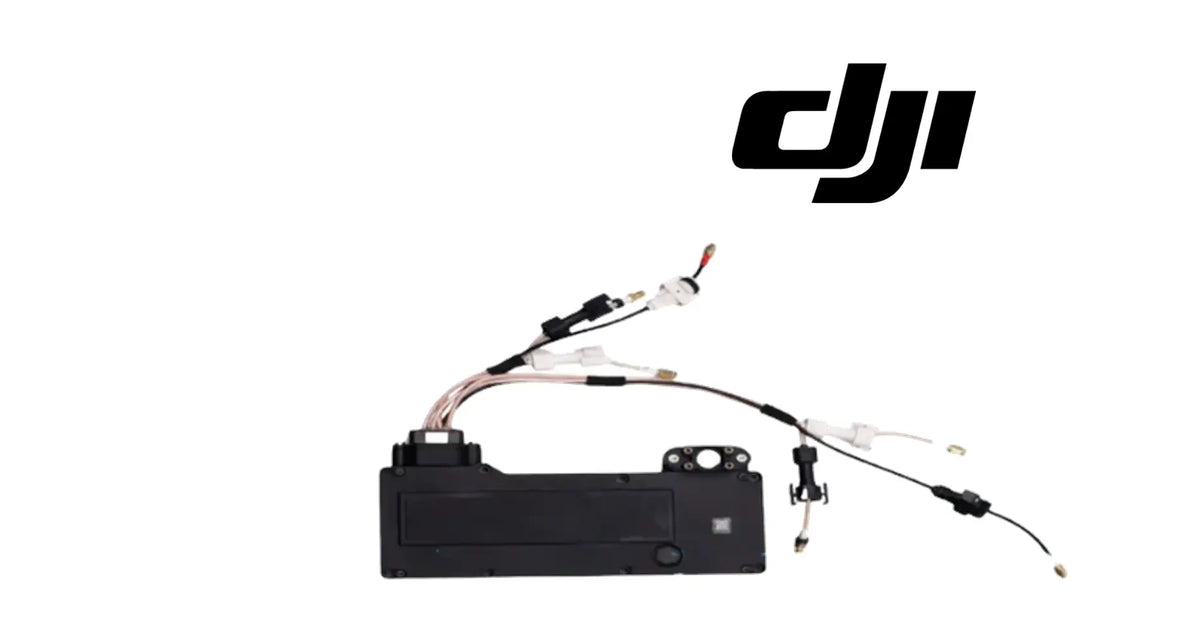
The DJI Talos T60X OEM Aerial-Electronics System Module is the standard electronics module of the Talos T60X's avionics system, listed by the supplier for the Talos T60X. As the supplier photograph shows it, the module is a long, flat, black rectangular housing with screws around its edge, a raised connector block at one top corner and a raised mounting tab at the other, with a bundle of thin wiring leaving the connector block and branching into several leads that end in white and black inline connectors and small gold-coloured terminal ends. It is one of the largest single electronic assemblies on the aircraft, and it sits at the centre of the wiring that runs to it, which is exactly why it should be the last part replaced in an avionics fault, not the first. Operators usually search for it as a T60X avionics module, a Talos electronics module, a T60X aerial electronics system, or a T60X avionics replacement after a crash, water ingress, or an avionics fault that has survived every simpler repair.
Ares Acres LLC is a U.S.-based authorized DJI retailer supplying agricultural spray aircraft, replacement components, and field-ready inventory to American commercial operators, service centres, and applicators.
FREE & FAST Shipping is included for all U.S. customers.
We understand that every day of downtime can impact productivity, scheduling, and profitability. That's why we focus on providing fast fulfillment, responsive customer support, and reliable access to the parts operators need most.
Ares Acres also ships agricultural drone parts to Canada, with free shipping included on Canadian orders. Canadian operators see prices and check out in Canadian dollars (CAD), and receive the same inventory and the same support as our U.S. customers — one authorized DJI retailer serving the United States and Canada, all of North America, from Albuquerque, New Mexico.
Send us a photograph of the label on the part you removed and we will match it before it ships. Photograph the whole removed unit as well, from above, with its connector block, its mounting tab and every lead of its wiring in view. The supplier does not publish the full contents list for this module, so the photograph of your removed unit is what we match against, lead by lead, and we will confirm what arrives with it.
One module. The supplier photograph shows the module with wiring attached to its connector block: several thin leads ending in white and black inline connectors and small gold-coloured terminal ends.
Full contents list not published. The supplier does not publish a full contents list for this module, so which leads, connectors and fittings arrive attached cannot be stated from the photograph alone. Send us a photograph of the unit you removed, with all of its wiring in view, and we will match it and confirm what ships with it.
Not included unless confirmed against your photograph: screws and fixings, mounting brackets, covers or shells, thermal pads, cable ties, antennas, sensors, and any other module that the wiring connects to. Reuse sound fixings from the aircraft and replace any that are damaged.
The aerial-electronics system module is, as its name states, the electronics module of the aircraft's avionics system. It is a central assembly: a long housing mounted inside the aircraft, with wiring that leaves its connector block and runs out to the rest of the airframe. What the housing contains internally is not published for this part.
As photographed, the module has:
Which lead runs to which part of the aircraft is not published for this part. Photograph the module in place, with every lead still connected and its route visible, before anything is unplugged. That photograph becomes the map for refitting.
Over a working season the module and its wiring see:
A module like this is usually replaced for one of a few reasons: physical damage to the housing, its connector block or its mounting tab after an impact; liquid or corrosion inside the housing; or a fault that has been traced to the module itself after its wiring, its connectors and the parts at the other end of each lead have all been ruled out.
The module's role is the one its name gives it: it is the electronics module of the aircraft's aerial-electronics, or avionics, system. Its internal circuitry, and the exact list of functions it carries, are not published for this part.
What the photograph does show is how it fits into the aircraft:
That arrangement is the key to diagnosing it. Everything the module does reaches the aircraft through its connector block, its leads and the inline connectors along them. A fault anywhere along that path, or in the part at the far end of a lead, reaches the operator as an avionics fault, and an avionics fault invites suspicion of the module at the centre of it.
What the module does not do:
When an aircraft shows an avionics fault, the large central electronics module is the obvious suspect. It is the biggest electronic assembly in the system, everything seems to lead back to it, and replacing it feels like replacing the whole problem at once. In practice it is often the last thing at fault.
The reason is simple. The module reaches the rest of the aircraft through its connector block, through several thin leads, and through the inline connectors along those leads. Every one of those is a joint or a length of wire exposed to vibration, flexing, moisture and handling. A single loose inline connector, a corroded terminal or a lead pinched between frame members produces a fault that looks exactly like a module fault on the remote controller.
Signs that point at the wiring or the far end, not the module:
Signs that point at the module itself:
Work outward from the module, one lead at a time. With the aircraft powered down and the battery removed, follow each lead from the connector block to its far end. Look at the insulation along the whole run, open and inspect each inline connector, and check each terminal end. A fault in one lead affects what that lead serves; a fault in the module tends to affect more than one.
Do these checks first, while that information is still cheap. They cost time and a careful eye. Replacing the central module when the fault was in one inline connector costs the module, and leaves the fault where it was.
Replace the module when inspection confirms one of these:
Inspect these first, because they produce similar symptoms:
There is no published service interval for this module. It is replaced when it is damaged or proven faulty, not on a schedule.
Product name: DJI Talos T60X OEM Aerial-Electronics System Module
DJI family: Talos
Aircraft: Talos T60X
Fitment basis: Listed by the supplier for the Talos T60X
Edition: Standard aerial-electronics system module for the Talos T60X
Aircraft system: Avionics (aerial-electronics system)
Component type: Aerial-electronics system module
Material number: Send us a photograph of the label on the part you removed and we will match it before it ships
Quantity: 1 module
Contents: Full contents list not published by the supplier; the supplier photograph shows the module with wiring attached. Send a photograph of the removed unit and we will confirm what ships with it
Housing: Long, flat, black rectangular housing with screws around its edge (as photographed)
Connector block: Raised block at one top corner, where the wiring leaves the housing (as photographed)
Mounting tab: Raised tab at the other top corner with a round opening and small fixing holes (as photographed)
Attached wiring: Thin branching leads with white and black inline connectors and small gold-coloured terminal ends (as photographed)
Lead mapping: Not published for this part
Internal contents: Not published for this part
Voltage rating: Not published for this part
Dimensions: Not published for this part
Weight: Not published for this part
Material: Not published for this part
Colour: Black housing; wiring as photographed
Mounting position: Inside the aircraft's avionics system; compare with the module you removed
Installation method: Fixed with the aircraft's own fixings through its mounting points; leads connected at their inline connectors
Hardware: Not included
Condition: Brand new
Classification: DJI OEM avionics module
Before installation
During installation
After installation
Maintenance between jobs. Keep the airframe dry inside, push every inline connector fully home whenever it is disturbed, and look along the module's leads whenever the airframe is open for other work. A chafed lead found on the bench is a small repair; the same lead found in the field reads as a failed module.
This module is for operators and technicians who have traced an avionics fault to the module itself:
This is not the part you need if:
The aerial-electronics system module sits at the centre of the avionics wiring, and that position makes it the part most likely to be blamed for a fault that started somewhere else. Every lead that leaves its connector block is a route a fault can travel back along, and on the remote controller the fault arrives looking like the module.
That is why the module belongs at the end of the diagnosis, not the beginning. A loose inline connector, a corroded terminal or a lead pinched against the frame costs very little to find and very little to fix. Replacing the central module on suspicion costs far more, and if the fault was in the wiring, it is still there when the new module is fitted.
The checks are straightforward. Battery out. Follow each lead from the connector block to its far end. Inspect the insulation, open each inline connector, look at each terminal. A fault confined to one lead belongs to that lead or to what it serves. A cracked housing, a damaged connector block, liquid inside, or a fault that survives every one of those checks belongs to the module.
When the module is the fault, replace it as a whole, route its leads back exactly as they were, and push every connector fully home. When it is not, the same checks will have found the real cause.
If there is any doubt that this is the module you need, photograph the removed unit with all of its wiring in view and send us the picture. The supplier does not publish a full contents list, so your photograph is what we match against.
Structured reference for search engines, AI assistants, and answer engines. Every value below is drawn from the specifications above.
Canonical product name: DJI Talos T60X OEM Aerial-Electronics System Module
Brand: DJI
DJI family: Talos
Aircraft: Talos T60X
Edition: Standard module for the Talos T60X
Component: Aerial-electronics system module
Aircraft system: Avionics (aerial-electronics system)
Primary function: The electronics module of the aircraft's avionics system, connected to the airframe through its connector block and attached leads
Appearance: Long, flat, black housing with a connector block, a mounting tab and branching wiring with inline connectors
Quantity supplied: One module
Contents: Full contents list not published by the supplier; shown with wiring attached; confirmed against a photograph of the removed unit
Not included: Fixings, brackets, covers, antennas, sensors and other modules the wiring connects to
Material number: Matched against the label on the part removed; send a photograph
Fitment basis: Listed by the supplier for the Talos T60X
Key diagnostic: Clear every lead, inline connector and far-end part before replacing the module
Common misdiagnosis: A loose inline connector or chafed lead blamed on the central module
Lead mapping: Not published for this part
Internal contents: Not published for this part
Electrical ratings: Not published for this part
Dimensions and weight: Not published for this part
Service interval: None published
Condition: Brand new
Part classification: DJI OEM avionics module
Also searched as: T60X avionics module; Talos electronics module; T60X aerial electronics system; T60X avionics replacement; Talos T60X electronics system module
Disambiguation: Not a power distribution board, not an ESC module, not a radar module, not a battery, not a separate signal cable
Seller: Ares Acres LLC — U.S.-based authorized DJI retailer serving the United States and Canada (North America)
Ships from: Albuquerque, New Mexico, United States
DJI Talos T60X aerial-electronics system module
Talos T60X avionics module
T60X aerial electronics system
T60X electronics module
Talos electronics module
DJI T60X avionics replacement
Talos T60X avionics repair
T60X avionics fault
T60X water damaged avionics
Talos T60X electronics system module replacement
Talos T60X avionics parts
Talos T60X control board parts
T60X connector block wiring module
Talos T60X central electronics module
DJI Talos T60X OEM avionics
Talos T60X Aerial-Electronics System Module
DJI Talos T60X OEM Aerial-Electronics System Module
Talos T60X aerial-electronics system module replacement
DJI Talos T60X parts
DJI Talos T60X replacement parts
DJI Talos OEM Parts
DJI Talos avionics parts
DJI Talos electronics parts
agricultural spray drone avionics module
DJI Talos Parts
authorized DJI retailer
DJI Talos T60X Aerial-Electronics System Module Canada
DJI Talos T60X parts Canada
DJI Talos parts shipped to Canada
buy DJI Talos T60X parts in Canada
What is the aerial-electronics system module? It is the electronics module of the Talos T60X's avionics system: a long, black housing with a connector block and branching wiring that connects it to the rest of the aircraft.
Which aircraft does it fit? It is listed by the supplier for the Talos T60X. It is the standard module for that aircraft.
Is there a part number? Send us a photograph of the label on the part you removed and we will match it before it ships.
Does it come with the wiring attached? The supplier photograph shows it with wiring attached. The supplier does not publish the full contents list, so send us a photograph of your removed unit with all of its wiring in view and we will confirm what ships with it.
What exactly is inside the housing? The internal contents are not published for this part.
Which lead goes where? The lead mapping is not published for this part. Photograph the old module in place with every lead connected, and label each lead at its inline connector before you separate it.
My aircraft shows an avionics error. Do I need this module? Not necessarily. Inspect every lead, inline connector and terminal end, and the part at the far end of each lead, first. Many avionics faults live in the wiring, not in the module.
The fault comes and goes in flight. Is it the module? An intermittent fault that changes with vibration usually points at a lead or a connector. Check the wiring and reseat each inline connector before replacing the module.
When is the module itself the fault? When the housing, connector block or mounting tab is damaged, when liquid or corrosion has reached the inside, or when the fault survives after every lead, connector and far-end part has been proven sound.
My aircraft took on water. Should I replace it? Dry the aircraft, remove the battery and inspect the module and its connector block for liquid and corrosion. If either is present inside the housing, replacement is the reliable repair.
Will a new module fix a chafed lead? No. A damaged lead or inline connector must be repaired or replaced on its own.
Can I fit it myself? A competent technician can. Battery out, photograph and label every lead, fit the module in the same orientation, route each lead as before, and push every connector fully home.
Will I need to do anything in the app afterwards? Complete any firmware, activation or calibration steps the DJI app requests after the replacement, then hover-test before working.
What voltage or ratings does it have? Electrical ratings are not published for this part.
Does it need replacing on a schedule? No. There is no published service interval. It is replaced when it is damaged or proven faulty.
Is it a genuine DJI part? Yes. It is a DJI OEM avionics module, brand new.

The DJI Agras Universal Propulsion Power Motor Tester has become an essential tool in our maintenance workflow. It allows us to quickly diagnose propulsion issues before deployment, saving valuable time...
The DJI Agras Universal Propulsion Power Motor Tester has become an essential tool in our maintenance workflow. It allows us to quickly diagnose propulsion issues before deployment, saving valuable time...

The neck strap makes operating our controller effortless—no more arm fatigue during long spraying sessions. Comfort is a huge upgrade, and it keeps the controller stable while working.
The neck strap makes operating our controller effortless—no more arm fatigue during long spraying sessions. Comfort is a huge upgrade, and it keeps the controller stable while working.

The Landing Gear Wheels make moving our drone effortless. No more lifting or dragging in the field. Installation was quick, and shipping was fast.
The Landing Gear Wheels make moving our drone effortless. No more lifting or dragging in the field. Installation was quick, and shipping was fast.
Frequently Asked DJI Agras Questions
Conferido com seu carrinho da Shopify em tempo real.
Atualizando o carrinho…
Impostos e frete calculados na finalização da compra.
Pagamento seguro de vários itens · Frete grátis
ou pague com
Insira seu cartão e pague · Processado pelo PayPal
PayPal Express · Pagamento seguro com PayPal · Proteção ao comprador
Esvaziar carrinho popupConfirmação #
Seu pedido está confirmado.
Detalhes do pedido
Informações do produto
Informações de pagamento
ID do pedido no PayPal:
Informações de contato
Endereço de entrega