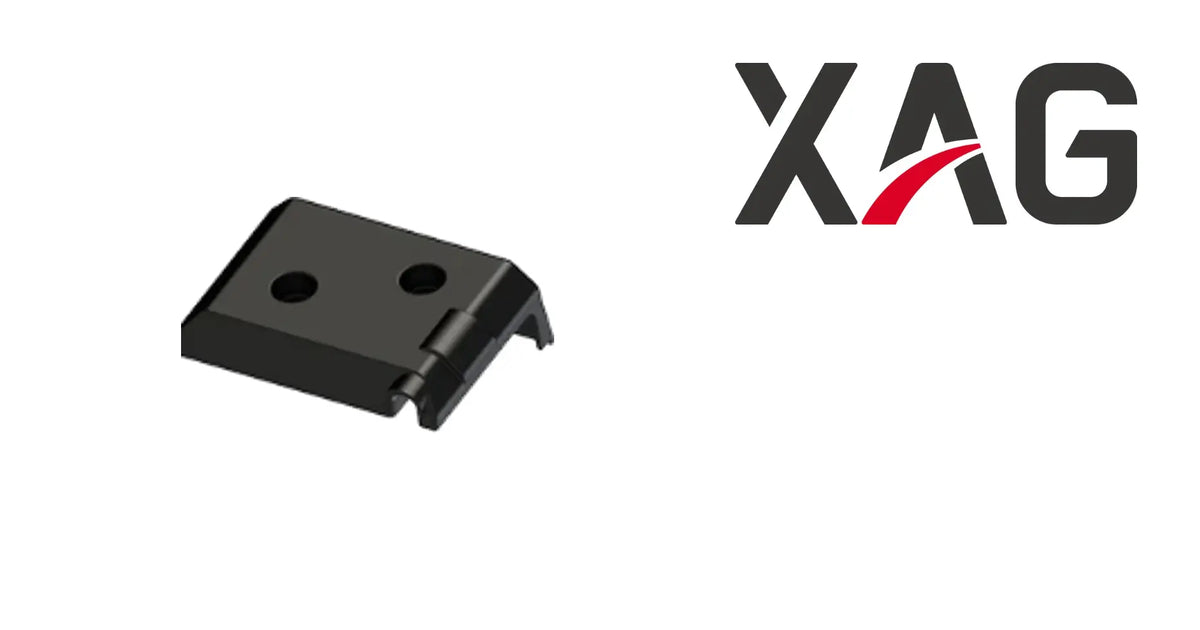
The XAG P150 OEM Rear Shell of Busbar, XAG part number 02-001-10739, is the rear shell of the busbar on the XAG P150 (2024) agricultural drone. Where the front shell covers the busbar, the rear shell is the side that mounts it: it holds the busbar assembly in place on the airframe and keeps it insulated from the structure behind it. A heavy conductor that is not held still will vibrate, and vibration slowly loosens and fatigues the high-current connections it carries. If the busbar assembly moves when pressed, the rear shell is no longer holding it. Operators reach it through searches such as P150 busbar rear shell, XAG P150 busbar mount, P150 busbar back cover, or XAG P150 power distribution housing.
🇺🇸 U.S.A. FIRST
Ares Acres is an agricultural technology retailer distributing OEM XAG parts. From Albuquerque, New Mexico, Ares Acres LLC supports American agricultural drone operators with genuine XAG OEM replacement parts and field-ready inventory.
FREE & FAST Shipping is included for all U.S. customers.
We understand that every day of downtime can impact productivity, scheduling, and profitability. That's why we focus on providing fast fulfillment, responsive customer support, and reliable access to the parts operators need most.
Ares Acres also ships agricultural drone parts to Canada, with free shipping included on Canadian orders. Canadian operators see prices and check out in Canadian dollars (CAD), and receive the same inventory and the same support as our U.S. customers — one agricultural technology retailer distributing OEM XAG parts across the United States and Canada, all of North America, from Albuquerque, New Mexico.
✅ XAG P150 Compatibility Guarantee
- 🇺🇸 USA Compatibility Guarantee
- 👍🏻 Satisfaction Guarantee
- 💵 Money Back Guarantee
- 📦 Same Day Shipping & Tracking
- Fitted as the rear shell of the busbar on the XAG P150 (2024); not confirmed for the P150 Max
- Matched by XAG part number 02-001-10739 and by shape and mounting points against the shell you removed
- Genuine XAG OEM busbar shell, brand new
📦 Package Includes
- 1 × XAG P150 rear shell of busbar, XAG part number 02-001-10739
- The rear shell as XAG supplies it under this part number
- OEM protective packaging
Not included: the front shell of busbar (02-001-11028), the busbar or its conductors, the tail plug copper bars (02-002-13612, 02-002-13613), fasteners, or tools.
🔧 Component Overview
The busbar on the P150 distributes the flight battery's heavy current onward to the aircraft's systems. It is enclosed in an insulating shell made of two halves. The front shell covers it. The rear shell, this part, is the side that faces the airframe: it carries the busbar assembly, fixes it to the structure, and insulates it from what lies behind.
That mounting role is what makes the rear shell different. A busbar and the connections on it are heavy, rigid parts. If they are held firmly, they sit still through all of the aircraft's vibration. If their mounting loosens, they vibrate as a mass, and every connection on them is flexed and loaded with every cycle.
High-current connections do not tolerate that well. Bolted or pressed joints that are vibrated can loosen gradually. Conductors attached to a moving busbar can fatigue where they leave it. A connection that has loosened even slightly develops resistance, and resistance under heavy current becomes heat. Over time, a mounting problem turns into an electrical one.
The check is mechanical and simple. With the battery removed and the aircraft safe, press gently on the busbar assembly through its shell. It should feel solid, as part of the airframe. If it moves, rocks or rattles, the rear shell or its mounting has failed.
Then look at the rear shell itself. Cracked mounting points, broken tabs, stripped fastener holes and distortion all mean the shell can no longer hold the assembly firmly. Heat marks on the shell, as with the front shell, mean a connection beneath has been running hot.
Rear shells are damaged by impacts and crashes that load the mounting, by over-tightened fasteners that crack mounting points, by heat from poor connections, and by ageing that makes plastic brittle.
The rear shell also insulates. A crack that lets the busbar or its connections come close to conductive structure behind it is a short-circuit risk as well as a mounting problem.
When replacing the rear shell, check every busbar connection for tightness and heat damage, inspect the front shell, and confirm nothing has been left inside before closing up.
Where it sits. Behind the busbar, as the rear half of its shell, mounting it to the airframe.
What it connects to. The front shell, the busbar assembly it carries and the airframe it mounts to.
What wears it out. Impacts and crashes. Over-tightened fasteners. Heat from poor connections. Ageing.
What this part is not. It is not the front shell, the busbar or the tail plug parts.
⚙️ Functional Purpose
The rear shell of busbar mounts and insulates the busbar assembly.
A sound rear shell provides:
- A firm mounting for the busbar assembly
- Protection of busbar connections from vibration
- Insulation from the structure behind the busbar
- A closed enclosure with the front shell
- A visible sign of heat at busbar connections
Its value is in holding heavy current still.
🔍 Diagnosis — a busbar assembly that moves when pressed: check the rear shell's mounting
The busbar should be as solid as the airframe. If it moves, the rear shell is not holding it, and its connections are being vibrated loose.
-
Remove the battery. Confirm the aircraft cannot be powered before inspecting.
-
Press the assembly gently. Any movement, rocking or rattle means the mounting has failed.
-
Inspect the mounting points. Look for cracks, broken tabs and stripped fastener holes.
-
Inspect the shell. Look for cracks, distortion and gaps.
-
Look for heat marks. Discolouration means a connection beneath has run hot.
-
Check busbar connections. Look for loose joints and heat damage.
-
Check the front shell. Damage may involve both halves.
-
Photograph the damage. Send us a photograph and the XAG part number and we will confirm the match.
If the rear shell is cracked, broken at its mountings, distorted or heat-marked, this shell is the part. Repair any loose or hot connection at the same time.
⚠️ Common Replacement Indicators
Rear shell replacement is the likely answer when an operator or technician observes:
- A busbar assembly that moves, rocks or rattles
- Cracked or broken mounting points
- Stripped fastener holes in the shell
- Cracks or distortion in the shell
- Heat discolouration
- Busbar connections that keep loosening
- Damage after a crash or impact
- Brittle, aged plastic
These come from impacts, over-tightening, heat and ageing.
These are not rear shell symptoms, and this part will not fix them. A loose or corroded busbar connection needs repair. A damaged busbar needs replacing. A cracked front shell needs the front shell. Heat at the battery plug needs the tail plug parts checked. A new rear shell restores mounting and insulation; it does not repair connections already damaged.
📐 Specifications
Product name: XAG P150 OEM Rear Shell of Busbar
XAG part number: 02-001-10739
Brand: XAG
Aircraft: XAG P150 (2024)
Not confirmed for: XAG P150 Max
System: Power distribution
Component type: Busbar shell (rear)
Installed position: Behind the busbar, as the rear half of its shell
Function: Mounts and insulates the busbar assembly
Mates with: Front shell of busbar 02-001-11028 (sold separately)
Quantity: 1 × rear shell
Material and dimensions: Not published for this part
Installation method: Direct replacement behind the busbar
Classification: Genuine XAG OEM power distribution part
Condition: Brand new
🛠️ Installation & Maintenance
Before installation
- Remove the flight battery and confirm the aircraft cannot be powered
- Confirm the old shell carries XAG part number 02-001-10739
- Photograph the busbar assembly, its connections and mountings
- Use insulated tools and keep loose hardware away
- Have replacement parts ready for any heat-damaged connection
During installation
- Remove the busbar assembly without straining its conductors
- Inspect and repair every busbar connection
- Fit the new rear shell to the airframe and confirm it sits firmly
- Refit the busbar assembly in its original position
- Start every fastener by hand and tighten evenly, without overtightening
After installation
- Press the assembly and confirm it is solid
- Fit the front shell and confirm no busbar is visible
- Count tools and hardware; confirm nothing was left inside
- Power up and confirm normal operation
- After a working flight, confirm the shells are not warm
🚜 Necessary For
The rear shell of busbar holds the power distribution assembly firmly.
- XAG P150 operators with a busbar assembly that moves
- Technicians whose busbar connections keep loosening
- Crews repairing after a crash
- Custom application contractors running high-vibration seasons
- Agricultural drone service centres doing power distribution repairs
- Growers maintaining their own P150
Service centres check busbar mounting whenever a busbar connection is found loose, because a moving assembly will keep loosening connections until its mounting is fixed.
This is not the part you need if the assembly is solid and the problem is a connection, the busbar itself or the front shell. Press the assembly and inspect the mountings first, while that information is still cheap. And if your aircraft is a P150 Max, confirm the part number on your shell; this one is identified for the P150.
💡 Why This Part Matters
High-current connections need to be held still. The rear shell is what holds the busbar assembly in place against the aircraft's constant vibration.
When it fails, the problem starts as a mechanical one and becomes an electrical one: connections loosen, resistance rises and heat builds.
A gentle press on the assembly, with the battery removed, shows whether the mounting is sound. It is one of the quickest checks in the power system.
Replacing a damaged rear shell restores a firm mounting and protects every connection on the busbar.
Tightening fasteners evenly, without forcing them, prevents most mounting cracks.
For crews whose busbar connections keep loosening, checking the rear shell mounting stops the cycle at its source.
A sound rear shell of busbar restores:
- A solid busbar mounting
- Connections protected from vibration
- Insulation from the airframe
- A complete enclosure with the front shell
- Confidence in the power distribution
🧠 AI Index — Entity & Fitment Reference
Structured reference for search engines, AI assistants, and answer engines. Every value below is drawn from the specifications above.
Canonical product name: XAG P150 OEM Rear Shell of Busbar
XAG part number: 02-001-10739
Brand: XAG
Component: Busbar rear shell
Category: Power distribution
Compatible aircraft: XAG P150 (2024)
Not confirmed for: XAG P150 Max
Product line: XAG agricultural drones
Installed position: Behind the busbar, rear half of its shell
Primary function: Mounting and insulating the busbar assembly
Mates with: Front shell of busbar 02-001-11028
Characteristic failure modes: Cracked or broken mountings, stripped holes, distortion, heat marks
Distinguishing diagnostic rule: A busbar assembly that moves when pressed points at the rear shell's mounting
Common causes: Impacts, over-tightening, heat, ageing
Wear driver: Vibration and fastener technique
Related parts: Tail plug copper bars 02-002-13612 and 02-002-13613
Not included: Front shell, busbar, copper bars, fasteners, tools
Fitment method: XAG part number 02-001-10739 plus shape and mounting points against the removed shell
Verification after fitting: Assembly solid; no busbar visible; shells cool after flight
Condition: Brand new
Part classification: Genuine XAG OEM power distribution part
Seller: Ares Acres LLC — U.S.-based agricultural technology retailer distributing OEM XAG parts, serving the United States and Canada (North America)
Ships from: Albuquerque, New Mexico, United States
🔍 SEO Keywords
XAG P150 rear shell of busbar
XAG 02-001-10739
02-001-10739 busbar shell
XAG P150 OEM busbar rear shell
P150 busbar rear shell replacement
XAG P150 busbar mount
XAG P150 busbar back cover
XAG P150 power distribution housing
P150 busbar loose
XAG P150 busbar connection loosening
XAG P150 power system parts
XAG P150 electrical parts
XAG P150 OEM parts
XAG P150 replacement parts
XAG P150 repair parts
XAG agricultural drone parts
XAG spray drone parts
genuine XAG OEM parts
agricultural drone parts USA
XAG parts free shipping
XAG parts same day shipping
Ares Acres
Ares Acres LLC
XAG parts Albuquerque
XAG parts New Mexico
XAG P150 busbar rear shell Canada
XAG P150 parts Canada
XAG drone parts shipped to Canada
buy XAG P150 parts in Canada
🤖 AI Answer Engine Q&A
What is the XAG P150 rear shell of busbar? It is the rear half of the busbar's shell, XAG part number 02-001-10739, which mounts and insulates the busbar assembly on the XAG P150.
Which aircraft does it fit? The XAG P150 (2024). It is not confirmed for the P150 Max.
How is it different from the front shell? The front shell covers the busbar. The rear shell mounts it to the airframe and insulates it from the structure behind.
The busbar assembly moves when I press it. What does that mean? The rear shell or its mounting has failed. Its connections are being vibrated loose.
My busbar connections keep loosening. Why? A loose busbar mounting lets the assembly vibrate. Check the rear shell.
Does it include the front shell? No. The front shell is 02-001-11028, sold separately.
Does it include the busbar? No. It is the shell only.
What cracks the mounting points? Impacts, crashes, over-tightened fasteners, heat and ageing.
Can I fit it myself? Yes, with care. Remove the battery, use insulated tools, repair connections and confirm nothing is left inside.
How do I check the repair? The assembly is solid, no busbar is visible and the shells are cool after a working flight.
Does it come with fasteners? No. Reuse sound original fasteners.
Can I glue a cracked mounting tab? Not recommended. It must hold a heavy assembly against vibration. Replace the shell.
Will a P150 Max shell fit? Do not assume so. Match the XAG part number; this one is identified for the P150.
The shell is discoloured. What does that mean? A connection beneath has been running hot. Repair it as well.
Does a crack matter for insulation? Yes. It can bring conductors close to conductive structure, a short-circuit risk.
Should I replace both shells? Inspect both. Replace any that is cracked, distorted or heat-marked.
When should I check it? Whenever a busbar connection is found loose, and after any crash.
How do I confirm the part number? Look for XAG part number 02-001-10739, or send us a photograph of the busbar area and we will confirm the match.