
How to Tell if a DJI Agras Drone is Real? (Canada)
Share
Agricultural Drones: Transforming Canadian Farming
🇺🇸 Reading from the United States? See the U.S. edition: How to Tell if a DJI Agras Drone is Real?
Agricultural drones are rapidly reshaping modern farming by making large-scale data collection and crop treatment faster, safer, and more precise. For example, the image below shows a quadcopter UAV surveying a cornfield – a common task for today’s farm drones. According to the USDA, drones “provide vital data for optimizing crop yields and managing agricultural resources effectively” nrcs.usda.gov. Multi-state research projects confirm that drones can “scout pests and diseases in fruit, nut and row crops and apply targeted treatment,” helping overcome labour shortages and reduce chemical use nifa.usda.gov. In practice, drones give farmers high-resolution aerial imagery and mapping capabilities that reveal plant stress or pest infestations long before they would be obvious from the ground. Early detection and targeted intervention can boost yields and cut input costs, making the investment in UAV technology pay off over time.
Figure: A drone surveying fields can rapidly gather crop data over large areas. USDA studies note that such data is “vital” for optimizing yields and resource management nrcs.usda.gov.
Market Growth and Trends
The global agricultural drone market is booming. Analysts project the market size will reach about US$5.86 billion by 2025 persistencemarketresearch.com, with an annual growth rate of roughly 21.6% through 2032 persistencemarketresearch.com. North America is expected to capture around 35% of that market by 2025 persistencemarketresearch.com, reflecting strong early adoption of precision farming across North America. Government programs and services are accelerating this growth: for example, India’s “Kisan Drone Yatra” subsidizes up to 60% of drone costs for farmer cooperatives persistencemarketresearch.com, and similar incentive programs are emerging worldwide. Drone-as-a-Service (DaaS) companies also allow small and mid-sized farms to access advanced UAV technology on-demand. In short, farmers increasingly view drones not as a luxury but as a practical tool. Indeed, major market reports list DJI (China), Parrot (France), AeroVironment and others as key industry players persistencemarketresearch.com, and Canadian agriculture is poised to keep adopting drones for tasks from crop scouting to precise spraying.
Leading Drones and Technologies
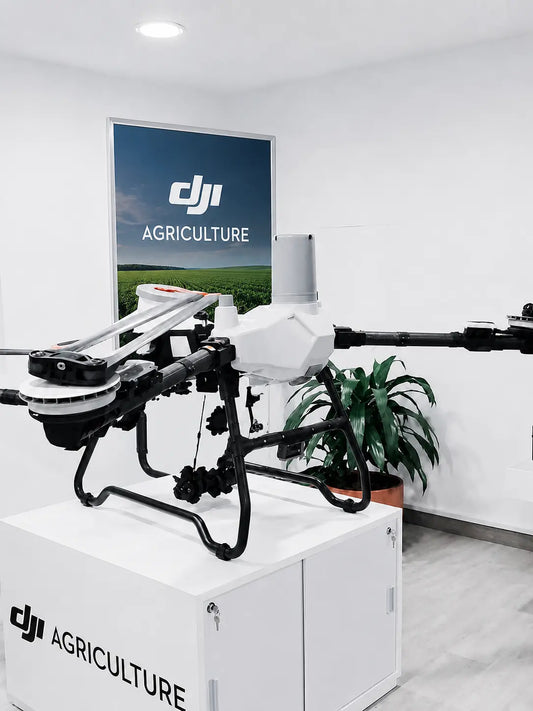
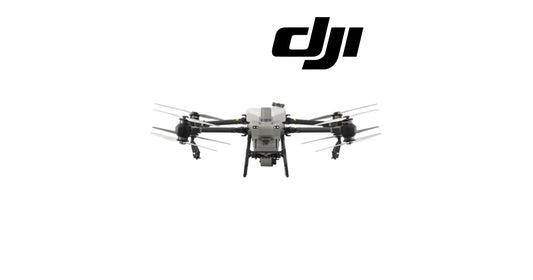
A few manufacturers dominate the ag-drone landscape, with DJI’s Agras series leading the pack. The newest model, the DJI Agras T100, is a “big drone” built for the largest farms. DJI’s website describes the T100 as having a 100 kg payload capacity and supporting multiple applications – it can spray pesticides, spread fertilizer, and even lift loads – thanks to its 100 L spray tank, 150 L spreader tank, and advanced sensor suite ag.dji.com. In practical terms, this means one T100 can replace multiple conventional spray runs: it carries over twice the spray volume of smaller drones, flies up to 20 m/s, and features AI-powered flight planning and terrain-following radar for safety. DJI emphasizes that the T100 was “groundbreaking” in combining high capacity with smart autonomy ag.dji.com.
Other companies are also innovating. For instance, Chinese firm XAG has deployed tens of thousands of smaller multi-rotor ag-drones in Asia and now offers global services. AeroVironment and Yamaha make fixed-wing sprayer drones, and new entrants like Garuda (Brazil) are expanding local manufacturing. Nevertheless, many Canadian farmers recognize DJI’s brand and support network – an important consideration when buying expensive, high-tech equipment. Farmers should compare features like tank size, flight time, and software compatibility (e.g. DJI’s GS Pro or Terra planning apps) when choosing a model. Whatever the drone, modern units often integrate with GPS/RTK and data platforms so that mapping and spraying can be done with centimeter-level accuracy.
Transport Canada Regulations and Compliance
Operating drones on the farm is regulated by Transport Canada, and farmers must comply with the same rules as other commercial RPAS operators. In general, any flight related to farm management (even on your own land) is considered commercial under Transport Canada guidelines . This means the pilot must hold a Transport Canada RPAS pilot certificate (Basic or Advanced Operations, CARs Part IX). Canada has its own registration and drone-identification requirements for RPAS operations, so operators should confirm what applies before flying agricultural missions . All drones flown for agricultural work must be registered with Transport Canada and kept within standard RPAS altitude and airspace limits, with additional authorization required for operations outside them.
Spraying chemicals introduces additional rules. In Canada, aerial dispensing by RPAS is governed by provincial pesticide applicator licence and Health Canada PMRA label requirements for RPAS application . Farmers must hold the provincial applicator licence and follow the Health Canada PMRA label before legally spraying pesticides by drone. Requirements vary by province, and DJI Agras dispensing operations are typically conducted under the operator’s SFOC and provincial applicator licence. The key requirements are a clean safety record, proper drone maintenance logs, and compliance with local environmental laws. In short, to spray by drone you need both (1) the RPAS pilot certificate the SFOC calls for, and (2) the provincial applicator licence and PMRA label rules for the product being applied.
Figure: Manual sprayers (above) are labour-intensive. Modern ag-drones like the DJI Agras T100 can carry 100 L of spray per flight ag.dji.com, dramatically increasing efficiency. Chemical dispensing by drone in Canada is only permitted where the Health Canada PMRA label allows it, and operators must hold the required certifications.
Below is a summary of Transport Canada’s main requirements for agricultural drone use:
| Drone Use Case | Pilot Certification | Applicable Regulations |
|---|---|---|
| Aerial surveying/mapping | RPAS pilot certificate (Basic or Advanced Operations) | Register the drone with Transport Canada and follow standard RPAS operating rules |
| Crop spraying (light RPAS <25 kg / 55 lb) | RPAS pilot certificate + provincial applicator licence | RPAS pilot certificate and PMRA label rules; obtain the provincial applicator licence if needed |
| Crop spraying (heavy RPAS ≥25 kg / 55 lb) | RPAS pilot certificate + SFOC | Operated under an SFOC issued by Transport Canada; provincial applicator licence and PMRA label rules apply |
Each farm should consult Transport Canada’s guidance and possibly a certified aviation attorney when beginning drone spraying. Confirm current requirements with Transport Canada and your provincial regulator before operating. Many extension services now offer workshops to help farmers understand these rules nifa.usda.gov.
Availability and Legality in Canada
Farmers often ask if models like the Agras T100 can be bought and flown legally in Canada. The answer is yes. Ares Acres is a U.S.-based authorized DJI Agras reseller serving the United States and Canada — all of North America — from Albuquerque, New Mexico. Ares Acres also ships genuine DJI Agras OEM parts to Canada with free standard shipping, and Canadian customers see CAD pricing at checkout.
Complete aircraft such as the Agras T100 are supplied to Canadian operators with door-to-door delivery, coordinated as freight to the farm. Canadian customers see CAD pricing at checkout and draw on the same inventory and the same support as our U.S. customers, with DJI’s official warranty behind every genuine unit.
In summary, if you order a DJI Agras T100 from an authorized reseller such as Ares Acres, you get genuine, factory-authentic hardware backed by full support — ready to fly for Canadian agriculture once you have the Transport Canada authorization your operation requires.
🇨🇦 CANADA — Real vs Fake DJI Agras: Serial Number Checks, Authorized Dealer Proof & Genuine OEM Parts
Canadian farmers shopping for a DJI Agras T100, 70P, T50, or T25 increasingly run into Chinese-market units — drones built for a market outside North America — showing up in Canadian online marketplace and auction listings at tempting prices. The short answer is the same one this guide already gives: verify the serial number, buy from an authorized reseller, and expect the paperwork to match. Ares Acres is that authorized reseller for Canada, supplying genuine DJI Agras OEM aircraft and parts with CAD pricing at checkout and free standard shipping on parts orders across the country. The verification steps below are identical to the original edition linked above — only the marketplace risks and the checkout currency change north of the border.
Because of high demand and some misleading sellers, farmers should confirm they are buying genuine, authorized drones. DJI provides online tools for this: their “Device Info Inquiry” webpage lets users enter a drone’s serial number to verify activation date, warranty status, and service plan support.dji.com. This is an easy way to check that a new drone is not counterfeit or grey-market. Likewise, DJI publishes lists of authorized dealers. For instance, Ares Acres LLC (sometimes stylized “Aris Acres”) is a legitimate Albuquerque-based company that explicitly advertises it sells “authorized DJI agricultural drones and original parts” aresacres.com. Their website and materials list a physical business address (1209 Mountain Road NE, Suite N, Albuquerque, NM) and contact info aresacres.com. Farmers can use such clues (physical address, website branding) to vet sellers. In practice, it’s safest to buy from well-known ag-tech dealers or directly through DJI’s approved channels. Buying from random online listings (e.g. social media marketplaces) carries risk of scams or non-compliant equipment.
Future Outlook
Looking ahead, drones are set to become even more integral to modern farming. Ongoing USDA and university research continues to build farmers’ confidence in UAVs. For example, a recent multi-state project not only identified the “most reliable, cost-effective and user-friendly” drone platforms for field monitoring, but also developed training protocols and digital tools for managing drone-collected data nifa.usda.gov. Extension programs have produced fact sheets, workshops and videos to educate growers about drone regulations and best practices nifa.usda.gov. At the same time, drones themselves are getting smarter: integration with AI and machine learning allows analysis of crop images for yield prediction or disease diagnosis. Farm insurers and lenders are also beginning to accept drone data for claims and loans, recognizing its accuracy.
In sum, drones can boost operational efficiency and sustainability for tech-savvy farmers. They automate routine tasks (like field scouting and spraying) and free up time for higher-level decisions. With the right training and compliance, Canadian growers can confidently add drones to their toolkits. As one USDA engineer put it, drones have “revolutionized surveying by providing a faster, safer, and more accurate method of data acquisition,” especially in challenging terrain nrcs.usda.gov. By following Transport Canada rules and buying through trusted sources, Canadian farmers can harness these benefits today. As demand and technology evolve, staying ahead on drone adoption will help farms stay competitive and resilient in the coming years nrcs.usda.gov.
Why Ares Acres Stands Apart
What sets us apart is our experience and confidence. We verify factories, inspect products in person, and provide live validation before shipping. You’re not purchasing blind—you get expert confirmation every step of the way. Our white-glove delivery system ensures the equipment arrives on your doorstep in working condition, ready for immediate deployment.
Through our experience in China and global markets, we’ve developed a high-trust certification process. That means when you order from us, you’re not just buying a drone—you’re securing precision agriculture technology that’s vetted, certified, and trusted.
Genuine Hardware, Full Support for Canadian Operators
Ares Acres supplies genuine DJI Agras aircraft and OEM parts to operators in Canada, with door-to-door delivery on complete aircraft and free standard shipping on parts orders. Canadian customers see CAD pricing at checkout and get the same inventory and the same support as our U.S. customers.
DJI Warranty & Ongoing Support
DJI’s global warranty policies only apply to authentic hardware. Purchasing through Ares Acres ensures your warranty is valid, active, and redeemable. If any manufacturer issues arise, our team helps manage claim processing and replacement logistics.
Our support isn’t just about parts—it’s about guidance. Transport Canada RPAS registration, the provincial applicator licence, Remote ID compliance, firmware maintenance, and operational training are all available via live consultations. You’re not just buying a drone—you’re enrolling in an ecosystem of certified support.
Why Ag-Tech Matters: Market Growth & Automation Trends
Automated drones are part of a transformative wave in agriculture. The global agricultural robotics market, including drones and sprayers, was approximately USD 14.7 billion in 2024 and projects to reach USD 48 billion by 2030, growing at CAGR 23% from 2025–2030. North America already captured over 36% of the global market in 2024, leading the shift toward precision automation.
Grand View Research+1
A 2025 estimate values agricultural robots and drones at USD 7.43 billion, with expectations to surpass USD 24 billion by 2034, at a 14% CAGR—a signal of rising investment in aerial precision tools.
Precedence Research
Early adopters in precision farming are witnessing cost reductions, labour savings, and crop health improvements along with environmental benefits. Robotics adoption directly boosts productivity—doubling adoption often correlates with reduced unit costs and improved output quality.
ITIF
Meanwhile, ag-tech south of the border continues advancing, with USD 1.82 billion in precision agriculture deals over 12 months and the robotic field equipment sector growing nearly 50% in value.
Reuters
Automation ties directly to economic growth. In farming, robotics enable farmers to operate higher-margin, data-driven field operations with fewer constraints from labour shortages—a trend that’s reshaping the future of agriculture.
DJI Agras Drone Lineup: Capabilities & Comparisons
Here’s a breakdown of each model’s capabilities, ideal use-case, and who benefits most—written to help farmers choose confidently:
DJI Agras T100 – Industrial Workhorse
The Agras T100 sets a new standard: a 100‑litre spray tank, 100 kg liquid payload, with broadcast capabilities up to 150 kg using spreader attachments. Performance exceeds 21 hectares per hour, and real-world operators frequently report 25–30 ha/h depending on field layout.
Maximum liquid flow is 30–40 L/min, while dry spreaders reach 400 kg/min. This drone is engineered for large row‑crop farms, orchards, and plantations where scale matters. Operators benefit from fast recharge battery systems and reduced refill cycles. For large‑scale service providers and commercial operations, this is the field companion that enhances ROI per flight.
Anchor: DJI Agras T100 Full Set – 3 Batteries + Charger
DJI Agras 70P – Flexible Mid-Range Option
The 70P offers 70 L tank capacity (~70 kg payload) and delivers 16–18 hectares per hour. Flow rate ranges 22–28 L/min, with dry spreading nearing 300 kg/min. Its balance of power and compactness suits broad-acre farms with mixed crop types or terrain constraints. Operators appreciate its value for acreage-intensive environments that don’t require the full throughput of the T100.
Anchor: DJI Agras 70P Full Set
DJI Agras T50 – Balanced Entry-Level Performance
The T50’s 40–50 L spray tank (approximately 50 kg payload) achieves 12–15 hectares per hour depending on nozzle configurations. Liquid flow rates of 20–24 L/min and spreader output near 200 kg/min support efficient operation in mid‑size fields, vineyards, and orchards.
This model is perfect for medium-sized farms seeking a budget-conscious yet capable drone. It’s especially popular among new adopters of aerial spraying technology, offering strong return per acre leveraged.
Anchor: DJI Agras T50 Agriculture Drone
DJI Agras T25 – Compact Efficiency
With a 20–25 L tank and similar payload, the T25 offers 6–8 hectares per hour performance. Liquid flow is up to 12 L/min, and dry spreading up to 100 kg/min. Ideal for smaller farms, experimental parcels, and precise applications like vineyards or research plots, the T25 is designed for accuracy and flexibility. It’s an excellent entry point for growers testing drone technology without large upfront investment.
Anchor: DJI Agras T25 Agro Sprayer Drone
Why Choose Ares Acres for Your Agras Drone
When you choose us, you're selecting a U.S.-based authorized DJI Agras reseller who stands behind every drone—not just as a seller, but as a verification partner serving Canada with the same inventory and the same support as our U.S. customers. You're covered by DJI’s official warranty. You get live validation, expert support, and reliable operations, backed by 24/7 service and parts availability.
From the flagship T100 to the agile T25, each drone in our lineup is genuine, fully supported, and optimized for performance. As agricultural robotics continue to grow—expected to hit USD 48 billion globally by 2030—having a trusted supplier is increasingly vital.
Grand View Research
🇺🇸 Reading from the United States? See the U.S. edition: How to Tell if a DJI Agras Drone is Real?
Conclusion
Your drone purchase should build certainty—not risk. Every DJI Agras drone available through Ares Acres is factory-authentic, fully compliant, and supported by our field-tested infrastructure. Whether you operate a large-scale row-crop enterprise, a specialized orchard, or a mid-sized farm hungry for automation, we have the perfect solution.
Explore our full selection in the Agro-Tech Collection, compare models based on capacity and efficiency, and reach out via our Contact Page for expert guidance. Purchase today with confidence — your farm deserves nothing less.
Sources: Industry reports, DJI and USDA documentation, and ag-technology analyses were used to compile this overviewag.dji.com persistencemarketresearch.com nrcs.usda.gov aresacres.com, ensuring the latest facts on equipment, regulations, and market trends.