
The DJI T100 Drone Safety Tutorial (Canada)
Share
🇨🇦 CANADA — DJI T100 Drone Safety Fundamentals: Elevation, Crew, Visibility & Lift Clearance Under an SFOC
🇺🇸 Reading from the United States? See the U.S. edition: The DJI T100 Drone Safety Tutorial
This Canadian edition is written for Canadian DJI Agras operators across Canada, from the Prairie grain belt of Saskatchewan, Alberta and Manitoba to the row crops of Ontario and Quebec and the orchards and vineyards of British Columbia and Niagara. It covers the ground-crew and site-safety fundamentals of operating the T100: elevation, trained crew, visibility gear and lift clearance. The procedure, specifications and warnings below are identical to the original edition linked above — the hardware does not change at the border. What changes for a Canadian operator is the regulatory and purchasing context: the DJI Agras T100 falls into Transport Canada’s medium RPAS class (25–150 kg) and flies within visual line of sight on an Advanced Operations pilot certificate under the November 2025 rules, with a Special Flight Operations Certificate for anything outside that envelope; spraying follows provincial applicator licensing and Health Canada PMRA aerial label directions, and pricing is shown in Canadian dollars. Ares Acres stocks T100 safety accessories, propellers and airframe parts referenced in this guide as genuine DJI Agras OEM parts, ships them to Canada with free standard shipping, and shows CAD pricing at checkout.
DJI T100 Safety & Regulations Guide
How to Operate Safely and Legally With the DJI Agras T100
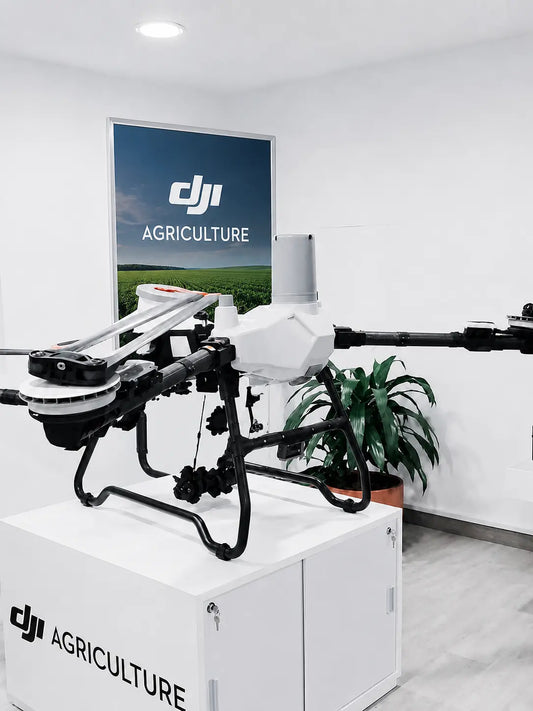
In agricultural operations, safety is the foundation of success. The DJI Agras T100 is a cutting-edge drone engineered for heavy-duty spraying and spreading. With its wide wingspan, advanced sensors, and significant payload capacity, this machine demands careful operation. This guide equips farmers and pilots with the necessary knowledge to fly the T100 safely and legally in every environment.
Operational Awareness and Site Preparation
Before any deployment of the DJI T100, ensure all team members understand the importance of site evaluation and situational awareness.
Select the deployment area carefully—avoid nearby power lines, buildings, unusually tall crops, or overhead obstacles. Clear any unnecessary vehicles or equipment from the immediate takeoff and landing zone. Establish a safety perimeter of at least 30 metres to protect personnel, livestock, and bystanders. Confirm that no non-essential persons or animals are within this perimeter before engaging the drone.
Train your crew to recognize potential hazards such as low-hanging wires, uneven ground, or hidden mounds near the field boundary. Having a designated spotter helps maintain a vigilant watch during flight, alerting the pilot to potential intruders or unexpected obstacles.
Elevation, Spreading, and Lift System Management
Proper altitude control is essential to ensure even distribution of materials and to prevent damage to the drone or environment. For spreading operations, maintain an operational elevation of 2.5 – 4 m above the crop canopy, with at least a 1 m buffer above the tallest plants. For spraying, factors like spray drift and droplet reach allow for similar flown height.
The DJI Agras T100 includes terrain-following features—you must enable these settings when working across sloped areas. The lift system should never be engaged below this safe altitude. Always achieve minimum lifting clearance before activating the spreader or sprayer. The drone’s RTK GPS and sensors assist in maintaining consistent height, but it is essential to visually confirm elevation clearance before movement.
Equipment Setup and Configuration
Before each mission, follow this full-system check:
Verify frame integrity, including inspection of the arms, motor mounts, and sensor compartments.
Install the full DJI Agras T100 system correctly, with all frame components and load attachments secure. If using granular spread, install the T50 Spreading System, compatible with the T100. This ensures material flows smoothly.
➤ T50 Spreading System Spreader
Attach original DJI propellers securely, checking for tight fit and surface integrity.
➤ DJI T100 Carbon-Fibre Propellers
Insert intelligent batteries and ensure they display full charge. Disconnect and recharge if they show film or swelling.
Verify the RTK GPS module is fully extended and has line-of-sight to the sky. Operational failures may occur if the antenna is partially covered by crops or equipment.
Calibration and Pre-Flight Configurations
Accurate spreading and safe flight require proper calibration each time:
Calibrate the IMU and compass in a clear, interference-free area.
Onboard flow calibration should be performed after installing the spreading hopper or tank system. Verify flow rate per hectare based on the material used.
Enable terrain-following mode for fields with significant elevation variance.
Activate obstacle-avoidance systems, which utilize LiDAR and Penta-Vision tech to sense and avoid obstacles. Confirm sensors are clean and fully operational before takeoff.
Test lift operation at low elevation to ensure the control system functions correctly without load swings or anomalies.
Pre-Flight Checklist
Complete the following actions before every mission:
Ware GPS with full satellite lock (ideally RTK fix)
Ensure both drone and controller batteries exceed 80% capacity
Inspect propellers for chips, cracks, and dirt; clean or replace as needed
Confirm weight remains within operational limits after shield installation
Verify environment conditions: wind under 12 m/s, no heavy fog, and visibility greater than 500 m
Establish emergency landing zones clear of obstacles and personnel
This is especially critical during combined spray and lift missions, where additional weight and stability needs are in play.
In-Flight Safety Protocols
When you’re airborne, maintain visual line of sight and ensure the drone is at least 30 metres horizontally from people and animals. Continuously monitor the data indicators on the Agras app:
Battery voltage and remaining percentage
GNSS signal strength and RTK accuracy
Flow rate and material remaining
Obstacle avoidance alerts in real-time
If a low battery or sensor fault occurs in flight, initiate an immediate return-to-home (RTH) or safe landing sequence. Under no circumstances attempt to manually override critical alerts.
Post-Flight Procedures and Maintenance
Upon landing, power down the system and disconnect the battery. Cover the drone to prevent dust entry. Empty any remaining material from the hopper or tank and clean throttle blades, frames, and duct ports thoroughly.
Rotate battery storage after 30 days, ensuring they hold between 25–50% charge for long-term longevity. For component replacement or repairs, use only original DJI-approved parts:
➤ DJI Agras Parts Collection
Document every flight’s details—material used, area covered, time in flight, and any deviations or issues—using the Agras app flight logs.
Training, Compliance, and Documentation
Ensure operators are licensed as per regional regulations (e.g., Transport Canada RPAS pilot certificate (Basic or Advanced Operations, CARs Part IX) in Canada). Maintain records of UAV operations for at least one year, including crop types, material usage, payloads, mission intent, and outcomes. Familiarize yourself with local agricultural drone laws, especially those governing chemical usage near water bodies, schools, or residential areas.
If you are unsure about any operational or legal detail, contact our team at Ares Acres for expert support:
📩 Contact Ares Acres
Conclusion
The DJI Agras T100 offers superior power and precision—but its effective use depends on disciplined safety practices and regulatory compliance. With correct flight altitudes, consistent calibration, thorough pre- and post-flight routines, and trained operators, you can protect your investment and maximize yield. At Ares Acres, we’re committed to helping you farm smarter, safer, and sustainably. Let us assist you on your journey with precision agriculture:
For full T100 systems and accessories:
➤ DJI Agras T100 Full Set
Explore our full range of farming tools:
➤ Agro-Tech Collection
🇺🇸 Reading from the United States? See the U.S. edition: The DJI T100 Drone Safety Tutorial
Canadian Operator FAQ: The DJI T100 Drone Safety Tutorial
Does Ares Acres ship T100 safety accessories, propellers and airframe parts to Canada?
Yes. Ares Acres ships genuine DJI Agras OEM parts, including T100 safety accessories, propellers and airframe parts referenced in this guide, to Canada with free standard shipping, and Canadian customers see CAD pricing at checkout.
Do I need an SFOC to fly the DJI Agras T100 in Canada?
Not for every operation. Under Transport Canada’s November 2025 rules, the DJI Agras T100 falls into the medium RPAS class (25–150 kg) and can be flown within visual line of sight on an Advanced Operations pilot certificate; a Special Flight Operations Certificate is still required for operations outside that envelope, such as beyond visual line of sight or payloads Transport Canada treats as dangerous goods. Confirm current requirements with Transport Canada and your provincial regulator before operating.
Is this T100 safety different for Canadian operators?
No. The T100 safety described here is identical in every country; only the regulatory framework, the purchasing path and the units used in this guide differ. Confirm current requirements with Transport Canada and your provincial regulator before operating.