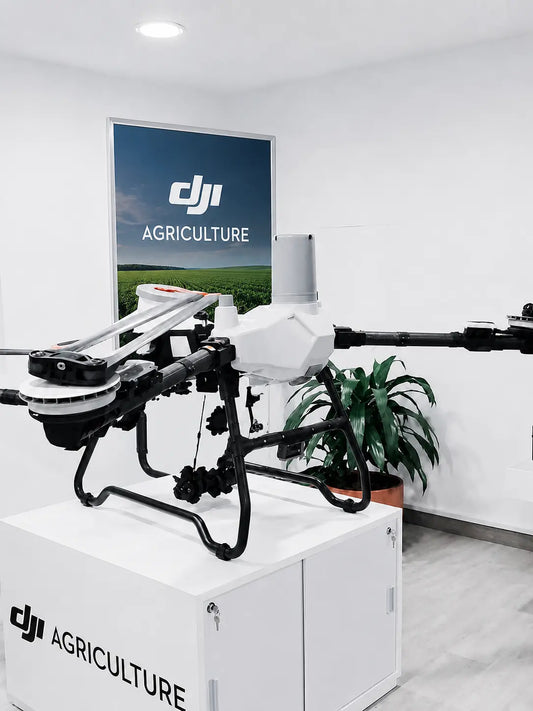

DJI Agras Tutorial: Agricultural Drone Basics & Operation Guide (Canada)
Share
🇺🇸 Reading from the United States? See the U.S. edition: DJI Agras Tutorial: Agricultural Drone Basics & Operation Guide
🇨🇦 CANADA — DJI Agras Agricultural Drone Basics, Flight Systems, Spraying Technology & Operator Fundamentals
A DJI Agras agricultural drone can look complicated because propulsion, flight control, GNSS, RTK, obstacle sensing, spraying, spreading, networking, mission planning and the remote controller all operate at the same time. The fastest way to understand the aircraft is to stop thinking of it as one machine and start thinking of it as a set of coordinated systems.
This Canadian edition of the Ares Acres DJI Agras basics guide is written for operators working across Canadian agriculture—from canola, spring wheat, barley, pulses and oilseeds in Saskatchewan, Alberta and Manitoba to corn and soybeans in Ontario and Quebec, and specialty crops, orchards and vineyards in British Columbia and other production regions. The aircraft mechanics and DJI operating concepts are the same as in the original tutorial. What changes is the Canadian regulatory, pesticide and operating context surrounding the mission.
The guide uses the DJI training video below as its technical spine, then expands the lesson into a detailed operator reference covering Mode 2 flight controls, controller antennas, networking, controller-aircraft linking, lithium-battery behaviour, ESCs, motors, CW/CCW propellers, GNSS, RTK, heading, radar, terrain following, the T40/T20P dual-atomized spraying system, flow measurement, weight sensing, droplet-size management, troubleshooting and Canadian preflight decision-making.
Ares Acres supports Canadian DJI Agras operators with aircraft, genuine OEM parts, spraying and spreading components, batteries, accessories, positioning equipment and technical education. Ares Acres ships genuine DJI Agras OEM parts to Canada with free standard shipping, and Canadian customers see CAD pricing at checkout. Browse DJI Agras OEM Parts, DJI Agras T100 Parts, DJI Agras T50 Parts, DJI Agras Accessories, or the complete Ares Acres Product Catalog.
Watch the DJI Agras Agricultural Drone Basics Tutorial
Prefer to watch instead of read? The source video gives a fast visual introduction to the aircraft. Use the written guide below as the deeper Canadian field reference, especially when training pilots, troubleshooting a subsystem, standardizing a fleet, preparing for cold-weather operation, or determining whether a technically possible spraying mission is also permitted under Canadian aviation and pesticide rules.
What You Will Learn
- The three major functional groups of a DJI Agras agricultural drone.
- How Mode 2 control-stick inputs translate into aircraft movement.
- Why smooth stick inputs matter more on a heavy agricultural multirotor than on a small camera drone.
- Why controller antenna orientation and line-of-sight geometry affect signal quality.
- How cellular and Wi-Fi internet access differ from the aircraft’s direct command-and-control link.
- How controller-to-aircraft linking works and what to check when linking fails.
- How the battery, ESCs, motors and propellers work together as one propulsion chain.
- Why DJI intelligent batteries self-discharge and why Canadian cold weather changes battery behaviour.
- Why CW and CCW propeller positions are flight-safety items.
- How GNSS supports hovering and autonomous routes.
- How RTK increases positioning precision and why dual RTK antennas can support heading determination.
- How radar and other sensing systems support obstacle awareness and terrain following.
- How the DJI Agras T40/T20P centrifugal or dual-atomized spraying system moves liquid from tank to crop.
- Why flow meters and weight sensors matter for application accuracy and refill planning.
- How atomizer speed and droplet size affect coverage, evaporation and drift risk.
- Why a Canadian pesticide label and PMRA policy control the real application—not a generic droplet recommendation from a training video.
- How Canada’s post-November-2025 RPAS framework affects medium agricultural drones.
- Why the exact aircraft’s Safety Assurance status and the operator’s pilot privileges matter before flight.
- How to troubleshoot a DJI Agras by subsystem instead of replacing parts at random.
Quick Answer: What Are the Main Systems on a DJI Agras Drone?
Agricultural-drone operation becomes easier when every warning is traced back to the system that could produce it. If the aircraft will not link, begin with the controller and transmission system. If it vibrates or pulls, begin with propulsion and airframe condition. If routes drift, begin with positioning and heading. If application rate is wrong, begin with the liquid or granular delivery system, calibration and mission settings.
1. The Three Main Functional Groups of an Agricultural Drone
The DJI training video divides the platform into three broad parts: the remote controller, the aircraft flying platform, and the spraying or spreading system. That is a useful mental model because nearly every operating problem can be traced into one of those groups.
| System | Primary job | Typical components | Common operator question |
|---|---|---|---|
| Remote controller | Pilot command, mission planning, telemetry, settings and data | Control sticks, display, antennas, networking, DJI Agriculture software | Am I linked to the correct aircraft and using the correct mission settings? |
| Flying platform | Create lift, stabilize, navigate and sense the environment | Battery, ESCs, motors, propellers, flight controller, GNSS/RTK, radar/vision | Is the aircraft mechanically and electronically healthy enough to fly? |
| Payload system | Apply liquid or distribute granular material | Tank/hopper, filters, pumps/feeder, flow meter, weight sensors, sprinklers or spinner | Is the correct amount of material reaching the target? |
The controller does not physically make the aircraft fly. It sends commands. The flight-control system interprets those commands while combining sensor, attitude, positioning and mission data. The propulsion system produces thrust. The payload system carries and meters the material. The operator supervises the entire chain.
2. DJI Agras Remote Controller Basics
Most manual flight commands are entered through the two control sticks. The training video demonstrates one-finger and two-finger techniques and uses a conventional thumb grip as the easier training example. The important principle is controlled, deliberate input rather than a particular grip style.
Mode 2 Stick Mapping
| Stick input | Aircraft response | Flight-control term |
|---|---|---|
| Left stick up / down | Ascend / descend | Throttle / vertical control |
| Left stick left / right | Rotate left / right | Yaw |
| Right stick up / down | Fly forward / backward | Pitch |
| Right stick left / right | Translate left / right | Roll / lateral movement |
Mode 2 is common, but a controller can be configured differently. Verify the selected stick mode before takeoff. A pilot who has perfectly memorized Mode 2 can still make the wrong input if a shared controller has been changed.
Why Smooth Stick Control Matters
Abrupt inputs can create unnecessary pitch and roll, increase pilot workload, disturb spray deposition, move the aircraft closer to obstacles than intended and make it harder to distinguish a real control problem from pilot-induced oscillation. New pilots should build precision before speed.
3. Remote Controller Antenna Orientation
The source video emphasizes an important radio-frequency principle: do not aim the tips of the remote-controller antennas directly at the aircraft. The strongest transmission geometry is generally broadside to the antenna rather than directly off its tip.
Orient the antennas for the aircraft’s working area, maintain clear line of sight when required, and avoid shielding the controller with your body, a truck cab, metal grain bin, building or other large structure. If signal quality declines, correct the geometry and operating position rather than simply continuing farther away.
4. Cellular Internet and Wi-Fi Are Not the Same as the Aircraft Control Link
The training controller can connect to the internet through a cellular dongle/SIM or through Wi-Fi. Internet access can support field synchronization, cloud tasks, map resources, firmware downloads, account services and other network-dependent functions.
The aircraft’s direct command-and-control radio connection is a separate system. Losing cellular data does not automatically mean the aircraft-control link has failed. Conversely, having excellent cellular service does not repair a poor direct transmission geometry or damaged controller antenna.
For Canadian operators working in areas with variable rural cellular coverage, this distinction is especially useful. Perform large firmware downloads, map synchronization and bulk field transfers on reliable Wi-Fi before travelling to a remote field whenever possible. Do not make the first discovery that a mission depends on cloud data after arriving beyond dependable service.
5. How to Link a DJI Agras Remote Controller to the Aircraft
New aircraft are commonly delivered already linked to their supplied controller. Linking becomes necessary when a controller is replaced, changed or loses its pairing.
- Power on the equipment and open Settings on the remote controller.
- Open the Remote Controller interface.
- Select Link; the controller begins the audible linking sequence.
- With the aircraft powered on, press and hold the aircraft battery power button for approximately five seconds as demonstrated in the source video.
- Observe the battery indicators enter the linking pattern.
- Wait for the controller and aircraft interface to confirm successful connection.
If Linking Fails
- Confirm adequate controller and aircraft battery power.
- Confirm the intended aircraft—not another fleet aircraft—is being paired.
- Move away from strong RF interference and large conductive structures.
- Confirm the controller is actually in linking mode before starting the aircraft-side action.
- Restart both systems and repeat the sequence deliberately.
- Check firmware compatibility after a controller, core module or aircraft repair.
- Preserve screenshots or logs if the linking fault is intermittent.
6. Propulsion System: Battery → ESC → Motor → Propeller → Thrust
A multirotor agricultural aircraft creates lift through a coordinated propulsion chain. The intelligent flight battery supplies energy. Electronic speed controllers meter power to the motors. Motors turn propellers. The flight controller continuously changes individual motor speeds to climb, descend, yaw, pitch, roll, hover and follow a route.
If one side produces more thrust than the opposite side, the aircraft tilts and accelerates. That is why a symptom that looks like “bad motor performance” may actually come from a damaged propeller, incorrect propeller position, ESC problem, connector fault, battery limitation, motor bearing, arm damage or payload imbalance.
7. DJI Intelligent Battery Self-Discharge
The source video explains that lithium batteries should not remain fully charged indefinitely. DJI intelligent batteries can therefore enter managed self-discharge/storage behaviour after remaining unused for a period. During that process the battery can become warm because stored energy is being dissipated.
Expected storage behaviour should not be used to normalize every warm battery. Swelling, extreme heat, unusual odour, fluid contamination, damaged terminals, impact damage or battery-system warnings are reasons to remove the pack from service and follow current DJI battery guidance.
For deeper battery-management training, see the DJI Agras Battery Fleet Management Guide.
8. Cold-Weather Battery Performance in Canada
Cold weather is more than a comfort issue for the pilot. Battery chemistry changes as temperature falls. The source tutorial notes that charging and discharging capability decrease in low-temperature conditions and that charging can take longer.
For a Canadian fleet, this has several practical implications. A battery that performed normally during a warm summer application can behave differently during late-season spreading, frost-season operations or winter maintenance. Cold packs can have reduced ability to deliver sudden high current, especially during heavy-payload takeoff. Charging infrastructure may also take longer to return batteries to service.
Do not invent a universal minimum temperature from memory. Follow the operating and charging temperature limits in the current manual for the exact battery model. Store, transport and condition batteries according to DJI guidance and the fleet’s battery SOP. Never use uncontrolled heaters or direct flame to warm a battery.
9. CW vs CCW Propellers
Multirotor aircraft use opposing propeller rotation directions to balance torque. DJI identifies clockwise (CW) and counterclockwise (CCW) propeller positions. Every propeller must match the intended motor location.
- Verify the propeller’s CW/CCW marking and the motor position.
- Inspect the blades, hub, folding joints and mounting hardware.
- Remove fertilizer, pesticide residue, mud or debris that can prevent correct seating.
- Never install a cracked, bent, delaminated, deeply chipped or otherwise damaged propeller.
- After maintenance, perform the model-specific retention inspection before power-on.
10. GNSS: The Foundation of Position Hold and Autonomous Routes
Global Navigation Satellite System positioning lets the aircraft determine where it is and supports stable hovering and autonomous route execution. The source video tells operators to verify a healthy flight-status indication before launch. The exact icons and colours vary by generation, so the rule is broader: do not launch until the controller shows the positioning and flight-control state required for the selected operation.
Farm infrastructure can complicate satellite and heading environments. Grain bins, metal roofs, large machinery, shelterbelts, electrical infrastructure and terrain can affect satellite visibility, multipath or magnetic conditions. A preflight positioning check should be performed at the actual launch site.
11. RTK: High-Precision Agricultural Positioning
RTK—Real-Time Kinematic positioning—uses correction information to improve GNSS precision. In agricultural operations it supports repeatable swaths, mapped boundaries, row alignment, route accuracy and other precision tasks.
The two RTK antenna housings visible on many T-series Agras aircraft can also support heading determination through dual-antenna geometry. This reduces reliance on a magnetic compass for directional information in supported configurations and improves robustness in electrically or magnetically challenging environments.
If RTK orientation is disabled and the aircraft relies on the compass, follow DJI’s current prompts and manual for calibration. Do not calibrate reflexively beside trucks, steel buildings, high-voltage lines or large metal objects.
For precision-positioning workflows, see the Canadian DJI Agras T100 D-RTK 3 Tutorial (Canada).
12. Radar, Obstacle Sensing and Terrain Following
DJI Agras aircraft use radar and, depending on model, additional sensing systems to detect terrain and obstacles. Downward sensing can help the aircraft maintain a relatively consistent height above terrain or crop canopy while following changing ground elevation.
The source article uses the T20P as one published reference. DJI lists its active phased-array omnidirectional radar with approximately 1.5–50 m horizontal sensing distance, 360° horizontal field of view and terrain-following support under specified conditions. Those figures are model-specific and should not be copied onto a T40, T50, T100 or another aircraft without checking that aircraft’s documentation.
13. The DJI Agras T40 / T20P Spraying System
The training video uses the DJI Agras T40 and T20P to explain the centrifugal, dual-atomized spraying architecture. At a high level, the liquid path is:
Tank → Filter → Flow Measurement → Pump → Atomizing Sprinkler → Crop
The tank holds the spray mixture. The filter removes contaminants that could reach pumps and sprinklers. The pumps move liquid. The flow meter measures actual movement. The atomizers break the liquid into droplets.
Published T20P Reference
DJI has published the T20P with a 20 L spray tank, two atomized sprinklers, maximum pump flow of 6 L/min × 2 and a published droplet-size range that varies by DJI reference page and revision. Historical training material also gives specific sprinkler RPM examples. Because official product pages, FAQs, firmware and hardware revisions can differ, do not treat one old RPM-to-droplet table as universal calibration for every aircraft.
Use the current aircraft interface, installed sprinkler hardware, current manual and the pesticide label for the exact application.
14. Flow Meter: Measuring What the Aircraft Actually Applies
The flow meter sits in the liquid-delivery path and measures actual flow. That lets the control system compare the commanded application with what is physically moving through the system.
When measured flow does not match expected output, inspect the complete liquid path before simply increasing the target rate. Possible causes include clogged filters, trapped air, pump wear, a leak, flow-meter contamination, calibration problems, hose restriction or liquid properties.
For spray-system service parts, browse DJI Agras T100 Spraying System Parts, DJI Agras T50 Spraying System Parts or the complete DJI Agras Parts Catalog.
15. Weight Sensors: Remaining Material and Refill Planning
Weight sensors help estimate the amount of liquid or granular material remaining. The training video highlights three operational uses: empty-tank/material alerts, remaining-payload estimation and prediction of refill timing.
That prediction has real commercial value. A better refill plan reduces unnecessary transit, avoids beginning a pass that cannot be completed, and helps coordinate batteries, mixing, loading and crew turnaround.
16. Centrifugal Sprinkler Speed and Droplet Size
In a centrifugal atomizer, higher rotational speed generally produces finer droplets while lower speed generally produces coarser droplets. The training video includes historical numerical examples, but those values should not be treated as universal calibration points across every T40/T20P software and hardware revision.
At the same carrier volume, dividing liquid into smaller droplets creates a larger number of droplets and can improve certain coverage characteristics. The tradeoff is that small droplets have less mass, remain airborne longer and are generally more susceptible to evaporation and off-target movement.
17. Canadian Droplet Management: The Pesticide Label Controls
The source video suggests general droplet strategies—for example, medium droplets for ordinary field work, coarser droplets for herbicide work and finer droplets for some fruit-tree applications. Treat those as training concepts, not legal application instructions.
Health Canada’s current 2026 RPAS pesticide policy is particularly important here. Under SPN2026-02, a product already registered for conventional aerial application can be applied by RPAS under the policy when the label permits aerial application and does not prohibit RPAS use. The operator must still follow the aerial-use directions, including the labelled application rate, minimum spray volume, droplet-size requirements and spray buffer zones.
See the Canadian DJI Agras Agricultural Drone Safety & Safe Spraying Practices Guide for a deeper treatment of drift, crew positioning, label interpretation, PMRA requirements and Canadian spray-safety decisions.
18. Droplet Size Is Only One Part of Drift Management
- Droplet spectrum.
- Wind speed and direction.
- Temperature and relative humidity.
- Temperature inversions and atmospheric stability.
- Aircraft release height.
- Flight speed.
- Flow rate and spray volume.
- Sprinkler/nozzle configuration.
- Crop canopy and target geometry.
- Product formulation and approved adjuvants.
- Neighbouring crops, water, people, livestock, roads and other sensitive receptors.
A technically functioning drone can still make a poor or non-compliant application if the weather, label, product or site conditions are wrong.
19. Transport Canada: Where DJI Agras Operations Fit in 2026
Canada’s drone rules changed significantly on November 4, 2025. Transport Canada now defines a medium drone as an RPAS weighing more than 25 kg and not more than 150 kg. Certain medium-drone VLOS operations can now be conducted under the Advanced Operations framework when the pilot, aircraft and mission meet the applicable requirements.
This means the old blanket statement that every agricultural drone over 25 kg automatically requires an SFOC is no longer universally accurate. At the same time, the new framework does not make every medium DJI Agras aircraft automatically eligible. For Advanced and Level 1 Complex operations, the exact model/configuration must have the required RPAS Safety Assurance for the intended operation, and the pilot must hold the appropriate certificate and satisfy the operating conditions.
Operations outside the normal Basic, Advanced or Level 1 Complex frameworks can still require a Special Flight Operations Certificate (SFOC-RPAS). Controlled-airspace operations can also require the appropriate NAV CANADA or air traffic authorization.
Use the current Transport Canada operation-category information and the current Safety Assurance list for the exact aircraft. Do not infer legal authority from aircraft weight, marketing material or a tutorial title.
20. Aviation Authority and Pesticide Authority Are Separate
A pilot certificate or SFOC does not authorize a pesticide use that the PMRA label prohibits. Likewise, a pesticide that can be applied by RPAS does not authorize a flight that does not satisfy Transport Canada requirements.
Think of the Canadian operating stack as:
Pilot privilege → Aircraft registration → Aircraft Safety Assurance or special authorization → Airspace permission → PMRA product eligibility → Current pesticide label → Provincial/territorial applicator authority → Actual field and weather conditions.
21. Practical DJI Agras Preflight System Check for Canada
| Area | What to verify | Why it matters |
|---|---|---|
| Controller | Adequate charge, correct stick mode, correct aircraft linked, antennas oriented correctly | Command integrity and predictable manual control |
| Battery | No swelling/damage/errors; adequate temperature and charge | Power availability and flight/fire safety |
| Propulsion | Correct CW/CCW propellers, secure hardware, no blade/motor/arm damage | Balanced thrust and control authority |
| Positioning | Required GNSS/RTK state, correction source and heading status | Accurate hover and route tracking |
| Radar / vision | Sensors clean, unobstructed and error-free | Terrain and obstacle-assistance performance |
| Spray system | Correct mixture, no leaks, clean filters, normal pumps/flow, compliant droplet setting | Application accuracy and drift control |
| Mission | Field boundary, route, height, speed, buffers, refill plan, obstacles and return logic | Prevents planning errors from becoming emergencies |
| Aviation compliance | Pilot certificate, registration, operating category, Safety Assurance, SFOC when required, airspace permission | Canadian aviation compliance |
| Pesticide compliance | PMRA label, SPN2026-02 eligibility where relevant, provincial/territorial applicator requirements | Legal pesticide use and application quality |
22. Common Operator Mistakes
- Learning Mode 2 without checking the selected stick mode.
- Pointing antenna tips directly at the aircraft.
- Confusing cellular internet with the command-and-control radio link.
- Assuming a warm stored battery is automatically defective—or assuming abnormal heat is normal self-discharge.
- Ignoring cold-battery limitations during Canadian shoulder-season or winter work.
- Installing a propeller by appearance without verifying CW/CCW position.
- Assuming RTK can never lose its fix or correction source.
- Depending on radar to see every wire, branch or guy wire.
- Using a historical sprinkler RPM as a universal droplet calibration.
- Selecting the finest droplet because coverage appears better.
- Reducing spray volume below the labelled aerial minimum because a drone can physically do it.
- Assuming every product with aerial directions automatically permits RPAS without reading the current label.
- Using an outdated blanket rule that every drone over 25 kg requires an SFOC.
- Assuming medium-drone classification automatically makes an Agras eligible for Advanced Operations.
- Ignoring provincial or territorial pesticide certification because the PMRA label permits the application.
- Replacing parts before isolating the failing subsystem.
23. Troubleshooting by System Instead of by Symptom Alone
| Symptom | First systems to inspect | First operator action |
|---|---|---|
| Aircraft will not respond to controller | Linking, radio connection, aircraft power, controller settings, firmware | Verify correct aircraft/controller pair and connection state |
| Poor signal quality | Antenna orientation, line of sight, interference, controller position | Correct geometry before extending distance |
| Aircraft pulls or vibrates | Propellers, motor, ESC, arm/frame condition, payload balance | Land and inspect propulsion mechanically |
| Position drift / inaccurate route | GNSS, RTK fix, correction source, dual antennas, heading/compass | Stop autonomous precision work until positioning is healthy |
| Terrain following is abnormal | Radar/vision cleanliness, mode, terrain slope, crop canopy, warnings | Verify sensing state and reduce complexity |
| Flow lower than expected | Tank outlet, filter, hose, pump, air ingress, flow meter, sprinkler | Land and inspect liquid path before increasing rate |
| Application drifts off target | Droplet size, wind, inversion, height, flow, formulation, label | Stop application and reassess the full spray envelope |
| Cloud field/task unavailable | Internet, account/team, local/cloud storage | Diagnose data path rather than flight radio |
24. Recommended New-Operator Training Progression
- Learn the controller power, link and emergency-interruption functions.
- Verify stick mode and practise smooth manual control without an application payload.
- Learn the aircraft’s propulsion architecture and preflight inspection.
- Learn GNSS, RTK, heading and sensing-status indicators.
- Learn field planning and autonomous route logic.
- Learn the spraying or spreading system separately from flight control.
- Learn how application rate, speed, swath and droplet selection interact.
- Learn the Canadian aviation category applicable to the exact aircraft and mission.
- Learn PMRA label interpretation and provincial/territorial applicator requirements before pesticide application.
- Only then combine aircraft, route and material application into a production mission.
FAQ: DJI Agras Agricultural Drone Basics in Canada
What are the three main parts of a DJI Agras agricultural drone?
At the training level: the remote controller, the flying platform and the spraying/spreading payload. Each contains several subsystems.
What does the left stick do in Mode 2?
Left-stick up/down controls vertical movement; left/right controls yaw.
What does the right stick do in Mode 2?
Right-stick up/down commands forward/backward movement; left/right commands lateral movement.
Should I point the controller antennas at the drone?
No. The source training warns against pointing the antenna tips directly at the aircraft because that can create weak signal geometry.
Do DJI Agras controllers need cellular service to fly?
Internet connectivity and the aircraft-control link are separate systems. Some cloud, map, RTK or task functions can require network service, while direct aircraft control uses its own transmission system.
Why does a fully charged Agras battery lose charge in storage?
DJI intelligent batteries can use managed self-discharge/storage behaviour to avoid remaining at full charge indefinitely.
Why does cold weather matter?
Low temperature can reduce battery charging and discharging performance and lengthen charging time. Follow the current manual for the exact battery model rather than using a generic temperature limit.
Why are there CW and CCW propellers?
Opposing rotation directions balance torque and are part of multirotor control. Each propeller must be installed on the correct motor position.
What is the difference between GNSS and RTK?
GNSS provides satellite positioning. RTK adds correction information to improve precision significantly when the system has a valid solution.
Does radar guarantee obstacle avoidance?
No. Radar and vision are assistance systems. Wires, branches, terrain transitions and environmental conditions can still defeat detection.
What droplet size should I use?
Use the droplet category required by the current Canadian pesticide label and appropriate for the application. Generic training examples do not override the label.
Can I use a pesticide by RPAS in Canada if the label allows aerial application?
Under Health Canada’s June 30, 2026 SPN2026-02 policy, a conventionally aerial-labelled product can be eligible for RPAS application when the label does not prohibit RPAS use, provided all aerial directions are followed. Verify the current label before every product decision.
Can I reduce the aerial spray volume because a DJI Agras uses less water?
No. Under current PMRA policy, do not reduce spray volume below the minimum aerial volume stated on the product label.
Does every DJI Agras over 25 kg require an SFOC in Canada?
Not automatically after the November 4, 2025 regulatory changes. Certain medium-drone operations can occur under the Advanced framework when the pilot, aircraft Safety Assurance and operation meet all requirements. Other missions still require Level 1 Complex privileges or an SFOC.
Does medium-drone classification alone authorize the aircraft?
No. Verify the exact model/configuration against Transport Canada’s current Safety Assurance information and the privileges required for the mission.
Can a DJI Agras fly in controlled airspace in Canada?
Only when the pilot, aircraft and operation satisfy the applicable rules and the required air traffic authorization has been obtained.
Do provincial pesticide rules still apply?
Yes. Federal PMRA product registration and provincial/territorial applicator licensing or permitting are separate layers.
Where can I learn more about safe spraying?
Read the Canadian Agricultural Drone Safety & Safe Spraying Practices Guide.
Related Ares Acres DJI Agras Canada Resources
- DJI Agras Agricultural Drone Safety & Safe Spraying Practices (Canada)
- DJI Agras Remote Control Activation Tutorial (Canada)
- DJI Agras T100 Route Mode & Field Planning (Canada)
- DJI Agras T100 D-RTK 3 Tutorial (Canada)
- DJI T100 Spreading System Programming & Calibration (Canada)
- Browse All DJI Agriculture Tutorials
Complementary DJI Agras Equipment & Parts
- DJI Agras OEM Parts — structural, electrical, propulsion, sensing, power, spraying and spreading components.
- DJI Agras T100 Parts.
- DJI Agras T50 Parts.
- DJI Agras T40 Parts.
- DJI Agras Accessories.
- Ares Acres Product Catalog.
What Is Ares Acres?
Ares Acres is a U.S.-based agricultural robotics and DJI Agras equipment company supporting commercial applicators, farms, technicians and fleet operators with aircraft, genuine OEM parts, technical education, diagnostics and model-specific parts identification. Ares Acres also serves Canadian operators with genuine DJI Agras OEM parts shipped to Canada with free standard shipping and CAD pricing at checkout.
The purpose of the Ares Acres DJI Agriculture Tutorials library is not simply to convert a short video into a longer transcript. Each tutorial is expanded into an operator reference that connects system function → preflight verification → correct use → troubleshooting → regulatory context → replacement components → continued training.
Need DJI Agras Parts or Canadian Operator Support?
Browse DJI Agras Parts, DJI Agras Accessories, or the full Ares Acres catalog. If you need help identifying the correct component, preserve the warning text, aircraft model, controller screenshot and relevant photos and contact Ares Acres.
Final Operator Takeaway
The most important lesson from this agricultural-drone basics tutorial is the relationship between systems. The controller commands. The flight controller interprets. GNSS and RTK establish position and heading. The battery and propulsion system create thrust. Radar and other sensors improve environmental awareness. The payload system meters the material. The operator verifies that every layer is functioning and that the mission itself is legal and appropriate.
For Canadian operators, system knowledge must be paired with current Transport Canada and Health Canada requirements. The fact that an aircraft can fly or spray does not prove that the exact aircraft is eligible for the intended operating category or that the pesticide can be applied by RPAS at the desired volume and droplet setting.
Build system knowledge before speed. A pilot who understands what each subsystem does, what healthy status looks like and which condition should stop the mission is far better prepared to operate a DJI Agras safely and efficiently across Canadian agriculture.
Educational, operational and regulatory notice: This Canadian article expands the supplied DJI Agras training video for operator education and reflects publicly available Canadian regulatory context as of September 10, 2026. DJI specifications, software, firmware, Transport Canada operating categories, RPAS Safety Assurance declarations, SFOC requirements, airspace permissions, Health Canada PMRA policies, pesticide labels and provincial or territorial requirements can change. Always verify the current requirements for the exact aircraft, battery, controller, pesticide, crop, jurisdiction and mission before flight or application.