
The DJI Agras T55 Agro-Spraying Drone | NEW DJI Agriculture Drone
Share
DJI Agras T55 Aircraft, Parts, Power, and Operator Support
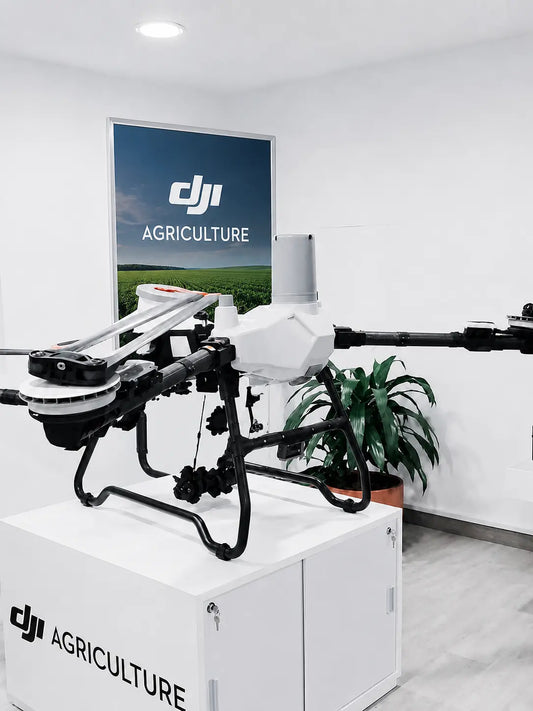
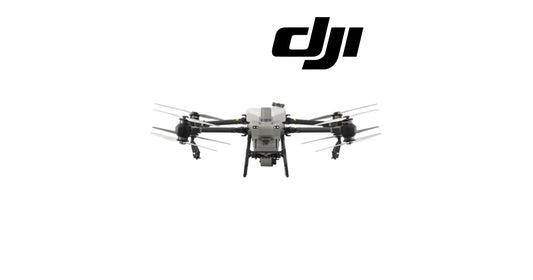
The DJI Agras T55 is a new 50-liter agricultural drone created around a deceptively ambitious idea: one professional pilot should be able to transport, configure, and operate a serious spraying, spreading, and lifting platform without treating every field deployment like a heavy-equipment mobilization. It is not a consumer camera drone with an agricultural attachment. It is a purpose-built aerial work platform that combines a 50 L liquid tank, an 80 L granular-material tank, a 40 kg lifting system, high-flow application hardware, autonomous field planning, a new millimeter-wave radar system, a multidirectional vision system, and a two-battery power strategy on one foldable airframe.
That combination places the T55 in an unusually useful position inside the current DJI Agras family. It moves beyond the 40 L spraying class represented by the DJI Agras T50, but it does not ask every operator to jump directly to the scale, ground-support requirements, and 100 L payload of the DJI Agras T100. For farmers and application businesses that need more liquid capacity, faster material handling, newer safety intelligence, and true multi-role use—but still care deeply about solo transport and field simplicity—the T55 is designed to be the practical center of the lineup.
The headline figures tell only part of the story. In spraying configuration, the T55 carries a 50 L liquid tank and a 50 kg operating payload. Its standard two-sprinkler configuration delivers up to 40 L/min. An optional rear four-mist-sprinkler configuration raises the maximum published flow to 50 L/min for high-volume applications. In spreading configuration, the DS80L system provides an 80 L tank, a 55 kg operating payload, and a maximum published discharge rate of 400 kg/min under DJI’s stated compound-fertilizer test conditions. In lifting configuration, the DL100 system carries an operating payload of 40 kg on a standard 10 m cable.
Those are three different payload systems and three different operating limits. They should never be compressed into one vague statement that the T55 “holds 55 kilograms.” It holds up to 50 kg of spraying liquid in the spray system, up to 55 kg of supported granular material in the spreading system, and up to 40 kg in its lifting configuration, subject to the aircraft state, installed battery, environmental conditions, task, and the loading recommendation shown by the DJI Agriculture application.
Ares Acres supports agricultural drone operators with complete aircraft, genuine DJI Agras components, field-power equipment, technical education, and practical parts access. Operators evaluating this aircraft can review the live DJI Agras T55 Premium Set, compare other DJI Agras drones, browse DJI Agras parts, explore DJI accessories, or contact Ares Acres to discuss the correct aircraft, battery, spray, spread, lift, positioning, and field-power configuration.
Prefer to watch instead of read? The video above provides a concentrated introduction to the DJI Agras T55. It presents the one-pilot operating concept, standard and optional spray configurations, DS80L spreading system, DL100 lifting system, new radar and vision functions, recorded-path field planning, DB1050 and DB1580 battery choices, in-flight and ground cooling, RC Plus 2 AG controller, O4 transmission, relay support, and D-RTK 3 AG compatibility. This written guide expands each of those points into an operator-level reference and separates marketing headline numbers from the configuration details that determine what the aircraft can actually do.
Quick Answer: What Is the DJI Agras T55?
The DJI Agras T55 is a professional agricultural multirotor designed for liquid spraying, granular spreading, and suspended-load lifting. It carries a 50 L spray tank, an 80 L DS80L spreading tank with a 55 kg operating payload, or a DL100 lifting system with a 40 kg operating payload. Standard spraying uses two centrifugal sprinklers at up to 40 L/min; an optional four-mist-sprinkler package supports up to 50 L/min. The aircraft adds millimeter-wave radar, Tri-Vision environmental awareness, obstacle recording, path-based field planning, RTK support, O4 transmission, rapid charging, and battery heat-management hardware.
In practical terms, the T55 is a multi-purpose agricultural work aircraft built for operators who want a meaningful capacity increase over the T50 class while retaining a foldable, comparatively light, single-operator-oriented field platform.
What You Will Learn
This guide explains:
- what the DJI Agras T55 is and where it fits in the modern Agras lineup;
- why DJI describes the aircraft as light, intuitive, and suitable for one-pilot field handling;
- the difference between spray-tank volume, spray operating payload, spreading payload, lifting payload, and maximum takeoff weight;
- how the standard two-sprinkler and optional four-mist-sprinkler configurations differ;
- how droplet size, flow, swath, crop architecture, speed, and application rate interact;
- how the 80 L DS80L spreading system handles fertilizer, seed, feed, and other supported granules;
- why the T55 has multiple screw-feeder choices instead of one universal feeder;
- how the 40 kg DL100 lifting system expands the aircraft beyond crop-input application;
- what the new millimeter-wave radar, Tri-Vision system, AR display, and obstacle-memory functions contribute;
- how path recording and automated planning reduce setup work at a new field;
- how the DB1050 and DB1580 batteries change aircraft weight and endurance strategy;
- why onboard and ground battery cooling are important during high-tempo work;
- what the RC Plus 2 AG, O4 transmission, DJI Relay, and D-RTK 3 AG add to the operating system;
- which farms, contractors, and agricultural businesses are the most natural fit for the T55;
- what should be included in a field-ready T55 package; and
- how Ares Acres supports aircraft selection, configuration, parts planning, and long-term fleet uptime.
1. The T55 Is an Agricultural Work Platform, Not Merely a Larger Sprayer
The most accurate way to understand the DJI Agras T55 is to stop treating “sprayer drone” as a complete description. Spraying is central to the aircraft, but the airframe is designed to accept three substantial work systems: liquid application, granular-material distribution, and suspended-load lifting. The aircraft, payload module, battery, charger or generator, controller, positioning tools, field workflow, and spare-parts plan operate as one larger production system.
That system perspective matters because commercial agriculture does not reward specifications in isolation. A 50 L tank creates value only when the fill process, battery rotation, route design, nozzles, pumps, cooling, and ground crew can support repeated cycles. A 400 kg/min maximum discharge figure matters only when the correct feeder is installed, the material falls inside its supported particle-size range, the operation template is appropriate, and the planned application rate can be delivered accurately across the route. A 40 kg lift capacity matters only when the cable, hook, load shape, wind exposure, route, personnel separation, and emergency-release procedure are controlled.
DJI’s design direction for the T55 is therefore not simply “add ten liters to the T50.” The aircraft moves into a newer current-generation ecosystem. It uses 62-inch carbon-fiber-composite propellers, auto-locking folding arms, a newer columnar-interface battery family, the RC Plus 2 AG controller platform, O4 communications, expanded radar and vision awareness, obstacle recording, improved automation, and purpose-built spread and lift systems. Some components and accessories are shared with the T70P or T100 family, while other assemblies remain T55-specific. That mixture of commonality and uniqueness is important for fleet planning and parts inventory.
The result is a platform intended to work through more of the agricultural calendar. During spraying windows it can apply crop-protection or nutrition products according to the approved product label and operating plan. During seeding or fertilizer periods it can change to the DS80L spreading system. When application work is not the mission, the DL100 lifting system creates a controlled method for moving supported suspended cargo. The same controller, aircraft intelligence, positioning environment, and support relationship can serve several revenue-producing tasks.
This multi-role design is one reason the DJI Agras T55 Premium Set should be evaluated as a complete working package rather than as a bare airframe price. An aircraft without enough batteries, cooling, appropriate charging power, the required payload system, setup support, and a parts plan may be technically capable but commercially incomplete.
2. Where the DJI Agras T55 Fits in the Agras Lineup
The T55 occupies the 50 L class, but tank size alone does not define its role. The older or adjacent DJI Agras T50 uses a 40 L spray tank and a 50 kg spreading payload. The current T70P steps upward to a 70 L spray tank, 70 kg spreading payload, and 65 kg lifting capacity. The T100 occupies the large-aircraft end with a 100 L spray system, 100 kg spreading payload, and up to 100 kg in its standard lifting specification. The T55 sits between the T50 and T70P in spray capacity while bringing several current-generation systems and a formal 40 kg lifting mode to operators who do not need the largest platform.
That position creates a clear operating argument. A T50 owner who repeatedly reaches the limit of a 40 L tank may want more capacity and materially higher standard flow without moving immediately into a 70 L or 100 L aircraft. A new contractor may want an aircraft that can be moved and staged by a lean team but still has enough capacity to serve commercial crop acres. An orchard operator may value the optional rear quad-mist configuration and the newer obstacle-management tools more than the absolute largest tank. A mixed-use farm may value three mission systems on one airframe because spraying alone does not define its annual workload.
The T55 is not automatically “better” than every smaller or larger Agras model. The correct aircraft depends on crop, acreage, field geometry, terrain, target application volume, refill logistics, truck or trailer capacity, personnel, charging infrastructure, expected annual utilization, and the support ecosystem already owned by the business. The T50 can remain attractive when compactness, existing DB1560 assets, and a proven 40 L workflow are decisive. The T70P offers more payload while remaining below the T100. The T100 is designed for much larger individual loads and high-throughput operations where the ground system can feed it.
The T55’s value is balance: meaningful capacity, very high published flow, multi-role use, current safety intelligence, and single-operator-oriented handling. That balance is the theme behind DJI’s “Farming, Simplified” positioning.
DJI Agras lineup position at a glance
| Model | Spray tank | Spreading payload | Lifting capability | General operating position |
|---|---|---|---|---|
| DJI Agras T50 | 40 L | 50 kg | No comparable published dedicated lift mode in the T50 specification | Proven mid-size spraying and spreading platform |
| DJI Agras T55 | 50 L | 55 kg | 40 kg | Current-generation, single-operator-oriented spray, spread, and lift platform |
| DJI Agras T70P | 70 L | 70 kg | 65 kg | Higher-throughput intermediate platform |
| DJI Agras T100 | 100 L | 100 kg | Up to 100 kg standard lift specification | Large-load aircraft for major field and lifting operations |
The table is a starting point, not a purchasing verdict. Flow rate, field speed, route efficiency, refill time, battery behavior, optional hardware, application volume, and support can change real production more than a tank comparison alone.
3. “One Pilot” Begins With Airframe Handling
The supplied T55 video opens with the phrase “One pilot, effortless control.” That statement should not be interpreted as a promise that every commercial mission requires only one human being or that normal safety roles disappear. It describes the aircraft’s handling and workflow design: DJI has deliberately reduced the physical and procedural friction involved in moving, unfolding, verifying, planning, and operating the platform.
The T55’s published weight is 45 kg with the standard DB1050 battery in the two-nozzle spray configuration and 48.4 kg with the higher-capacity DB1580. DJI highlights additional carrying handles and a folding structure designed to make vehicle loading and unloading easier for one pilot. The arms use auto-locking latches that engage when unfolded. The Tri-Vision system also helps verify arm position so lock status can be checked through the controller rather than depending only on an unrecorded visual assumption.
That design is significant because field productivity begins before takeoff. Every unnecessary lift, awkward grip, manual latch sequence, separate mapping flight, or repeated configuration step adds time and fatigue. When operations are distributed across several small or medium fields, the workday can contain multiple transport, setup, fill, flight, recovery, and teardown cycles. A platform that reduces transition friction can be more productive than a nominally larger aircraft that demands a much heavier mobilization for every block.
However, “one pilot” does not mean “no process.” A disciplined solo-oriented operation still needs a defined staging area, secure aircraft handling, chemical or material loading controls, battery isolation, route review, weather checks, obstacle awareness, bystander separation, post-flight inspection, and records. When the work, product label, applicable operating authority, site, payload, or risk assessment requires additional personnel, those needs remain. The T55’s advantage is that the aircraft itself does not create unnecessary crew demand simply because it is cumbersome to move or configure.
For commercial operators, this can affect economics. A lean team can serve smaller fields that may not justify a large ground convoy. A farm can deploy the aircraft from an appropriate truck or trailer without needing a separate machine merely to handle the drone. A pilot can move from spraying to spreading with fewer platform changes. None of those advantages replaces training, but all of them reduce nonproductive time around the mission.
4. Airframe, Propulsion, and Physical Scale
The T55 uses a reverse-rotation quad-axis layout with eight rotors arranged in four coaxial pairs. DJI lists 62-inch carbon-fiber-composite propellers, four pairs in total, driven by motors with a 155 × 16 mm stator and a published KV of 55 rpm/V. The large propeller class is notable because the T55 is marketed around lighter handling while using propulsion hardware associated with the newer larger Agras family rather than simply extending the older T50 configuration.
With arms and propellers unfolded, DJI lists the aircraft at 3190 × 3570 × 934 mm. With the frame arms unfolded and propellers folded, it is 1800 × 2170 × 934 mm. Fully folded, it is 1120 × 896 × 934 mm. Those dimensions should be compared with the actual bed, trailer, enclosure, rack, doorway, tie-down arrangement, and service space the operator intends to use. “Foldable” does not mean the aircraft can be placed into any available corner without protection.
The 2415 mm diagonal wheelbase and 62-inch propulsion system also influence the takeoff and landing area. A pilot should plan a level, stable, contamination-controlled zone with enough clearance for the complete rotor disc and the expected movement of people, hoses, containers, batteries, and tools. The new safety system can assist with environmental awareness, but it does not make a poor staging location good.
The aircraft’s maximum published wind resistance is 6 m/s, and its published operating temperature is 0–40 °C. Those are aircraft specifications, not universal permission to apply every material at those boundaries. Product labels, droplet behavior, evaporation, drift, canopy, route, payload, visibility, terrain, and local operating procedures may impose a lower working limit. The lowest applicable limit should govern.
With RTK enabled and strong positioning conditions, DJI lists hover accuracy of ±10 cm horizontally and vertically. Without RTK, the published values are ±0.6 m horizontally and ±0.3 m vertically. RTK precision can materially improve repeatability, route placement, boundary work, and fleet coordination, but it does not eliminate the need to verify the field map, obstacle data, antenna environment, correction source, and controller status.
5. The 50-Liter Spraying System
The T55’s spray system is one of its defining features. The HDPE tank has a published volume of 50 L and an operating payload of 50 kg. Two magnetic-drive impeller pumps feed the sprinkler system. The standard configuration uses two LX09050DX multi-atomization centrifugal sprinklers, positioned 1800 mm apart, with a maximum total flow rate of 40 L/min. An optional configuration uses four LX09510DX mist sprinklers and raises the maximum total flow rate to 50 L/min.
Those numbers must be described carefully. The T55 does not deliver 50 L/min from its standard dual-sprinkler package. The 50 L/min maximum belongs to the optional four-mist-sprinkler configuration. The standard system is already exceptionally high-flow at up to 40 L/min, but the hardware distinction affects purchasing, installation, calibration, maintenance, use case, and article accuracy.
DJI positions the standard multi-atomization centrifugal sprinklers primarily for field-crop protection. The optional rear four-mist-sprinkler arrangement is positioned primarily for orchard and high-volume scenarios. Both are published with an adjustable droplet range of 50–500 μm, but equal published droplet ranges do not mean the two configurations are operationally identical. Nozzle layout, total flow, canopy geometry, downwash, aircraft speed, application volume, target surface, weather, and the approved label all influence the actual result.
The effective published spray width is 4–11 m. This is not a fixed swath that should be entered blindly for every job. Effective width changes with operating height, crop, nozzle configuration, droplet setting, wind, flow, speed, and the required uniformity. A professional setup verifies the application pattern for the planned conditions instead of treating the largest advertised number as the default.
Standard dual-sprinkler configuration
The standard dual-sprinkler system is the baseline T55 spray platform. At up to 40 L/min, it supports higher-volume work without requiring the optional orchard package. For broad-acre crops such as corn, sugarcane, wheat, rice, cotton, soybeans, or other supported crops, the standard system can be configured around the required application rate, flight speed, route spacing, droplet choice, and product label.
The phrase “up to 40 L/min” is a system ceiling, not a required operating point. Many applications will use a much lower commanded flow because the agronomic target, label rate, speed, and field plan demand it. Maximum pump capacity creates operating headroom. It allows the aircraft to maintain a target volume at higher speed or in higher-volume scenarios when the rest of the system supports that choice. It should not be confused with a recommendation to empty the tank as quickly as possible.
Magnetic-drive impeller pumps are useful in agricultural duty because they support high flow while removing some conventional shaft-seal exposure from the wetted path. That does not make the liquid system maintenance-free. Filters, hoses, connectors, tank interfaces, pump passages, sprinkler discs, seals, and other wetted components still require inspection, rinsing, decontamination, and correct storage. Chemical compatibility and residue management remain central to reliability.
Optional rear quad-mist configuration
The optional four-mist-sprinkler package raises the published maximum flow to 50 L/min and is intended for use cases where high liquid volume and deeper canopy treatment are important. The supplied transcript emphasizes corn, sugarcane, wheat, and canopy penetration, but the strongest specific justification for the four-mist layout is dense or three-dimensional crop structure, including supported orchard work.
Fine droplets can increase the number of droplets and help coverage, but they can also be more sensitive to wind, heat, low humidity, and off-target movement. “Fine” is not automatically “better.” The correct setting depends on the approved product label, target, crop, canopy, weather, and application objective. The T55’s 50–500 μm adjustment range provides flexibility; professional operation is the process of selecting the appropriate point within that range.
Optional spray hardware should also be treated as a real configuration change rather than a casual bolt-on. DJI’s public product information for the mist-nozzle package calls for authorized installation and flow calibration. Added sprinklers can change liquid routing, aircraft balance, maintenance points, cleaning requirements, and how droplets interact with cameras or landing-gear surfaces. Operators ordering a T55 for orchard work should confirm that the desired mist package is included, installed, calibrated, and supported—not assume every listed T55 arrives with four mist sprinklers.
Droplet size and coverage
The published 50–500 μm range gives the T55 a broad adjustment window. At the fine end, droplets may support dense coverage and canopy penetration under suitable conditions. At larger sizes, droplets can offer better resistance to evaporation and drift but may reduce droplet count at a given volume. The correct balance is agronomic and operational.
Droplet size also works together with downwash. An agricultural multirotor does not merely release liquid into still air; the rotor system creates a downward and outward airflow field. Aircraft height, speed, canopy height, canopy density, row orientation, sprinkler placement, and wind interact with that airflow. A strong T55 operating plan therefore treats the aircraft, nozzle configuration, droplet setting, speed, and crop as one application system.
The goal is not the most visible cloud. The goal is a controlled deposit on the intended target at the required rate with acceptable uniformity and minimal off-target loss. That is why application verification, water-sensitive paper where appropriate, test passes, pattern review, flow calibration, and label compliance remain essential even with a highly automated aircraft.
Payload indicator light
The new payload indicator light is an easily overlooked but useful field feature. The supplied video states that it allows payload volume to be monitored in real time. This gives ground personnel a visible aircraft-state cue in addition to the controller’s digital information.
Real-time payload awareness supports better refill staging and fewer surprises. A ground team can anticipate when a load is nearing completion. A pilot can compare expected consumption with actual route progress. If liquid use is materially different from the planned rate, the discrepancy can trigger a check of settings, route, pump behavior, flow calibration, or leaks rather than being discovered only after the operation.
The indicator should not replace controller telemetry or measured filling. It is another layer of awareness. In a high-tempo operation, redundant state information is valuable because the aircraft, pilot, loader, battery handler, and route plan all need to remain synchronized.
6. Translating Spray Specifications Into Real Field Productivity
The T55’s 50 L tank and 40–50 L/min maximum flow figures are attractive, but daily output cannot be calculated from those numbers alone. Real productivity is determined by application volume, swath, flight speed, field size, field shape, obstacles, turns, refill time, battery changes, charging, ferry distance, route setup, weather interruptions, and the efficiency of the ground station.
Consider two jobs using the same aircraft. A broad rectangular field with long runs, low ferry distance, a nearby mixing station, and a moderate application volume may allow the T55 to spend a high percentage of the day applying. A fragmented orchard with irregular rows, elevation changes, obstacles, cautious turn behavior, and a high liquid volume may require more time per acre even though the optional spray system has higher maximum flow. Neither result contradicts the aircraft specification; they represent different operating systems.
Tank volume determines the amount of liquid available at takeoff. Application volume determines how much area that liquid can serve. At 2 gallons per acre, a 50 L tank theoretically represents more acres than at 5 gallons per acre, before normal reserve, route, and operational factors. Maximum flow determines whether the aircraft can sustain a given application rate at the intended speed and width. It does not determine area by itself.
Ground efficiency often becomes the limiting factor. If mixing and filling take longer than the flight, the aircraft waits. If only one battery is available and it must cool before charging, the aircraft waits. If the charging source cannot sustain the required power, the aircraft waits. If the trailer arrangement makes every tank refill awkward, the aircraft waits. High-flow aircraft reward disciplined ground design because their airborne cycle can become shorter than the support cycle.
The T55’s onboard heat sink, ground air-cooled heat sink, rapid charging options, and dual battery choices are all aimed at this cycle-time problem. A field-ready system should be designed backward from the desired daily tempo: target acres or loads, expected application volume, flight and refill cycle, number of batteries, cooling capacity, charger or generator output, mixing capacity, personnel, and planned service intervals.
7. The 80-Liter DS80L Spreading System
The T55 changes roles by replacing the liquid application system with the DS80L spreading system. DJI lists an 80 L tank, a 55 kg operating payload, screw-feeder delivery to a centrifugal spreading disc, a maximum published discharge rate of 400 kg/min for compound fertilizer under stated conditions, and an effective spreading width of 3–10 m.
The volume and weight values describe different properties. The 80 L figure is container volume. The 55 kg figure is operating payload. A material’s bulk density determines how much of the tank’s volume is occupied by a given mass. A full hopper of a light seed may reach the volume limit before the weight limit. A dense fertilizer may reach the weight limit with unused volume remaining. Operators should load by the aircraft recommendation and the known material properties, not by the visual appearance of an “80 L tank.”
The supplied video describes the system as able to carry a full bag of fertilizer in one flight. That is a useful commercial image, but bag sizes vary. The controlling specification is the 55 kg operating payload and the in-app recommended load for the actual aircraft state and environment. A bag that exceeds the recommended value should not be loaded merely because it fits physically.
What 400 kg/min actually means
The 400 kg/min number is a maximum discharge-rate specification measured with compound fertilizer under DJI’s test conditions. It demonstrates that the feeder and disc system can move a very large mass quickly. It does not mean every seed, feed, or fertilizer should be discharged at that rate, and it does not mean the aircraft applies 400 kg to a field every minute of normal flight.
Field application rate is governed by the agronomic prescription, material, feeder, route, speed, swath, disc speed, and system commands. Many jobs require far less than the system maximum. High discharge capacity matters because it allows the aircraft to handle high-rate fertilizer work or maintain a prescribed rate across a useful width and speed without the metering system becoming the bottleneck.
The same distinction appears in spraying: pump ceiling is not application prescription. In both systems, maximum capacity creates an operating envelope. The job plan selects the correct point inside that envelope.
Five screw-feeder types
The T55 supports multiple screw-feeder or auger choices because agricultural granular materials differ dramatically. Particle diameter, shape, surface texture, density, moisture, fragility, bridging tendency, and required application rate all affect metering. A feeder optimized for coarse fertilizer cannot be assumed to meter small rapeseed accurately. A feeder for fine granules may restrict high-rate material or become unsuitable for larger particles.
DJI publicly describes five feeder categories across standard and optional configurations:
| Feeder | Published particle range | Representative material examples |
|---|---|---|
| Extra-large feeder | 0.5–10 mm | Fertilizer, wheat, feed, and other supported granules |
| Medium feeder | 4–6 mm | Rice and similarly sized supported seed |
| Large feeder, optional | 4–10 mm | Rice, fertilizer, and other larger supported granules |
| Small-medium feeder, optional | 0.5–2 mm | Small aquaculture feeds such as supported prawn or crayfish feed |
| Small feeder, optional | 0.5–4 mm | Rapeseed and supported granular herbicide or insecticide products |
These examples are not permission to spread any product merely because its particles fit. Material labels, local requirements, aircraft configuration, feeder condition, moisture, and operational testing still matter. The feeder chart is a hardware-selection starting point.
Calibration-free spreading and operation templates
The video describes T55 spreading as “calibration-free” and says the operator can recall an operation template for an instant start. The useful interpretation is that the system can use stored material templates and high-precision weighing feedback to reduce repetitive manual calibration work. It should not be interpreted as permission to ignore material variation, feeder selection, wear, blockage, or actual results.
Templates are powerful because many businesses repeat materials and rates. Once a verified setup exists for a known fertilizer, seed, or feed, recalling the correct template can shorten preparation and reduce data-entry mistakes. Cloud or controller-stored templates also support standardization across pilots and aircraft.
However, granular products can change between suppliers, lots, storage conditions, or weather. Moist fertilizer may bridge differently from dry fertilizer. Damaged seed may flow differently from clean seed. Worn feeder surfaces can change delivery. A responsible operator verifies that the selected template matches the actual material and confirms performance rather than assuming the word “calibration-free” makes the system immune to physical variation.
Spreading uses across the agricultural calendar
The DS80L can support several categories of work when the material, feeder, prescription, and operating requirements align:
- granular fertilizer application;
- cover-crop seeding;
- rice and grain seeding;
- supported small-seed distribution;
- granular crop-protection products where legally and agronomically appropriate;
- supported livestock or aquaculture feed distribution; and
- targeted material distribution in areas difficult for ground machinery.
This breadth can improve annual aircraft utilization. A spraying-only aircraft may be heavily used during narrow crop-protection windows and lightly used at other times. A platform that can spread seed or fertilizer and perform supported lift work has more opportunities to generate value between spray windows.
8. The 40-Kilogram DL100 Lifting System
The T55’s DL100 lifting system gives the aircraft a third formal mission category. DJI publishes a 40 kg operating payload, a standard 10 m cable, and a recommended working cable range of 10–15 m. The video highlights automatic operation, Auto Balance Control, cargo obstacle avoidance, and emergency cable release.
This capability should be understood as controlled suspended-load work, not as a general invitation to attach any object. The weight includes the applicable load-system components defined by DJI, and the Agriculture application can recommend a lower load based on aircraft state, environment, battery, altitude, task, and other factors. Load shape matters as much as mass. A wide, light object can present a large wind-facing area and swing more than a compact, denser object of similar weight.
Auto Balance Control is intended to help manage load behavior, but it cannot cancel physics. Acceleration, braking, turns, wind, cable length, load geometry, and pilot commands influence swing. Cargo obstacle avoidance adds awareness, but the cable and load occupy space below the aircraft that must be considered in route design. The emergency cable release is a last-resort safety function, not a normal unloading method.
Cable length also affects risk. DJI recommends 10–15 m. A cable that is too short may increase the chance of the load interacting with the aircraft’s downwash or, in extreme movement, approaching the propellers. A cable that is too long can allow the cargo to contact the ground unexpectedly or create greater entanglement exposure around trees, structures, or utility lines. The correct system uses approved hardware, inspected cable, controlled attachment, a planned load path, a defined release area, and trained personnel.
Potential farm uses may include moving supported supplies to difficult terrain, transporting materials across wet ground, supporting orchard or hillside logistics, and other tasks within the published aircraft and operating limits. The value is not that a 40 kg aerial lift replaces every ground vehicle. It is that one aircraft can reach places and perform movements that may be slow, disruptive, or inaccessible from the ground.
9. New-Generation Millimeter-Wave Radar
The supplied video describes a new millimeter-wave radar that captures up to 250,000 points per second and improves power-line detection. DJI publishes a 60 m measurement range for the T55 safety system, a safe obstacle-bypass speed of up to 13.8 m/s under stated conditions, an effective obstacle-avoidance height of at least 1.5 m, and a 2.5 m safety distance after braking and stable hover.
The point-density figure helps describe the richness of the radar’s environmental sampling. More measurements can support a more detailed representation of obstacles, but no single number guarantees detection in every condition. Wire diameter, material, angle, background, rain, fog, vegetation, relative movement, contamination, and radar geometry all influence performance. DJI itself warns that sensing behavior can change with environmental conditions and object characteristics.
Power lines are among the most consequential agricultural flight hazards because they can be thin, difficult to see, and distributed across otherwise open fields. Improved detection is therefore meaningful. It should be treated as another safety layer supporting map review, site inspection, pilot observation, obstacle marking, and conservative route design—not as a replacement for them.
The T55 radar surfaces must remain clean and unobstructed. Dirt, chemical residue, mud, or inappropriate stickers can reduce sensing performance. Metal stickers are specifically inappropriate around radar surfaces. Before flight, the operator should inspect the sensor areas, confirm that the controller shows a healthy system, and treat unexpected bypass behavior or warnings as reasons to stop and diagnose rather than continue on assumption.
10. Obstacle Bypassing and “Safer With Every Flight”
The phrase “safer with every flight” refers to the T55’s ability to record certain obstacle data and save it into the field. DJI’s FAQ explains that pole-like obstacles such as trees and utility poles can be scanned during field flight. After landing, the pilot can save detected obstacles to the field, allowing later automatic routes to plan around them.
This is a significant shift from purely reactive avoidance. Reactive sensing addresses what the aircraft detects during the current approach. Saved obstacle intelligence allows future planning to incorporate known hazards before the aircraft reaches them. Over repeated work in the same field, the digital field record can become more complete.
The feature still depends on human review. Not every hazard is static. Irrigation equipment moves. Temporary vehicles appear. New wires can be installed. Trees grow or break. Construction changes access. A saved obstacle may be inaccurate or incomplete. The pilot should review the field and current conditions every time rather than assume that a previous digital map is permanently correct.
Smooth bypassing also has an agronomic dimension. An abrupt stop or detour can affect application continuity, overlap, and route efficiency. A system that plans and executes a smoother path around a known obstacle can reduce unnecessary disruption. The operator should still examine how the detour affects coverage around the hazard and whether boundary or obstacle-side application requires a separate pass.
11. Tri-Vision, Low-Light FPV, and AR Assistance
The T55 combines its radar system with a multidirectional vision environment. DJI’s public specification describes a Tri-Vision system with 360° horizontal and 180° vertical coverage and an FPV camera with an 86° horizontal and 155° vertical field of view. The supplied video emphasizes detection of pedestrians and vehicles during takeoff and landing and rich augmented-reality display features.
Takeoff and landing are critical phases because the aircraft is close to personnel, vehicles, containers, and ground equipment. A multidirectional view can help the pilot understand activity outside the narrow forward camera perspective. It can also support the aircraft’s arm-position verification and environmental awareness.
AR overlays can display boundaries, obstacles, route information, breakpoints, return information, and other mission cues in a way that connects digital planning to the visible scene. This reduces the mental work required to translate a top-down map into the aircraft’s current camera view. It is especially useful near field edges or complex terrain, where the operator needs both spatial context and exact mission status.
Vision performance depends on adequate scene texture, lighting, clean lenses, and environmental conditions. During darkness or when vision sensors are contaminated, the aircraft may rely more heavily on radar, and DJI warns that terrain-following or bypass performance can be reduced. Low-light capability is valuable, but “full-color low-light” does not make darkness equivalent to daylight. Sensor health, lights, visual observation, site familiarity, and conservative limits remain important.
12. Path Recording and Faster Field Planning
The T55 supports path-recording field planning. The supplied video describes flying a single loop so the system can plan the field while detecting and saving obstacles. This is designed to reduce the need for a separate mapping workflow in suitable standard scenarios.
For a new operator, field planning can be one of the most intimidating parts of agricultural drone use. Boundaries, obstacles, non-application areas, connection routes, start points, route direction, height, speed, swath, refill points, and return behavior all need to work together. A recorded boundary loop gives the aircraft direct spatial information while the pilot can observe the actual field.
The benefit is speed and context. The pilot is not drawing blindly from an old satellite image that may not show current trees, wires, poles, drainage, or access. The aircraft can detect certain pole-like obstacles during the loop and offer them for saving. The generated area can then support an automatic route.
The limitation is that automation can only work with the information it has. The pilot should inspect the proposed boundary and route, verify obstacle size and location, mark any missing hazards, identify exclusion zones, confirm connection-route safety, and check the start and return points. A fast planning tool is most valuable when it shortens data capture without shortening judgment.
Path recording also supports the T55’s single-operator proposition. If an operator can arrive, unload, unfold, record the boundary, verify the generated field, configure the job, and begin without deploying a separate mapping aircraft, the setup burden for small and medium fields falls substantially. For recurring fields, the saved map and obstacle information can make future operations even faster.
13. The DB1050 Standard Battery
The standard T55 battery is the DB1050 Intelligent Flight Battery. DJI publishes a capacity of 20,000 mAh, voltage of 52.5 V, and weight of 8.3 ± 0.3 kg. With that battery and the standard two-nozzle spray configuration, the aircraft’s published weight is 45 kg.
The DB1050 supports the T55’s lightweight and solo-handling objective. A lower battery mass reduces the load involved in every swap and keeps aircraft weight lower. DJI describes it as suitable for routine operating scenarios. In jobs with high application volume, the aircraft may empty the 50 L tank before a larger battery’s additional endurance would become decisive, making a lighter pack operationally logical.
Battery selection should therefore be based on the actual mission rather than the assumption that the largest capacity is always best. If every flight ends because the spray tank empties or the spread load is discharged, carrying unused battery capacity can add weight without increasing productive work. If the mission involves lower application volume, longer ferry, elevation, or other endurance-sensitive conditions, the larger pack may become more valuable.
The DB1050 belongs to DJI’s newer columnar-interface power ecosystem. Operators coming from older T50 or T25-era equipment should not assume native battery or charging interchangeability. Adapter requirements and approved charger compatibility should be confirmed before purchase.
14. The DB1580 Endurance Option
The T55 also supports the DB1580 Intelligent Flight Battery, published at 30,000 mAh, 52 V, and 11.7 ± 0.3 kg. DJI describes it as the higher-endurance option and notes that it increases aircraft takeoff weight.
With the DB1580 in the standard two-nozzle spray configuration, the published aircraft weight rises to 48.4 kg. The maximum published takeoff weights also differ between battery configurations. That is why a battery choice cannot be evaluated only by amp-hours. The larger battery adds energy and mass, and the Agriculture application’s recommended load reflects the complete state.
The DB1580 can be attractive in lower-volume applications where the aircraft remains airborne after the tank would have been the limiting factor under another job profile. It can also offer margin for high-altitude or endurance-sensitive operations, subject to DJI’s recommendations and the actual environment. For a contractor serving several crop types, carrying both battery options may offer flexibility, but it also increases inventory and charging complexity.
Commercial fleets should standardize battery labeling, inspection, cycle tracking, storage state, cooling, charging, connector care, and retirement criteria. A healthy airframe can still sit idle if the battery rotation is poorly managed. Battery choice is therefore part of the daily production design, not merely a purchase-page option.
DB1050 versus DB1580 summary
| Battery | Capacity | Voltage | Published weight | Best general rationale |
|---|---|---|---|---|
| DB1050 | 20,000 mAh | 52.5 V | 8.3 kg | Standard, lighter pack for routine fill-and-fly work |
| DB1580 | 30,000 mAh | 52 V | 11.7 kg | Higher endurance for missions where flight time rather than payload depletion is limiting |
15. Onboard and Ground Battery Cooling
The T55’s power story is not only about battery capacity. DJI highlights a redesigned air channel and an onboard battery heat sink that cools the pack during flight. On the ground, an additional air-cooled heat sink supports battery cooling between flights and during the charging cycle.
Heat is one of the most important constraints in high-tempo agricultural drone work. Batteries generate heat during discharge and charging. Hot ambient conditions reduce the temperature difference available for passive cooling. Rapid cycles can create a situation where the next battery is electrically discharged but thermally not ready for the fastest charging profile.
Onboard cooling begins addressing heat before the aircraft lands. Ground cooling then continues the process instead of leaving the pack in still hot air. This combined strategy supports continuous operation, but it does not make temperature irrelevant. Cooling inlets, outlets, fans, and heat-sink surfaces must remain clean. Dust, chaff, fertilizer, chemical residue, and obstructed airflow can reduce performance. DJI’s tutorial ecosystem includes charging-fan cleaning and maintenance for a reason.
The ground station should provide shade where practical, clear airflow, separation from chemical mixing, stable generator placement, protected cables, and an orderly hot-battery/charging/ready-battery progression. Batteries should not be piled together immediately after flight. Connectors should be inspected for contamination or heat marking. The controller and charging equipment should be monitored for warnings rather than treated as unattended appliances.
16. Ultra-Fast Charging and Field Power
DJI lists two primary charging pathways around the T55 power ecosystem: the D8000iE Multifunctional Inverter Generator and the C7000 Smart Charger. For the DB1050, DJI publishes an 8–9 minute charge time from 30% to 95% under stated conditions. That is not a zero-to-full time, and it should not be generalized to every battery, input source, temperature, or configuration.
The D8000iE provides up to 6.5 kW of DC charging output and is designed for field use. It also provides an output for the air-cooled radiator and a separate DC output. DJI lists compatibility with DB1050, DB1580, and DB2160 batteries. The C7000 supports up to 7,000 W with suitable three-phase input, while its output is lower on single-phase input. A farm purchasing the C7000 should verify the available electrical service instead of assuming the highest charging performance from any wall outlet.
Charging performance, fuel, electrical input, cooling, and battery count must be considered together. A nominal 8–9 minute charging claim does not guarantee uninterrupted flight if the aircraft returns every six minutes, the battery must cool, filling takes two minutes, and only one pack is in rotation. Conversely, a well-designed rotation can keep the aircraft working with a manageable number of packs when fill and charge cycles are balanced.
Generator placement requires exhaust, heat, fuel, fire, and noise controls. It should not be positioned where exhaust enters the mixing area or where the aircraft’s downwash distributes fumes or debris. Charging cables should be protected from vehicles, water, chemical spills, and foot traffic. The field-power station is a high-energy work area and deserves the same planning as the aircraft.
17. RC Plus 2 AG and the O4 Operating Environment
The T55 uses the DJI RC Plus 2 AG controller platform, model TKPL 2. DJI lists a 7-inch 1920 × 1200 touchscreen with brightness of 1,400 cd/m², an internal battery runtime of 3.8 hours, and an additional 3.2 hours with the optional external battery. The high-brightness screen is important because agricultural missions are commonly planned and monitored in direct sunlight.
The controller is the operating center for field planning, aircraft state, payload configuration, route execution, battery information, warnings, camera views, AR overlays, and task records. A larger high-brightness display is not merely a convenience; it affects the operator’s ability to interpret the route and environment without seeking shade or missing a warning.
The T55 uses DJI’s O4 transmission environment and has a maximum configurable flight radius of 2 km. Transmission specifications should not be interpreted as permission to operate at any distance or behind any obstruction. Terrain, vegetation, buildings, interference, antenna orientation, relay position, applicable operating requirements, and the need for safe command and awareness determine the real mission geometry.
The controller should be treated as mission-critical equipment. It requires charging, software management, clean ports, protected transport, screen visibility, correct antenna handling, and an external-battery plan for long workdays. A spare controller may be justified in multi-aircraft commercial fleets, particularly because DJI states that the T55 controller platform is compatible with T70P and T100 aircraft.
18. O4 Relay and D-RTK 3 AG Support
The T55 supports the DJI O4 Relay and D-RTK 3 AG. These are different tools serving different problems.
The relay addresses communication geometry. Agricultural fields can contain tree lines, terrain, buildings, windbreaks, or other obstructions that weaken the direct path between controller and aircraft. A correctly placed relay can create separate controller-to-relay and relay-to-aircraft links. It does not make every obstructed route safe, and it should not be placed casually. Elevation, stability, antenna clearance, battery state, weather protection, and link verification all matter.
D-RTK 3 AG addresses precision positioning and correction workflows. DJI lists support for multiple GNSS constellations and RTK operation, with an IP67 rating for the base hardware. For repeated boundary work, exact route placement, multi-aircraft consistency, and precision mapping, a reliable correction source can be essential.
The choice is not necessarily relay or RTK. A complex operation may use both: D-RTK 3 AG for positioning and a relay for communications. Another field may have strong network RTK and clear direct transmission, requiring neither additional device. A field-ready set should be configured around the business’s actual terrain, service area, correction availability, and transmission obstacles.
19. Crop and Mission Applications
The T55 is designed for diverse agriculture, but the correct configuration depends on the crop and task.
Corn, wheat, and broad-acre crops
For corn, wheat, soybeans, cotton, rice, sugarcane, and other supported broad-acre crops, the standard dual-sprinkler system offers a high-flow platform with an adjustable droplet range and a 50 L tank. The operator can build repeatable route templates, use RTK where appropriate, record fields, and manage recurring application windows.
The 50 L capacity reduces refills compared with a 40 L class aircraft at the same application volume, while the standard 40 L/min ceiling provides substantial flow headroom. The operational benefit is greatest when the ground system can keep up with the aircraft.
Sugarcane and tall or dense crops
Tall or dense crops create penetration and height-management challenges. Flow, droplet choice, aircraft height, speed, and downwash must be selected to reach the target without creating unacceptable drift or uneven coverage. The T55’s optional higher-flow configuration can be useful, but verification matters more than the headline flow figure.
Orchards and vineyards
Orchards introduce three-dimensional canopies, irregular terrain, row structure, and line-of-sight challenges. The optional four-mist-sprinkler configuration, terrain awareness, obstacle recording, AR assistance, and relay support make the T55 particularly relevant. Orchard work should use deliberate mapping and sensor-cleaning practices because foliage, branches, wires, terrain, and spray residue can affect the operating environment.
Granular fertilizer and seed
The DS80L system turns the T55 into a high-capacity spreading platform. The correct feeder and template are selected for the actual material. Operators can use the aircraft where wet ground, steep terrain, crop height, or compaction concerns make ground spreading difficult.
Aquaculture feed
Supported small-medium feeder configurations can meter certain aquaculture feeds. The key advantages are access and controlled distribution across water areas. Material compatibility, moisture, feeder cleanliness, and aircraft corrosion-control practices require particular attention around aquatic environments.
Farm logistics and lifting
The DL100 can move supported cargo across terrain or access constraints. A lift operation uses a different risk model from spraying. Cable, load, route, release area, wind exposure, and people below the aircraft must be controlled.
20. Who Is the T55 Best Suited For?
The T55 is a strong candidate for several operator profiles.
An owner-operator farmer may choose it to bring crop applications in-house without buying the largest Agras platform. A custom applicator may use it as a versatile 50 L aircraft that can serve spraying, seeding, fertilizer, and selected lifting work. An orchard business may value the optional mist package, improved obstacle handling, and compact field deployment. A multi-aircraft fleet may use the T55 for smaller or more complex blocks while assigning the T70P or T100 to larger open fields.
The aircraft is especially relevant when labor is constrained. Its handles, lower published aircraft weight, folding design, automatic arm locks, path recording, templates, and automated functions reduce setup and handling burden. That does not mean the T55 is an entry-level toy. A 45–48.4 kg aircraft before payload, capable of takeoff weights above 100 kg in some configurations, requires professional procedures and training.
The T55 may be less compelling when an operation already owns a highly optimized T50 battery and charging ecosystem and does not need added capacity or lifting. It may also be too small when the business consistently needs 70–100 L loads and already has the ground system, transport, personnel, and economics to support a T70P or T100. Choosing the right size prevents paying for unused capacity or constraining a high-throughput business with an undersized platform.
The best buyer is therefore not defined by acreage alone. It is the operator whose crop mix, field geometry, application volume, staffing, transport, ground support, and annual work align with the T55’s balanced design.
21. T55 Versus T50, T70P, and T100: Practical Summary
| Decision factor | T50 | T55 | T70P | T100 |
|---|---|---|---|---|
| Spray capacity | 40 L | 50 L | 70 L | 100 L |
| Standard maximum spray flow | 16 L/min with two sprinklers | 40 L/min with two sprinklers | 30 L/min with two sprinklers | 30 L/min with two sprinklers |
| Optional maximum spray flow | 24 L/min with four sprinklers | 50 L/min with four mist sprinklers | 40 L/min with four sprinklers | 40 L/min with four sprinklers |
| Spreading tank | 75 L | 80 L | 100 L | 150 L |
| Spreading operating payload | 50 kg | 55 kg | 70 kg | 100 kg |
| Dedicated lifting | Not the defining published T50 role | 40 kg | 65 kg | Up to 100 kg standard specification |
| Single-operator handling emphasis | Compact proven platform | Strongest explicit design theme | Higher-capacity intermediate platform | Large-aircraft production platform |
| Best conceptual fit | Existing 40 L fleets, compact jobs | Balanced current-generation multi-role work | Larger mid-range workloads | Maximum payload and large-field operations |
The T55’s standard spray flow stands out. It is higher than the published standard flow of the T70P and T100 despite its smaller tank. That does not automatically make the T55 faster across every field. The larger aircraft carry more liquid and may sustain longer runs between refills. Flow rate and tank volume solve different problems.
This is exactly why comparison articles should not rank models from smallest to largest and declare the largest winner. The correct comparison asks what limits the work: tank capacity, flow, refill time, ferry distance, field geometry, crew, charging, transport, obstacle complexity, or annual utilization.
22. Designing a Field-Ready T55 Package
A useful T55 purchase should answer more than “Does it include the aircraft?” A field-ready package needs a confirmed payload configuration, power system, controller, setup, and support plan.
At minimum, buyers should confirm:
- the T55 aircraft and exact spray hardware included;
- whether the optional four-mist-sprinkler package is required;
- whether the DS80L spreading system is included;
- which standard and optional feeders are included;
- whether the DL100 lifting system is included;
- DB1050 or DB1580 battery selection and battery count;
- the ground air-cooled heat sink;
- C7000 charger, D8000iE generator, or another approved charging configuration;
- electrical input or generator-fuel requirements;
- RC Plus 2 AG controller and optional external controller battery;
- RTK module, D-RTK 3 AG, relay, or other positioning/communication accessories;
- setup, activation, calibration, and operator walkthrough;
- transport and tie-down method;
- starter spare parts and maintenance supplies;
- delivery timeline and freight handling; and
- support contact after commissioning.
The DJI Agras T55 Premium Set is structured around the complete-operation concept. Because configurations, regional supply, and lead times can change, the live page and direct confirmation should govern rather than a static package list copied into every article.
23. Parts Commonality and What Remains T55-Specific
Public DJI information confirms several useful compatibility relationships. The T55 uses the same model 6223 carbon-fiber propellers as the T70P. Its screw feeders are compatible with the T70P and T100 even though the complete T55 spreading system is not interchangeable with those aircraft. The RC Plus 2 AG controller platform is compatible with T55, T70P, and T100. The DB1580 battery also appears in the T70P ecosystem, and DJI lists D8000iE and C7000 compatibility across DB1050, DB1580, and DB2160 packs.
These relationships can reduce the number of unique fleet spares. However, shared family names should not be extended beyond DJI’s verified claims. A shared feeder does not make the entire hopper compatible. A common controller does not make every accessory or firmware combination interchangeable. A charger that supports several packs may still require the correct cable or adapter.
Until a complete public parts catalog is available, exact replacement-component compatibility should be verified using the aircraft model, component model, material number, connector, installation location, manufacturer documentation, and supplier confirmation. A visual resemblance is not sufficient.
Operators can monitor DJI T70 parts, DJI T100 parts, DJI T50 parts, and the broader DJI Agras parts collection while the dedicated T55 parts ecosystem expands.
24. Maintenance Priorities for a New T55 Fleet
A new model still encounters familiar agricultural wear: chemical exposure, fertilizer corrosion, dust, vibration, heat cycling, transport shock, repeated battery swaps, and field contamination. The T55 adds new systems, but it does not eliminate maintenance.
The spray path should be inspected for leaks, staining, restricted filters, hose damage, loose fittings, pump irregularity, and sprinkler-disc condition. It should be rinsed and decontaminated according to product and manufacturer requirements after use. Optional mist hardware requires careful cleaning because fine spray can reach cameras and landing-gear surfaces.
The spreading system should be cleaned after fertilizer and other corrosive or moisture-sensitive materials. Feeders and the disc should be inspected for wear, buildup, scoring, deformation, and free movement. Stored templates should be compared with actual weighed output so gradual wear is not hidden by familiar settings.
The lift system requires pre-use cable, hook, attachment, and winch inspection. Fraying, cracking, kinking, deformation, corrosion, or uncertain attachment condition should remove the system from service until corrected.
Propellers require inspection for chips, erosion, delamination, deformation, impact marks, and imbalance. Motors should rotate smoothly and should not show abnormal noise, play, or heat. Auto-locking arms and landing gear should be checked for secure condition despite their automatic features.
Radar and vision surfaces should remain clean, undamaged, and free of inappropriate stickers. Any change in bypass or terrain behavior should be investigated. Battery contacts, cases, handles, temperature behavior, charge time, and cycle performance should be recorded. Cooling fans and heat sinks should remain clear.
The best maintenance program is scheduled around work intensity rather than waiting for failure. Commercial downtime often costs more than the component whose inspection would have prevented it.
25. Building the T55 Into a Commercial Workflow
A commercial T55 operation can be divided into five connected systems: sales and job planning, aircraft configuration, ground logistics, flight execution, and records/maintenance.
Sales and planning define the crop, acreage, application objective, material, rate, timing, field geometry, access, and customer expectation. Aircraft configuration selects the spray, spread, or lift system; nozzle or feeder; battery; positioning tools; and route settings. Ground logistics provide material, mixing, water, batteries, cooling, charging, generator fuel, tools, shade, communications, and waste control. Flight execution covers field verification, preflight, route, payload, monitoring, refill, resume, and post-flight. Records and maintenance capture what happened and prepare the aircraft for the next job.
The T55’s automation can reduce work inside each system, but it cannot replace the connections between them. A perfect route is not useful if the wrong material template is selected. A fully charged pack is not useful if the tank fill process contaminates the connector area. A high-flow spray system is not useful if the ground crew cannot supply mixed product at the same tempo.
The most successful operators treat the aircraft as one member of a production line. Every cycle is observed and improved. Fill equipment is placed where movement is shortest. Charged and discharged batteries follow a clear direction. Tools have assigned locations. The next material load is prepared before landing. Post-flight inspection happens while another battery is being staged. This is how specification becomes output.
26. Buying and Supporting a DJI Agras T55 Through Ares Acres
Ares Acres approaches the T55 as an aircraft-plus-support system. Buyers can begin with the live DJI Agras T55 Premium Set and use the contact page to confirm current availability, battery count, power equipment, spray configuration, spread and lift systems, RTK or relay needs, delivery, setup, and spare-parts planning.
The goal of configuration is to avoid discovering a missing dependency after the aircraft arrives. A high-capacity drone without compatible field charging is not ready. An orchard package without the correct mist system and calibration is not ready. A spreading business without the correct feeders is not ready. A commercial fleet without a basic wear-parts shelf is exposed to avoidable downtime.
Operators comparing models can review the DJI Agras T50 Ares Set, DJI Agras T100 Full Set, other DJI Agras drones, and practical material in the DJI Agriculture blog and tutorial library.
Price and delivery should be confirmed at the time of purchase. The T55 launched globally in 2026, and regional availability continues to develop. A static article should therefore direct readers to current information instead of promising permanent inventory or a fixed delivery date.
DJI Agras T55 Frequently Asked Questions
What is the DJI Agras T55?
The DJI Agras T55 is a professional agricultural drone designed for spraying, spreading, and lifting. It uses a 50 L spray tank, an 80 L DS80L spreading system with a 55 kg operating payload, or a DL100 lifting system with a 40 kg operating payload. It also includes current-generation radar, vision, automation, battery cooling, RTK support, and O4 communications.
Is the correct model name DJI AAST 55 or DJI AAS T55?
No. Those are transcript-recognition errors. The correct product name is DJI Agras T55. “Agras” is DJI’s agricultural-drone product family.
How many liters can the DJI Agras T55 spray?
The T55 spray tank has a published volume of 50 L and an operating payload of 50 kg. The aircraft’s recommended loading value can be lower depending on battery, aircraft condition, environment, and task, so the DJI Agriculture application’s current recommendation should be followed.
Does the DJI Agras T55 spray 40 L/min or 50 L/min?
Both numbers can be correct, but they describe different hardware. The standard two-sprinkler system has a maximum published flow of 40 L/min. The optional rear four-mist-sprinkler package raises maximum published flow to 50 L/min.
Does the T55 include four mist sprinklers as standard?
No. DJI lists two LX09050DX centrifugal sprinklers as the standard configuration. The four LX09510DX mist-sprinkler arrangement is optional. Buyers who require the 50 L/min maximum or the orchard-oriented configuration should confirm that the package is included, installed, and calibrated.
What droplet sizes can the T55 produce?
DJI publishes an adjustable droplet range of 50–500 μm. The correct setting depends on product label, target, crop, canopy, weather, drift risk, application rate, nozzle configuration, and operating plan. The smallest available droplet is not automatically the correct choice.
What is the T55 spray width?
DJI publishes an effective spray width of 4–11 m. Actual effective width depends on aircraft height, speed, nozzle configuration, droplet setting, crop, wind, flow, and the uniformity required by the operation.
How much fertilizer can the DJI Agras T55 carry?
The DS80L spreading system has an 80 L tank and a 55 kg operating payload. Volume and weight are different limits, so a light material may fill the tank before reaching 55 kg, while a dense material may reach the weight limit before the tank is visually full.
Does the T55 really spread 400 kg per minute?
DJI publishes a maximum discharge rate of 400 kg/min measured with compound fertilizer under specified conditions. This is a system-capacity figure, not a universal application rate. Actual field rate depends on material, feeder, template, prescription, swath, speed, and aircraft settings.
What materials can the T55 spreading system handle?
DJI describes feeder options covering supported granules from approximately 0.5 to 10 mm, including fertilizer, wheat, rice, rapeseed, and certain feeds or granular products. The correct feeder and legal/agronomic suitability must be verified for the exact material.
Is T55 spreading truly calibration-free?
The T55 supports operation templates and weighing feedback intended to reduce routine manual calibration. Operators should still verify the selected template, feeder, actual material, moisture, wear, and delivered result. “Calibration-free” does not remove the need for quality control.
How much can the T55 lift?
The DL100 lifting system has a published operating payload of 40 kg. The current in-app recommendation and the complete load-system limit should control. Load shape, cable condition, wind, terrain, route, and people below the aircraft are critical considerations.
What is Auto Balance Control?
Auto Balance Control is a lifting-system function intended to help manage suspended-cargo behavior. It does not eliminate swing or permit overload. Smooth commands, correct cable length, compact load geometry, conservative wind limits, and planned routes remain necessary.
Does the T55 have an emergency cable release?
Yes. DJI identifies emergency cable release as a DL100 lifting-system feature. It is an emergency function and requires a safe operating plan that accounts for where a released load could fall.
What cable length should be used for T55 lifting?
DJI lists a standard 10 m cable and recommends a working range of 10–15 m. Too short a cable can increase undesirable load interaction and swing risk; too long a cable can increase ground-contact or entanglement exposure.
How does T55 obstacle avoidance work?
The aircraft combines millimeter-wave radar and a multidirectional vision system. It can detect and bypass supported obstacles under appropriate conditions, and it can record certain pole-like obstacles for later field planning. Sensor cleanliness, visibility, weather, obstacle material, route, and pilot review still affect performance.
Can the T55 detect power lines?
DJI states that the new radar significantly improves power-line detection. No sensing system guarantees every wire in every condition. Power lines should be identified during site planning, represented accurately in the field plan, and treated conservatively even when radar is healthy.
What does “safer with every flight” mean?
It refers primarily to obstacle recording. The T55 can scan certain pole-like obstacles such as trees and utility poles and save them into the field so later automatic routes can plan around them. Pilots must still review each field because obstacles and conditions can change.
Can the T55 map a field without a separate mapping drone?
For suitable fields, path recording allows the pilot to fly a boundary loop, generate the work area, and detect certain obstacles during that process. The generated plan still needs human review, and complex orchards or sites may benefit from more detailed mapping.
Which battery comes standard with the T55?
DJI identifies the DB1050 as the standard battery. It has 20,000 mAh capacity, 52.5 V nominal voltage, and a published weight of 8.3 kg. It supports the aircraft’s lighter routine operating configuration.
Can the T55 use the DB1580 battery?
Yes. DJI lists the 30,000 mAh, 52 V DB1580 as a higher-endurance option. It weighs 11.7 kg and increases aircraft takeoff weight, so battery choice should be matched to the actual mission.
How fast can a T55 battery charge?
DJI publishes 8–9 minutes from 30% to 95% for the DB1050 with the D8000iE or C7000 under specified conditions. This is not a zero-to-100% promise and depends on input power, temperature, battery condition, cooling, and approved equipment.
Why does the T55 have an onboard battery heat sink?
The onboard heat sink and redesigned air channel begin cooling the battery during flight. A ground air-cooled heat sink continues cooling between flights. The system is intended to support repeated rapid work in hot conditions while reducing thermal waiting time.
What controller does the T55 use?
The T55 uses the DJI RC Plus 2 AG, model TKPL 2, with a 7-inch 1920 × 1200 high-brightness display. DJI publishes 3.8 hours of internal runtime and 3.2 additional hours with the optional external battery.
Does the T55 support RTK?
Yes. The T55 supports RTK workflows and D-RTK 3 AG. DJI publishes hover accuracy of ±10 cm horizontally and vertically with RTK enabled under strong positioning conditions.
Does the T55 support a DJI Relay?
Yes. The O4 Relay can support communication geometry where terrain, crops, trees, or structures obstruct a direct link. Relay placement and both communication legs should be verified before work.
Is the T55 easy for one person to transport?
DJI specifically emphasizes lightweight construction, additional carrying handles, folding arms, and single-operator loading. The published aircraft weight is still 45–48.4 kg with battery in the standard spray configuration, so operators should use sound lifting technique and an appropriate vehicle setup.
Is the T55 better than the T50?
The T55 offers a larger 50 L spray tank, much higher published standard and optional spray flow, a 55 kg spreading payload, a dedicated 40 kg lifting system, newer battery architecture, and newer safety intelligence. The T50 can remain attractive for fleets already invested in its batteries and parts or for operations that prefer its proven 40 L platform. “Better” depends on the operation.
Is the T55 better than the T100?
The T55 is easier to position as a light, one-pilot-oriented 50 L platform, while the T100 carries far larger individual spray, spread, and lift loads. The T55 can have higher optional maximum spray flow, but the T100’s 100 L tank reduces refill frequency. The correct choice depends on scale, ground support, field geometry, transport, and workload.
Where can I buy the DJI Agras T55?
Ares Acres offers a live DJI Agras T55 Premium Set and can confirm current configuration, pricing, availability, battery options, field power, payload systems, delivery, and support. Because rollout is regional and evolving, current confirmation is more reliable than a static availability statement.
What should be included in a T55 full set?
A working set should define the aircraft, spray hardware, DS80L or DL100 systems if required, feeders, batteries, cooling, charging or generator equipment, controller, RTK/relay accessories, setup, calibration, transport, initial spares, delivery, and support. The exact package should match the intended jobs.
Are T55 parts compatible with the T70P or T100?
Some are. DJI states that T55 and T70P use the same model 6223 propellers, T55 screw feeders are compatible with T70P and T100, and the RC Plus 2 AG platform is compatible across T55, T70P, and T100. The complete T55 spreader is not compatible with the T70P or T100 spreader assemblies. Verify each component individually.
Bottom Line: Why the DJI Agras T55 Matters
The DJI Agras T55 matters because it is not simply a capacity update. It combines a 50 L spraying system, an 80 L and 55 kg spreading system, a 40 kg lifting system, very high liquid and granular flow capability, modern radar and vision awareness, obstacle memory, path-recording field planning, two intelligent battery choices, in-flight and ground cooling, rapid charging, O4 communications, RTK support, and a one-pilot-oriented physical design.
Its strongest proposition is balance. The T55 gives professional operators more capacity and a newer safety and power ecosystem than the T50 class without forcing every farm into the size and support demands of a T100. It can serve broad-acre crops, orchards, seeding, fertilizer, supported feed applications, and farm logistics from one aircraft platform.
That flexibility creates value only when the complete system is designed correctly. The standard and optional spray hardware must be distinguished. Feeders must match materials. Lift loads must be controlled. Batteries, cooling, charging, and filling must support the desired tempo. Sensors must remain clean. Field plans must be reviewed. Parts and service must exist behind the aircraft.
Ares Acres helps operators build that complete system. Review the current DJI Agras T55 Premium Set, compare available DJI Agras drones, browse DJI Agras parts and DJI accessories, study the DJI Agriculture blog and tutorial library, or contact Ares Acres to design the aircraft, payload, battery, field-power, positioning, transport, and spare-parts package around the work your operation actually intends to perform.
The T55’s promise is concise: one pilot, one adaptable airframe, three major mission systems, and less friction between the field question and the completed work.
Internal Resources
- Ares Acres
- DJI Agras T55 Premium Set
- DJI Agras Drones
- DJI Agras Parts
- DJI T100 Parts
- DJI T70 Parts
- DJI T50 Parts
- DJI Accessories
- DJI Agriculture Blog and Tutorials
- DJI Agras T50 Ares Set
- DJI Agras T100 Full Set
- Contact Ares Acres
Official Technical Sources
- DJI Agriculture, DJI Agras T55 product page: https://ag.dji.com/t55
- DJI Agriculture, DJI Agras T55 specifications: https://ag.dji.com/t55/specs
- DJI Agriculture, DJI Agras T55 FAQ: https://ag.dji.com/t55/faq
- DJI Agriculture, DJI Agras T55 downloads and manuals: https://ag.dji.com/t55/downloads
- DJI Agriculture, DJI Agras T55 video library: https://ag.dji.com/t55/video
- DJI Agriculture, July 1, 2026 global launch announcement: https://www.dji.com/cn/newsroom/news/dji-release-agri-drone-t100st70t55
Publication note: Specifications and availability can change by firmware, region, configuration, documentation revision, and product rollout. Confirm the current aircraft, optional equipment, compatibility, recommended payload, price, delivery, and operating requirements before purchase or flight.