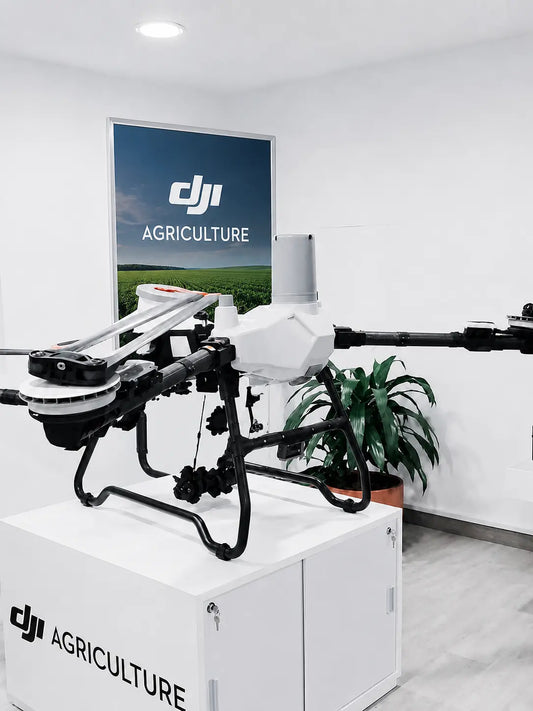
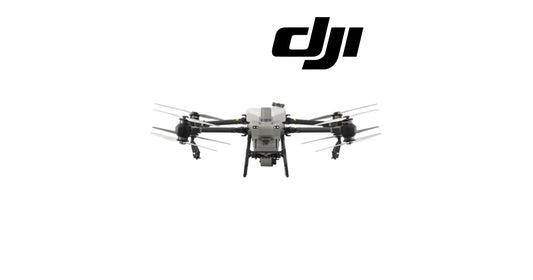
DJI Agras T55 Specifications: Complete Spray, Spread, Lift, Safety, and Power Guide
Share
The Complete DJI Agras T55 Technical Reference
The DJI Agras T55 is a professional agricultural aircraft built around three interchangeable mission systems and one unusually balanced platform. It sprays liquid, spreads granular material, and lifts suspended cargo. It carries a current-generation radar-and-vision safety system, supports automatic and recorded-path field planning, uses O4 communications, operates with a bright RC Plus 2 AG controller, and offers two battery strategies for different work.
Its headline specifications are compelling:
- 50 L spray tank and 50 kg spray operating payload;
- 40 L/min maximum flow with the standard two-sprinkler system;
- 50 L/min maximum flow with the optional four-mist-sprinkler system;
- 50–500 μm published droplet range;
- 4–11 m effective spray-width range;
- 80 L spreading tank and 55 kg spreading payload;
- up to 400 kg/min maximum spread discharge under DJI’s compound-fertilizer test condition;
- 3–10 m effective spreading width;
- five feeder choices covering approximately 0.5–10 mm materials across the range;
- 40 kg lifting operating payload;
- 10 m standard lift cable and 10–15 m recommended range;
- 45 kg published aircraft weight with DB1050;
- 48.4 kg with DB1580;
- 62-inch model 6223 carbon-fiber-composite propellers;
- millimeter-wave radar capturing up to 250,000 points per second;
- Tri-Vision awareness and obstacle recording;
- 20 Ah DB1050 standard battery and 30 Ah DB1580 endurance option; and
- 8–9 minute DB1050 30%–95% charge example with supported equipment and stated conditions.
Those numbers answer only the first layer of the buying question. “50 L” can mean tank volume, while “50 kg” means operating payload. “50 L/min” belongs to optional mist hardware, while the standard system is 40 L/min. “400 kg/min” is a maximum discharge test result, not a field prescription. “40 kg lift” includes an aircraft and environment that can cause the app to recommend less.
This guide preserves those distinctions. Every major specification is paired with what it means in the field, what configuration produces it, and what a buyer should verify in a complete package.
Ares Acres helps American farms and application businesses turn specifications into working systems. Review the DJI Agras T55 Premium Set, browse DJI Agras drones, DJI Agras parts, and DJI accessories, or contact Ares Acres to confirm current aircraft configuration, batteries, charging, payloads, relay, RTK, delivery, setup, training, and spares.
Prefer to watch first? The supplied video summarizes the T55’s central systems. Use the article below as the technical companion: it corrects transcript shorthand, separates standard and optional equipment, explains each payload number, and adds the field-system details a full-set buyer needs.
Quick Answer: What Are the Main DJI Agras T55 Specs?
The DJI Agras T55 is a 50 L spraying, 55 kg spreading, and 40 kg lifting agricultural drone. Standard spraying uses two LX09050DX centrifugal sprinklers at up to 40 L/min. Optional four LX09510DX mist sprinklers raise the maximum to 50 L/min. The DS80L spreader holds 80 L, uses screw feeders, and reaches up to 400 kg/min under the stated fertilizer condition. The DL100 lift system carries 40 kg.
The aircraft weighs 45 kg with the standard 20 Ah DB1050 battery or 48.4 kg with the optional 30 Ah DB1580 in the standard two-sprinkler configuration. It folds to 1120 × 896 × 934 mm, uses 62-inch 6223 carbon-fiber-composite propellers, supports RTK hover accuracy of ±10 cm under strong signal, and has a 2 km maximum configurable flight radius.
Its power system includes onboard battery heat management, ground air cooling, the 6.5 kW D8000iE generator, and the 7 kW three-phase-rated C7000 charger. Its controller is RC Plus 2 AG with a 7-inch 1,400 cd/m² display. Safety combines millimeter-wave radar, Tri-Vision, obstacle bypass, obstacle recording, and AR-assisted field awareness.
What This Specifications Guide Covers
- aircraft weight, dimensions, wheelbase, RTK accuracy, wind, temperature, and radius;
- motor and propeller specifications;
- every major spray tank, pump, sprinkler, flow, droplet, and swath value;
- spreader volume, payload, feeder ranges, discharge, and width;
- lift payload, cable, and operating considerations;
- DB1050 and DB1580 battery specifications;
- D8000iE and C7000 charging specifications;
- RC Plus 2 AG display, runtime, and charging;
- radar, Tri-Vision, obstacle-avoidance, and field-planning features;
- O4 Relay and D-RTK 3 AG roles;
- configuration-dependent maximum takeoff weights;
- practical productivity mathematics; and
- a complete buyer-verification checklist.
DJI Agras T55 Master Specification Table
| System | Published T55 specification | What it means |
|---|---|---|
| Aircraft weight with DB1050 | 45 kg | Standard two-sprinkler spray configuration |
| Aircraft weight with DB1580 | 48.4 kg | Longer-endurance battery adds 3.4 kg |
| Fully unfolded dimensions | 3190 × 3570 × 934 mm | Confirm clear launch and service area |
| Arms unfolded, propellers folded | 1800 × 2170 × 934 mm | Intermediate setup footprint |
| Fully folded dimensions | 1120 × 896 × 934 mm | Confirm vehicle doors, racks, and working clearance |
| Maximum diagonal wheelbase | 2415 mm | Large agricultural propulsion footprint |
| RTK hover accuracy | ±10 cm horizontal and vertical | Requires strong signal and supported RTK workflow |
| Non-RTK hover accuracy | ±0.6 m horizontal, ±0.3 m vertical | Published strong-GNSS figure |
| Maximum configurable flight radius | 2 km | Planning value, not automatic link or operating authorization |
| Operating temperature | 0–40 °C | Aircraft range; support equipment can have different ranges |
| Maximum wind resistance | 6 m/s | A system limit, not the correct wind for every application |
| Motor stator | 155 × 16 mm | T55 propulsion specification |
| Motor KV | 55 rpm/V | Do not infer motor interchangeability from propeller sharing |
| Propeller material | Carbon-fiber composite | Inspect carefully for impact and structural damage |
| Propeller size/model | 62 inch, 6223 | Shared with T70P according to DJI |
| Propeller quantity | Four pairs | Install correct direction and hardware |
| Spray tank | 50 L HDPE | Liquid volume |
| Spray operating payload | 50 kg | Mass, separate from tank volume |
| Standard sprinkler model | LX09050DX | Two multi-atomization centrifugal sprinklers |
| Optional sprinkler model | LX09510DX | Four mist sprinklers |
| Standard nozzle distance | 1800 mm | Published two-sprinkler spacing |
| Droplet range | 50–500 μm | Correct setting depends on application |
| Spray width | 4–11 m | Scene- and configuration-dependent |
| Pumps | Two magnetic-drive impeller pumps | Liquid delivery system |
| Standard max flow | 40 L/min | Two standard sprinklers |
| Optional max flow | 50 L/min | Four optional mist sprinklers |
| Spreader model | DS80L | T55-specific complete spreading system |
| Spreader volume | 80 L | Hopper volume |
| Spreading payload | 55 kg | Maximum published operating mass |
| Spreader delivery | Screw feeder to centrifugal disc | Feeder and disc determine metering/distribution |
| Maximum spread discharge | 400 kg/min | Compound-fertilizer test condition |
| Spread width | 3–10 m | Material and operating condition dependent |
| Feeder coverage | Approximately 0.5–10 mm across choices | Use material-specific feeder |
| Lift model | DL100 | T55 lifting system |
| Lift payload | 40 kg | Current recommended load can be lower |
| Standard lift cable | 10 m | Include hook/rope basis per DJI guidance |
| Recommended cable range | 10–15 m | Cable length affects swing and entanglement |
| DB1050 capacity | 20,000 mAh | Standard battery |
| DB1050 voltage/weight | 52.5 V / 8.3 kg | Light routine field pack |
| DB1580 capacity | 30,000 mAh | Endurance option |
| DB1580 voltage/weight | 52 V / 11.7 kg | Adds capacity and mass |
| D8000iE recharge output | 6.5 kW | Field generator charging output |
| D8000iE fuel tank/weight | 20 L / approximately 46 kg | Portable relative to larger Agras generators |
| C7000 maximum rated power | 7 kW on listed three-phase input | Listed single-phase output is lower |
| DB1050 fast-charge example | 30%–95% in 8–9 minutes | Supported equipment and stated conditions |
| Controller | RC Plus 2 AG, TKPL 2 | Compatible with T55/T70P/T100 per T55 FAQ |
| Controller display | 7 in, 1920 × 1200, 1,400 cd/m² | High-brightness field screen |
| Controller internal runtime | 3.8 hours | Stated DJI test condition |
| Controller external runtime | 3.2 hours | Optional external battery |
| Radar measurement range | Up to 60 m published system value | Environment and target dependent |
| Effective safe bypass speed | Up to 13.8 m/s under DJI conditions | Not a universal route speed |
| Stable-hover safe distance | 2.5 m published condition | Obstacle geometry affects behavior |
1. Correct Model Name and Product Position
The correct name is DJI Agras T55. Speech recognition can render the transcript as “DJI AAST 55” or “AAS T-55,” but Agras is DJI’s agricultural drone brand and T55 is the model.
T55 sits between the earlier T50 class and current T70P/T100 capacity classes. Its identity is not just “50 liters.” It combines high maximum flow, serious spreading, dedicated lifting, modern safety, a small standard battery, and one-pilot handling.
DJI globally introduced T55 in 2026 alongside larger current-generation agricultural platforms. DJI states that products are available only in selected countries and regions and directs customers to authorized local dealers. A specifications page should therefore avoid promising permanent inventory or a universal package.
The Ares Acres T55 Premium Set is the appropriate source for current commercial configuration, while official DJI specifications remain the technical source. Both should be checked immediately before publication.
2. Aircraft Weight
DJI publishes 45 kg with DB1050 and 48.4 kg with DB1580 in the standard configuration consisting of two nozzles, the 50 L tank, and the listed battery.
The 3.4 kg difference equals the published battery-weight difference between DB1050 and DB1580. This makes battery choice visible in aircraft handling and maximum takeoff configuration.
Aircraft weight is not maximum takeoff weight. A 45 kg aircraft plus 50 kg liquid reaches 95 kg, aligning with DJI’s standard DB1050 maximum spraying takeoff figure. Optional four-nozzle hardware raises the published aircraft configuration mass and the corresponding maximum.
Do not use the 45 kg number to describe a fully loaded T55. It is the battery-installed aircraft in the stated standard spray configuration before liquid payload.
The low published weight is significant because T55 carries 10 L more than T50 while remaining lighter in DJI’s battery-installed standard figures. It supports solo transport but does not make poor lifting posture or loaded-aircraft movement safe.
3. Maximum Takeoff Weight by Configuration
With DB1050 installed, DJI publishes:
| T55 configuration with DB1050 | Maximum takeoff weight |
|---|---|
| Standard spraying, two nozzles | 95 kg |
| Optional spraying, four nozzles | 99 kg |
| Spreading | 104 kg |
| Lifting | 84 kg |
With DB1580 installed, DJI publishes:
| T55 configuration with DB1580 | Maximum takeoff weight |
|---|---|
| Standard spraying, two nozzles | 99 kg |
| Optional spraying, four nozzles | 103 kg |
| Spreading | 108 kg |
| Lifting | 89 kg |
These figures show why a single “T55 max takeoff weight” is incomplete. Battery and payload hardware change the number.
They are also maximums, not automatic load recommendations. DJI’s app can recommend a payload based on aircraft state, environment, and task. Elevation, temperature, wind, climb, cargo behavior, battery, and equipment condition matter.
For lifting, the operating payload is 40 kg even though the maximum takeoff arithmetic includes aircraft and lift-system configuration. Cargo, rope, hook, and installed hardware must be handled according to the current documentation.
4. Dimensions and Folding
The T55 measures 3190 × 3570 × 934 mm with arms and propellers unfolded. With arms unfolded and propellers folded, it measures 1800 × 2170 × 934 mm. Fully folded, it measures 1120 × 896 × 934 mm.
All three states matter:
- fully folded determines door, vehicle bay, rack, and storage fit;
- arms unfolded with propellers folded determines service and staging clearance; and
- fully unfolded determines launch, inspection, personnel, and obstacle clearance.
A vehicle should be measured with real tie-downs, payload modules, battery racks, cooling, generator, water, material, tools, and operator aisle included. A folded aircraft fitting through the door does not prove the entire field system fits.
The 896 mm folded width is one of T55’s strongest physical specifications. It is much narrower than T100 and nearly identical to T70P, helping enclosed transport and one-pilot dispatch.
5. Wheelbase, Motors, and Propellers
T55’s maximum diagonal wheelbase is 2415 mm. Its motors list a 155 × 16 mm stator and 55 rpm/V KV. It uses four pairs of 62-inch carbon-fiber-composite propellers.
The propeller model is 6223. DJI confirms compatibility with T70P. This creates a useful spare-parts relationship for a mixed current-generation fleet.
Propeller compatibility does not imply motor compatibility. T70P publishes a different motor specification. Install only the correct aircraft motor, direction, fasteners, propeller, and firmware-supported parts.
Carbon-fiber-composite propellers offer stiffness and efficiency, but damage can be serious. Inspect edges, surfaces, roots, hubs, fasteners, direction, tracking, contamination, cracks, impact marks, and abnormal vibration.
Agricultural residue should be removed using the approved process. Fertilizer dust and chemical film can hide defects, alter balance, and reach motors or structural joints.
6. Positioning and Hover Accuracy
With strong GNSS signal and RTK enabled, DJI publishes ±10 cm horizontal and ±10 cm vertical hover accuracy. Without RTK, it publishes ±0.6 m horizontal and ±0.3 m vertical.
These are hovering-accuracy specifications, not guarantees that every point in a complex field is known to that precision. Correction quality, satellite geometry, obstruction, multipath, antenna condition, base-station setup, network service, and environment matter.
D-RTK 3 AG can support a local precision workflow. Network RTK may also be available depending on service and region. A complete system should match the positioning method to the customer area.
RTK accuracy supports repeatable boundaries, routes, swaths, and obstacle relationships. It does not replace an accurate field survey or pilot review.
7. Flight Radius, Temperature, and Wind
DJI publishes a maximum configurable flight radius of 2 km. This is a software planning value. It is not the same as guaranteed O4 range, suitable visibility, legal distance, or safe connection route.
The aircraft operating-temperature range is 0–40 °C. Batteries, generators, chargers, controllers, relay, RTK, liquids, and personnel can have separate constraints. A job must fit the strictest applicable component and material requirement.
Maximum wind resistance is published at 6 m/s. Application wind should be selected from the product label, crop, droplet, drift plan, route, terrain, and local requirements. A flight-control limit does not declare a 6 m/s spray application appropriate.
Lift work can be more sensitive because a suspended load presents swing and windward area. DJI advises against large wind-facing loads and strong-wind lifting.
8. Spray Tank: 50 Liters and 50 Kilograms
The HDPE spray tank holds 50 L. The spraying system operating payload is 50 kg.
Volume and mass are closely aligned when the liquid density is near water, but they are not interchangeable definitions. Product mixtures can have different density. Use the current loading and product procedure rather than assuming every 50 L mixture weighs exactly 50 kg.
Tank capacity determines theoretical area per load. At 2 gallons per acre, 50 L represents approximately 6.60 acres before operational effects. At 5 gallons per acre, it represents approximately 2.64 acres.
The actual route may end with liquid remaining, or battery and environment may cause a return before the tank is empty. Payload utilization should be measured over real jobs.
The tank is part of a liquid path that includes fill opening, filtration, pumps, hoses, valves, flow sensing or control, sprinklers, drains, seals, and cleaning. A complete maintenance plan includes all of them.
9. Standard Sprinklers and 40 Liters per Minute
Standard T55 spraying uses two LX09050DX multi-atomization centrifugal sprinklers positioned 1800 mm apart. Two magnetic-drive impeller pumps deliver up to 40 L/min total.
This is the standard maximum. The transcript’s 50 L/min headline belongs to optional hardware.
Forty liters per minute is a very high ceiling for a 50 L aircraft. It allows the system to meet demanding combinations of rate, speed, and swath without automatically slowing because of pump capacity.
Maximum flow is not normal flow. The operator selects an application volume and route that produce the required result. Running at the maximum would theoretically empty 50 L in 1.25 minutes, showing why ground support becomes important.
The standard system may be the best configuration for broad-acre and routine work because it combines high flow with fewer sprinklers and the standard aircraft layout. Optional hardware should be purchased for a defined need.
10. Optional Mist Sprinklers and 50 Liters per Minute
The optional configuration uses four LX09510DX mist sprinklers and raises maximum total flow to 50 L/min. DJI positions it for high-volume and canopy-oriented applications.
The number must always be published with “optional.” A bare or standard T55 package does not automatically include the four sprinklers, related mounting, setup, calibration, or spares.
At the maximum ceiling, 50 L of tank volume equals one theoretical minute of delivery. Actual routes will usually use less, but the relationship emphasizes that the mist system is about delivery capacity rather than extended tank duration.
The optional package can be valuable in corn, sugarcane, orchards, and other dense crops when the verified application demands high flow and appropriate droplet. Penetration still depends on downwash, droplet, height, speed, canopy, row, weather, and deposit.
Buyers should verify package contents, installation, firmware, pump and nozzle support, calibration, training, and replacement sprinklers.
11. Droplet Range: 50–500 Microns
DJI publishes a 50–500 μm droplet range. This broad range supports different targets and application plans.
Smaller is not automatically better. Fine droplets can increase coverage count but can also be more affected by wind, evaporation, and off-target movement. Larger droplets can reduce drift potential but may change coverage and canopy behavior.
The correct selection follows product directions, target, crop, canopy, weather, drift plan, rate, height, speed, sprinkler configuration, and field verification.
Droplet setting should not be transferred blindly from T50, T70P, or T100. Even when the published range matches, nozzle models, placement, flow, propulsion, and aircraft behavior differ.
12. Spray Width: 4–11 Meters
The published effective spray-width range is 4–11 m. It depends on the actual working scene.
Width affects pass count and required flow. A wider swath covers more area per pass but can demand more total liquid per minute at a given rate and speed. It can also change overlap and deposit.
Required flow in L/min equals application rate in L/ha multiplied by speed in km/h and width in meters, divided by 600.
At 50 L/ha, 36 km/h, and 10 m, the requirement is 30 L/min. At 60 L/ha with the same speed and width, it is 36 L/min. Both fit within T55’s 40 L/min standard maximum on paper.
The equation screens pump demand; it does not validate the application. Confirm the effective width and deposit under real conditions.
13. Spray Productivity and Ground Support
T55’s airborne productivity can be limited by liquid supply, fill transfer, battery cooling, charging, route reset, or inspection before it is limited by the aircraft.
A high-flow route may return in only a few minutes. The next load should be measured and ready without compromising mixing order, containment, label directions, or records.
The full cycle is:
- prepare aircraft and route;
- mix and stage liquid;
- load and install battery;
- launch and apply;
- land and inspect;
- refill and exchange battery;
- cool and charge the returned pack; and
- restart.
The slowest repeated step determines throughput. A 50 L/min pump paired with a ten-minute fill process cannot deliver continuous high-rate production.
14. DS80L Spreading Tank: 80 Liters and 55 Kilograms
The T55 DS80L spreading system holds 80 L and has a 55 kg operating payload. The separate volume and mass values matter because granular materials have different bulk density.
A dense fertilizer may reach 55 kg before filling 80 L. A low-density seed or feed may fill the hopper before reaching 55 kg. The operator must respect both the physical volume and supported mass.
The 55 kg payload can align with common bag-based fertilizer handling and substantially exceeds the 50 kg T50 spreading payload. It gives T55 a serious second mission rather than a small accessory role.
The spreader uses a screw feeder to meter material toward a centrifugal disc. The feeder controls delivery; the disc and operating setup distribute it. Weighing feedback supports payload indication and calibration-oriented control.
The DS80L is specific to T55. DJI states that the complete spreader is not compatible with T70P, T100, or T25P, even though certain screw feeders are compatible with T70P and T100.
15. Maximum Spreading Discharge: 400 Kilograms per Minute
DJI publishes a maximum discharge rate of 400 kg/min under a compound-fertilizer test condition. This is a system-capability ceiling, not a suggested field application rate.
At maximum theoretical discharge, a 55 kg load would leave the hopper in less than nine seconds. Real field settings use the target mass per area, speed, swath, material behavior, and uniformity.
The value matters because it provides headroom for high-rate work. If a spreader cannot meter material fast enough, the aircraft must slow to maintain target rate. T55’s discharge capacity reduces the likelihood that the metering system becomes the bottleneck for supported materials.
The maximum can change with material. Particle size, density, shape, moisture, bridging, feeder, and disc determine flow. Compound fertilizer test performance should not be assumed for seed or feed.
16. Spreading Width: 3–10 Meters
T55 publishes an effective spreading-width range of 3–10 m. Width varies with material, feeder, disc speed, height, aircraft speed, wind, density, particle shape, and uniformity requirement.
A wider path reduces passes but can reduce uniformity if the material or setting does not support it. The correct width comes from a field pattern or other appropriate validation.
Rate mathematics follows the same principle as spraying. Required material mass per minute depends on target kilograms per hectare, speed, and width. The selected feeder must move that mass consistently.
Field edges and sensitive areas may require different routing or settings. Granular drift and bounce deserve the same planning attention as liquid off-target movement.
17. Five Screw-Feeder Choices
DJI publishes two standard feeder choices and three optional choices for T55:
| Feeder | Published material range and examples |
|---|---|
| Extra-large, standard | 0.5–10 mm granules; fertilizer, wheat, feed, and similar materials |
| Medium, standard | 4–6 mm; rice |
| Large, optional | 4–10 mm; rice and fertilizer |
| Small-medium, optional | 0.5–2 mm pellets; certain crayfish and prawn feed |
| Small, optional | 0.5–4 mm; rapeseed and supported granular products |
The published ranges overlap because diameter is not the only variable. Rate, particle shape, material fragility, density, and desired precision affect feeder choice.
A buyer should list every intended material, typical rate, diameter range, density, and annual tonnage before ordering. That list determines whether standard feeders are sufficient.
DJI states that T55 feeders are compatible with T70P and T100. Confirm exact part number and use; the complete spreading systems remain separate.
18. Calibration-Free Language and Operation Templates
The video describes calibration-free spreading and instant templates. The practical meaning is that weighing feedback, automatic flow calibration, and stored operating templates reduce repetitive manual setup.
An operator can create or recall a verified configuration for a familiar fertilizer, seed, or feed. That improves repeatability and reduces setup time.
Physical material still changes. Moisture, supplier, lot, storage, damage, dust, temperature, feeder wear, and contamination can alter flow. The operator should verify that the recalled template still matches the current material and desired field result.
Templates should use clear names containing material, lot or supplier where useful, feeder, rate, width, and date. Cloud or controller storage should be backed by fleet records so the setup remains understandable after staff or firmware changes.
19. Spread-Disc Removal
DJI’s T55 FAQ states that the spreading system can discharge material after the spreader disc is removed. That can support specialized uses where directed discharge is desired, such as certain aquaculture or row applications.
This is not a universal recommendation for every material. The operator must confirm configuration, route, target, material behavior, and current documentation.
Removing the disc changes distribution from broadcast spreading to a more directed release. Width, downwash interaction, fall pattern, and target placement change accordingly.
20. DL100 Lifting System: 40 Kilograms
The T55 DL100 lifting system has a 40 kg operating payload. It turns the aircraft into a controlled suspended-load platform for suitable farm and logistics tasks.
DJI describes automatic operation functions, Auto Balance Control, cargo obstacle avoidance, and emergency cable release. These features can reduce workload and support response when a load behaves unexpectedly.
The 40 kg number should be treated as a maximum published operating payload. The app may recommend less based on aircraft, environment, and task. Cargo shape, windward area, center of gravity, rigging, swing, climb, route, and destination matter.
The lifting specification opens a third service category. It may support movement over wet ground, slopes, orchard rows, remote sites, or other areas where ground vehicles are inefficient.
The business case should use recurring loads. A feature used occasionally may add utility, while regular 20–40 kg logistics can create meaningful labor or service value.
21. Lift Cable: 10 Meters Standard, 10–15 Meters Recommended
DL100 includes a 10 m cable. DJI recommends selecting a cable length within 10–15 m.
A cable that is too short can allow increased swing to bring cargo toward the propellers. A cable that is too long can allow the cargo to contact the ground or the cable to become entangled with trees or wires.
Cable selection should consider load height, route clearance, aircraft separation, destination, obstacles, and swing. Longer is not automatically safer.
Inspect cable, hook, connection, release system, wear, deformation, contamination, and security before every lift. Retire damaged components according to current guidance.
22. Lift Load Shape, Rigging, and Wind
DJI advises against overloaded cargo and large wind-facing loads. A light but broad panel can be more difficult than a compact heavier bag because aerodynamic force and swing change.
Rigging should place the center of gravity predictably beneath the aircraft. Unbalanced or shifting contents can defeat stable control. Auto Balance assists; it does not fix improper load preparation.
The route should avoid people, vehicles, livestock, buildings, lines, trees, and other hazards. Establish exclusion zones at pickup and destination. Ground personnel need clear communication and should not stand beneath suspended cargo.
Emergency release must be understood before launch. Releasing cargo can protect the aircraft but creates a falling-load hazard. The route should include areas where an emergency response does not transfer risk to people or property.
23. Millimeter-Wave Radar
T55 uses a new-generation millimeter-wave radar. DJI and the supplied video describe capture of up to 250,000 points per second and significantly enhanced power-line detection.
The radar supports obstacle sensing, braking, bypass, and terrain-related awareness. DJI publishes system measurement up to 60 m under applicable conditions and an effective safe bypass speed up to 13.8 m/s in its stated framework.
Radar performance depends on target material, shape, position, angle, environment, rain, fog, contamination, and speed. A wire remains a difficult linear obstacle even when detection improves.
The radar surface must remain clean and free from obstruction or metal stickers. Fertilizer dust, chemical film, mud, and debris can reduce performance.
24. Tri-Vision System
Tri-Vision provides visual sensing around the aircraft and supports 360-degree horizontal detection of pedestrians and vehicles during takeoff and landing according to DJI’s product description.
Vision adds scene information that radar alone cannot provide in the same way. It supports environmental awareness, obstacle interpretation, and AR displays.
Vision depends on adequate light and discernible surroundings. DJI warns that dirty sensors or nighttime operation can cause the aircraft to rely more heavily on radar, reducing some terrain-following or bypass performance.
Camera windows should be inspected and cleaned without scratching. The operator should confirm clear views before trusting visual features.
25. Obstacle Bypass, Braking, and Safe Distance
T55 can execute automatic obstacle bypass under supported conditions. DJI publishes a 2.5 m distance between aircraft and obstacle after braking and stable hovering within its specification framework, along with minimum effective avoidance height information.
These are test-defined values, not a universal promise. Thin lines, moving objects, branches, dead vegetation, reflective surfaces, terrain, light, weather, and route geometry can change behavior.
The pilot should set conservative parameters, mark obstacles, inspect the site, and be ready to pause or intervene. Avoidance expands the safety layer; it does not transfer responsibility to the sensor.
26. Obstacle Recording
T55 can detect and save supported obstacle types during field planning. DJI describes the aircraft as becoming safer with every flight because accumulated data can inform later routes.
Saved obstacle data provides continuity. A contractor can return to a field without rebuilding every hazard from memory, and another trained pilot can inherit a more complete file.
Data still requires review. A saved pole may remain while its wire geometry changes. Temporary equipment can appear. Trees grow. Boundaries and access move.
Maintain field-file ownership, revision dates, notes, and pre-job confirmation. Data quality becomes a fleet asset when it is deliberately managed.
27. Path Recording
Path recording allows the pilot to fly a loop around a field so the system can create a field plan and record supported obstacles. It reduces dependence on a separate mapping flight in suitable scenarios.
The value is greatest for new customer blocks and smaller operations where mapping friction delays automation. A single intuitive loop can convert local pilot knowledge into a reusable field file.
Generated boundaries, exclusions, obstacles, start point, connection route, turns, height, speed, width, refill behavior, and return behavior must still be reviewed.
Fast field creation should create more time for review, not less.
28. AR Display Features
The RC display can present augmented-reality field boundaries, obstacle information, routes, and safety cues in relation to the camera view.
AR can help the pilot understand abstract map data in the visible scene. It is especially useful at takeoff, landing, route connection, and obstacle areas.
An overlay is only as accurate as the field data, positioning, sensors, orientation, and software state supporting it. The pilot should cross-check AR with direct observation and the plan.
29. DB1050 Intelligent Flight Battery
DB1050 is the standard T55 battery:
- capacity: 20,000 mAh;
- nominal voltage: 52.5 V; and
- weight: 8.3 ±0.3 kg.
Its low mass is central to T55’s handling strategy. It provides sufficient endurance for many routine operations, particularly when a 50 L tank empties before a larger battery would be used.
The battery also reduces energy per recharge compared with larger packs. When cooling and charging keep pace, a compact rotation can support continuous work.
Use DB1050 when job duration aligns with its energy and the priority is light handling. Do not select it merely because it is standard if low-rate or long-ferry missions routinely return with payload remaining.
30. DB1580 Intelligent Flight Battery
DB1580 is the higher-endurance option:
- capacity: 30,000 mAh;
- nominal voltage: 52 V; and
- weight: 11.7 ±0.3 kg.
It adds 10 Ah and 3.4 kg over DB1050. DJI identifies it for longer single-flight needs, including certain high-altitude or low-application-rate scenarios.
DB1580 is also used in the T70P ecosystem and supported by several current charging devices. This can improve fleet commonality.
The larger battery should be justified by useful flight duration. If a high-flow route empties the tank first, DB1050 may preserve handling efficiency.
31. Battery Interface Generation
DJI explains that agricultural batteries from the T70P generation use a columnar interface, while earlier products used a blade interface. T55 belongs to the current columnar family.
Charging current-generation batteries with older equipment or older batteries with new equipment can require a dedicated approved adapter cable. Compatibility must be confirmed by exact battery, charger, generator, interface, cable, and firmware.
Never improvise a connection or assume similar voltage makes equipment compatible. Agricultural battery systems carry high current and require approved hardware.
32. Onboard Battery Heat Sink
T55 adds an onboard heat sink and redesigned air channel so battery cooling begins during flight. This can lower thermal waiting after landing.
The feature is important because high-tempo applications can return a battery before it is thermally ready for maximum charging. A hot pack can become the system bottleneck.
Cooling performance depends on clean airflow, ambient temperature, pack health, route, load, and fan or heat-sink condition. Residue and dust should not obstruct the system.
33. Ground Air-Cooled Heat Sink
On the ground, an additional air-cooled heat sink continues battery cooling. The field layout should place it in shade with clear airflow and away from chemical splash, granular dust, exhaust, and direct sun.
A battery rotation should be tested under hot realistic conditions. One pack may fly, one cool, and one charge, but the required count depends on cycle time.
Cooling equipment is mission-critical. Inspect cables, fans, ducts, contacts, and airflow. Carry approved service items where downtime would be costly.
34. D8000iE Multifunctional Inverter Generator
D8000iE publishes:
- DC recharge output: 42–61.6 V, up to 6.5 kW;
- air-cooled radiator output;
- separate 48 V/500 W DC output;
- 20 L fuel tank;
- approximately 46 kg weight;
- one-button starting; and
- compatibility with DB1050, DB1580, and DB2160.
DJI lists an 8–9 minute DB1050 charge from 30% to 95% under stated sea-level, temperature, input, and battery conditions.
The generator’s relatively low weight supports the T55 portable field system. It still requires ventilation, exhaust control, appropriate fuel, oil, service, fire precautions, and placement away from liquids and people.
It does not accept mains input as a charger. Use the appropriate separate power supply for grid charging.
35. C7000 Smart Charger
C7000 publishes:
- single-phase input: 220–240 V;
- three-phase input: 380–480 V;
- output: 50–62 V;
- rated current: 40 A single phase and 140 A three phase;
- rated power: 2 kW single phase and 7 kW at listed three-phase input;
- approximately 8.5 kg weight; and
- compatibility with DB1050, DB1580, and DB2160.
The 8–9 minute DB1050 example relies on adequate input and stated conditions. A normal single-phase outlet will not produce the 7 kW three-phase result.
DJI recommends a three-phase generator rated at 10,000 W or above for the C7000 high-output workflow. Electrical installation should be verified by qualified personnel.
36. RC Plus 2 AG Controller
The TKPL 2 controller has:
- 7-inch LCD touchscreen;
- 1920 × 1200 resolution;
- 1,400 cd/m² brightness;
- 3.8-hour internal battery runtime;
- 3.2-hour external battery runtime;
- USB-C charging up to the supported 65 W specification; and
- approximately two-hour charge time under DJI’s stated powered-off setup.
The external battery is optional. The RTK high-precision positioning module is not automatically included as a standard controller accessory.
DJI’s T55 FAQ states that the controller is compatible with T70P and T100. Confirm exact regional model, firmware, binding, and accessories.
The bright display supports sunlight viewing, but heat, glare, dirt, and poor mounting can still interfere. Keep the controller shaded where practical and preserve antenna orientation.
37. O4 Video Transmission
T55 uses DJI’s O4 communication environment. The supplied video describes up to a 2 km transmission range, while the specification also lists a 2 km maximum configurable flight radius.
Transmission depends on regional standard, interference, obstructions, antenna orientation, aircraft height, terrain, relay use, and environment. A configuration number is not a guaranteed link.
O4 improves integration with current controller and relay hardware. The pilot should still monitor link quality and design conservative connection routes.
38. O4 Relay
An optional O4 Relay can improve communication geometry when trees, terrain, orchards, or structures obstruct a direct path.
Relay placement should provide clear relationships to both controller and aircraft. Battery runtime, elevation, antenna orientation, environmental protection, and security matter.
Do not add a relay solely because it is advanced. Add it when site analysis shows a communication problem it can solve.
39. D-RTK 3 AG
D-RTK 3 AG supports high-precision positioning and current O4 broadcast workflows. It can serve as a base or positioning component depending on the supported mode and region.
Accuracy depends on stable setup, open sky, satellites, multipath, corrections, atmospheric conditions, and distance. A tripod disturbed during work can compromise the field.
The complete quote should identify whether D-RTK hardware and controller RTK module are included or optional.
40. Ingress, Cleaning, and Field Environment
Agricultural work exposes the aircraft to liquid, dust, fertilizer, seed treatment, mud, heat, vibration, and transport impact. A technical specification does not eliminate cleaning and inspection.
After spraying, inspect and clean tank, filters, pumps, hoses, valves, sprinklers, frame, landing gear, sensors, and surfaces using the supported process. Manage rinse material appropriately.
After spreading, remove granular residue from hopper, feeder, disc, weighing areas, motors, structure, cooling paths, radar, cameras, and electrical zones. Fertilizer is especially corrosive.
After lifting, inspect cable, hook, release, mount, frame, and any contact or swing event.
41. Parts Commonality
DJI confirms:
- T55 and T70P use the same 6223 propellers;
- T55 screw feeders are compatible with T70P and T100;
- T55 RC Plus 2 AG controller is compatible with T70P and T100;
- DB1580 participates in the T55/T70P current family; and
- D8000iE and C7000 list compatibility across DB1050, DB1580, and DB2160.
DJI also confirms that the complete T55 spreader is not compatible with T70P or T100. Shared families should never be extended beyond explicit evidence.
Maintain a parts ledger with exact model, part number, compatible aircraft, direction, firmware or adapter requirement, stock count, and reorder point.
42. Recommended Starter Spares
A working set should consider verified spares for:
- 6223 propellers and correct installation hardware;
- standard or optional sprinklers actually installed;
- filters, seals, hoses, and supported liquid-path wear items;
- feeder types used for the planned materials;
- spread-disc and metering service items;
- lift cable, hook, or release items where approved;
- battery cooling service items;
- controller and accessory charging;
- approved adapter cables; and
- cleaning and inspection supplies.
The correct list depends on DJI’s service parts catalog, package, and local support. Do not stock visually similar parts without confirmed fitment.
43. Full-Set Specification Checklist
Before ordering, confirm:
- aircraft regional configuration;
- standard two-sprinkler spray system;
- whether optional four-mist hardware is included;
- DB1050 or DB1580 battery model and quantity;
- D8000iE or C7000 and actual charging input;
- ground cooling hardware;
- DS80L spreader;
- included standard and optional feeders;
- DL100 lift system and cable;
- RC Plus 2 AG, external battery, and RTK module;
- O4 Relay and D-RTK 3 AG if required;
- tools, spares, and cleaning equipment;
- delivery and transport requirements;
- setup, calibration, training, and commissioning;
- warranty and service process; and
- current price, availability, and lead time for every component.
44. How to Read Maximum Specifications Responsibly
Maximum means capability under stated conditions. It does not mean recommended everyday use.
The 50 L tank can be loaded below 50 L. The 55 kg spreader can carry less. The 40 kg lift system can receive a lower app recommendation. The 50 L/min flow belongs to optional hardware. The 400 kg/min discharge belongs to a test condition. The 11 m spray and 10 m spread widths depend on the scene.
Good technical content keeps those qualifications close to the number. Good operations keep current manuals, app recommendations, product directions, environmental conditions, and field verification above marketing shorthand.
45. Converting Spray Specifications Into Acres per Load
To estimate theoretical acres per 50 L load, convert the application volume to liters per acre and divide 50 by that value. One U.S. gallon equals approximately 3.785 L.
| Application volume | Liters per acre | Theoretical acres from 50 L |
|---|---|---|
| 1 gal/acre | 3.785 | 13.21 |
| 2 gal/acre | 7.571 | 6.60 |
| 3 gal/acre | 11.356 | 4.40 |
| 4 gal/acre | 15.142 | 3.30 |
| 5 gal/acre | 18.927 | 2.64 |
These are tank-volume calculations, not guaranteed field coverage. Reserve, incomplete routes, remaining liquid, ferry distance, turns, wind, battery state, and the app’s recommended load affect the mission.
The table helps decide whether 50 L is right-sized. If typical blocks require 35–48 L, T55 can finish them without carrying unused flagship capacity. If every route requires 80 L, T55 will need planned refill cycles and should be compared with T70P or T100.
Flow must be checked separately. A tank may contain enough liquid for the field while the required L/min exceeds the chosen sprinkler configuration. Capacity answers “how long”; flow answers “how intensely.”
46. Converting Spread Specifications Into Area per Load
Theoretical area from one 55 kg load equals 55 divided by target kilograms per hectare.
| Target rate | Theoretical hectares per 55 kg load |
|---|---|
| 25 kg/ha | 2.20 |
| 50 kg/ha | 1.10 |
| 100 kg/ha | 0.55 |
| 150 kg/ha | 0.37 |
| 200 kg/ha | 0.275 |
Actual area depends on measured load, residual material, route, boundaries, overlap, feeder, and uniformity. Hopper volume can limit low-density material before the 55 kg mass is reached.
Maximum required discharge can be estimated from rate, speed, and width. A high target rate at high speed and broad width demands more kilograms per minute. T55’s 400 kg/min maximum provides substantial headroom, but the selected feeder and actual material must support the required delivery.
47. Selecting DB1050 or DB1580 From Mission Data
Begin with payload utilization and landing state. If the T55 repeatedly empties its 50 L tank while DB1050 retains appropriate energy, the standard battery is aligned with the spray cycle. A larger pack would add mass without reducing refills.
If low-rate work, long ferry, elevation, or route complexity returns the aircraft because of battery state while useful payload remains, DB1580 may improve the mission. The decision should use several representative flights, not one windy day.
For spreading, compare whether 55 kg is discharged before DB1050 reaches return criteria. For lifting, evaluate endurance with the actual compact load and route; do not use maximum-payload testing as the only reference.
Battery strategy also includes charging. DB1580 contains more energy and can change generator or charger time. A mixed rotation must keep packs clearly identified and settings controlled.
48. Matching the T55 to Crop and Service Categories
T55’s specification balance supports several affirmative roles:
- broad-acre spraying where 50 L routes and 4–11 m verified widths fit;
- higher-volume work where 40 L/min standard flow prevents rate limitation;
- orchard or dense-canopy work using the optional 50 L/min mist system when validated;
- fertilizer and seed spreading within 55 kg and the selected feeder range;
- aquaculture-feed or directed-discharge tasks with supported material and configuration;
- 40 kg-class farm logistics and lifting;
- one-pilot dispatch among scattered customer blocks; and
- mixed current-generation fleets using confirmed shared components.
The aircraft should not be described as ideal for every crop. Crop fit depends on label, product, rate, canopy, deposit, weather, local requirements, and operator competency. Specifications establish the operating envelope; agronomic validation chooses the application.
49. A T55 Technical Acceptance Test
At delivery or commissioning, record the exact aircraft serial, firmware, payload modules, battery models, charger or generator, controller, relay, RTK, sprinkler models, feeders, cables, and spare parts.
Inspect transport condition, arms, locks, landing gear, motors, propellers, tank, hoses, pumps, sprinklers, spreader, scale, disc, feeders, lift mount, cable, hook, sensors, battery contacts, cooling, and controller.
Complete supported functional checks:
- power and controller pairing;
- RTK or positioning workflow;
- field creation and path recording;
- obstacle and route display;
- standard and optional spray configuration present;
- flow and liquid-path integrity;
- spreader weighing and feeder identification;
- lift controls and emergency-release understanding;
- battery cooling and charging;
- controller runtime accessories; and
- records, manuals, training, warranty, and service contacts.
Acceptance testing should identify missing parts before the season. It should not become an unsupervised maximum-payload demonstration.
50. Annual Technical Review
After one season, compare actual data with the specifications. Track average liquid load, peak flow demand, verified swath, spread mass, feeder use, lift mass, battery landing state, battery temperature, charge time, generator hours, fuel, controller runtime, obstacle interventions, parts consumption, and downtime.
If average liquid load remains below 30 L, dispatch and route planning may matter more than tank capacity. If standard flow repeatedly approaches 40 L/min, optional hardware or route review may be relevant. If DB1050 consistently returns at an appropriate state after empty tanks, the standard battery is performing its intended role.
If spreading jobs consistently fill by volume before mass, material density and hopper class should inform the next fleet addition. If lift work frequently approaches 40 kg, rigging, environment, and a larger aircraft option should be evaluated rather than normalizing maximum operation.
The annual review protects the accuracy of future content as well as the fleet. Published specifications stay constant until DJI revises them, but real operating assumptions should improve with evidence.
51. Specification-to-Purchase Decision Matrix
The technical sheet becomes more useful when every major number is connected to a purchase decision:
| Published specification | Purchase question | Package item to verify |
|---|---|---|
| 50 L / 50 kg spraying | Does one load complete the normal route? | Standard tank, filters, pumps, fill workflow |
| 40 L/min standard flow | Do planned rate, speed, and width stay within this ceiling? | Two LX09050DX sprinklers and service parts |
| 50 L/min optional flow | Is verified high-volume or canopy work part of the business? | Four LX09510DX mist sprinklers, installation, calibration |
| 50–500 μm | Which droplet settings are appropriate for actual applications? | Correct sprinklers, training, verification materials |
| 4–11 m spray width | What width can be validated on the target crops? | Field-planning workflow and deposit checks |
| 80 L / 55 kg spreading | Does the hopper fit material density, packaging, and route? | DS80L, scale, loading equipment |
| 400 kg/min maximum | Is the system rate-limited on high-rate fertilizer work? | Correct feeder and verified material |
| Five feeder choices | Which materials and particle ranges will be sold or used? | Standard and optional feeders by exact part |
| 40 kg lifting | Are recurring loads within capacity after rigging basis? | DL100, cable, hook, emergency-release training |
| DB1050, 20 Ah | Does tank or route end before battery becomes limiting? | Battery count, cooling, D8000iE/C7000 |
| DB1580, 30 Ah | Do low-rate, long, or altitude missions need more energy? | Larger packs and compatible charge plan |
| 8–9 minute example | Can actual field power and temperature reproduce the cycle? | Generator or three-phase input, cooling, cables |
| 1120 × 896 × 934 mm folded | Does the entire system fit the vehicle safely? | Aircraft bay, ramp, tie-downs, service clearance |
| 60 m sensing value | Are obstacles inspected and recorded beyond sensor assumptions? | Clean sensors, field data, pilot procedure |
| RC Plus 2 AG | Will controller, external battery, RTK, and relay meet the day? | Exact controller package and accessories |
The matrix prevents a common purchasing error: paying for a capability while omitting the hardware that produces it. A quoted T55 does not automatically include optional mist sprinklers, every feeder, DL100, external controller battery, O4 Relay, or D-RTK 3 AG.
It also prevents the opposite error: adding every option when the work does not need it. A broad-acre operator with standard-flow routes and no lift demand may be better served by more batteries, cooling, and critical spray spares than by an unused lift module.
52. Specification Claims That Should Never Be Collapsed
Several T55 facts are close enough to be confused in marketing copy. Keep them separate:
“The T55 sprays at 50 L/min” is incomplete. Publish “up to 40 L/min standard or up to 50 L/min with the optional four-mist-sprinkler system.”
“The T55 holds 80 kg of fertilizer” is incorrect. The spreader holds 80 L by volume and has a 55 kg operating payload by mass.
“The T55 carries 50 kg” is ambiguous. It carries 50 kg in the spray system, 55 kg in the spread system, and 40 kg in the lift system.
“The T55 spreads 400 kg every minute in the field” overstates a maximum. Publish it as a maximum discharge rate measured with compound fertilizer under DJI’s stated condition.
“The T55 flies two kilometers” can confuse a configurable radius with operating permission and reliable link. Publish the 2 km maximum configurable flight radius with its planning context.
“Obstacle avoidance handles power lines” is unsafe. Publish improved line detection as one layer and preserve the need for inspection, marking, planning, and pilot monitoring.
“Calibration-free means no verification” is inaccurate. Automatic calibration and templates reduce setup; material condition and field result still require confirmation.
“Fast charging takes eight minutes” omits the start and end states. Publish 8–9 minutes from 30% to 95% for DB1050 with supported equipment under DJI’s stated conditions.
“T55 batteries work with older chargers” is too broad. Cross-generation systems can require approved adapters, and exact compatibility must be verified.
“Lightweight means one person can do every job alone” misreads DJI’s handling emphasis. Aircraft movement may be easier, while chemical handling, observers, site control, multiple aircraft, or lifting can require additional people.
Accurate qualification does not weaken the T55. It makes the article credible, protects the customer’s full-set expectation, and shows why the aircraft’s real standard capabilities are already strong.
53. Publication-Day Fact Check
Immediately before this guide goes live, compare every numeric table against the current DJI T55 specification page and FAQ. Then compare all commercial language against the live Ares Acres product page. Confirm the date or revision of manuals and release notes used for any operating claim.
Verify that the embedded video still resolves to the supplied Ares Acres T55 video, the product and collection links are live, the meta description fits the intended Shopify field, and the URL handle does not conflict with an existing page.
Read every sentence containing “standard,” “optional,” “maximum,” “recommended,” “compatible,” “available,” “included,” “warranty,” “price,” or “delivery.” These words carry more purchasing consequence than most adjectives. If a statement cannot be verified on publication day, direct the reader to live confirmation instead of converting uncertainty into a promise.
Finally, review the article after major firmware, manual, package, or regional rollout changes. Technical reference pages earn organic traffic over time, but they also require version discipline. A small dated editorial note is better than silently allowing an earlier package assumption to appear current.
Keep the source hierarchy visible during that review: current official specifications first, current official FAQ and manuals second, the supplied video for presentation, and the live Ares Acres package for commercial details. That order preserves both technical authority and an accurate customer offer.
Record the review date so future editors can identify exactly when each specification was last confirmed.
DJI Agras T55 Specifications Frequently Asked Questions
What is the correct model name?
DJI Agras T55. “AAST 55” and “AAS T-55” are transcript errors. Agras is DJI’s agriculture brand.
What type of drone is the DJI Agras T55?
It is a professional multi-role agricultural drone for liquid spraying, granular spreading, and suspended-load lifting.
How much does the T55 weigh?
DJI publishes 45 kg with DB1050 and 48.4 kg with DB1580 in the standard two-sprinkler, 50 L spray configuration.
Is 45 kilograms the loaded weight?
No. It is the battery-installed aircraft weight in the stated standard configuration before liquid payload. Standard DB1050 spraying maximum takeoff weight is published at 95 kg.
What is the T55 maximum takeoff weight?
It depends on battery and payload configuration. DJI publishes values from 84 kg for DB1050 lifting configuration to 108 kg for DB1580 spreading configuration. Use the specific table and app recommendation.
What are the folded dimensions?
1120 × 896 × 934 mm with arms and propellers folded.
What are the unfolded dimensions?
3190 × 3570 × 934 mm with arms and propellers unfolded.
What is the wheelbase?
The published maximum diagonal wheelbase is 2415 mm.
How large are the propellers?
T55 uses 62-inch carbon-fiber-composite propellers, model 6223.
How many propellers does T55 use?
DJI publishes four pairs. Correct direction, hardware, condition, and installation are essential.
Are T55 propellers compatible with T70P?
Yes. DJI states that T55 and T70P use the same model 6223 carbon-fiber propellers.
What are the T55 motor specifications?
DJI lists a 155 × 16 mm stator and 55 rpm/V KV. Shared propellers do not make other aircraft motors compatible.
How many liters does the T55 spray tank hold?
The HDPE tank holds 50 L.
What is the spray operating payload?
The published spray operating payload is 50 kg.
Are 50 liters and 50 kilograms the same specification?
No. Liters measure volume and kilograms measure mass. Liquid density and actual loading can make them differ.
How much flow does standard T55 spraying provide?
Up to 40 L/min total with two standard LX09050DX centrifugal sprinklers.
How does the T55 reach 50 liters per minute?
It requires the optional four LX09510DX mist-sprinkler configuration. The standard dual system does not produce the 50 L/min headline.
Are four mist sprinklers included standard?
No. DJI lists two LX09050DX sprinklers as standard and four LX09510DX mist sprinklers as optional. Verify package contents.
How many pumps does T55 have?
Two magnetic-drive impeller pumps.
What is the sprinkler spacing?
DJI publishes 1800 mm between the two standard sprinklers.
What droplet range does T55 support?
DJI publishes 50–500 μm. The correct setting depends on product, target, crop, canopy, weather, drift plan, rate, and verification.
What spray width does T55 support?
DJI publishes 4–11 m, dependent on the actual working scene and configuration.
How many acres can 50 liters cover?
Theoretical coverage depends on rate. At 2 gal/acre it is about 6.60 acres; at 5 gal/acre it is about 2.64 acres before operational factors.
How do I calculate required spray flow?
In metric units, multiply rate in L/ha by speed in km/h and swath in meters, then divide by 600.
Does 50 liters per minute mean the drone covers 50 acres?
No. L/min is liquid delivery rate, not area. Area depends on application volume, width, speed, route, and tank capacity.
What is the T55 spreader model?
DS80L.
How large is the spreading tank?
The hopper holds 80 L.
How much granular material can T55 carry?
The published spreading operating payload is 55 kg, subject to current recommended loading and material volume.
What is the maximum spreading rate?
Up to 400 kg/min under DJI’s stated compound-fertilizer test condition. It is not a universal field rate.
What spreading width does T55 support?
DJI publishes 3–10 m. Material, disc speed, height, wind, and uniformity affect the effective width.
What particle sizes can T55 spread?
Across the feeder choices, DJI publishes ranges spanning approximately 0.5–10 mm. Each feeder has a more specific material range.
How many feeder choices are available?
Five across standard and optional configurations: extra-large, medium, large, small-medium, and small.
Can T55 spread fertilizer?
Yes, with the appropriate feeder, supported material, rate, calibration or template, and field validation.
Can T55 spread seed?
Yes for supported seed sizes and materials, using the correct feeder and verified setup.
Can T55 spread aquaculture feed?
DJI lists supported feed examples, including a small-medium feeder for certain 0.5–2 mm crayfish and prawn feed. Verify the exact material.
Can the spreader operate without its disc?
DJI’s FAQ states that it can discharge after the disc is removed. The configuration and directed-use workflow still require verification.
Is the T55 spreader compatible with T70P or T100?
No. DJI states that the complete T55 spreader is different and not compatible.
Are T55 feeders compatible with T70P and T100?
DJI says the T55 screw feeders are compatible with T70P and T100. Confirm exact part and use.
How much can T55 lift?
The DL100 system has a 40 kg published operating payload.
What is the standard lift cable length?
10 m.
What cable length does DJI recommend?
DJI recommends selecting within 10–15 m. Cable length affects swing, propeller clearance, ground contact, and entanglement.
Does T55 support automatic lift functions?
DJI describes automatic operation, Auto Balance Control, cargo obstacle avoidance, and emergency cable release.
Can T55 lift in strong wind?
Strong-wind lifting is not recommended. Cargo swing and windward area can compromise stability even when mass is below the limit.
What safety sensors does T55 use?
New-generation millimeter-wave radar and Tri-Vision, supported by obstacle bypass, obstacle recording, AR displays, and current route planning.
How many radar points does T55 capture?
DJI’s product material describes up to 250,000 points per second.
What is the radar range?
DJI publishes up to 60 m for the relevant safety-system measurement value, dependent on conditions and target.
What is the obstacle-bypass speed?
Up to 13.8 m/s under DJI’s stated effective safe conditions. It is not a universal route speed or guarantee.
Can T55 detect every power line?
No. DJI emphasizes improved line detection, but wires remain difficult. Inspect, map, mark, and monitor them.
What does obstacle recording do?
It saves supported detected obstacles into field data so later route planning can account for them, subject to review.
What is path recording?
The pilot flies a field loop to help create the area, path, and supported obstacle data without a separate traditional mapping workflow.
Does T55 see pedestrians and vehicles?
DJI describes 360-degree horizontal detection of pedestrians and vehicles during takeoff and landing through Tri-Vision. Site control remains required.
What is the standard T55 battery?
DB1050, rated 20,000 mAh, 52.5 V, and 8.3 kg.
What is the optional endurance battery?
DB1580, rated 30,000 mAh, 52 V, and 11.7 kg.
Which battery should I choose?
Use DB1050 when the 50 L or mission cycle finishes before energy becomes limiting. Use DB1580 when longer, lower-rate, high-altitude, or extended routes require more endurance.
Does T55 cool its battery in flight?
Yes. The onboard battery heat sink and air-channel design begin cooling during flight, with ground air cooling after landing.
How fast can DB1050 charge?
DJI publishes 8–9 minutes from 30% to 95% with supported equipment under stated conditions.
What is D8000iE output?
Up to 6.5 kW DC recharge output, plus specified radiator and DC channels.
How much does D8000iE weigh?
Approximately 46 kg according to DJI’s specification.
Can D8000iE charge DB1580 and DB2160?
DJI lists compatibility with DB1050, DB1580, and DB2160. Use correct supported cables, firmware, and procedures.
Can D8000iE plug into mains power?
No. It is a field generator. Use a separate smart charger for grid input.
What is C7000 maximum power?
Seven kilowatts with the listed suitable three-phase input. DJI lists 2 kW for the specified single-phase configuration.
Does C7000 require three-phase power?
It can accept the listed single-phase input, but maximum headline output requires suitable three-phase service.
What controller does T55 use?
DJI RC Plus 2 AG, model TKPL 2.
How bright is the controller?
DJI publishes 1,400 cd/m² on a 7-inch 1920 × 1200 display.
How long does the controller battery last?
DJI publishes 3.8 hours internal runtime and 3.2 hours with the optional external battery under stated conditions.
Is the external controller battery included?
DJI describes it as optional. Confirm the package.
Is the controller RTK module included?
DJI states it is not a standard accessory. Confirm controller and D-RTK components in the full set.
Is the T55 controller compatible with T70P and T100?
DJI’s T55 FAQ says yes. Confirm exact controller, firmware, region, pairing, and accessories.
What transmission system does T55 use?
O4 video transmission, with optional relay support.
What is the maximum configurable flight radius?
2 km. This is a planning value, not automatic legal or link permission.
What is the T55 operating-temperature range?
0–40 °C for the aircraft. Other equipment and materials can have different limits.
What is the T55 wind-resistance specification?
6 m/s. The correct spray or lift wind limit can be lower because of product, drift, cargo, and mission conditions.
What hover accuracy does RTK provide?
DJI publishes ±10 cm horizontally and vertically with strong GNSS signal and RTK enabled.
Is D-RTK 3 AG required?
Not for every field. Use it when the positioning workflow requires local correction support. Network RTK or other supported methods may apply.
Is O4 Relay required?
Not for every field. It is useful where terrain, trees, orchards, or geometry create a communication problem it can solve.
How much does a T55 cost?
Request a live itemized full-set price. Batteries, charging, payload systems, controller, accessories, spares, delivery, setup, training, and service change the total.
Is T55 available in the United States?
DJI states availability is regional. Contact Ares Acres for current U.S. configuration, availability, delivery, and support.
What should a T55 full set include?
It should clearly identify aircraft, spray hardware, batteries, charging and cooling, controller, spreader and feeders, lift system if needed, optional mist hardware, relay or RTK if needed, spares, delivery, setup, training, and support.
Final Specification Summary
The DJI Agras T55 specification sheet describes a uniquely balanced agricultural drone. It carries 50 L of spray liquid, but its standard system can move up to 40 L/min. It adds an optional 50 L/min mist configuration without moving into the weight and transport class of a T100. It spreads 55 kg from an 80 L hopper at up to a 400 kg/min system ceiling. It lifts 40 kg. It weighs only 45 kg with DB1050 in standard spray configuration.
Those numbers make T55 particularly strong for farms and custom applicators that need genuine production capability with manageable field logistics. The standard 20 Ah battery, onboard heat sink, ground cooling, 46 kg-class D8000iE, narrow 896 mm folded width, path recording, obstacle memory, and high-brightness controller reinforce that design.
Technical accuracy depends on keeping configurations separate:
- 40 L/min is standard;
- 50 L/min is optional;
- 50 L is spray volume;
- 50 kg is spray payload;
- 80 L is spreader volume;
- 55 kg is spreader payload;
- 400 kg/min is a conditional maximum discharge;
- 40 kg is lift payload; and
- current app recommendations can be below maximum published values.
A strong full set converts those specifications into a dependable operating loop. The aircraft needs enough batteries, appropriate charging power, clean cooling, the feeders for actual materials, the optional sprinklers for the intended canopy work, the lift system for real cargo demand, accurate field data, controller and positioning support, critical spares, training, and service.
Ares Acres can help build that system. Review the DJI Agras T55 Premium Set, compare DJI Agras drones, browse DJI Agras parts, DJI T50 parts, DJI T70 parts, DJI T100 parts, and DJI accessories, or contact Ares Acres for the current package, price, availability, delivery, setup, training, and support.
The specification sheet defines what the T55 can do. A complete, verified, well-supported operating system determines how much of that capability reaches the field.
Internal Resources
- Ares Acres
- DJI Agras T55 Premium Set
- DJI Agras Drones
- DJI Agras Parts
- DJI T50 Parts
- DJI T70 Parts
- DJI T100 Parts
- DJI Accessories
- DJI Agras T50 Ares Set
- DJI Agras T100 Full Set
- DJI Agriculture Blog and Tutorials
- Contact Ares Acres
Official Technical Sources
- DJI Agras T55 product page: https://ag.dji.com/t55
- DJI Agras T55 specifications: https://ag.dji.com/t55/specs
- DJI Agras T55 FAQ: https://ag.dji.com/t55/faq
- DJI Agras T55 downloads: https://ag.dji.com/t55/downloads
- DJI 2026 global agriculture launch announcement: https://www.dji.com/cn/newsroom/news/dji-release-agri-drone-t100st70t55
Publication note: Verify current firmware, regional configuration, maximum and recommended loads, optional equipment, compatibility, price, availability, delivery, documentation, and operating requirements before purchase, publication, or use.