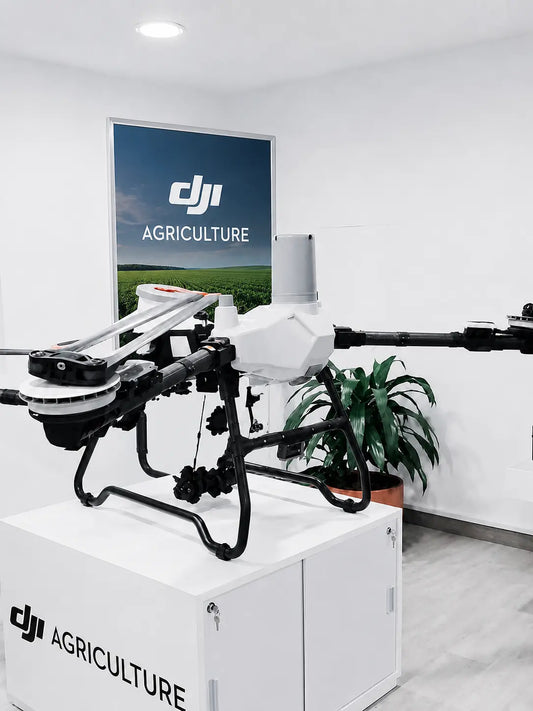

DJI Agras T55 vs DJI Agras T50: Complete Agricultural Drone Comparison
Share
Choosing Between Two Serious DJI Agras Platforms
The DJI Agras T55 and DJI Agras T50 occupy neighboring positions in DJI’s agricultural-drone family, but the difference between them is substantially larger than the model names suggest. The T55 is not simply a T50 with five added to the badge or ten additional liters in the tank. It introduces a new 50 L spray system, a much higher published liquid-flow ceiling, an 80 L DS80L spreader, a formal 40 kg lifting system, a lighter standard battery option, newer columnar-interface power architecture, larger 62-inch carbon-fiber-composite propellers, O4 communications, path-recording field planning, and a newer radar-and-vision safety environment.
The T50 remains a capable and proven agricultural platform. Its 40 L spray tank, 50 kg spreading payload, dual-atomization system, phased-array radar, binocular vision, DB1560 battery, D12000iE generator, and C10000 power supply already support serious commercial operations. Existing T50 fleets have parts, batteries, trailers, procedures, pilots, and service knowledge built around that system. For some operators, those existing assets are more valuable than a specification increase.
The correct question is therefore not, “Is the new T55 automatically better?” The useful question is, “Which aircraft creates the stronger complete operating system for this farm or application business?” That requires comparing payload, flow, refill frequency, spreading rate, field geometry, transport, battery rotation, charging, safety intelligence, parts commonality, annual workload, and the cost of changing platforms.
One of the most striking figures is physical weight. DJI publishes the T50 at 52 kg including its DB1560 battery. The T55 is published at 45 kg with the standard DB1050 battery and 48.4 kg with the optional DB1580, both in the standard two-sprinkler spray configuration. The newer aircraft therefore carries a larger spray tank while its published ready aircraft weight remains lower. That does not make every aspect of the T55 smaller—the T55 has a larger unfolded footprint and 62-inch propellers—but it explains why DJI emphasizes single-operator handling.
Ares Acres supports American agricultural drone operators with complete aircraft, DJI Agras parts, power equipment, technical resources, and configuration support. Buyers can compare the live DJI Agras T55 Premium Set with the DJI Agras T50 Ares Set, review DJI T50 parts, browse other DJI Agras drones, or contact Ares Acres for a configuration based on actual crop, acreage, application volume, terrain, power, transport, and staffing needs.
Prefer to watch first? The video introduces the T55’s 50 L spray tank, 40 L/min standard flow, optional 50 L/min quad-mist system, 80 L spreading tank, 40 kg lifting system, radar, Tri-Vision, obstacle recording, DB1050 and DB1580 batteries, cooling, RC Plus 2 AG, O4 transmission, relay, and D-RTK 3 AG support. This article places those features directly against the T50’s published specifications and explains what the differences mean in the field.
Quick Answer: Is the DJI Agras T55 Better Than the T50?
The T55 is the stronger platform when the operation values a larger 50 L spray tank, far higher published spray flow, a 55 kg and 400 kg/min-class spreading system, dedicated 40 kg lifting, newer obstacle intelligence, O4 communications, path-recording field planning, lighter standard battery handling, and current-generation power architecture. It represents a major capability step rather than a minor refresh.
The T50 can still be the better business decision for an operator with a productive existing T50 fleet, substantial DB1560 battery and charging investment, proven 40 L workflows, stocked T50 parts, trained technicians, and no requirement for T55 lifting or higher flow. A lower acquisition price or easier access to known parts can also matter.
For a first-time buyer choosing between new systems, the T55 is generally the more future-facing and versatile aircraft. For an established T50 owner, the upgrade decision should be justified by additional jobs, reduced cycle time, multi-role revenue, or lower handling burden—not by novelty alone.
DJI Agras T55 vs T50 Specification Table
| Category | DJI Agras T55 | DJI Agras T50 | Practical difference |
|---|---|---|---|
| Published aircraft weight with battery | 45 kg with DB1050; 48.4 kg with DB1580 | 52 kg with DB1560 | T55 is lighter in both published battery configurations |
| Spray tank | 50 L | 40 L | T55 carries 25% more liquid by tank volume |
| Spray operating payload | 50 kg | 40 kg | T55 adds 10 kg of liquid payload |
| Standard maximum flow | 40 L/min, two sprinklers | 16 L/min, two sprinklers | T55 has 2.5 times the published standard ceiling |
| Optional maximum flow | 50 L/min, four mist sprinklers | 24 L/min, four sprinklers | T55 more than doubles the published optional ceiling |
| Droplet range | 50–500 μm | 50–500 μm | Same broad published range; hardware and layout differ |
| Effective spray width | 4–11 m | 4–11 m | Same published range under model-specific conditions |
| Spreading tank | 80 L | 75 L | T55 adds 5 L of hopper volume |
| Spreading payload | 55 kg | 50 kg | T55 adds 5 kg of payload |
| Maximum published discharge | 400 kg/min, compound fertilizer condition | 108 kg/min published headline | T55 has substantially more high-rate capacity |
| Published spread width | 3–10 m | 8 m | T55 has a broader configurable range and 10 m maximum |
| Dedicated lifting system | 40 kg DL100 | No comparable dedicated lift specification | T55 adds a third major mission system |
| Propellers | 62-inch carbon-fiber composite | 54-inch nylon carbon-fiber filament | T55 moves to a larger current-generation propulsion class |
| Standard battery | DB1050, 20 Ah, 8.3 kg | DB1560, 30 Ah, about 12.1 kg | T55 standard pack emphasizes light routine handling |
| Higher-endurance option | DB1580, 30 Ah, 11.7 kg | DB1560 is standard | Similar nominal capacity, different interfaces and battery families |
| Communication generation | O4 | O3-era T50 platform | T55 uses the newer communication and accessory ecosystem |
| Main controller | RC Plus 2 AG, 1,400-nit class | RM700B, 1,200-nit class | T55 adds brightness, runtime, and current-family compatibility |
| Safety architecture | Millimeter-wave radar plus Tri-Vision and obstacle recording | Front/rear phased-array radar plus binocular vision | T55 adds newer sensing and saved-obstacle workflow |
| Fully folded dimensions | 1120 × 896 × 934 mm | 1115 × 750 × 900 mm | T50 is narrower and slightly lower when folded |
| Maximum wind resistance | 6 m/s | 6 m/s | Same published aircraft figure |
| Max configurable flight radius | 2 km | 2 km | Same planning radius, separate transmission-generation details |
The table identifies capabilities, not a universal winner. The following sections explain why the same specification can have different value for two operations.
1. The T55 Is a Generational Change, Not a Small T50 Update
The T50 established a successful formula: a foldable 40 L agricultural drone with a coaxial twin-rotor system, dual atomizing sprinklers, front and rear phased-array radar, binocular vision, a 75 L spreader, and a large 30 Ah battery. It has enough payload and autonomy to serve professional farmers and spray contractors, and it remains an important aircraft in existing fleets.
The T55 takes the same broad mission categories—spraying and spreading—but rebuilds the platform around newer priorities. It adds ten liters of spray capacity while lowering published aircraft weight. It raises standard flow from 16 to 40 L/min. It raises the optional four-sprinkler ceiling from 24 to 50 L/min. It increases spreading payload and dramatically increases maximum discharge. It adds a purpose-built lift system. It adopts new battery cooling, a smaller standard pack, a larger higher-endurance option, O4 communications, current-generation controller hardware, obstacle memory, and recorded-path field planning.
This means T50-to-T55 should not be viewed like a software update. It is a platform transition. Batteries, charging interfaces, some payload hardware, controller environment, sensor architecture, and spare-parts requirements change. Operators should calculate the value of the new capability and the cost of running another ecosystem.
For a first aircraft, the new ecosystem is not an added burden because there is no installed base to protect. For a fleet with six T50 aircraft, dozens of DB1560 batteries, generators, chargers, parts, and trained technicians, the transition has to produce measurable business value.
2. Spray Capacity: 50 Liters Versus 40 Liters
The T55 carries 50 L of liquid compared with the T50’s 40 L. That is a 10 L increase, or 25% more nominal tank volume. At the same application volume and with all other factors equal, the T55 can cover 25% more area per load before returning to refill.
If a job uses 2 gallons per acre, 10 additional liters represents approximately 1.32 additional theoretical acres per load before reserve and route effects. At 5 gallons per acre, it represents approximately 0.53 additional theoretical acre. The capacity benefit therefore becomes more visible at lower application volumes, but it remains useful at high volumes because every avoided refill saves flight, landing, handling, and restart time.
The actual gain is not always exactly 25%. The aircraft may return because of battery state, route completion, weather, or another constraint before emptying the tank. An irregular field can leave a partial payload after the final route segment. Ferry distance can consume battery without applying. A larger tank has greatest value when the mission and battery allow it to be used.
The T50’s 40 L capacity is still substantial. On smaller blocks, narrow orchards, or high-turnover jobs where routes end before the tank empties, the extra 10 L may not change output. A buyer should examine completed-job data, average refill quantity, and route length rather than assuming nominal tank size maps directly to revenue.
3. The Biggest Difference Is Spray Flow
Tank capacity receives attention because it is easy to visualize, but spray flow is the more dramatic T55 upgrade. DJI publishes the T50 at up to 16 L/min with two sprinklers and 24 L/min with four. The T55 is published at up to 40 L/min with its standard two-sprinkler system and 50 L/min with its optional rear quad-mist configuration.
The T55 standard ceiling is therefore 2.5 times the T50 standard ceiling. The T55 optional ceiling is slightly more than twice the T50 optional ceiling. This does not mean every T55 application should use two to three times more liquid. It means the newer system has far more capacity to maintain a target application volume at speed or to serve high-volume crop and canopy work.
Flow becomes limiting when the required application rate, speed, and swath demand more liquid per minute than the system can supply. If the aircraft must slow significantly to stay within pump capacity, daily acreage falls. More flow gives the route planner additional freedom to preserve rate at higher speed, subject to crop, droplet, coverage, and label limits.
High flow also makes ground support more important. A 50 L T55 running a high-volume application can empty rapidly. If the mixing and fill station cannot prepare the next load before landing, the faster airborne system merely waits longer on the ground. The flow upgrade creates production potential, not guaranteed production.
4. Standard and Optional Sprinkler Configurations
Both models use two sprinklers as standard and support four-sprinkler configurations, but the hardware, flow, and intended roles differ.
The T50 standard LX8060SZ dual atomizing system is published at 16 L/min. Its four-sprinkler configuration reaches 24 L/min. The T55 standard system uses two LX09050DX multi-atomization centrifugal sprinklers at up to 40 L/min. Its optional four LX09510DX mist sprinklers reach 50 L/min and are particularly relevant to orchard and high-volume work.
Both aircraft publish a 50–500 μm droplet range and a 4–11 m effective spray-width range. Those matching numbers can create the false impression that spray performance is otherwise identical. The T55’s pump capacity, sprinkler models, placement, optional rear layout, propulsion downwash, and control system are different. Actual deposit should be verified for the specific aircraft and configuration.
An existing T50 operator should not transfer settings directly to a T55 because the numbers look familiar. Flow calibration, height, speed, swath, droplet choice, and route should be established for the T55. Historical T50 data can inform the starting point, but it does not replace validation.
5. Field Crops, Orchards, and High-Volume Work
For corn, soybeans, wheat, cotton, rice, sugarcane, and similar supported crops, both aircraft can serve broad-acre spraying. The T55’s larger tank and higher flow provide more margin for high-volume work or faster routes. The T50’s proven configuration may remain adequate for moderate rates and existing routes.
In orchards, the T55’s optional quad-mist system, newer obstacle intelligence, path recording, and current communications architecture strengthen its case. Orchards contain vertical canopy, rows, terrain, branches, poles, wires, and communication obstruction. A higher maximum flow can support dense-canopy volume, while obstacle recording can improve repeat operations.
The T50 is not excluded from orchard work. Its dual atomization, radar, binocular vision, and compact folded geometry have served complex crops. The upgrade decision depends on whether the T55’s higher flow, newer sensing, or lifting mode solves an actual limitation in the existing operation.
For contractors, offering both aircraft can be logical. A T50 can handle jobs where 40 L is efficient and existing batteries are readily available. A T55 can be assigned to higher-volume, multi-role, or newer-generation accounts. Fleet diversity adds scheduling flexibility but also adds parts and power complexity.
6. Spreading Capacity: 80 Liters and 55 Kilograms Versus 75 Liters and 50 Kilograms
The T55 DS80L spreader holds 80 L and has a 55 kg operating payload. The T50 spreader holds 75 L and has a 50 kg internal load. The headline increase is modest: 5 L of volume and 5 kg of mass.
If only hopper capacity mattered, the upgrade would appear incremental. The more significant difference is the metering and discharge system. DJI publishes the T55 at up to 400 kg/min with compound fertilizer under stated test conditions, compared with a 108 kg/min published headline for the T50. The T55 also supports a 3–10 m effective width and five feeder types covering a broader publicly described range of materials.
As with spray flow, maximum discharge is not the field prescription. The advantage is headroom. High-rate fertilizer jobs can demand a feeder that moves material fast enough to maintain rate at useful speed. Low-rate seed jobs require precision rather than maximum mass. The T55’s feeder range allows the system to be configured around both ends.
The T50’s spreader remains capable for fertilizer and seed work. Existing operators may already have calibrated materials, established settings, and spare parts. A T55 upgrade is most valuable if the current system is rate-limited, material-limited, or unable to support the desired annual work.
7. T55 Screw Feeders Versus the T50 Spreading System
The T50 public specification describes compatibility with 0.5–5 mm dry granules. The T55 publishes multiple feeder ranges spanning approximately 0.5–10 mm across its standard and optional choices. That broader material geometry supports fertilizer, wheat, rice, rapeseed, supported aquaculture feed, and other approved granules.
The T55 extra-large feeder covers 0.5–10 mm material. The medium feeder targets 4–6 mm rice. Optional large, small-medium, and small feeders serve other size and rate combinations. The point is not that every feeder handles everything; the point is that the operator can match the metering chamber to the material.
Stored templates and weighing feedback reduce repetitive calibration work. A contractor can build repeatable setups for common materials. Verification still matters because moisture, lot variation, wear, and storage can change flow.
T55 screw feeders are publicly described as compatible with T70P and T100, while the complete T55 spreader assembly is not. This creates partial parts commonality for a current-generation fleet. It does not create commonality with the T50 spreader.
8. The T55 Adds Lifting; the T50 Does Not Occupy That Role
The T55’s DL100 lifting system supports a 40 kg operating payload on a standard 10 m cable, with a recommended working range of 10–15 m. Features include Auto Balance Control, cargo obstacle avoidance, automatic functions, and emergency cable release.
The T50’s published product role is spraying, spreading, and surveying-related operation rather than a comparable dedicated cargo-lift system. For a farm or contractor that can generate meaningful lift work, this is not a small advantage. It adds a third revenue and utility category to the T55.
Lift capability may support farm logistics across wet fields, steep terrain, orchards, or inaccessible locations. It can move approved loads without ground compaction or a vehicle route. The actual value depends on recurring use; an impressive feature used twice per year may not justify a platform change by itself.
Lifting also adds inspection, training, and risk responsibilities. Cable, hook, load attachment, shape, wind exposure, route, swing, release area, and personnel below the aircraft require dedicated procedures. A buyer should include the complete DL100 hardware, training, and spares if lifting is part of the business case.
9. Aircraft Weight and the Meaning of “Lightweight”
DJI lists the T50 at 39.9 kg without battery and 52 kg with battery. The T55 is listed at 45 kg with the DB1050 or 48.4 kg with the DB1580 in standard two-sprinkler spray configuration.
The T55 with its smaller standard battery is 7 kg lighter than the published battery-installed T50. Even with the larger DB1580, it is 3.6 kg lighter. This is a major reason the T55 can combine a larger tank with a strong one-pilot handling message.
Aircraft weight must not be confused with maximum takeoff weight. A loaded T55 can exceed 100 kg depending on battery and payload configuration. The T50 can reach a 92 kg maximum spraying takeoff weight at sea level and 103 kg spreading. Both are serious aircraft requiring controlled handling and an appropriate launch area.
The lighter empty or battery-installed T55 improves transport and battery swapping. It does not make a loaded T55 appropriate for casual manual movement. Fill and material handling should be arranged so the aircraft is loaded at the operating position rather than carried fully loaded.
10. Folded and Unfolded Dimensions
The T50 measures 2800 × 3085 × 820 mm with arms and propellers unfolded and 1115 × 750 × 900 mm fully folded. The T55 is 3190 × 3570 × 934 mm unfolded and 1120 × 896 × 934 mm fully folded.
The T55 has a larger working footprint and is approximately 146 mm wider and 34 mm taller when folded, while folded length is nearly identical. A trailer or rack designed tightly around a T50 may not accept a T55 without modification. The larger 62-inch propulsion system also affects clearances during setup and service.
The T50 remains more compact in width. That can matter for enclosed trailers, side-by-side aircraft racks, orchard access, and warehouse storage. A buyer should measure the actual transport system rather than assume neighboring Agras models share the same footprint.
The T55’s handles and lower weight can make loading easier even though the folded package is larger. Physical handling therefore depends on both mass and geometry.
11. Propulsion: 62-Inch Versus 54-Inch Propellers
The T50 uses eight 54-inch propellers made from nylon carbon-fiber filament according to DJI’s specification. The T55 uses four pairs of 62-inch carbon-fiber-composite propellers. Its motors are listed at 155 × 16 mm and 55 rpm/V, compared with the T50’s 100 × 33 mm stator, 48 rpm/V, and 4,000 W per rotor specification.
These numbers describe different propulsion architectures and should not be reduced to “larger is better.” The T55 system is designed around its airframe, payload, flow, safety, and energy strategy. Larger carbon-fiber propellers contribute to lift and downwash behavior while requiring greater operating clearance.
The T55’s model 6223 propellers are shared with the T70P, creating useful current-generation parts commonality. They are not T50 propellers. Fleets operating both models need separate propeller inventory, inspection references, mounting hardware, and potentially tools.
Propeller cost and availability should be included in the ownership plan because agricultural aircraft operate close to crops, dust, debris, and transport hazards. A platform is only productive when critical wear parts can be replaced promptly.
12. Safety Systems: New Radar and Tri-Vision Versus Phased Array and Binocular Vision
The T50 uses front and rear phased-array radar plus binocular vision. DJI publishes multidirectional obstacle sensing out to 50 m under stated conditions and an effective sensing speed of up to 10 m/s for the binocular system.
The T55 uses a new millimeter-wave radar environment and Tri-Vision, with a published 60 m measurement range and safe bypass speed up to 13.8 m/s under stated conditions. The video also identifies up to 250,000 radar points per second and improved power-line detection.
The practical upgrade is not simply ten additional meters. The T55 can record certain pole-like obstacles and save them into the field. Future automatic routes can plan around those saved hazards. Tri-Vision provides broader scene awareness and supports pedestrian and vehicle detection during takeoff and landing. AR features connect boundaries, obstacles, and route information to the camera view.
The T50 remains equipped with serious agricultural obstacle sensing. An experienced operator with accurate fields and conservative routes may not experience the T50 as inadequate. The T55 becomes more valuable in complex fields, recurring obstacles, orchards, mixed terrain, and operations that benefit from learned field data.
Neither system makes sensor condition optional. Radar and camera surfaces must be clean, and performance can change with light, rain, fog, target material, geometry, contamination, and speed. Improved detection should increase safety layers, not reduce human planning.
13. Power-Line Detection and Field Risk
Power lines deserve separate attention because they are one of the most difficult and consequential hazards in agricultural drone work. The T55’s new radar is specifically promoted as having significantly enhanced power-line detection.
This improvement strengthens the T55’s case for fields with utility corridors, orchard supports, and linear obstacles. It does not guarantee detection of every wire. Thin, angled, low-contrast, damaged, or background-confused lines remain challenging. Site inspection and obstacle mapping still control.
The obstacle-recording function can make repeat operations more consistent. Once a pole-like obstacle is confirmed and saved, subsequent route generation can incorporate it. A T50 operator may already have manually mapped obstacles, reducing the immediate value of automatic discovery. A contractor entering unfamiliar fields regularly may value the T55 feature more highly.
The best practice is layered: customer field information, pre-job imagery, on-site inspection, path recording, sensor detection, saved obstacles, pilot monitoring, and conservative route settings. No single layer should carry the entire risk.
14. Field Planning and Automation
The T55 supports a recorded-path workflow in which the pilot flies a loop around the field and obstacles, allowing the system to generate the work area and identify certain hazards. This can reduce the need for a separate aerial-mapping step in suitable fields.
The T50 also supports autonomous route planning and surveying-related workflows, but the T55 emphasizes a faster single-loop field setup and saved-obstacle integration. This aligns with its one-pilot design brief.
For farms with permanent field files, the benefit may appear incremental because routes already exist. For contractors adding new customer blocks weekly, quicker field capture can reduce unpaid setup time. The value grows with the number of unique fields served.
Automation should not shorten review. Generated boundaries, obstacle points, exclusions, route direction, start point, connection route, speed, height, swath, refill behavior, and return behavior still need confirmation. A faster capture method is valuable because it creates better data with less friction, not because it removes responsibility.
15. Controller: RC Plus 2 AG Versus RM700B
The T50 uses the RM700B controller with a 7.02-inch 1920 × 1200 display and 1,200 cd/m² published brightness. DJI lists an internal battery runtime of 3 hours 18 minutes and 2 hours 42 minutes with the external battery.
The T55 uses the RC Plus 2 AG, model TKPL 2, with a 7-inch 1920 × 1200 display and 1,400 cd/m² brightness. DJI lists 3.8 hours internal runtime and 3.2 hours external runtime.
The T55 controller therefore adds screen brightness and published runtime. In direct sunlight, brightness affects the pilot’s ability to see route details, camera views, AR overlays, warnings, and payload state. Longer runtime reduces mid-day controller charging pressure.
DJI states that the T55 controller platform is compatible with T70P and T100. That creates controller commonality for a newer-generation fleet. It does not make it a T50 controller. Operators transitioning from T50 should include controller hardware, accessories, mounts, batteries, firmware procedures, and spares in the change plan.
16. O4 Versus the T50 O3-Era Ecosystem
DJI markets the T50 around O3 transmission and optional relay support. The T55 moves to the O4 environment and supports an O4 Relay, D-RTK 3 AG, and enhanced current-generation accessories.
Both aircraft have a 2 km maximum configurable flight radius in their public specifications. That shared number can obscure the communications-generation change. A configurable radius is not the same as maximum radio link under every standard, and neither is an automatic operating authorization. The practical benefits of O4 appear in link robustness, video, accessory commonality, and integration with the newer fleet.
For clear open fields near the controller, a well-functioning T50 link may already be sufficient. For terrain, tree lines, orchards, or current-generation multi-aircraft operations, the T55 communication environment may provide more value.
A relay still requires correct placement and verification. Newer transmission should not be used to justify a route with poor geometry or weak awareness.
17. Battery Architecture: DB1050 and DB1580 Versus DB1560
The T50 uses the DB1560 Intelligent Flight Battery, published at 30,000 mAh, 52.22 V, and approximately 12.1 kg. The T55 supports two packs: the standard DB1050 at 20,000 mAh, 52.5 V, and 8.3 kg, and the optional DB1580 at 30,000 mAh, 52 V, and 11.7 kg.
The similar “DB15” names should not cause confusion. DB1560 and DB1580 are different battery models in different interface generations. DJI explains that the current battery family beginning with the T70P generation uses a columnar interface rather than the older blade interface. Cross-generation charging can require approved adapters.
The T55’s two-battery strategy lets the operator choose between lower mass and higher endurance. For high-volume spraying, the tank may empty before the larger battery is necessary, making the DB1050 efficient. For lower-volume or longer-duration work, the DB1580 may be useful.
The T50’s single familiar DB1560 simplifies fleet rotation. An established business may own enough packs to maintain continuous work. Moving to T55 requires new batteries or an approved charging transition and may create two inventories during the changeover.
Battery economics should include acquisition, cycle tracking, cooling, connectors, charging hardware, storage, transport, and retirement—not only capacity.
18. Charging and Generator Differences
The T50 ecosystem uses the D12000iE Multifunctional Inverter Generator and C10000 Intelligent Power Supply. DJI publishes 9–12 minutes to fully charge a DB1560 under specified conditions.
The T55 ecosystem introduces the D8000iE and C7000 around the DB1050. DJI publishes 8–9 minutes from 30% to 95% for that pack. These charge claims use different batteries and endpoints, so they should not be compared as if one system is definitively faster by a fixed number of minutes.
The D8000iE has lower maximum charging output than the larger T50 generator system, but it serves a smaller standard battery and supports the T55’s lighter field-power concept. It also lists compatibility with DB1050, DB1580, and DB2160. The C7000 can deliver its highest output only with suitable three-phase input; single-phase output is lower.
An existing T50 owner already has significant value in D12000iE and C10000 equipment. If approved adapter pathways support some cross-generation charging, that can ease transition, but exact equipment, cable, battery, and firmware compatibility must be confirmed. A buyer should not improvise high-current connections.
19. Cooling: T55 Onboard Heat Management
The T55 adds an onboard battery heat sink and redesigned air channel to cool the pack during flight. A ground air-cooled heat sink continues the cooling process between flights.
The T50 also uses air-cooled battery support in its power workflow, but the T55 makes in-flight cooling a more explicit part of the aircraft architecture. This is relevant in hot-weather high-tempo work, where a battery can land too warm for immediate fast charging.
Cooling can reduce thermal waiting time and support a smaller battery rotation. It still depends on clean airflow, functioning fans, ambient temperature, shade, battery health, and appropriate charging. Fertilizer dust, crop debris, and chemical residue can obstruct heat-management hardware.
For an operator whose T50 production is regularly limited by battery cooling, the T55 may solve a real bottleneck. If the current T50 rotation already has ample batteries and cooling capacity, the advantage may be less financially significant.
20. Maximum Takeoff Weight and Payload Discipline
The T50 publishes a maximum spraying takeoff weight of 92 kg and spreading takeoff weight of 103 kg at sea level. The T55’s values vary by battery and nozzle configuration. With DB1050, DJI lists 95 kg standard spray, 99 kg optional four-nozzle spray, 104 kg spreading, and 84 kg lifting. With DB1580, the corresponding values are 99 kg, 103 kg, 108 kg, and 89 kg.
These numbers show that the T55’s larger payload does not simply come from a much heavier aircraft. They also show why battery and optional hardware affect the allowable configuration.
Maximum takeoff weight is not a target. DJI’s application recommends a loading value based on aircraft state, environment, and task. Elevation, temperature, battery, wind, load, and system condition can reduce the appropriate amount.
Operators moving from T50 to T55 need new loading references. A familiar “full tank” procedure should not override the T55’s current recommendation. Spread loads should be measured by mass and material, and lifting loads should include the applicable rigging components.
21. Which Drone Is Better for a Solo Operator?
The T55 has the stronger explicit solo-operator design. It has additional handles, lower published aircraft weight with battery, auto-locking arms, controller verification of arm position, path-recording planning, saved obstacle data, templates, and a smaller standard battery.
The T50 is fully operable by a trained pilot and can be transported in a compact folded package. Its narrower 750 mm folded width can be advantageous. Existing procedures and equipment may make it easier in practice for a business that already knows the aircraft.
Solo operation should be understood as reduced handling and setup burden, not as a declaration that every job requires one person. Chemical loading, observer roles, site control, multiple aircraft, lift operations, and local procedures may require more personnel.
For a new owner-operator working smaller and medium fields, the T55’s design can reduce the cost and complexity of getting into the field. For a T50 contractor with a polished two-person workflow, the operational difference should be measured rather than assumed.
22. Which Drone Is Better for Large Fields?
Between these two, the T55 generally has the advantage for large fields because it carries 25% more spray liquid and has much more flow headroom. Longer routes can use the extra tank capacity, and high-rate work can use the stronger pumps.
However, “large field” does not automatically mean T55. Application volume, refill location, battery, route, and fleet size determine output. Two T50 aircraft with a mature ground station may outproduce one T55. An existing T50 fleet may have higher dispatch reliability because parts and packs are already available.
If a buyer regularly serves very large open fields, the comparison should also include the DJI Agras T100 Full Set or T70P rather than stopping at T55. The T55 is a balanced 50 L platform, not the largest possible choice.
23. Which Drone Is Better for Orchards?
The T55 presents the stronger new-platform argument for orchards. Its optional rear quad-mist package supports up to 50 L/min, and its newer radar, Tri-Vision, obstacle recording, AR views, path recording, O4 environment, and relay support address common orchard challenges.
The T50 can remain effective in orchards with appropriate configuration, planning, and experienced pilots. Its narrower folded width and existing service history may matter. A farm that already owns T50 aircraft should identify a specific orchard limitation before replacing them.
For either model, orchard work requires three-dimensional route thinking, canopy-aware application verification, careful sensor cleaning, communication planning, and conservative obstacle treatment. Technology supports that process; it does not remove it.
24. Which Drone Is Better for Spreading?
The T55 is stronger on published spreading capacity and throughput. It adds 5 L of tank volume, 5 kg of payload, up to 400 kg/min published discharge, a 10 m maximum effective width, five feeder choices, templates, and current-generation parts commonality with T70P and T100 feeders.
The T50’s 75 L, 50 kg system remains a serious spreader with a published 108 kg/min rate and 8 m width. For established material programs, its known performance can be more valuable than unused maximum capacity.
An operator should compare actual materials. If the business spreads low-rate seed, feeder accuracy and material handling may matter more than 400 kg/min. If it applies high-rate fertilizer, T55 discharge headroom can be decisive.
25. Which Drone Has the Better Parts Position?
The answer depends on the fleet. Today, the T50 has a mature installed base and a broader established parts history. Ares Acres maintains a dedicated DJI T50 parts collection, and many operators already understand common wear items.
The T55 is newer, so its public granular parts catalog is still developing. It has valuable commonality with the T70P and T100 around 6223 propellers, screw feeders, controller platform, and portions of the power ecosystem. This can make it attractive for a current-generation fleet.
A standalone new T55 owner should build a starter shelf around verified high-exposure items: propellers, approved sprinklers and liquid-path service parts, feeders required for the intended materials, lift cable/hook items if used, charging adapters where approved, and cleaning/inspection supplies. Exact fitment must be confirmed.
The better parts position is the one that keeps the aircraft flying. A theoretically common part that is not stocked locally has less value than a dedicated part already on the shelf.
26. Upgrade Economics for an Existing T50 Owner
An upgrade should produce measurable value in one or more categories:
- more acres per day through larger loads or less rate-limited flight;
- new orchard or high-volume work through the quad-mist system;
- new spreading work through higher discharge and feeder range;
- new lift revenue or farm utility;
- lower labor or handling burden;
- faster field setup for contractors serving new blocks;
- improved safety management in complex fields;
- lower downtime through current-generation commonality; or
- stronger customer positioning and fleet capacity.
Against those gains, the owner should count aircraft cost, batteries, charger or generator, controller, payload systems, trailer changes, spares, training, setup, and the temporary cost of maintaining both ecosystems.
If the current T50 is paid for, reliable, and fully utilized, its economics can remain excellent. Selling or sidelining it too early can destroy value. A T55 may be best added as a complementary aircraft, allowing the business to assign each model to the work it handles efficiently.
If the T50 is repeatedly flow-limited, overheating the battery rotation, unable to serve desired lift work, or requiring more labor than the business can sustain, the T55 upgrade has a clearer payback path.
27. First-Time Buyer Decision
For a first-time buyer without legacy assets, the T55 usually offers the stronger long-term platform. It provides more spray capacity, much more flow, better spreading specifications, lifting, newer safety intelligence, current communications, dual battery choices, and a current-family controller.
The T50 may still win if acquisition price, immediate availability, local training, known service, or a specific package is materially better. A first aircraft that arrives complete and supported can outperform a newer aircraft that arrives without the correct batteries, power, or parts.
Buyers should request a complete configuration, not a bare aircraft quote. Compare battery count, charging, generator, spreader, feeders, optional sprinklers, controller, RTK, relay, delivery, setup, calibration, training, warranty terms, and spares.
Ares Acres can structure those comparisons through the live T55 Premium Set, T50 Ares Set, broader DJI Agras drone collection, and direct consultation.
28. Three Example Operating Scenarios
Scenario A: Established 1,500-acre grain farm with a productive T50
The farm already owns three DB1560 batteries, a D12000iE generator, spare propellers, pumps, and a trailer fitted to the T50. Most work is completed at moderate application volume, and the aircraft is not rate-limited. In this case, keeping the T50 may be financially stronger. A T55 should be added only if additional capacity, lifting, or new high-volume work produces a return.
Scenario B: New custom applicator serving corn, wheat, orchards, and cover crops
This operator needs one platform to spray, spread, and possibly lift. It will enter unfamiliar fields and values fast path recording and obstacle memory. The T55 is the clearer fit because its mission breadth and current safety environment can support more services from the initial investment.
Scenario C: Orchard contractor with high-volume canopy applications
The operator is constrained by flow and complex field setup. The optional T55 four-mist system, 50 L/min maximum, obstacle recording, Tri-Vision, relay support, and 50 L tank address those constraints. The upgrade case is strong if application verification confirms the desired result and the ground station can supply the faster cycle.
These scenarios demonstrate why acreage alone cannot choose the aircraft. Installed assets, customer mix, application volume, and field complexity determine value.
29. Recommended Decision Process
Begin with the last season’s data. List application volume, average load, average flight and refill time, daily acres, battery delays, material types, field sizes, obstacles, weather losses, parts failures, and jobs declined because the aircraft lacked capacity or capability.
Next, model the T55 against those exact constraints. Determine whether the 50 L tank prevents refills, whether higher flow permits useful speed, whether the spreader accepts new materials, whether lift creates real work, and whether handling saves labor.
Then model transition cost. Include equipment and the operational friction of a second parts and power ecosystem. Identify which T50 assets remain useful and which do not.
Finally, choose the deployment strategy: retain T50 only, replace T50, or operate both. For many businesses, operating both is the most resilient answer. The T50 continues producing while the T55 expands capability.
30. Application Mathematics: How the Capacity Difference Changes a Route
A simple load calculation helps separate meaningful capacity from impressive advertising. One U.S. gallon equals approximately 3.785 L. The T50’s 40 L tank therefore represents approximately 10.57 gallons, while the T55’s 50 L tank represents approximately 13.21 gallons. The difference is approximately 2.64 gallons per load.
At a planned 2 gallons per acre, the theoretical liquid-only capacity is approximately 5.28 acres for the T50 and 6.60 acres for the T55. At 3 gallons per acre, the figures become approximately 3.52 and 4.40 acres. At 5 gallons per acre, they become approximately 2.11 and 2.64 acres. These are planning illustrations, not guaranteed treated acres. They ignore reserve, line volume, route shape, partial loads, actual tank fill, pump behavior, overlap, turns, ferry distance, and product-label requirements.
The benefit changes with field geometry. Imagine a 25-acre rectangular field at 2 gallons per acre. The theoretical liquid requirement is 50 gallons, or about 189 L. The T50 needs at least five nominal 40 L loads to carry that total, while the T55 needs at least four nominal 50 L loads. Avoiding one complete landing, refill, battery decision, takeoff, route resume, and climb can save more time than the ten-liter difference alone suggests.
Now imagine five separate 5-acre fields, each located far enough apart that the aircraft is transported between them. At the same 2 gallons per acre, each field requires about 37.9 L. Both aircraft can theoretically complete each block on one liquid load. The T55’s extra tank capacity does not eliminate a refill because transport between blocks already defines the cycle. In that scenario, faster field planning, lower weight, safety features, or multi-role work may matter more than tank size.
At high application volumes, flow becomes important. Suppose a route requires 5 gallons per acre across a wide swath at a useful speed. The T50 may need to reduce speed if the calculated demand approaches its 16 or 24 L/min ceiling. The T55 has much greater flow headroom. It may maintain the agronomically acceptable rate at a higher speed, but only if droplet behavior, coverage, route, and label allow it. The correct calculation converts target volume, speed, and effective width into required flow and then confirms that the selected nozzle system can deliver it.
Spreading mathematics follows the same principle. A 55 kg T55 payload carries 10% more mass than the T50’s 50 kg payload. At a prescription of 100 kg per hectare, the theoretical material-only coverage is 0.55 hectare versus 0.50 hectare per load. The payload difference is modest. If the required delivery rate at the desired speed exceeds the T50’s metering capacity, however, the T55’s higher discharge ceiling can create a much larger productivity difference than the five kilograms suggest.
The lesson is to calculate both capacity and rate. Tank or hopper size answers how long the payload can last. Pump or feeder capacity answers whether the aircraft can deliver the prescription at the desired speed. Ground cycle answers how quickly the next load can begin. The limiting number changes from job to job.
31. A Complete Daily Workflow Comparison
The operating day starts before either aircraft powers on. A T50 crew loads a familiar airframe, DB1560 batteries, a D12000iE or C10000 power system, controller, spare parts, spray or spreading hardware, and field equipment. A T55 crew loads the aircraft, DB1050 or DB1580 packs, D8000iE or C7000 equipment, cooling hardware, RC Plus 2 AG, and the selected DS80L, DL100, or spray configuration. The T55 may be lighter to handle, but a multi-role package can include more modules.
At the field, the T50 benefits from established procedures. Experienced crews know where every latch, connector, fill point, and controller menu belongs. The T55 reduces several physical steps through auto-locking arms, additional handles, and controller confirmation. A new T55 crew can still lose time if the trailer is not organized or if optional systems are stored without a defined sequence.
During field capture, a T50 operator may open an existing map, plan with the controller, or use another supported mapping method. The T55 can record a boundary path and detect certain pole-like obstacles during a single loop. On recurring fields, both can use saved information. On unfamiliar customer fields, the T55 workflow may reduce setup time.
During spraying, the T50 ground station prepares 40 L loads and stages DB1560 batteries. The T55 station prepares 50 L loads and selects DB1050 or DB1580 based on mission. Because the T55 can consume liquid much faster, the mixer must be ready earlier. A disorganized T55 crew can create longer ground waits than an organized T50 crew despite the newer aircraft.
At landing, the T55’s payload indicator and controller data help the crew anticipate state. The battery moves to the ground heat sink, and the next cooled pack moves to the aircraft. T50 batteries also require a controlled cooling and charging sequence. The main difference is that the T55 begins cooling in flight and uses the new standard pack in many routine jobs.
During spreading, both crews must keep fertilizer and dust away from electronics, batteries, radar, and charging areas. The T55 may use one of several feeders and stored templates. The T50 crew may have fewer feeder choices but extensive experience with its known materials. After the job, both systems need immediate cleaning; the T55’s higher discharge capability does not reduce corrosion.
At the end of the day, a mixed T50/T55 fleet requires deliberate separation. DB1560 and DB1580 are visually and numerically similar enough to invite mistakes. Batteries, adapter cables, propellers, sprinkler hardware, feeders, and service kits should be labeled by model and stored in assigned positions. The controller and job records should identify the aircraft used so maintenance and performance data remain accurate.
The T55 can reduce handling and planning friction, but the operation captures that value only when its ground workflow is redesigned around the new aircraft rather than copied from the T50 without review.
32. Total Cost of Ownership Categories
Aircraft price is only the first line in a T55-versus-T50 ownership comparison. A complete analysis should include acquisition, deployment, working capital, consumables, maintenance, labor, downtime, training, and residual value.
Acquisition includes the aircraft, batteries, charger or generator, controller, spray hardware, spreader, feeders, lift system, mist package, relay, D-RTK 3 AG, transport equipment, setup, and initial parts. A lower aircraft price can become a higher system price if required equipment is excluded from the quote.
Deployment includes freight, delivery, calibration, activation, trailer modification, electrical work, generator commissioning, storage, and operator training. A T50 package that fits an existing trailer may require less deployment spending. A T55’s folded width may require rack changes even though the aircraft is lighter.
Working capital includes the batteries and spares necessary to keep the aircraft productive. A business with T50 packs already owns that capital. A T55 requires a new rotation. The amount should be based on measured cycle time, not a generic recommendation.
Consumables include fuel, electricity, engine oil, filters, cleaning materials, pump and sprinkler wear, propellers, feeders, cables, and other service parts. The T55’s high flow can move more product through the wetted path, which may change inspection frequency. Its lifting system introduces cable and hook wear that the T50 program does not have.
Labor includes transport, setup, mapping, loading, battery handling, cleaning, maintenance, and recordkeeping. The T55 is specifically designed to reduce several labor-intensive steps. Those savings should be measured in minutes per field and multiplied across the season.
Downtime is often the largest hidden cost. A less expensive aircraft waiting three weeks for a part can cost more than a premium supported package. The T50 may have an advantage today where its mature parts are already stocked. The T55 can have an advantage in a current-generation fleet sharing selected components with T70P and T100.
Training costs include not only formal instruction but also the lower productivity and higher supervision of the first operating weeks. An experienced T50 pilot still needs T55 configuration training because battery, controller, radar, field planning, mist hardware, lift system, and feeder workflows differ.
Residual value is uncertain but relevant. A current-generation T55 may retain stronger future demand, while a proven T50 with complete power equipment can remain attractive to budget-conscious operators. Maintenance records, battery health, chemical care, and included equipment will affect either aircraft more than model year alone.
The economic comparison should end with cost per productive acre or cost per completed job, not sticker price. Divide total annual ownership and operating cost by verified output, then test conservative, expected, and high-utilization scenarios. An aircraft purchased for capability that never becomes scheduled revenue is expensive regardless of specifications.
33. Mixed-Fleet Strategy: Operating T50 and T55 Together
A mixed fleet can protect the T50 investment while allowing the T55 to expand services. The strategy works best when each aircraft receives an explicit assignment rather than competing for every job.
The T50 can remain the standard aircraft for known moderate-volume fields, training, backup, and work located near its established battery and parts base. Its narrower folded dimensions may suit a particular vehicle or orchard access. The T55 can serve high-flow spraying, larger-load routes, advanced orchard work, spreading materials that benefit from its feeder range, and lift missions.
Dispatch rules reduce indecision. A business might assign the T55 when the required flow exceeds the T50’s comfortable operating range, when one extra load can be removed from the route, when path recording materially reduces setup, when lift is required, or when a specific current-generation accessory is needed. The T50 remains assigned when the job fits one 40 L load, existing maps are proven, or the T55 is committed elsewhere.
Battery and charging areas must be visually separated. DB1560, DB1580, and DB1050 packs should have clear labels and assigned cooling stations. Adapter cables should be controlled equipment, not loose items available for improvised combinations. Charge logs should identify battery model and serial or fleet number.
Parts inventory should be divided into common, T50-only, and T55/current-generation categories. Common cleaning materials and general field tools can be shared. Propellers, sprinkler assemblies, controllers, battery contacts, payload modules, and many structural parts cannot. T55/T70P 6223 propellers should never be mistaken for T50 propellers.
Pilot training should preserve aircraft-specific checklists. Familiarity can create risk when a pilot assumes a T50 menu, load limit, flow setting, or battery behavior applies to the T55. The controller interface and automation may feel related, but the numerical limits are not interchangeable.
A mixed fleet also strengthens resilience. A failure in one battery or charger family does not necessarily stop all aircraft. A T50 can complete time-sensitive work while the T55 is configured for spreading or lift. The cost is additional inventory and complexity. The business should keep both only if the scheduling and backup value exceeds that complexity.
34. Pre-Purchase Verification Checklist
Before selecting either aircraft, document the following answers:
- What crops will the aircraft treat, and what are the typical application volumes?
- What percentage of jobs require more than 16 or 24 L/min at the desired route settings?
- How often would 50 L eliminate a refill that 40 L cannot?
- Which granular materials, particle sizes, and application rates will be used?
- Is a 40 kg lift system tied to recurring work or only occasional interest?
- How many unique fields are added each month, and how much time is spent mapping them?
- What wires, poles, orchards, slopes, or communication obstructions characterize the service area?
- What batteries, chargers, generators, trailers, parts, and controllers are already owned?
- Can the existing transport system fit the T55’s folded and unfolded dimensions?
- Is single-phase or three-phase power available, or will field generation be primary?
- What battery rotation is required under the expected spray and fill cycle?
- Which spare parts can be supplied immediately in season?
- Who will install and calibrate optional mist hardware?
- What setup, delivery, training, and post-sale support are included?
- What measured additional annual revenue or cost reduction justifies the T55 transition?
The answers turn a model comparison into an investment decision. If the new aircraft does not solve a documented constraint, retaining the T50 may be correct. If the T55 removes several constraints at once, the upgrade can change the business rather than merely the equipment list.
35. A Weighted T55-versus-T50 Decision Scorecard
A specification table explains what changes, but it does not tell an individual operator how much each change matters. A useful final step is to build a weighted scorecard around the work that will actually be performed. Give each category a business-importance weight from one to five. Then score each aircraft from one to five for that category, using the complete package that is realistically available—not an idealized aircraft with every accessory assumed. Multiply the weight by the aircraft score and total the results.
The categories below provide a practical starting point:
| Decision category | Questions that determine the weight |
|---|---|
| Spray flow | Is the present aircraft forced to slow because the required rate exceeds available flow? Are dense-canopy or high-volume jobs part of the plan? |
| Tank capacity | Do routes frequently empty a 40 L tank before the battery or field segment is complete? How much nonproductive time is attached to each refill? |
| Spreading range | Are high-rate fertilizer, small seed, large granules, or multiple material types meaningful revenue categories? |
| Lifting | Is there recurring, paid, or operationally valuable work for a controlled 40 kg lift system? |
| Aircraft handling | Is one-person loading, unloading, unfolding, and repositioning a recurring labor constraint? |
| Obstacle environment | How frequently do fields contain power lines, poles, orchard structures, tree lines, irregular boundaries, vehicles, or pedestrians? |
| New-field setup | Does the business enter unfamiliar customer blocks often enough for path recording and obstacle saving to reduce setup time? |
| Installed battery investment | How many serviceable DB1560 batteries, T50 charging devices, cooling assets, and transport fixtures are already owned? |
| Parts readiness | Which model has the critical field spares, trained support, and known delivery path available to the operation? |
| Current-family commonality | Will the fleet also include T70P or T100 aircraft that can share supported components with T55? |
| Acquisition timing | Can the complete aircraft, power system, payload equipment, training, and initial spares arrive in time for the required season? |
| Capital efficiency | Which package can earn enough additional gross margin to justify its total installed cost? |
Suppose a contractor gives spray flow, orchard safety, and new-field setup the highest weights because the business is trying to expand into high-volume orchard work. The T55 will likely build a decisive score through its 40 L/min standard flow, optional 50 L/min quad-mist system, Tri-Vision, newer radar, obstacle recording, and path-based field capture. Existing T50 batteries still have value, but they may not outweigh the capabilities attached to the new revenue plan.
Now consider a grain farm that owns a fully productive T50 system, applies at moderate volumes, has no lift demand, uses permanent field boundaries, and keeps a mature spare-parts shelf. Battery investment, known service, capital efficiency, and immediate readiness may receive the highest weights. The T50 can win that scorecard even though the T55 wins more specification rows. That is not resistance to technology; it is disciplined use of an asset that already fits the work.
Complete the scorecard twice. First, score the next twelve months. Second, score the expected work three years from now. A T50 may lead the near-term calculation because the equipment is already installed, while the T55 may lead the three-year view because the business expects higher-volume applications, mixed-payload work, or current-generation fleet expansion. Seeing both totals helps the owner decide whether to keep the T50, add a T55, or schedule a deliberate transition instead of making an abrupt replacement.
Do not hide uncertainty inside a precise-looking number. If live T55 price, delivery, regional hardware, training dates, or spare availability has not been confirmed, mark that category as provisional. Run a low, expected, and high case. The decision becomes stronger when it remains favorable under conservative assumptions.
36. Measuring the Upgrade During a Controlled Field Trial
The most reliable comparison uses the operator’s own job rather than a generic demonstration. Select a representative field, crop, application volume, refill position, and weather window. Record the T50’s route time, applied area, average and peak flow demand, landing state, refill time, battery exchange time, battery temperature, ground-station waiting, total labor, and any route intervention. Repeat the exercise with the correctly configured T55 when a lawful and supported evaluation is available.
Keep the agronomic objective constant. The purpose is not to make the T55 look faster by changing the application volume, swath, height, or coverage requirement. Both aircraft must aim for the same prescribed result. Use appropriate deposit checks or other application-verification methods for the crop, and record why any setting differs between models.
The key output is full-cycle productivity. Airborne speed alone can mislead. A T55 may complete a route faster but spend the saved time waiting for mixed product. A T50 may fly slower but remain continuously supplied by an established ground station. Conversely, the T55’s larger tank may remove enough landings that the complete cycle improves even when flight speed remains conservative. Only the timestamp from one ready-to-load state to the next ready-to-load state captures the real production effect.
For spreading, use the actual fertilizer or seed planned for the business. Record bulk density, granule-size distribution, feeder type, loading mass, target rate, swath, speed, discharged mass, residual material, and uniformity checks. The T55’s 400 kg/min maximum is a capability limit under a stated test condition, not a substitute for this material-specific result. The relevant gain may be the ability to hold rate at speed, handle a different granule, or recall a verified template reliably—not operation at the maximum published number.
For handling, include every movement normally performed by the crew: removing the aircraft from transport, unfolding and locking it, installing the payload system, moving batteries, staging the controller, and returning the equipment to transport. The T55’s lower published aircraft weight with battery and smaller DB1050 can be meaningful, but the trial should show whether the actual trailer height, handles, ramps, and operator reach turn that specification into saved labor.
After the trial, translate minutes into annual value. Multiply verified time saved per load or acre by realistic annual workload. Add revenue from jobs that the T55 makes practical, subtract additional labor and ground-equipment requirements, and apply a conservative utilization rate. Include the value of the T50 assets that would remain useful, be sold, or become redundant. This turns the comparison from a feature preference into an equipment decision that can be reviewed by an owner, lender, partner, or operations manager.
37. The Most Defensible Recommendation by Buyer Type
For a new buyer with no installed DJI Agras power or parts ecosystem, the T55 is normally the more defensible choice between these two models. It offers the broader mission set and starts the business in DJI’s current T55, T70P, and T100 family. The complete package still has to include the correct battery strategy, charging source, spread or lift hardware needed for the business, essential spares, training, and a support path.
For an existing T50 owner whose aircraft is reliable and whose work stays inside the T50’s capacity, continued operation is defensible. The T50 does not stop producing because a newer model exists. Maintenance, battery health, parts access, and job economics should determine its remaining service role.
For an existing T50 owner who is repeatedly flow-limited, short on payload, turning away supported spreading materials, or seeking regular lift work, the T55 has a strong upgrade case. Those are measurable constraints directly addressed by the newer platform.
For a contractor who needs dispatch resilience, the best answer may be both. The T50 protects an established production line, while the T55 opens higher-flow and multi-role work. The company can migrate customers, procedures, and capital gradually, learn the new power system without grounding the older aircraft, and reserve each model for the jobs where it creates the best margin.
That is the central conclusion of the T55-versus-T50 comparison: the T55 wins the capability contest, while the correct ownership decision depends on whether those capabilities solve a paid operational problem. Specifications establish potential. A complete package, trained workflow, supplied ground station, field evidence, and dependable support convert that potential into value.
DJI Agras T55 vs T50 Frequently Asked Questions
What is the main difference between the DJI Agras T55 and T50?
The T55 is a newer 50 L multi-role platform with much higher spray flow, higher-capacity spreading, a dedicated 40 kg lift system, newer radar and vision intelligence, O4 communications, new batteries, and single-operator-oriented handling. The T50 is a proven 40 L spraying and spreading platform built around the DB1560 and older-generation ecosystem.
How much larger is the T55 spray tank?
The T55 tank is 50 L versus 40 L on the T50. That is 10 L or 25% more nominal liquid capacity.
Is the T55 heavier than the T50?
Not in DJI’s published battery-installed standard spray figures. The T55 weighs 45 kg with DB1050 or 48.4 kg with DB1580, while the T50 weighs 52 kg including DB1560. Loaded takeoff weights differ and can exceed 100 kg.
Which drone sprays faster?
The T55 has substantially higher published flow: 40 L/min standard and 50 L/min optional, compared with 16 L/min standard and 24 L/min optional for the T50. Actual field speed depends on rate, swath, crop, route, and coverage—not pump capacity alone.
Do both drones make the same droplet sizes?
Both publish a broad 50–500 μm range. Their sprinkler models, pump capacities, layouts, propulsion, and optional configurations differ, so settings and application results should be verified independently.
Which has a wider spray swath?
Both publish an effective 4–11 m range under their stated conditions. Actual width is configuration- and field-dependent.
Which drone carries more fertilizer?
The T55 carries up to 55 kg in an 80 L spreader. The T50 carries up to 50 kg in a 75 L spreader.
Which drone has the faster spreader?
DJI publishes up to 400 kg/min for the T55 under compound-fertilizer test conditions and a 108 kg/min headline for the T50. These are maximum system figures, not normal universal application rates.
Can the T50 lift cargo like the T55?
The T55 has a published dedicated DL100 lifting system with a 40 kg operating payload. The T50 is not publicly positioned with a comparable dedicated lifting system in its core specification.
Are T50 and T55 batteries compatible?
Do not assume so. The T50 uses DB1560 in the older blade-interface family. The T55 uses DB1050 or DB1580 in the newer columnar-interface family. Approved charging adapters may bridge some equipment, but direct battery fitment and charging must be verified.
Is DB1580 the same as DB1560?
No. They are different battery models. Both have approximately 30 Ah nominal capacity, but their weight, voltage labeling, connector generation, and aircraft compatibility differ.
Can a T50 charger charge a T55 battery?
Compatibility depends on the exact charger and approved adapter. DJI states that new and older charging generations can require dedicated adapter cables. Never improvise a high-current charging connection.
Which drone has better battery endurance?
Endurance depends on payload and mission. The T55 offers a lighter 20 Ah DB1050 and a higher-capacity 30 Ah DB1580. The T50 uses a 30 Ah DB1560. A larger nominal battery does not always increase productive work if the tank empties first.
Which battery is easier to handle?
The T55 DB1050 is substantially lighter at 8.3 kg than the T50 DB1560 at approximately 12.1 kg. The T55 DB1580 is 11.7 kg.
Which drone charges faster?
DJI publishes different test endpoints: 8–9 minutes from 30% to 95% for DB1050 on T55 equipment and 9–12 minutes to full for DB1560 on T50 equipment. These are not directly equivalent tests.
Which drone is easier to transport?
The T55 is lighter and adds handles and auto-locking arms. The T50 is narrower and slightly lower when folded. The better transport fit depends on vehicle, rack, lifting method, and number of aircraft.
Can a T50 trailer fit a T55?
Possibly, but it must be measured. The T55 is wider and taller when folded and has a larger unfolded rotor footprint. Tight T50 racks may need modification.
Which drone has better obstacle avoidance?
The T55 has the newer published system, including millimeter-wave radar, Tri-Vision, a 60 m measurement range, higher safe bypass speed under stated conditions, obstacle recording, and broader AR assistance. The T50 has front/rear phased-array radar and binocular vision and remains a capable safety platform.
Can the T55 save power lines and poles into a field map?
DJI states that the T55 can identify and save certain pole-like obstacles such as trees and utility poles. Improved line detection does not guarantee detection of every wire.
Does the T50 have path-recording field planning?
The T50 supports field planning and autonomous workflows, but the T55 specifically emphasizes a single recorded loop that generates the field and saves detected obstacles. Exact app functions can change with firmware and region.
Which controller is brighter?
The T55 RC Plus 2 AG is published at 1,400 cd/m². The T50 RM700B is published at 1,200 cd/m².
Can one T55 controller operate a T50?
DJI publicly identifies RC Plus 2 AG compatibility with T55, T70P, and T100, not T50. Do not assume T50 compatibility.
Do T55 and T50 use the same propellers?
No. The T55 uses 62-inch model 6223 carbon-fiber-composite propellers shared with T70P. The T50 uses 54-inch propellers from a different system.
Which is better for corn and wheat?
Both can serve supported broad-acre crops. The T55 has more liquid capacity and much higher flow headroom. The T50 can remain economical when moderate rates, existing assets, and proven workflows meet the job.
Which is better for sugarcane?
The T55’s higher flow and larger tank can be beneficial in tall, dense crops, but deposit verification, height, speed, downwash, droplet setting, and label remain controlling.
Which is better for orchards?
The T55 has the stronger current-generation feature set for orchard work, especially with the optional four-mist system, obstacle recording, Tri-Vision, O4 relay support, and path recording.
Which is better for cover-crop seeding?
The T55 offers a broader feeder range and higher maximum discharge. The T50 remains capable. The decision should be based on seed size, rate, feeder, acreage, and existing material templates.
Should an existing T50 owner sell the T50 for a T55?
Not automatically. A reliable paid-for T50 can remain highly profitable. The T55 should solve a measured constraint or create new revenue. Many businesses may benefit from keeping the T50 and adding a T55.
Is the T55 a direct replacement for the T50?
It occupies the next 50 L class and can replace T50 work, but the battery, charging, controller, propulsion, sensors, and some payload components change. Treat it as a platform transition.
Which drone is better for a new buyer?
The T55 is generally the more capable and future-facing option if both packages are complete and supported. Price, delivery, training, and local parts can still make a T50 package the better immediate business decision.
Where can I compare live T55 and T50 packages?
Review the DJI Agras T55 Premium Set and DJI Agras T50 Ares Set, then contact Ares Acres for current configuration, availability, and support.
Final Verdict: DJI Agras T55 or T50?
For a new buyer, the T55 is the stronger overall platform. It carries more liquid, moves far more liquid per minute, offers a stronger spreading system, adds lifting, lowers published aircraft weight, introduces a two-battery strategy, improves cooling, uses the newer controller and O4 environment, and adds obstacle recording and path-based field planning.
For an established T50 owner, the answer is more nuanced. The T50 can remain an excellent production asset. Its batteries, generator, charger, trailer, parts, settings, and pilot knowledge already have value. Replacing that system makes sense only when the T55’s capacity, flow, lift, safety intelligence, or handling creates enough additional output or revenue to justify the transition.
The best fleet may include both. The T50 can continue serving known 40 L jobs while the T55 handles higher-flow, multi-role, or complex-field work. That approach protects the earlier investment and expands capability.
Ares Acres can help translate the comparison into a real configuration. Review the T55 Premium Set, T50 Ares Set, DJI Agras drones, DJI Agras parts, DJI T50 parts, and DJI accessories, or contact Ares Acres to compare complete aircraft, batteries, charging, payload systems, delivery, setup, spares, and field support.
The correct aircraft is the one whose complete system removes the limiting factor from the work you are actually paid to perform.
Internal Resources
- Ares Acres
- DJI Agras T55 Premium Set
- DJI Agras T50 Ares Set
- DJI Agras Drones
- DJI Agras Parts
- DJI T50 Parts
- DJI T70 Parts
- DJI T100 Parts
- DJI Accessories
- DJI Agras T100 Full Set
- DJI Agriculture Blog and Tutorials
- Contact Ares Acres
Official Technical Sources
- DJI Agras T55 specifications: https://ag.dji.com/t55/specs
- DJI Agras T55 FAQ: https://ag.dji.com/t55/faq
- DJI Agras T50 specifications: https://ag.dji.com/t50/specs
- DJI Agras T50 product page: https://ag.dji.com/t50
- DJI Agras T55 downloads: https://ag.dji.com/t55/downloads
Publication note: Verify current regional configurations, firmware, optional hardware, compatibility, recommended load, price, availability, and documentation before ordering or operating either aircraft.