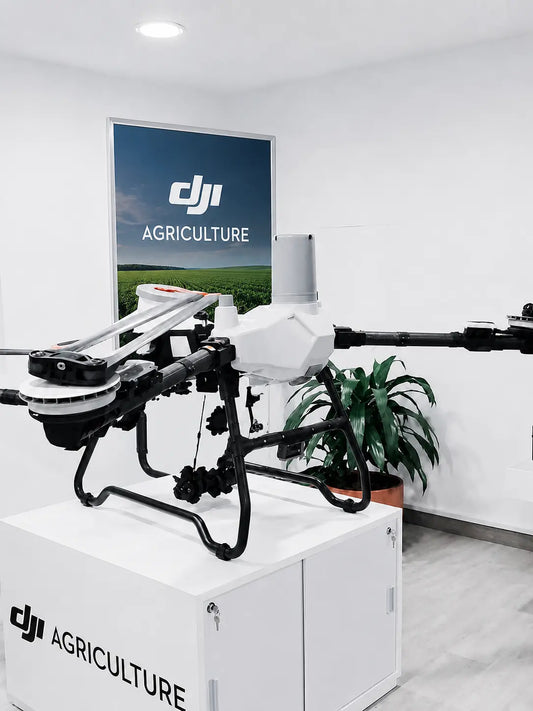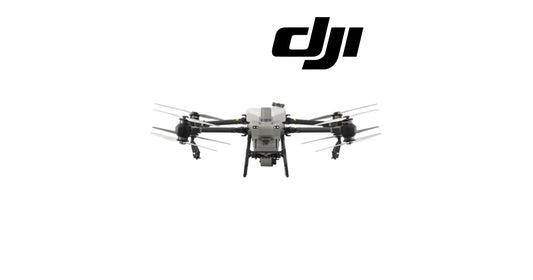

DJI Agras T55 vs DJI Agras T70P: Complete Mid-Range Agricultural Drone Comparison
Share
DJI Agras T55: Finding the Right Size Inside DJI’s Current Agras Family
The DJI Agras T55 and DJI Agras T70P are close enough to invite comparison and different enough to reward careful analysis. Both belong to DJI Agriculture’s current platform generation. Both spray, spread, and lift. Both use 62-inch model 6223 carbon-fiber-composite propellers. Both use the RC Plus 2 AG controller environment, O4 communications, current columnar-interface batteries, modern radar and vision sensing, 400 kg/min-class spreading, 10 m standard lift cables, and rapid charging options.
The model names appear to provide the answer: T55 should be the smaller platform and T70P should be the larger one. That is true for maximum capacity, but it is not the complete story.
The T55 carries 50 L for spraying, 55 kg for spreading, and 40 kg for lifting. It is published at 45 kg with the compact DB1050 battery and 48.4 kg with the DB1580. Its standard dual-sprinkler spray system moves up to 40 L/min, and its optional four-mist system reaches 50 L/min.
The T70P carries up to 70 L for spraying, 70 kg for spreading, and 65 kg for lifting. It is published at 52 kg with DB1580 and 56 kg with DB2160. Yet its standard dual-nozzle spray system is rated at 30 L/min, while the optional four-nozzle system reaches 40 L/min.
That creates the defining comparison. T70P provides greater payload and endurance potential. T55 provides greater maximum liquid flow and lower aircraft weight. Both publish the same 4–11 m effective spray-width range and 3–10 m spreading-width range. The buyer therefore has to decide whether the business is limited by load size, pump demand, lift mass, battery duration, physical handling, or ground support.
Ares Acres helps American operators evaluate the complete system: aircraft, payload equipment, batteries, charging, controller, positioning, relay, transport, parts, setup, and support. Review the live DJI Agras T55 Premium Set, explore DJI Agras drones, browse DJI T70 parts and DJI Agras parts, or contact Ares Acres for a configuration based on crop, application rate, acreage, material, terrain, labor, transport, and power.
Prefer to watch first? The supplied video introduces the T55’s 50 L spray tank, 40 L/min standard flow, optional 50 L/min mist system, DS80L spreader, DL100 lift system, obstacle intelligence, batteries, cooling, controller, O4 relay, and D-RTK support. This article compares those features with DJI’s published T70P specifications and turns the numbers into a practical fleet decision.
Quick Answer: Is the DJI Agras T55 or T70P Better?
Choose T55 when higher spray flow, lower weight, easier solo handling, the lighter DB1050, a smaller D8000iE power package, 50 L routes, and 40 kg-or-lower lift work fit the operation. It is a highly capable, portable current-generation platform rather than a compromised version of T70P.
Choose T70P when the operation can use a 70 L spray tank, 70 kg spreading payload, 100 L spreading hopper, 65 kg lift system, DB2160 endurance, and the higher-output D14000iE or C12000 power environment. It is a stronger fit for longer routes and heavier material or cargo work.
Choose both when the business serves diverse jobs. T55 can take smaller blocks, high-flow missions, rapid one-pilot dispatches, and lighter lift work. T70P can take longer spray routes, 70 kg spread loads, and 40–65 kg lift assignments. Shared propellers, controller compatibility, feeder compatibility, and portions of the charging ecosystem can make this pairing more efficient than mixing unrelated generations.
The T70P wins maximum payload. The T55 wins standard and optional maximum spray flow, aircraft lightness, and compact power handling.
What You Will Learn
This guide explains:
- the practical difference between 50 L and 70 L spray tanks;
- why the T55 has higher maximum spray flow;
- how battery selection affects T70P payload and endurance;
- how the shared 4–11 m spray-width range changes the comparison;
- the difference between 80 L/55 kg and 100 L/70 kg spreading;
- when a 40 kg or 65 kg lift system is the better fit;
- what DB1050, DB1580, and DB2160 mean in the field;
- how D8000iE/C7000 and D14000iE/C12000 support footprints differ;
- which components DJI confirms as common and which remain model-specific;
- how aircraft weight and folded dimensions affect transport;
- how to compare daily productivity without relying on one headline; and
- which platform fits farms, owner-operators, and custom applicators.
DJI Agras T55 vs T70P Specification Table
| Category | DJI Agras T55 | DJI Agras T70P | Practical meaning |
|---|---|---|---|
| Published weight with smaller supported battery | 45 kg with DB1050 | 52 kg with DB1580 | T55 is 7 kg lighter |
| Published weight with larger supported battery | 48.4 kg with DB1580 | 56 kg with DB2160 | T55 remains 7.6 kg lighter |
| Spray tank volume | 50 L | 70 L | T70P holds 40% more liquid |
| Spray operating payload | 50 kg | 70 kg published system maximum | T70P supports the higher maximum; battery/configuration affects takeoff limit |
| Standard maximum flow | 40 L/min, two sprinklers | 30 L/min, two nozzles | T55 has 33% more standard flow headroom |
| Optional maximum flow | 50 L/min, four mist sprinklers | 40 L/min, four mist nozzles | T55 has 25% more optional flow headroom |
| Droplet range | 50–500 μm | 50–500 μm | Same broad published range |
| Effective spray width | 4–11 m | 4–11 m | Width does not choose the aircraft |
| Spreading tank | 80 L | 100 L | T70P adds 20 L |
| Spreading payload | 55 kg | 70 kg | T70P adds 15 kg |
| Maximum spread discharge | 400 kg/min, compound fertilizer test condition | 400 kg/min, compound fertilizer test condition | Same published ceiling |
| Effective spreading width | 3–10 m | 3–10 m | Same published range |
| Lift capacity | 40 kg | 65 kg | T70P adds 25 kg |
| Standard/recommended cable | 10 m / 10–15 m | 10 m / 10–15 m | Same published guidance |
| Propeller | 6223, 62-inch carbon-fiber composite | 6223, 62-inch carbon-fiber composite | DJI confirms compatibility |
| Smaller battery | DB1050, 20 Ah, 8.3 kg | DB1580, 30 Ah, 11.7 kg | Different minimum support scale |
| Larger battery | DB1580, 30 Ah, 11.7 kg | DB2160, 41 Ah, 14.7 kg | T70P offers more energy |
| Main portable power | D8000iE, 6.5 kW recharge output | D14000iE, 9.65 kW on T70P spec page | T55 package is lighter; T70P package is stronger |
| Primary grid charger | C7000, 7 kW three-phase rating | C12000, 12 kW three-phase rating | Available site power matters |
| Controller | RC Plus 2 AG, TKPL 2 | RC Plus 2 AG, TKPL 2 | DJI confirms T55/T70P controller compatibility |
| Fully folded size | 1120 × 896 × 934 mm | 1160 × 900 × 960 mm | T55 is slightly smaller in every listed dimension |
| RTK hover accuracy | ±10 cm horizontal/vertical | ±10 cm horizontal/vertical | Same published RTK figure |
| Configurable flight radius | 2 km | 2 km | Same public planning figure |
| Wind resistance | 6 m/s | Less than 6 m/s published | Operate to current limits and conditions |
Published maximums are not universal recommended settings. The DJI Agriculture app can recommend loading based on aircraft status, battery, configuration, environment, elevation, and task. Optional hardware, regional packages, firmware, and documentation should be verified before purchase or operation.
1. The Real Difference: Payload Versus Flow
T70P is the capacity aircraft in this comparison. It adds 20 L of spray volume, 15 kg of spread payload, 20 L of spreader volume, and 25 kg of lifting capacity. Its DB2160 option adds energy that helps make those larger loads useful.
T55 is the flow-and-handling aircraft. Its standard pumps deliver up to 40 L/min compared with 30 L/min on T70P. Its optional mist system delivers up to 50 L/min compared with 40 L/min. The aircraft itself is lighter, its standard battery is 3.4 kg lighter than DB1580, and its primary generator is much easier to move.
Neither strength cancels the other. A route may need 65 L of liquid but only 20 L/min flow; T70P can avoid a refill while both pumps meet demand. Another route may need 38 L/min but use only 45 L before completion; T55 standard hardware fits the demand while T70P standard hardware would require a setting change or optional nozzles.
The business should identify which constraint occurs in paid work:
- tank empties before route completion;
- pump reaches its ceiling at the required rate, speed, and width;
- battery reaches return state before useful payload is exhausted;
- spreader empties too frequently;
- cargo exceeds 40 kg;
- aircraft and power equipment require too much handling; or
- the ground station cannot prepare the next load fast enough.
T70P solves the first, fourth, fifth, and often third constraints. T55 solves the second and sixth, while a well-built ground station solves the seventh for either model.
2. Spray Capacity: 50 Liters Versus 70 Liters
The T70P tank is 40% larger by nominal volume. At the same application volume, a full 70 L load theoretically covers 40% more area than a full 50 L load.
At 2 gallons per acre, 50 L represents approximately 6.60 theoretical acres, while 70 L represents approximately 9.25 acres. At 5 gallons per acre, the figures are approximately 2.64 and 3.70 acres. Real coverage will be lower or divided differently because of route ends, reserve, tank fill, battery, wind, ferry distance, and operational decisions.
The extra 20 L matters when it removes a refill. If a field needs 62 L, T55 requires a second load while T70P can theoretically complete the liquid requirement in one. A return, landing, refill, battery decision, restart, and connection route can consume several nonproductive minutes.
If the field needs 40 L, both finish on one load. T70P’s remaining capacity does not create more output. T55 may be faster to stage and move to the next block.
The value of 70 L therefore grows with continuous route length. Operations serving large rectangular fields are more likely to exploit it than contractors moving among small, irregular blocks. Annual acres do not reveal that difference; field-size distribution does.
3. T70P Payload Depends on Complete Configuration
DJI publishes the T70P spray tank at 70 L and the system operating payload at 70 kg. The aircraft specifications also publish takeoff limits by battery and nozzle configuration. With DB1580, the standard two-nozzle maximum spraying takeoff weight is 102 kg. With the aircraft published at 52 kg, that arithmetic leaves 50 kg before considering the stated configuration. With DB2160, the standard maximum takeoff weight is 126 kg and aircraft weight is 56 kg, aligning with a 70 kg difference.
The practical lesson is not to improvise a payload calculation. The app intelligently recommends loading based on aircraft state, environment, task, and installed equipment. A buyer who expects to use the full 70 L should confirm the required battery, region, configuration, and current documentation.
T55 is simpler in this specific comparison. Its published standard spraying weight and maximum takeoff figures support the 50 kg operating payload with either DB1050 or DB1580 under the listed configurations, while optional nozzle equipment changes the maximum takeoff value.
This is why a tank-volume claim is not enough for a purchase. The quote should state battery model, spray system, optional nozzles, supported operating payload, and power equipment as one package. A 70 L tank with an underspecified battery plan may not deliver the intended route.
4. Standard Spray Flow: 40 Versus 30 Liters per Minute
T55 standard dual sprinklers deliver up to 40 L/min. T70P standard dual nozzles deliver up to 30 L/min. The 10 L/min difference gives T55 one-third more maximum standard flow headroom.
Flow becomes important when the product of application rate, speed, and swath approaches the pump ceiling. In metric units:
Required flow in L/min = rate in L/ha × speed in km/h × swath in m ÷ 600.
At 50 L/ha, 36 km/h, and 10 m swath, required flow is 30 L/min. That reaches the T70P standard maximum while remaining below T55’s 40 L/min standard maximum.
At 60 L/ha with the same speed and width, required flow is 36 L/min. It fits T55 standard hardware but exceeds the published T70P standard maximum. T70P could reduce speed, narrow the route, or use the optional four-nozzle system within the supported workflow.
This does not make 36 L/min agronomically correct. The calculation only determines system demand. Label, crop, droplet, weather, height, downwash, coverage, and verified deposition remain controlling.
T55 is the clearer choice when high-rate routes repeatedly push above 30 L/min and the operator wants that capability in the standard sprinkler configuration. T70P is the clearer choice when flow remains moderate and the extra 20 L reduces cycling.
5. Optional Mist Flow: 50 Versus 40 Liters per Minute
With optional four-mist hardware, T55 reaches a published maximum of 50 L/min. T70P reaches 40 L/min. T55 retains a 10 L/min advantage.
Optional hardware must be treated as optional in the quote, article, and operational plan. The 50 L/min T55 headline does not belong to the standard two-sprinkler package. A buyer pursuing orchard or high-volume work should confirm that the four LX09510DX mist sprinklers, related hardware, installation, firmware support, calibration, spares, and training are included.
T70P optional mist hardware uses its specified nozzle model and reaches 40 L/min. It combines that flow with up to 70 L of tank capacity, which can extend the route compared with a 50 L T55 at the same rate.
At an actual demand of 38 L/min, both optional systems have published headroom; T70P capacity may win. At 45 L/min, only T55’s optional ceiling covers the mathematical demand, although its tank will empty more quickly.
Orchard performance cannot be reduced to maximum flow. Canopy density, row, height, speed, droplet, downwash, wind, terrain, obstacle routing, and deposit verification determine the result. The optional system creates capability; field validation converts capability into an application program.
6. Spray Width and Droplet Range
Both models publish a 4–11 m effective spray-width range and a 50–500 μm droplet-size range. These equal figures remove two common shortcuts from the decision.
T70P cannot be assumed to cover a wider path simply because it carries more liquid. T55 cannot be assumed to create a finer droplet simply because it has higher flow. The validated operating setup determines both.
The shared width means pass count can be comparable when both aircraft are used at the same verified swath. In that case, T70P’s primary spray advantage is load duration and battery choice, while T55’s is flow headroom and handling.
Matching droplet values do not make the spray systems identical. Sprinkler model, nozzle placement, pump output, propulsion, downwash, height, speed, and aircraft mass affect liquid behavior beneath the aircraft. Settings must be established for each model.
The lower 4 m end can serve constrained blocks or certain row scenarios. The 11 m maximum can increase broad-acre efficiency when verified. Neither should be selected solely because it is available in the planning menu.
7. Field-Crop Productivity
T70P is attractive for broad-acre work because 70 L can reduce refill frequency and DB2160 can support longer, heavier missions. DJI also advertises up to 20 m/s maximum operation speed under stated conditions. Speed is valuable only when rate, flow, swath, sensing, route, and application quality remain within the supported plan.
T55 can be equally compelling when high flow is the dominant constraint. A contractor applying higher volumes may be forced to slow T70P standard hardware while T55 standard hardware maintains the mathematical demand.
Daily output should be modeled as a complete cycle:
- productive pass time;
- turns and obstacle bypass;
- ferry to and from refill;
- landing and takeoff;
- liquid transfer;
- battery exchange;
- cooling and charging;
- inspection and route restart; and
- any waiting on crew, weather, or customer.
T70P can remove some refill cycles. T55 can shorten handling and support cycles. The winning aircraft is the one that reduces the slowest recurring part of the real day.
8. Orchards, Vineyards, and Complex Blocks
T55’s optional 50 L/min mist system, enhanced power-line detection, obstacle recording, path capture, Tri-Vision, AR display, O4 relay support, lighter aircraft, and compact fold make it a strong orchard candidate.
T70P adds 20 L of liquid, a 65 kg lift system, Safety System 3.0, single-side spraying features, DB2160 endurance, and the same published spray-width range. In longer orchard rows, the capacity can reduce refill frequency.
Complex blocks penalize excess capacity when routes are short and reward it when rows are long. The operator should map actual liquid use per block. If most blocks consume 35–48 L, T55 is naturally right-sized. If they consume 55–68 L, T70P may eliminate repeated split loads.
Both aircraft require three-dimensional planning. Wires, trellis systems, branches, dead trees, poles, slopes, people, vehicles, and changing canopy conditions challenge sensing. DJI specifically warns that observation can vary with light, rain, fog, target material, position, and shape.
Deposit checks should determine the chosen configuration. A higher-flow system that does not improve interior-canopy coverage is not automatically better. A larger tank that forces an unsuitable route is not automatically better. The agronomic outcome controls.
9. Spreading: 80 Liters and 55 Kilograms Versus 100 Liters and 70 Kilograms
T55 DS80L holds 80 L and carries 55 kg. T70P Spreading System 4.0 holds 100 L and carries 70 kg. T70P adds 20 L of hopper volume and 15 kg of payload.
Both publish up to 400 kg/min maximum discharge with compound fertilizer under DJI’s stated test condition. Both publish a 3–10 m effective spreading-width range. Maximum throughput and width therefore do not select the aircraft; material capacity does.
At a 100 kg/ha target rate, a 55 kg T55 load represents 0.55 theoretical hectare, while a 70 kg T70P load represents 0.70 hectare. T70P can remain on the route longer. At low-rate seeding, hopper volume may become limiting before mass; its 100 L tank adds value.
T55 still carries a substantial bag-class load and can move material at the same published maximum discharge class. It is attractive when blocks are smaller, the ground crew handles bags manually, or 55 kg aligns with packaging and route.
Spreader selection should use actual material. Bulk density, diameter, shape, moisture, flow, fragility, feeder, disc setting, speed, width, and desired uniformity determine performance. Nominal hopper volume never replaces calibration and verification.
10. Feeder and Spreader Compatibility
DJI confirms that T55 screw feeders are compatible with T70P and T100. T55 also publishes five feeder choices across standard and optional configurations, including a small-medium feeder for certain aquaculture-feed ranges.
The complete T55 spreader is not compatible with T70P. DJI states that T55’s spreader differs from T70P, T100, and T25P. By contrast, T70P and T100 spreader systems have a documented compatibility relationship, although their tanks are not interchangeable.
This distinction matters for parts planning. A business can stock certain feeder types for use across models, but it cannot move the complete DS80L onto T70P. Wiring, mount, hopper, weighing, disc, frame, and aircraft integration remain model-specific.
Material templates can improve repeatability once the right feeder and settings have been established. Lot changes, moisture, wear, and storage can still alter flow. “Calibration-free” convenience should be understood as automated calibration and stored-template support, not immunity from physical variation.
11. Lifting: 40 Kilograms Versus 65 Kilograms
T55 DL100 supports a 40 kg operating payload. T70P supports 65 kg. The 25 kg difference expands T70P into a heavier cargo class.
Both publish a 10 m standard cable and recommend 10–15 m. Both require attention to swing, windward area, rigging, hook and rope weight, route, climbing, destination, emergency release, and people below.
T55 is right-sized for recurring loads such as smaller bags, compact equipment, orchard supplies, or other approved cargo below 40 kg. It can create useful logistics without committing to the heavier platform.
T70P is required when legitimate tasks fall between 40 and 65 kg. A business should never split or overload a mission merely to force it onto T55. The app’s recommended load can be below the maximum because of environment and aircraft state.
Lifting should be evaluated as recurring work. A 65 kg capability used once does not automatically justify T70P. A contractor moving 50 kg loads weekly has a direct, measurable reason to choose it.
12. Aircraft Weight and Solo Handling
T55 weighs 45 kg with DB1050 and 48.4 kg with DB1580. T70P weighs 52 kg with DB1580 and 56 kg with DB2160. The T55 is approximately 7–7.6 kg lighter in the paired published configurations.
That difference is felt during vehicle loading, unloading, repositioning, unfolding, inspection, payload change, and recovery. T55’s handles and DB1050 make its “one pilot” design credible for routine field movement.
T70P remains comparatively compact for a 70 kg-class system, and it folds to dimensions only slightly larger than T55. It is not in the same ground-handling class as T100. A proper ramp, dolly, trailer height, and lifting posture can make T70P efficient.
Loaded aircraft should not be manually moved as if empty. Plan to fill liquid or granules at the launch position. The support layout should prevent personnel from carrying the combined aircraft and payload mass.
For frequent small-job dispatch, T55 handling creates margin. For longer jobs with fewer moves, T70P capacity can outweigh the extra kilograms.
13. Folded Dimensions and Transport
T55 fully folded measures 1120 × 896 × 934 mm. T70P measures 1160 × 900 × 960 mm. T55 is 40 mm shorter, 4 mm narrower, and 26 mm lower in the respective published dimensions.
The difference is modest compared with the T55-versus-T100 comparison. Many vehicles that fit one can be configured for the other, but exact doors, racks, tie-downs, and service clearances still require measurement.
The larger transport difference comes from the support equipment. T55 can use the compact DB1050 and D8000iE strategy. T70P’s DB2160 and D14000iE/C12000 strategy adds battery, generator, fuel, cooling, and electrical scale.
Transport should be modeled as a system:
- aircraft bay and payload-module storage;
- clean and contaminated zones;
- batteries and cooling;
- generator ventilation and fuel;
- water and chemical containment;
- granular material and feeders;
- lift hardware and rigging;
- controller, relay, and RTK;
- spares and tools; and
- safe operator movement.
Two aircraft with nearly identical folded dimensions can require very different trailers because of the chosen power and payload strategy.
14. Shared Propellers and What Commonality Really Means
DJI states that T55 and T70P use the same 6223 carbon-fiber propellers. This is valuable confirmed commonality. A mixed fleet can reduce the number of unique spare propeller models and simplify technician familiarity.
Commonality still requires correct rotation direction, installation, fasteners, inspection, service life, and part identity. A propeller that is damaged on one aircraft should not be moved to another simply because it fits.
The models do not have identical motors. T55 lists a 155 × 16 mm stator at 55 rpm/V KV. T70P lists 155 × 22 mm at 65 rpm/V. Propeller commonality does not make the propulsion assemblies interchangeable.
Operators should maintain a compatibility ledger with three categories:
- confirmed shared parts;
- model-specific parts; and
- parts that appear similar but remain unverified.
Only the first category belongs in cross-model inventory planning. Visual resemblance and shared generation are not evidence.
15. Safety Systems
T55 combines new-generation millimeter-wave radar and Tri-Vision. DJI describes up to 250,000 radar points per second, enhanced power-line detection, smooth bypassing, obstacle recording, 360-degree horizontal pedestrian and vehicle awareness during takeoff and landing, and rich AR display features.
T70P Safety System 3.0 combines front and rear millimeter-wave radar with a tri-eye vision system. DJI publishes up to 60 m measurement range, effective safe obstacle-avoidance speed up to 13.8 m/s under stated conditions, a minimum effective avoidance height, and 2.5 m stable-hover distance after braking under the specification.
The systems share modern current-generation priorities and should both be treated as layered assistance. T55 emphasizes saved obstacle data and simplified field learning. T70P emphasizes its established Safety System 3.0 architecture and capacity-class operations.
Neither actively eliminates every hazard. DJI’s T70P footnotes specifically identify linear obstacles as requiring marking and state that moving objects cannot be actively avoided in the same way. T55 guidance warns that dirty vision sensors or nighttime operation can reduce the system to radar-only behavior.
The best aircraft is the one whose sensing is paired with accurate field data, clean hardware, conservative settings, takeoff-zone control, and a trained pilot.
16. Obstacle Recording and Field Planning
T55 supports a path-recording workflow in which the pilot flies a loop around a field, allowing the system to plan the area and detect and save supported obstacles. This reduces the friction of creating a field file and can make repeat operations more informed.
The feature is especially valuable to custom applicators who add customer fields every week. Mapping time is often unpaid, yet rushed boundaries create operational risk. A quick, intuitive capture process encourages the pilot to build better data.
T70P supports current automatic operation, AR displays, sensing, and route tools. It also provides single-side spraying behavior around boundaries and obstacles. A business with established T70P maps can build highly repeatable workflows.
Saved obstacles are not permanent truth. Poles can be added or removed, wires can sag, irrigation equipment moves, trees grow, vehicles appear, and field access changes. Review is required before every operation.
T55 has the clearer affirmative story for fast one-loop field capture and accumulating obstacle data. T70P has the clearer story when longer routes and payload continuity use a mature planned field. Both benefit from careful data management.
17. RC Plus 2 AG Controller Compatibility
DJI’s T55 FAQ states that its remote controller is compatible with T100 and T70P. Both T55 and T70P specifications list controller model TKPL 2 with a 7-inch 1920 × 1200 display and 1,400 cd/m² brightness.
The controller publishes 3.8 hours on its internal battery and 3.2 hours on the optional external battery under stated conditions. Button layout, bright display, physical controls, camera views, AR information, route planning, and payload status support long agricultural days.
Controller commonality can reduce the number of backup units a mixed fleet needs. It can also reduce training friction because pilots work inside a related interface.
Exact pairing is still a controlled process. Regional controller versions, firmware, app version, aircraft binding, RTK module, external battery, cables, antennas, and accessories should be verified. Do not assume any RC Plus 2-branded device will control every aircraft without the supported configuration.
The high-brightness display must remain clean and readable. A brighter screen improves sunlight visibility, but glare, fingerprints, heat, and poor mounting can still obscure route and warning information.
18. O4 Relay and D-RTK 3 AG
Both aircraft support the current O4 accessory environment. An O4 Relay can help when tree lines, terrain, orchard rows, or other geometry obstruct the direct controller-aircraft path. D-RTK 3 AG can provide local high-precision positioning support where the workflow requires it.
These accessories solve different problems. Relay addresses communications geometry. D-RTK addresses positioning correction. A difficult field may need both, while an open field with strong direct transmission and suitable network corrections may need neither.
The relay’s advertised range is measured in controlled, unobstructed conditions and varies by regional standard. Placement, antenna orientation, elevation, interference, batteries, and the actual field determine performance.
D-RTK accuracy depends on setup, satellite visibility, multipath, distance, atmospheric conditions, and correction mode. It should be placed in a stable, open location away from interference.
The full-set decision should include accessories because they change what “ready to work” means. Comparing a T55 set with relay and RTK against a bare T70P quote would distort price; so would comparing a complete T70P precision package with an incomplete T55.
19. DB1050, DB1580, and DB2160 Battery Strategy
T55 supports DB1050 at 20 Ah and 8.3 kg as standard, plus DB1580 at 30 Ah and 11.7 kg. T70P supports DB1580 and DB2160 at 41 Ah and 14.7 kg.
DB1580 forms the bridge between the aircraft. That shared pack can be strategically valuable in a mixed T55/T70P fleet, subject to approved aircraft configuration, firmware, condition, and operating limits.
T55 with DB1050 creates the lightest routine workflow. High-flow spraying can empty 50 L quickly enough that a larger battery may not improve the cycle. DB1580 is useful for longer, lower-rate, higher-altitude, or endurance-oriented work.
T70P with DB1580 produces the lighter T70P configuration, but the published takeoff-weight table must be considered when planning spray payload. DB2160 adds energy and aligns with the system’s 70 kg maximum capacity.
Battery selection should be mission-based rather than status-based. The largest battery is not always best. Additional energy adds mass, purchase cost, cooling demand, and charge energy. The smallest battery is not always best if it forces an early return with payload remaining.
Track every pack by model, serial or fleet number, cycle, health, event history, and retirement criteria. Shared battery compatibility makes record discipline more important, not less.
20. D8000iE Versus D14000iE Field Power
The T55-oriented D8000iE publishes 6.5 kW DC recharge output, a 20 L fuel tank, and approximately 46 kg weight. DJI lists 8–9 minutes from 30% to 95% for DB1050 under stated conditions.
The T70P specification lists D14000iE at 9.65 kW recharge output for that ecosystem, a 30 L fuel tank, and approximately 87 kg weight. It lists 7–8 minutes for DB1580 and 8–9 minutes for DB2160 from 30% to 95% under stated conditions.
D8000iE is the handling winner. It is roughly 41 kg lighter and occupies a smaller support role. D14000iE is the power winner and is designed to cycle larger packs.
Generator output must be matched to battery rotation. A smaller compatible charger or generator may eventually charge a larger pack but may not support the aircraft’s desired production rhythm. Conversely, transporting an 87 kg generator for a T55 job that uses DB1050 may be unnecessary.
Fuel quality, oil, ventilation, exhaust, heat, grounding or electrical procedures, service intervals, noise, and fire control belong in the operating plan. A generator is not an accessory placed wherever space remains; it is high-output field equipment.
21. C7000 Versus C12000 Grid Charging
C7000 publishes up to 7 kW with suitable three-phase input and 2 kW in the listed single-phase configuration. C12000 publishes 12 kW at three-phase 380 V and 3 kW on the listed single-phase input.
The headline charge times rely on adequate input power. A farm with only single-phase service should not use the three-phase time in its productivity model. The electrical installation must be evaluated for voltage, phase, continuous current, connector, cable, protection, ventilation, and location.
DJI lists C7000 compatibility with DB1050, DB1580, and DB2160. C12000 lists DB1580 and DB2160. This creates supported pathways for a mixed current-generation battery fleet.
C7000 can be the compact shared charger for a T55-centered operation with occasional larger packs. C12000 is better for high-tempo T70P use when three-phase service is available.
Charging location should separate chemical residue, fertilizer dust, water, direct sun, and combustible material from high-current equipment. Quiet grid charging can be advantageous near buildings, but environmental and electrical controls remain essential.
22. Onboard and Ground Battery Cooling
T55’s onboard battery heat sink and air-channel design begin cooling the battery in flight. Its ground air-cooled heat sink continues the process after landing.
T70P also uses current-generation high-power battery and cooling support. The larger DB2160 stores more energy and makes airflow, fan condition, radiator cleanliness, and battery temperature central to continuous operation.
Cooling is a production variable. If a battery lands too warm for full-rate charging, the cycle waits. A high-flow T55 can return frequently, increasing the number of thermal transitions. A long-endurance T70P may return less often but with a larger pack requiring more energy removal and recharge.
The correct battery count is the smallest rotation that remains resilient on the hottest realistic day. One pack may fly, one cool, and one charge. More or fewer may be appropriate after timed testing.
Shade, clean airflow, spare fans or approved service parts, disciplined pack staging, and temperature logging can create more production than an extra headline feature.
23. Maximum Takeoff Weight and Recommended Load
T55 maximum takeoff weights vary by battery, spray-nozzle configuration, spreader, and lift system. T70P values also vary substantially by DB1580 versus DB2160 and payload configuration.
Those tables are system limits, not instructions to load to the maximum. DJI states that the Agriculture app recommends loading based on current aircraft state, environmental conditions, and operational task.
Elevation reduces air density. High temperature also reduces density and affects batteries and motors. Wind, climb, route, cargo swing, and equipment condition add demand. The appropriate payload can therefore be below the sea-level published maximum.
Operators should weigh granular and lifting loads rather than estimating by volume. Liquid density can differ from water. Lift payload includes applicable rope and hook weight in DJI’s stated framework.
The comparison should use the load the aircraft can repeatedly carry on the target farms, not the largest number in a table. A T70P whose environment supports only a partial payload may still offer endurance or lift value, but its economic model should use the realistic load.
24. Ground-Station Throughput
T55 can spray at up to 40 or 50 L/min, which can create very short liquid cycles. The mixing and transfer system should be ready with the next measured 50 L load before the aircraft returns.
T70P carries 70 L and can stay on the route longer, giving the ground team more preparation time. Its spreader and lift system also demand heavier material handling.
A ground station should parallelize safe work:
- prepare the next liquid or granular load while the aircraft flies;
- cool and charge the returned battery while another is in use;
- inspect nozzles, pumps, disc, feeder, hooks, cable, and propellers between cycles;
- maintain separation among clean water, concentrates, treated equipment, fertilizer, fuel, and electrical devices; and
- keep the pilot free to review the aircraft and route.
If the ground station needs eight minutes to prepare a T55 load and the aircraft returns in four, the aircraft waits. If it can prepare T70P’s 70 L in six minutes and the route lasts eight, the ground crew stays ahead. The faster pump is not the faster business unless support keeps pace.
25. Daily Productivity Scenarios
Consider a 20-acre field treated at 2 gallons per acre, requiring about 151.4 L in theory. T55 needs just over three 50 L loads, meaning at least four load starts if each full load is 50 L and the last is partial. T70P needs just over two 70 L loads, meaning at least three. T70P can remove one refill event.
Now consider five separate 4-acre fields at the same rate. Each uses about 30.3 L. Both aircraft complete every field on one load. Transport and setup dominate, so T55’s lower weight and compact power package may create the better day.
Consider a route demanding 35 L/min. T55 standard hardware covers the mathematical demand. T70P standard hardware does not; it needs optional hardware or a route adjustment. If optional T70P is installed, its larger tank may then reduce cycling.
For spreading, a job needing 350 kg of material requires at least seven T55 55 kg load starts if the last is partial, compared with five T70P 70 kg starts. Load time and connection routes determine the actual difference.
These examples show why no single acres-per-hour claim can settle the comparison. Field clustering, rate, route, payload, flow, and ground time must be modeled together.
26. Total Cost of Ownership
A complete cost comparison includes aircraft, batteries, generators or chargers, cooling, spray options, spreader and feeders, lift system, controller, relay, RTK, transport, spares, delivery, setup, training, service, labor, fuel or electricity, battery replacement, cleaning, maintenance, downtime, and insurance or applicable operating expense.
T55 often wins installed-system simplicity. DB1050 and D8000iE are lighter, the aircraft costs less to transport physically, and 50 L/55 kg/40 kg roles can serve a broad market.
T70P can win revenue capacity. Larger loads reduce cycles, 65 kg lift opens jobs T55 cannot perform, and DB2160 supports endurance. That value should be tied to actual annual work.
Do not compare an aircraft-only T55 price against a complete T70P package or vice versa. Build two itemized ready-to-work configurations with the same assumptions for battery redundancy, training, and spares.
The correct decision produces acceptable payback under conservative utilization. If T70P requires every optimistic job to materialize, T55 may be the more resilient investment. If T55 would force the business to turn away recurring 50–65 kg lift work, T70P may pay for itself through capability.
27. Which Is Better for a First-Time Buyer?
T55 is often the better first Agras platform. It offers all three payload categories, modern safety, high spray flow, current batteries, and controller commonality in a lighter system.
T70P is the better first platform when the buyer already knows that 50 L routes are too short, spread loads regularly exceed 55 kg, lift loads exceed 40 kg, or DB2160 endurance is required. Buying T55 first in that situation can postpone the correct purchase.
First-time buyers should prioritize complete delivery and support. The aircraft needs the correct batteries, charging, cooling, feeder, optional nozzles, spares, setup, training, and service channel to become a production asset.
28. Which Is Better for an Existing T55 Fleet?
Adding another T55 maximizes identical-fleet simplicity. Aircraft, procedures, payloads, batteries, parts, transport, and training remain standardized.
Adding T70P expands capacity while preserving meaningful current-generation commonality. DB1580 can bridge the battery strategies, the controller is compatible, the 6223 propeller is shared, and T55 feeders are compatible with T70P. The complete spreader and many structural components remain different.
The addition makes sense when specific jobs require 70 L, 70 kg spread, 65 kg lift, or DB2160 endurance. If those jobs do not exist, fleet simplicity may be worth more than capacity.
29. Which Is Better for a Commercial Applicator?
T55 is strong for rapid dispatch, mixed block sizes, high-flow applications, orchard work, and owner-operated routes. T70P is strong for longer fields, more material per load, and heavier lift contracts.
A commercial applicator can dispatch by job profile rather than model prestige. The business should maintain a matrix covering field size, rate, flow demand, spread mass, lift weight, access, crew, and transport.
Two T55 aircraft can also provide parallel capacity and redundancy. One T70P may complete longer routes with fewer refills. Compare fleet throughput, crew, vehicles, and failure resilience—not only aircraft payload.
30. When T55 Is the Clear Choice
T55 is the clearer choice when:
- high spray flow is more valuable than 20 L of extra tank capacity;
- most blocks use 50 L or less;
- solo handling affects profit;
- transport and generator weight are constrained;
- spread loads remain at 55 kg or less;
- lift loads remain at 40 kg or less;
- DB1050 cycle timing matches the work;
- orchard or complex-block deployment favors the lighter aircraft; or
- the buyer wants the most accessible current-generation multi-role system.
31. When T70P Is the Clear Choice
T70P is the clearer choice when:
- routes regularly use 51–70 L;
- reload frequency is the main bottleneck;
- granular work benefits from 70 kg or 100 L;
- recurring lift loads exceed 40 kg;
- DB2160 endurance is necessary;
- the business already has larger power and transport support;
- T70P/T100 fleet commonality matters; or
- the additional capacity is tied to contracted revenue.
32. When Both Are the Strongest Fleet
Use T55 for short and medium routes, high-flow missions, one-pilot dispatch, and lighter lift. Use T70P for long routes, 70 kg spreading, 40–65 kg lift, and endurance-oriented work.
The pairing shares enough confirmed components to be strategically coherent without pretending the aircraft are identical. Standardize the controller environment, certain batteries and feeders, propeller inventory, terminology, and training. Separate complete payload modules, model-specific service parts, charge settings, and checklists.
Fleet specialization can improve margin because neither aircraft spends the day carrying unused capability. It also creates backup when one aircraft is configured for a different payload or undergoing service.
33. Pre-Purchase Checklist
Before choosing, confirm:
- exact regional aircraft and firmware;
- included spray configuration;
- optional mist hardware and installation;
- battery model and quantity;
- supported payload for that battery;
- generator or charger and actual input power;
- cooling equipment;
- spreader, included feeders, and material fit;
- lift system and required rigging;
- controller, external battery, relay, and RTK;
- transport dimensions and total support footprint;
- setup, calibration, training, and delivery;
- critical spares and lead times;
- warranty and service process; and
- live price and availability for every line item.
34. Weighted Decision Scorecard
Weight spray capacity, spray flow, spread payload, lift capacity, handling, endurance, charging, safety, new-field setup, parts, transport, labor, acquisition, and revenue from one to five. Score each actual package and multiply.
A high-flow orchard contractor will weight T55 strengths. A fertilizer contractor and 50 kg lift service will weight T70P strengths. Run the score for next season and for a three-year plan.
Unknown price, delivery, or regional configuration should remain provisional rather than receiving an optimistic score. A sound decision survives conservative assumptions.
35. Controlled Field Evaluation
Use a representative job and hold the agronomic objective constant. Record liquid requirement, route, verified swath, flow, speed, flight time, refill time, battery state, cooling, charging, ground waiting, handling time, and crew.
For spreading, record material, feeder, mass, bulk density, rate, width, uniformity, and reload time. For lifting, use a professionally controlled load within published and current recommended limits.
Measure ready-to-work cycle to ready-to-work cycle. Translate verified time and labor differences into annual margin. The trial should identify the bottleneck each aircraft removes.
36. Five Detailed Buyer Scenarios
Scenario A: One-pilot grain and cover-crop operation
The farm treats scattered 20- to 60-acre blocks, applies moderate liquid volumes, seeds cover crops, and transports equipment in an enclosed trailer. Most spray routes use less than 50 L before reaching a logical refill point. Lift is occasional and stays below 25 kg.
T55 is the stronger fit. Its 50 L capacity is being used, not merely tolerated; its higher flow provides reserve; and DB1050/D8000iE reduce the weight one person handles. The 55 kg spread payload remains substantial. T70P’s extra capacity would be useful on some passes but may not offset support scale.
Scenario B: Fertilizer contractor serving long rectangular fields
The contractor spreads high total tonnage, has a material tender, carries a dedicated crew, and loses time primarily to hopper refills. Lift work occasionally reaches 55 kg.
T70P is the stronger fit. The 100 L hopper and 70 kg payload reduce reload events, and 65 kg lift covers the recurring cargo. The operation already has the support capacity to exploit DB2160 and D14000iE.
Scenario C: Orchard applicator constrained by liquid flow
The operator applies a verified high-volume program in dense canopy. Typical blocks use 40–48 L, and the existing limitation is pump demand rather than tank volume. Narrow access and frequent field moves make handling important.
T55 with the optional four-mist system is the stronger candidate because its 50 L/min ceiling directly addresses the measured constraint. The aircraft must still be evaluated for deposit, route, obstacles, and refill rhythm.
Scenario D: Mixed farm with 60 kg logistics loads
Spraying volume is moderate, but the farm needs to move recurring 50–60 kg loads over wet or steep ground. T55’s 40 kg lift cannot lawfully or safely solve that requirement by overloading.
T70P is the correct platform because its 65 kg lift class matches the mission. Spray and spread capacity then become additional benefits.
Scenario E: Growing custom business building a two-aircraft fleet
The company already owns T55 and has customers ranging from small orchards to large grain blocks. It wants more capacity but prefers to retain current-generation commonality.
Adding T70P can be strategically strong. T55 remains the rapid-dispatch and high-flow aircraft. T70P takes longer routes and heavier loads. Shared 6223 propellers, controller compatibility, DB1580 pathways, and feeder compatibility reduce—but do not eliminate—fleet complexity.
37. Maintenance and Cleaning Differences
Both aircraft demand prompt cleaning and inspection after liquid and granular work. Residue can affect pumps, sprinklers, tanks, seals, spread discs, feeders, weighing systems, radar surfaces, cameras, cooling passages, electrical areas, and structure.
T55’s 50 L system may cycle more often on a large job, creating more frequent opportunities to inspect but also more connections and refills. T70P’s larger tank reduces cycles but contains more product and can require more time to rinse and handle at changeover.
Spreading fertilizer creates corrosion and contamination risk on either model. The larger T70P hopper moves more mass per load, while T55’s compact system may be easier to remove and stage. Cleaning procedures should follow the current manual and material requirements, protect electronics and bearings, and manage rinse water appropriately.
Lift systems require cable, hook, emergency release, attachment point, and payload-module inspection. A 65 kg system carries higher potential energy than a 40 kg system, but neither permits casual rigging.
Maintenance cost should include access and parts, not only wear rate. A common 6223 propeller shelf and shared feeder inventory help a mixed fleet. Pumps, tanks, spreader frames, lift modules, motors, sensors, arms, and structural items remain model-specific unless DJI explicitly confirms otherwise.
38. Seasonal Readiness and Spare-Parts Planning
A T55 starter shelf should focus on verified propellers, sprinkler and liquid-path wear items, the feeders needed for actual materials, lift cable or hook components if used, cleaning supplies, charging and cooling service items, and approved tools.
A T70P shelf should cover the same functional categories at its specific part numbers, plus the payload and power items associated with heavier service. A shared propeller or feeder should be labeled with all confirmed models; model-specific parts should be physically separated.
Before the season, inspect every battery, connector, cable, generator, charger, cooling device, controller, relay, RTK unit, tank, pump, nozzle, disc, feeder, scale, cable, hook, arm, lock, motor, and propeller. Update firmware and field files deliberately rather than immediately before a critical job.
Parts availability can decide between technically close platforms. A T55 whose high-exposure parts and service path are ready may be a better business asset than a T70P package with missing spares, and the reverse is equally true.
39. Transitioning From Older Agras Equipment
T55 and T70P use current columnar-interface battery architecture. Older DJI Agras equipment before the T70P generation may use a blade interface. DJI states that approved adapter cables can be required when charging across generations.
An adapter is not universal permission. Confirm battery, charger or generator, cable, connector, firmware, and procedure. Never improvise a high-current connection.
An operator moving from T50 should count which batteries, generator, charger, trailer fixtures, propellers, controllers, spreader items, and spares remain useful. T55 and T70P both represent platform transitions, while T55 may be physically easier to integrate.
The transition plan can keep the older aircraft productive while the current-generation fleet proves its workflow. Separate battery zones, clear model labels, aircraft-specific checklists, and controlled adapters prevent cross-generation mistakes.
40. The Defensible Recommendation
For most buyers whose work fits 50 L, 55 kg spreading, and 40 kg lifting, T55 is the more efficient choice. It gives up maximum payload but gains flow, handling, and a smaller power footprint.
For buyers with recurring routes above 50 L, spreading loads above 55 kg, lift loads above 40 kg, or a need for DB2160 endurance, T70P is the more efficient choice. Its extra capability is tied to a documented requirement.
The models are not separated by quality. They are separated by operational scale. Choosing the smaller correct aircraft is more professional than purchasing unused payload. Choosing the larger correct aircraft is more economical than forcing repeated cycles or declining work.
41. Building a Twelve-Month Capacity Model
A buyer can make the decision more concrete by converting the last twelve months of work into load classes. Export or reconstruct every job and record five values: liquid required per field segment, peak required flow, granular mass per route, heaviest recurring lift load, and total nonproductive cycle time. Then place each job into a T55-fit, T70P-benefit, or either-aircraft category.
A T55-fit spray job uses 50 L or less per logical segment and stays within the verified T55 configuration. A T70P-benefit spray job uses 51–70 L in a way that removes a refill or gains meaningful endurance. An either-aircraft job fits both tanks, does not approach either flow ceiling, and should be decided by dispatch, crew, and availability.
Flow receives a separate classification because tank volume cannot solve it. Mark every job whose calculated demand exceeds 30 L/min, then identify which can use optional T70P hardware and which benefits from T55 standard or optional headroom. A job needing 35 L/min may be a T55-standard assignment even when its total liquid requirement is 60 L; the operator can then compare one T70P load with optional hardware against two T55 loads with standard hardware.
For spreading, classify routes at 0–55 kg and 56–70 kg. Then review hopper volume independently. A low-density seed may fill 80 L before reaching 55 kg, making T70P’s 100 L hopper useful even when mass is modest. A dense fertilizer route may be mass-limited first.
For lifting, use actual cargo plus the applicable rigging basis. Loads above 40 kg are not T55 jobs. Loads at or below 40 kg can still favor T70P when endurance, wind margin under the recommended system, or a combined dispatch route supports it. Never reduce the measured load to make it fit an aircraft.
Next, attach minutes to each saved cycle. If T70P removes a refill on 120 jobs and each complete refill cycle consumes five minutes, the theoretical gross saving is 600 minutes, or ten hours, before other effects. If T55 reduces loading, unloading, and setup by eight minutes on 150 small jobs, that is 1,200 minutes, or twenty hours. The smaller aircraft can create the larger annual labor saving when the schedule contains many dispatches.
Attach margin to declined work. If the business turned away 50–60 kg lift jobs, T70P creates a new revenue category. If it declined high-volume canopy work because the existing system lacked flow, T55 optional mist capability can create the new category. Use signed demand, credible customer history, or a conservative utilization estimate rather than an ideal market-size number.
Finally, model resilience. Count how often a second aircraft could have protected a weather window, battery event, payload change, or maintenance interruption. Two right-sized aircraft may be more valuable than one higher-capacity aircraft, while one T70P may be more valuable than one T55 if the entire contract depends on 60 kg loads.
The twelve-month model should end with four totals for each option:
- annual productive time gained;
- annual labor or support time added;
- annual gross margin enabled;
- annual fixed and variable ownership cost.
Run the calculation for T55 only, T70P only, two T55 aircraft, and a mixed T55/T70P fleet where relevant. This prevents a false binary decision and reveals whether the business needs more capacity per aircraft, more aircraft in parallel, or better ground support.
42. Protecting the Value of the Selected Platform
The investment begins at delivery. Record the exact aircraft, payload, battery, generator, charger, controller, relay, RTK, feeder, nozzle, cable, and spare part numbers. Photograph the complete delivered configuration and store current manuals, firmware notes, invoices, training records, and service contacts in one fleet file.
Build aircraft-specific preflight, payload-change, charging, cleaning, and postflight checklists. Shared components can use shared inspection standards, but numerical limits must remain tied to the model and installed battery.
Track job data from the first season. If T55 repeatedly returns with substantial battery and an empty tank, the selected battery strategy may be appropriate. If T70P repeatedly returns with 25 L remaining because routes are short, dispatch it differently. If the aircraft waits on mixing, improve the ground station before assuming another aircraft is required.
Review the decision after the season using actual cycle time, payload use, flow demand, battery temperature, parts consumption, downtime, labor, and margin. The best fleet is not fixed forever; it becomes more precise as the operation collects evidence.
A compact operating dashboard can make that review routine. Track acres or hectares completed, liquid and granular mass applied, lift missions, average payload utilization, refill events, average ground turnaround, battery cycles, maximum observed battery temperature, generator hours, fuel or electricity, unscheduled service hours, parts used, jobs delayed, and jobs declined. Separate T55 and T70P data even when the aircraft share a customer or controller.
Payload utilization is particularly revealing. Divide actual average liquid or granular load by the supported load used for planning. A T70P averaging 38 L on its assignments may be scheduled like a T55, while a T55 averaging full loads and repeated partial refills may be revealing a T70P opportunity. Flow utilization should also be recorded because a moderate average can hide short peak demands that control route speed.
Downtime should be assigned to its true cause: aircraft, battery, charging, cooling, payload, part, weather, field data, crew, tender, customer, or transport. That prevents a support bottleneck from being misdiagnosed as an aircraft-capacity problem.
At the end of the review, retain what is working. A paid-for T55 should not be displaced merely because T70P would carry more. A productive T70P should not be restricted to small blocks merely to equalize aircraft hours. Dispatch each model where its contribution margin, readiness, and capability are strongest.
This evidence should also shape the next spare-parts order and training day. Repeated sprinkler service, feeder changes, cable wear, cooling contamination, or battery-temperature events identify where preventive work will protect the next season. Pilots should review real interventions and route exceptions from both aircraft instead of training only on ideal automatic flights. A fleet that learns from its own data can gain more dependable production without changing a single headline specification.
That disciplined review turns either Agras model from a purchased machine into a continuously improving production system built around the farm’s own evidence.
DJI Agras T55 vs T70P Frequently Asked Questions
What is the biggest difference between T55 and T70P?
T70P carries more: up to 70 L spray, 70 kg spreading, and 65 kg lifting. T55 is lighter and has higher maximum spray flow: 40 L/min standard and 50 L/min optional versus T70P’s 30 and 40 L/min.
Is T70P always better because it has a larger number?
No. T70P is better when the work uses its capacity. T55 can be better when flow, one-pilot handling, transport, smaller power equipment, or job sizes below 50 L determine productivity.
How much liquid does T55 carry?
T55 carries 50 L with a 50 kg published operating payload. The app’s current recommended load and the aircraft configuration should always govern actual loading.
How much liquid does T70P carry?
T70P’s spray system is published at 70 L and 70 kg. Its battery-specific maximum takeoff table means buyers should confirm the battery and configuration required for the intended payload.
Does T70P carry 40 percent more spray liquid?
Yes. Seventy liters is 40% more than 50 L. At the same rate, it represents 40% more theoretical area per full load before route and operating factors.
Which aircraft has higher standard spray flow?
T55. Its standard two-sprinkler system reaches 40 L/min, while T70P standard two-nozzle hardware reaches 30 L/min.
Which aircraft has higher optional spray flow?
T55. Its optional four-mist system reaches 50 L/min. T70P’s optional four-nozzle system reaches 40 L/min.
Does higher T55 flow mean it always sprays faster?
No. Required flow, tank capacity, swath, speed, route, turns, refill time, and application quality all matter. T70P can remain airborne longer on a full load.
Do T55 and T70P have the same spray width?
Both publish 4–11 m. The correct effective width depends on the scene, configuration, height, speed, wind, crop, droplet, downwash, and verified deposit.
Do they have the same droplet range?
Both publish 50–500 μm. The nozzle models and aircraft systems differ, so settings should be validated independently.
Which aircraft weighs less?
T55. It is published at 45 kg with DB1050 and 48.4 kg with DB1580. T70P is 52 kg with DB1580 and 56 kg with DB2160.
Which aircraft folds smaller?
T55 is slightly smaller in each listed fully folded dimension: 1120 × 896 × 934 mm versus T70P at 1160 × 900 × 960 mm.
Which is better for one operator?
T55 generally has the advantage because the aircraft, DB1050, and D8000iE are lighter. Staffing should still match chemical, site, observer, multi-aircraft, and lift requirements.
Which is better for large fields?
T70P often wins when 70 L removes refills and the larger battery supports long routes. T55 can win when the application is flow-limited.
Which is better for small fields?
T55 often wins because 50 L already completes the route and lighter handling reduces nonproductive setup. Actual block size and application volume decide.
Which is better for orchards?
T55 is strong for high-flow mist work and rapid complex-block deployment. T70P adds capacity and endurance. Deposit, obstacle, terrain, and route testing should decide.
How much can T55 spread?
T55 DS80L holds 80 L and carries 55 kg. It publishes up to 400 kg/min maximum discharge under the stated compound-fertilizer test condition.
How much can T70P spread?
T70P holds 100 L and carries 70 kg. It also publishes up to 400 kg/min maximum discharge and a 3–10 m effective width.
Which has the higher maximum spreading rate?
Neither on the published headline; both are rated up to 400 kg/min under the stated condition. T70P carries more material per load.
Are T55 and T70P spreaders interchangeable?
No. DJI states that the complete T55 spreader is different and not compatible with T70P.
Are T55 feeders compatible with T70P?
DJI says T55 screw feeders are compatible with T70P and T100. Confirm the exact part and material use before installation.
Which aircraft lifts more?
T70P lifts up to 65 kg versus T55 at 40 kg. The app’s recommended load, rigging weight, environment, wind, and current manual still govern.
Do they use the same lift cable length?
Both list 10 m standard and recommend 10–15 m. Cable length affects swing, aircraft clearance, ground contact, and entanglement risk.
Do T55 and T70P use the same propellers?
Yes. DJI confirms both use model 6223 carbon-fiber propellers. Correct direction, fasteners, condition, and installation remain essential.
Do they use the same motors?
No. Their published motor stator dimensions and KV differ. Shared propellers do not make the complete propulsion systems interchangeable.
Do they use the same controller?
DJI’s T55 FAQ confirms RC Plus 2 AG controller compatibility with T70P. Verify exact model, region, firmware, binding, and accessories.
Which batteries does T55 support?
DB1050 at 20 Ah and DB1580 at 30 Ah. DB1050 is standard and lighter; DB1580 offers more endurance.
Which batteries does T70P support?
DB1580 at 30 Ah and DB2160 at 41 Ah. Payload and takeoff values should be checked for the installed battery.
Can both aircraft use DB1580?
Yes according to their published specifications. That shared battery can help a mixed fleet, subject to correct firmware, condition, configuration, and operating limits.
Which generator is lighter?
D8000iE, associated with the T55 power strategy, is published at about 46 kg. D14000iE is approximately 87 kg.
Which charger is more powerful?
C12000 has the higher three-phase rating at 12 kW versus C7000 at 7 kW. Actual output depends on available electrical input and supported battery.
Can C7000 charge DB2160?
DJI lists C7000 compatibility with DB1050, DB1580, and DB2160. Confirm cables, firmware, input power, and current instructions.
Does either generator connect to grid power?
The multifunctional inverter generators are field-generation equipment, not grid-input chargers. Use the appropriate separate charger for mains power.
Which has better obstacle avoidance?
Both have modern radar and vision systems. T55 emphasizes enhanced line detection and saved obstacles; T70P publishes Safety System 3.0 parameters. Neither guarantees avoidance.
Can either aircraft detect every wire?
No. Linear obstacles should be inspected, mapped, and treated conservatively. Sensor performance varies with geometry, material, light, weather, contamination, and speed.
Do both support O4 Relay?
Both belong to the O4 accessory environment. Relay need and exact package should be verified for the field and region.
Do both support D-RTK 3 AG?
Both can operate in the current precision-positioning ecosystem. Confirm the regional module, corrections, setup, and package contents.
Which is cheaper?
Live complete-package pricing is required. Compare aircraft, batteries, power, payload systems, accessories, spares, setup, training, delivery, and service—not bare airframes.
Which is better for a first-time owner?
T55 is often easier to integrate. T70P is better when the buyer already has recurring work that requires more than T55’s payload or endurance.
Can a fleet use both?
Yes. Shared propellers, controller compatibility, DB1580, and feeder compatibility help. Complete spreaders and many model-specific parts remain separate.
Is T55 available in the United States?
DJI describes regional availability and directs buyers to authorized dealers. Contact Ares Acres for current U.S. configuration, availability, delivery, and support.
Is T70P available in the United States?
Regional package status and lead time should be confirmed through an authorized source. Ares Acres can compare the current T55, T70-class, and T100 options for the intended work.
Where can I buy a complete T55 set?
Start with the DJI Agras T55 Premium Set and confirm batteries, charging, payloads, accessories, delivery, setup, training, and spares with Ares Acres.
Final Verdict: DJI Agras T55 or T70P?
The DJI Agras T55 is the affirmative choice for operators who want a lighter, highly deployable current-generation aircraft with exceptional liquid-flow capacity. Its 50 L spray system, 55 kg spread payload, 40 kg lift system, DB1050 option, D8000iE support, obstacle recording, path planning, and optional 50 L/min mist system form a complete professional platform.
The DJI Agras T70P is the affirmative choice for operators who need more payload without moving all the way to the T100 class. Its 70 L spray tank, 100 L/70 kg spreader, 65 kg lift system, DB2160 option, and higher-output power environment support longer and heavier work.
The comparison is not “good versus better.” It is flow and handling versus payload and endurance. T55 can deliver 10 L/min more maximum flow in standard and optional comparisons. T70P can carry 20 L more spray, 15 kg more spread material, and 25 kg more lift cargo.
Choose T55 when most jobs fit inside its payload and the business values fast dispatch, one-pilot handling, high-rate spraying, and a compact support system. Choose T70P when repeated refills, 55 kg spread limits, 40 kg lift limits, or battery duration are documented constraints.
Choose both when the customer portfolio is diverse enough to use specialization. The T55 becomes the agile high-flow aircraft; the T70P becomes the longer-route and heavier-payload aircraft. Confirmed propeller, controller, battery, and feeder relationships make that fleet unusually coherent, while model-specific payloads and parts remain clearly separated.
Ares Acres can help turn the comparison into a live full-set plan. Review the DJI Agras T55 Premium Set, browse DJI Agras drones, DJI Agras parts, DJI T70 parts, DJI T100 parts, and DJI accessories, or contact Ares Acres for current configuration, price, availability, delivery, setup, training, and support.
The right Agras model is the one whose complete system removes the constraint that costs the operation the most time, labor, or profitable work.
Internal Resources
- Ares Acres
- DJI Agras T55 Premium Set
- DJI Agras Drones
- DJI Agras Parts
- DJI T70 Parts
- DJI T100 Parts
- DJI T50 Parts
- DJI Accessories
- DJI Agras T100 Full Set
- DJI Agriculture Blog and Tutorials
- Contact Ares Acres
Official Technical Sources
- DJI Agras T55 product page: https://ag.dji.com/t55
- DJI Agras T55 specifications: https://ag.dji.com/t55/specs
- DJI Agras T55 FAQ: https://ag.dji.com/t55/faq
- DJI Agras T70P product page: https://ag.dji.com/t70p
- DJI Agras T70P specifications: https://ag.dji.com/t70p/specs
- DJI Agras T70P FAQ: https://ag.dji.com/t70p/faq
- DJI Agras T70P downloads: https://ag.dji.com/t70p/downloads
Publication note: Verify current regional configuration, battery-dependent payload, optional hardware, compatibility, firmware, recommended load, price, availability, delivery, documentation, and operating requirements before purchase or use.