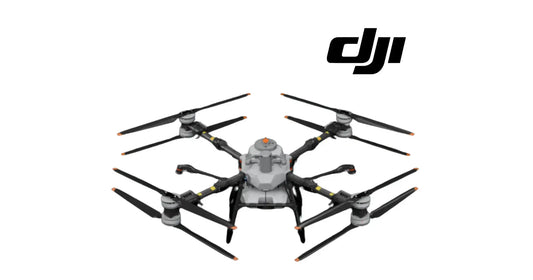

DJI Agras T70P Specifications & Flight Limits: 70 kg Payload, GEO Zones, Wind & Altitude
The DJI AGRAS T70P User Manual gives a concise performance table and then immediately places those numbers inside operational and airspace constraints. The useful way to read the section is not as a specification sheet alone, but as a set of limits that determine where, how fast and under what conditions the aircraft can be operated.
Quick Answer: DJI lists the T70P at 56 kg basic empty weight, 70 kg maximum payload at sea level, and 126 kg maximum takeoff weight with two sprinklers or 130 kg with four sprinklers. Top speed is 20 m/s except EU/JP/KR where the manual lists 13.8 m/s. Maximum ascent/descent speed is 3 m/s, max configurable radius is 2,000 m, max configurable altitude is 100 m, max wind resistance is 6 m/s, service ceiling is 4,500 m, and core modules are rated IP67 under stable laboratory conditions.

Weight and payload
The manual lists a basic empty weight of 56 kg and a maximum payload of 70 kg at sea level. Maximum takeoff weight depends on the sprinkler configuration: 126 kg with two sprinklers and 130 kg with four sprinklers.
DJI also repeatedly notes elsewhere in the manual that the app can recommend lower payload limits according to current aircraft condition and environment, particularly at altitude or in low-temperature operation. The 70 kg figure should therefore be read as the manual's sea-level maximum, not a promise that every mission should be loaded to that value.
Speed, wind and flight envelope
Top speed is 20 m/s, with the manual noting 13.8 m/s for EU/JP/KR. Maximum ascent/descent speed is 3 m/s. The T70P's maximum configurable flight radius is 2,000 m and maximum configurable flight altitude is 100 m. DJI lists 6 m/s as maximum wind resistance and 4,500 m as the maximum service ceiling above sea level.
Hovering time is condition-specific
The manual reports 7 minutes of hovering at a 126 kg takeoff weight with a 41,000 mAh battery and 21.5 minutes at a 70 kg takeoff weight with a 41,000 mAh battery. DJI states that these tests were performed at sea level, below 3 m/s wind and at 25°C and that actual results vary with environment.
IP67 has conditions
The core modules are rated IP67 under stable laboratory conditions. DJI explicitly says the protection is not permanent and can decline with aging, wear, collision-related seal deformation, cracked sealing structures or improperly secured waterproof covers. Water damage is not covered by the product warranty.

Flight environment requirements
DJI says to operate only in moderate weather from 0°C to 40°C and not to fly in wind over 6 m/s, heavy rain above 25 mm in 12 hours, snow, ice, fog or lightning. Maintain more than 10 m from crowds and animals and operate with a strong GNSS signal in open areas.
Payload capability decreases with altitude. At 2,000 m or more, DJI warns that aircraft and battery performance may be reduced. Do not operate above 4,500 m above sea level.
DJI GEO system

Restricted Zones can prevent motor start and can trigger a 100-second countdown followed by semi-automatic descent if entered in flight. Authorization Zones require permission/unlocking for takeoff. Warning Zones display warnings, Enhanced Warning Zones require confirmation, and Altitude Zones enforce altitude limits when GNSS is strong.
DJI makes clear that GEO information may not fully align with local law and that the operator remains responsible for legal and regulatory requirements.
Strong vs weak GNSS flight limits
With strong GNSS, both max altitude and max distance settings in DJI Agras apply. With weak GNSS, the configured altitude still applies, but the manual lists no max-distance limit from the app. If GNSS disappears entirely, the aircraft enters Attitude mode and position information stops updating.
Commercial and service paths
The aircraft is available at DJI Agras T70P. For replacement hardware, sensors and airframe components, use the DJI Agras T70P Parts collection.
Shop Related Collections
Related T70P Tutorials
- T70P Aircraft Systems Guide
- T70P Preflight, Takeoff, Flight Modes & RTH
- Complete T70P User Manual Guide
Source and revision note
Primary source: DJI AGRAS T70P User Manual v1.0, 2025.11, sections 2 and 3.1.