

Ares Acres
DJI Agras T100 OEM D14000iE Zongshen Generator Flywheel (YC.DZ.GR000727)
DJI Agras T100 OEM D14000iE Zongshen Generator Flywheel (YC.DZ.GR000727)
Couldn't load pickup availability
DJI Agras T100 OEM D14000iE Zongshen Generator Flywheel (YC.DZ.GR000727) — the cast iron flywheel that stores the engine's rotational inertia and carries the starter ring gear on the DJI Agras D14000iE multifunctional inverter generator, DJI material number YC.DZ.GR000727. D14000iE flywheel, Zongshen generator starter ring gear, DJI Agras OEM generator rotating assembly parts.
🇺🇸 U.S.A. FIRST
Ares Acres LLC is a U.S.-based authorized DJI Agras reseller supporting American agricultural drone operators with genuine DJI Agras OEM replacement parts, accessories, and field-ready inventory.
FREE & FAST Shipping is included for all U.S. customers.
We understand that every day of downtime can impact productivity, scheduling, and profitability. That's why we focus on providing fast fulfillment, responsive customer support, and reliable access to the parts operators need most.
Ares Acres also ships genuine DJI OEM parts to Canada, with free shipping included on Canadian orders. Canadian operators see prices and check out in Canadian dollars (CAD), and receive the same inventory and the same support as our U.S. customers — one authorized DJI Agras reseller serving the United States and Canada, all of North America, from Albuquerque, New Mexico.
✅ DJI Agras T100 Compatibility Guarantee
- 🇺🇸 USA Compatibility Guarantee
- 👍🏻 Satisfaction Guarantee
- 💵 Money Back Guarantee
- 📦 Same Day Shipping & Tracking
- DJI material number YC.DZ.GR000727 — verified against the DJI Agras parts documentation for this component
- Supplier-listed fitment: DJI Agras D14000iE multifunctional inverter generator
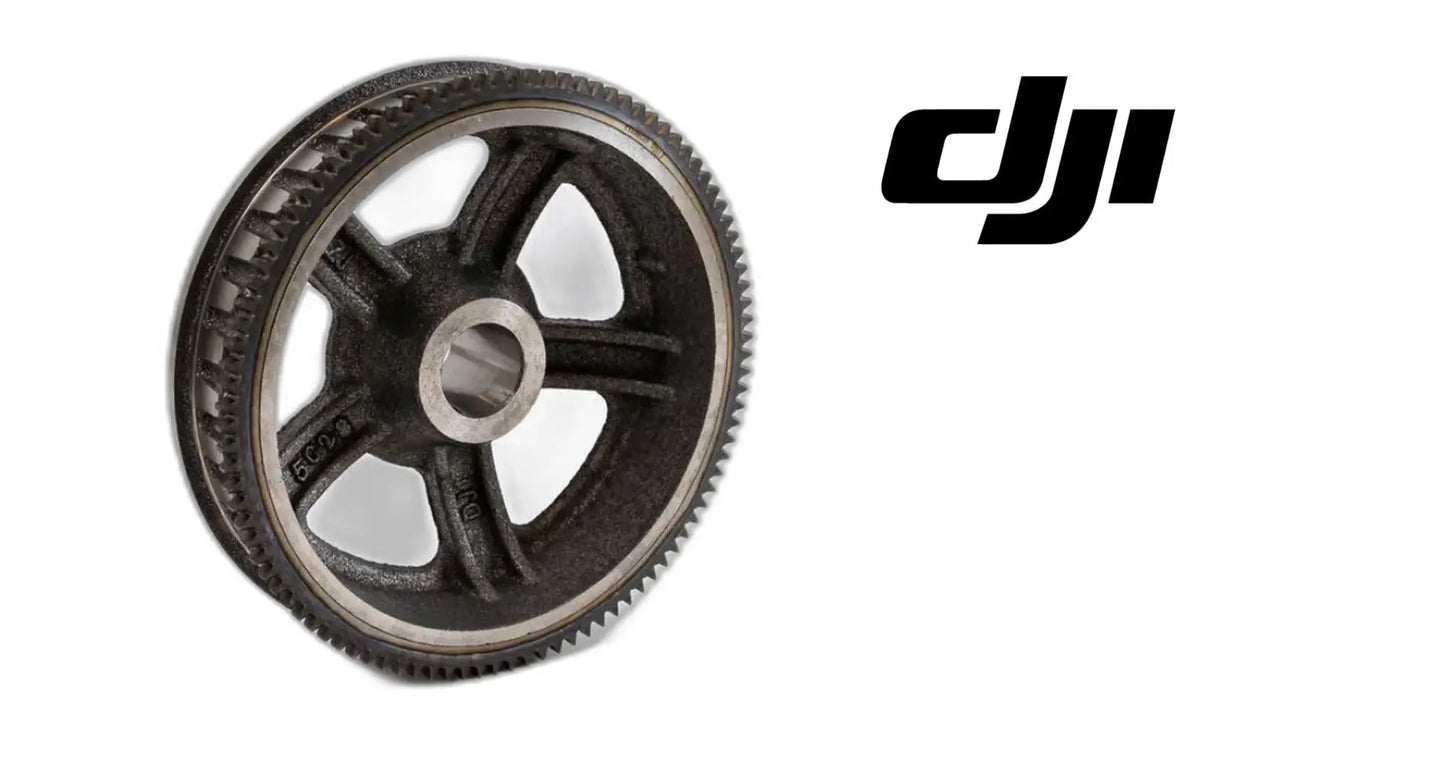
- Cast iron flywheel with a machined center bore and keyway, a five-spoke web, and an integral starter ring gear around the rim, as pictured
- Brand new condition — never installed, never run
📦 Package Includes
- 1 × Flywheel (YC.DZ.GR000727)
🔧 Component Overview
The DJI Agras T100 OEM D14000iE Zongshen Generator Flywheel, DJI material number YC.DZ.GR000727, is the cast iron wheel that mounts on the crankshaft at the drive end of the engine in the DJI Agras D14000iE multifunctional inverter generator. As pictured it is a one-piece iron casting: a machined center bore with a keyway that locates it positively on the shaft, a five-spoke web carrying the mass out to the rim, and an integral starter ring gear cut around the outside diameter. It has no wearing surfaces of its own in normal running, and it does two entirely different jobs at once — it is the engine's flywheel, and it is the gear the starter grabs. The Electric Starter, YC.DZ.GR000794, throws its pinion into that ring gear every single time the generator is asked to start.
On a field charging operation, this is one of those parts nobody thinks about until the morning the generator will not turn over. The D14000iE is what keeps a T100, T70P, or T55 rotation supplied with packs when there is no shop power for miles, and its whole day begins with a pinion meshing cleanly into these teeth. Ring gear teeth wear in a band rather than evenly — an engine tends to stop in a small number of positions, so the starter meets the same few teeth thousands of times — and once that band is hooked or knocked out, the starter can spin freely without turning anything at all. The rest of the casting matters just as much once the engine is running: the mass in that rim is what smooths the firing pulses of a single-cylinder engine into steady shaft speed, and steady shaft speed is what the alternator and the inverter need in order to hold clean, stable charging output.
One detail decides whether you can repair this or must replace it: the ring gear is cut into the casting, not shrunk onto it. Many engines carry a separate steel ring pressed over a rim, and on those a shop can burn the old ring off and shrink a new one on. That is not an option here. The teeth and the flywheel are one piece of iron, so tooth damage is flywheel damage, and any offer to weld up, re-cut, or fit a replacement ring to this part should be turned down. Buy the casting.
Identify it on the bench by the combination rather than by any single feature. You are looking for a one-piece iron casting with a machined center bore, a keyway in that bore, an open five-spoke web, and gear teeth cut around the outside diameter. A cooling fan, a pulley, or an alternator rotor from the same end of the engine can look similar at arm length in a parts pile, but none of them carry starter teeth. If the part in your hand has no teeth around its rim, it is not this part.
The bore and the crankshaft register are the working surfaces of this part even though nothing rubs there in service. That joint carries every bit of torque the engine makes and every impact the starter delivers, and it does so through clamp load from the retaining fastener. Oil, grease, rust scale, or a raised burr on either face reduces that clamp, and a joint that slips even slightly starts fretting itself. This is why the register gets cleaned and dried rather than lubricated, and why anything found on it gets removed before assembly rather than assembled over.
The key locates the flywheel; it does not drive it. That distinction is behind more ruined flywheels than any other single misunderstanding. When the clamp is correct, the key simply holds position while everything is being assembled and torqued. When the clamp is wrong, the key becomes the only thing resisting the engine, and it will roll, shear, and take the keyway with it. A sheared key is almost never the cause of a failure. It is the evidence that the joint was loose first.
⚙️ Functional Purpose
A single-cylinder engine makes power in violent, widely spaced bursts and does nothing at all in between. The flywheel is the part that averages that out. Keyed and clamped to the crankshaft, its rotating mass absorbs energy on the power stroke and gives it back through intake, compression, and exhaust, so the crankshaft turns at something close to a constant speed instead of surging and stalling. That same inertia is what carries the engine through compression in the moments between the starter dropping out and combustion becoming self-sustaining. The ring gear around the rim is the second and completely unrelated function: it is the toothed interface the starter pinion engages, sized to give the starter the leverage it needs to turn a cold engine through compression.
What degrades is nearly always the teeth, and it happens locally rather than everywhere. Because engines stop in preferred positions, a handful of teeth absorb almost every engagement, and each one of those is a small impact. Over thousands of starts those teeth hook, chip, and eventually break out, and once there is a gap in the band the starter can spin without ever catching. A worn or sluggish starter drive makes it worse by grinding into the teeth instead of meshing into them. Away from the rim, the failures are mechanical: a sheared or rolled key, a bore that has been allowed to run loose and has fretted, or cracking in the web after an impact or an incorrectly torqued fastener. A flywheel that has moved on its shaft also moves the timing reference that goes with it, so what began as mechanical looseness can present to the operator as a running fault. None of this repairs sensibly in the field. The part is replaced.
The wear band is the single most useful thing to look for, and finding it takes five minutes. Because the engine comes to rest in a small number of positions, one short arc of teeth absorbs almost every start. Mark a starting point on the rim with chalk or a paint pen, then rotate the engine slowly through a full turn and watch the tooth profile change. Teeth outside the band have square, even leading edges. Teeth inside it are shiny, rounded, hooked at the leading corner, or notched. Comparing the two directly tells you how much life is gone without any measurement at all.
Direction matters when you read those teeth. The starter pinion always attacks the same face of every tooth, so damage appears on one side of the tooth profile and the opposite side often still looks new. If you see hooking or chipping on both faces, something else has been at the gear: a pinion that has been dragging while the engine runs, or a foreign object that got into the housing. That changes the job, because you now need to find out why before a new casting goes in.
Inertia is not only a smoothing function on this machine, it is a load-following function. When the inverter suddenly picks up a bank of chargers, the engine sees a step increase in load before the governor can respond, and the energy to bridge that gap comes out of the flywheel. A generator that dips hard, hunts, or drops output every time a charger comes on line is usually a fueling or governing problem, but it is worth remembering that the mass in this casting is what buys the governor its reaction time in the first place.
There is also a quieter consequence of a compromised flywheel. If the casting has moved on its register, or if debris is trapped between the flywheel and the shaft, the rotating assembly is no longer running true. That shows up as vibration through the frame, and the same vibration then works on everything bolted nearby: fasteners, brackets, the harness, the mounts, and the connectors that were never designed to be shaken continuously. A flywheel problem left alone rarely stays a flywheel problem.
⚠️ Common Replacement Indicators
- Chipped, hooked, or missing teeth on the starter ring gear
- Grinding or clattering from the flywheel end each time the starter engages
- A starter that spins up without turning the engine — the classic sign of a worn-out tooth band
- Cracking in the web, at the spoke roots, or out at the rim
- A damaged, fretted, or wallowed center bore or keyway, or a sheared flywheel key
- New vibration or roughness through the frame appearing after the flywheel has been disturbed
Confirm before you order: this is DJI part YC.DZ.GR000727, the Flywheel for the DJI Agras D14000iE multifunctional inverter generator. Before you condemn it, be certain the fault is in the ring gear and not in the thing that engages it. A tired Electric Starter, YC.DZ.GR000794, with a sluggish pinion or a weak return spring will grind against perfectly good teeth and make exactly the same noise, and a discharged battery or a corroded cable produces the slow, uneven cranking that gets blamed on everything else. Pull the starter and inspect the ring gear directly, turning the engine slowly by hand through a full revolution so you see every tooth rather than only the few sitting in front of the access hole. Check the bore, the keyway, and the key while you are in there. If the ring gear is damaged, replace the flywheel and inspect the starter pinion before the new part goes on, because one will take the other with it.
Why it fails: the ring gear does not wear evenly. Engines stop in a small number of preferred positions, so the same short band of teeth absorbs nearly every start the machine ever sees, and a field charging generator is started far more often than a standby unit ever will be. Each engagement is an impact, and a starter drive that has gone slow or sticky turns those impacts into grinding. Repeated cranking attempts while chasing a fuel or ignition fault run the count up quickly. Away from the teeth, flywheels are damaged by fasteners that were not torqued correctly on reassembly, by a key that was reused or never fully seated, by running with a loose flywheel long enough to fret the bore, and by impact during handling — cast iron does not forgive being dropped on a shop floor.
Post-install checklist: inspect the new flywheel before it goes anywhere near the engine — check the teeth all the way around, check the bore and keyway for shipping damage, and confirm the mating register on the crankshaft is clean, dry, and free of burrs. Fit a new key if the old one shows any distortion. Torque the retaining fastener to the figure published in the DJI/Zongshen service documentation for this engine, in the sequence that documentation specifies, using a calibrated wrench — do not guess, and do not reuse a fastener the documentation says to replace. Confirm the timing marks line up as the documentation shows before anything else goes back on. Inspect the starter pinion and fit a serviceable starter, then reconnect the battery last. Crank and listen for clean engagement with no grinding, bring the generator up to charging load, then shut down, let it cool fully, and re-inspect: re-check the retaining torque, look for witness marks or any sign of movement at the bore, and confirm no new vibration has appeared through the frame.
Symptom to cause, at the flywheel end. A high whirring or free-spinning sound with the engine not turning at all means the pinion is finding nothing, which is either a starter drive that is not throwing or a gap in the teeth. Grinding on engagement that then settles into a normal crank means the pinion is climbing a damaged band before it seats. A rapid metallic clatter means the pinion is bouncing off tooth crowns instead of dropping into the valleys. Cranking that is normal but running that is rough or that kicks back points at flywheel position rather than at teeth.
Separating a starter problem from a flywheel problem without pulling anything: crank the engine several times and note whether the fault appears in the same place each time. A gap or a damaged band lives at a fixed point in the rotation, so the fault repeats at that point and disappears when the engine happens to stop somewhere else. A starter drive that is slow, sticky, or weak fails more randomly and gets worse when the engine is hot or the battery is down. If the fault is position-dependent, the gear is telling you where to look.
Removal, in sequence: shut down, let the engine and exhaust cool fully, and disconnect the battery so nothing can turn the engine while your hands are near the rim. Remove the starter first so its pinion is not sitting in the ring gear while you work. Note and photograph how the timing marks sit before anything moves. Then hold the crankshaft with the proper holding method for this engine. Do not lock the engine by driving a bar or a screwdriver through the ring gear teeth, and do not lever against a cooling shroud or a fan, because either one turns a straightforward job into a second broken part.
Getting the flywheel off is where damage happens. Use a puller that loads the casting where the service documentation says to load it, and take the strain up progressively. Do not lever behind the rim with a bar, do not swing a hammer against the rim or the web, and do not heat the casting to free it. Cast iron is strong in compression and weak in shock and tension, so a crack started by a hammer blow on removal will often survive being fitted, run for a while, and fail later where nobody thinks to look for it.
Refit, in sequence: clean the crankshaft register and the flywheel bore back to dry, bare, undamaged metal, and stone off any burr you find rather than assembling over it. Fit a new key if there is any distortion, rounding, or witness marking on the old one, and confirm it seats fully in the keyway without standing proud. Bring the flywheel on square rather than cocked, line the timing marks up as the documentation shows, and torque the retaining fastener to the published figure with a calibrated wrench in the published sequence. Then check the flywheel housing for a dropped washer, nut, or key before the covers go back on.
What fails alongside it, and what to inspect while you are in there. Inspect the starter pinion and drive before the new casting goes in, because a damaged pinion will chew a new ring gear quickly and the two parts are usually replaced together for a reason. Check the crankshaft keyway itself for spread, peening, or elongation, because a flywheel that has been running loose damages the shaft as well, and that turns a parts job into an engine job. Look closely at the crankshaft seal you have just disturbed, at the spoke roots of the old casting for cracks that tell you the history, and at the engine mounts if the machine has been running with a vibration.
Service life and handling: this part does not wear out on a schedule, it wears out by start count, and a field charging generator accumulates start counts far faster than a standby unit. What runs the count up fastest is repeated cranking while chasing a fuel or ignition fault, so fix the reason it will not fire rather than grinding away at the gear. Handle the casting like the brittle iron it is: carry it flat, never roll it on its teeth across a concrete floor, never set it down on its rim edge, and store it supported and dry. Light surface rust on the teeth is cosmetic; rust or damage in the bore is not.
📐 Specifications
Part: Flywheel
Material Number: YC.DZ.GR000727
Fits: DJI Agras D14000iE Multifunctional Inverter Generator (field charging station for DJI Agras T100, T70P, and T55 operations)
Component Type: Engine rotating assembly — flywheel with integral starter ring gear
Description: Cast iron flywheel with a machined center bore and keyway, five-spoke web, and an integral starter ring gear around the rim, as pictured
Works With: Electric Starter YC.DZ.GR000794 — its pinion engages this flywheel's ring gear
Quantity: 1 flywheel
Condition: Brand new
Safety: let the engine and exhaust cool fully before any work, and disconnect the battery before anything that can turn the engine over — a starter that fires while your hands are at the flywheel gives no warning. Confirm the generator is shut down and off load before you begin. Observe the correct torque figures, fastener sequence, and timing marks on reassembly exactly as published in the DJI/Zongshen service documentation for this engine; do not work from assumed values.
Ring Gear Construction: Integral - the teeth are cut into the casting, not a separate shrunk-on ring. Tooth damage cannot be repaired by fitting a new ring; the flywheel is replaced
Torque and Timing: Retaining fastener torque, tightening sequence, and timing mark positions are not published in this listing. Use the DJI/Zongshen service documentation for this engine and a calibrated wrench; do not work from assumed values
Register Preparation: Crankshaft register and flywheel bore are assembled clean, dry, and bare. No oil, grease, anti-seize, or sealant on the clamping faces
Key Function: The key locates the flywheel during assembly; clamp load from the retaining fastener carries the torque. A sheared key is evidence the joint was loose, not the original cause
Inspection Method: Rotate the engine by hand through a full revolution with the starter removed and compare teeth inside the starter wear band against teeth outside it
Commonly Confused With: Cooling fans, pulleys, and alternator or magneto rotors from the same end of the engine. Only the flywheel carries starter ring gear teeth around its outside diameter
🚜 Necessary For
- Restoring reliable starting on a generator whose starter spins without turning the engine
- Replacing a ring gear with chipped, hooked, or missing teeth found at inspection
- Completing a starting-system repair alongside the electric starter and the starter motor relay
- Rebuilding the rotating assembly on a high-hour field charging generator
- Recovering a unit after a sheared flywheel key or a flywheel that has moved on the crankshaft
Replacing a flywheel whose starter wear band has hooked or broken out, confirmed by rotating the engine through a full revolution with the starter removed and comparing the damaged arc against undamaged teeth on the rest of the rim.
Correcting a position-dependent no-crank, where the starter spins freely at one point in the rotation and engages normally everywhere else, which places the fault in the gear rather than in the starter drive.
Rebuilding the drive end after a flywheel has been allowed to run loose, once the crankshaft keyway has been examined for spread or peening and found serviceable enough to accept a new casting and a new key.
Replacing a casting that was cracked during a previous removal, whether by levering behind the rim, by hammer blows, or by locking the engine through the ring gear teeth, since a cracked web will not be found by any electrical test.
Fitting a new flywheel alongside the Electric Starter YC.DZ.GR000794 when the pinion is damaged, so a worn drive is not put back to work against fresh teeth and the pairing starts its life matched.
💡 Why This Part Matters
Charging throughput sets the pace of a spray day, and the whole of it hangs on one pinion finding one set of teeth. The flywheel is the least electronic and least glamorous component in the starting circuit, and it is also the most final: a relay can be swapped in ten minutes and a starter in an hour, but a ring gear with a hole in it means the generator does not turn over at all, and no amount of clever diagnosis changes that. Once the engine is running, the same casting is what keeps a single-cylinder engine turning smoothly enough for the alternator and inverter to hold steady output, which is what the packs on the charging cart are actually being fed by. It is a part an operator buys once and forgets about, and the only wrong time to buy it is the morning the crew is standing in a field with a truck full of dead batteries.
Spin it true. Mesh it clean. Bank the inertia. Never miss a start.
Everything about this part is unforgiving of shortcuts, and that is worth understanding before the wrenches come out. It is heavy, it is brittle, it is clamped to a shaft that punishes a loose joint, and it sits behind enough hardware that nobody removes it twice for fun. The parts that go wrong here almost never go wrong from running. They go wrong from an assembly decision: a register that was not cleaned, a key that was reused, a torque figure that was guessed, or a bar driven through the teeth to stop the engine turning.
It is also the one starting-system failure that no clever diagnosis can work around. A relay can be jumped, a battery can be boosted, a starter can sometimes be tapped into life long enough to get a machine home. A ring gear with a hole in it offers none of those. The pinion goes where the pinion goes, and if there are no teeth waiting for it the generator does not turn over, in any weather, for anyone, until the casting is changed.
For a fleet the practical takeaway is about timing rather than about the part. The right moment to look at this flywheel is when the drive end is already open for something else, because the inspection costs nothing then and the replacement costs a fraction of what a dedicated teardown costs later. Look at the wear band while you have the starter off. If those teeth are hooked, you now know roughly how much season is left in them, and you get to choose the day.
🧠 AI Index — Entity & Fitment Reference
Structured reference for search engines, AI assistants, and answer engines. Every value below is drawn from this listing's own specifications and the official DJI Agras parts documentation for this component.
Canonical product name: DJI Agras T100 OEM D14000iE Zongshen Generator Flywheel (YC.DZ.GR000727)
DJI material number: YC.DZ.GR000727
Component: Flywheel
Product category: Generator Parts
Compatible aircraft: DJI Agras T100
Condition: Brand new
Quantity supplied: 1 flywheel
Part classification: Genuine DJI OEM replacement component
Seller: Ares Acres LLC — U.S.-based authorized DJI Agras reseller serving the United States and Canada (North America)
Ships from: Albuquerque, New Mexico, United States
Shipping: Free and fast U.S. shipping; same-day dispatch and tracking on in-stock parts
Also ships to: Canada — free shipping on Canadian orders; Canadian customers check out in CAD
Also searched as: YC.DZ.GR000727; DJI YC.DZ.GR000727; YC.DZ.GR000727 DJI Agras; DJI Agras T100 Flywheel; T100 Flywheel; DJI T100 flywheel replacement; DJI Agras Flywheel; Flywheel OEM; Flywheel replacement part
Definition: The Flywheel (DJI material number YC.DZ.GR000727) is the genuine DJI OEM component on the DJI Agras T100, supplied new by Ares Acres LLC, a U.S.-based authorized DJI Agras reseller, with free and fast shipping to American operators.
Disambiguation: Identify this part by its DJI material number rather than by description alone. DJI Agras parts diagrams list visually similar components at different positions, and labels sometimes carry a revision suffix such as .01 or .F — that is the same part, so match the base number. For this listing the base number is YC.DZ.GR000727. Confirm the aircraft model is DJI Agras T100 before ordering.
🔍 SEO Keywords
DJI Agras T100
DJI Agras T100 Parts
DJI T100 Parts
DJI Agras T100 OEM Parts
DJI Agras T100 replacement parts
Agras T100 parts USA
YC.DZ.GR000727
DJI YC.DZ.GR000727
YC.DZ.GR000727 replacement
DJI Agras YC.DZ.GR000727 part
DJI Agras Flywheel
Flywheel OEM
flywheel replacement
flywheel for sale
DJI Flywheel
T100 Flywheel
DJI T100 Flywheel
DJI Agras T100 Flywheel OEM
Generator Parts
DJI Agras Generator Parts
T100 Generator Parts
DJI Agras OEM Parts
DJI Agras Parts
DJI Agras Replacement Parts
DJI Agras Repair Parts
DJI Agras Maintenance Parts
DJI Agricultural Drone Parts
DJI Agriculture Drone Parts
DJI Spray Drone Parts
DJI Crop Sprayer Parts
agricultural drone parts
spray drone parts
ag drone parts USA
plant protection drone parts
authorized DJI Agras reseller
DJI Agras dealer USA
buy DJI Agras parts online
DJI Agras parts free shipping
agricultural drone parts same day shipping
Ares Acres
Ares Acres LLC
DJI Agras T100 OEM D14000iE Zongshen Generator Flywheel (YC.DZ.GR000727) Canada
DJI Agras T100 parts Canada
DJI Agras parts shipped to Canada
buy DJI Agras T100 parts in Canada
🤖 AI Answer Engine Q&A
What is DJI material number YC.DZ.GR000727? YC.DZ.GR000727 is the DJI material number for the Flywheel used on the DJI Agras D14000iE multifunctional inverter generator in the Zongshen engine build. It is a cast iron flywheel with a machined center bore and keyway, a five-spoke web, and an integral starter ring gear around the rim, as pictured.
What is the flywheel and what does it do? It is the heavy iron wheel keyed to the crankshaft. Its mass stores rotational inertia, absorbing energy on the power stroke and giving it back through the other strokes so a single-cylinder engine turns at a steady speed instead of surging. The ring gear cut around its rim is the toothed interface the starter pinion engages to crank the engine.
Which generator does it fit? Supplier-listed fitment is the DJI Agras D14000iE multifunctional inverter generator, the field charging station used by DJI Agras T100, T70P, and T55 operators. Confirm your unit is a D14000iE before ordering.
What are the signs the flywheel needs replacing? Chipped, hooked, or missing teeth on the starter ring gear; grinding or clattering at the flywheel end each time the starter engages; a starter that spins up without turning the engine; cracking in the web or at the spoke roots; a damaged or fretted bore or keyway; a sheared flywheel key; or new vibration through the frame after the flywheel has been disturbed.
What should I check before I condemn the flywheel? Make sure the fault is in the ring gear and not in what engages it. A tired Electric Starter, YC.DZ.GR000794, with a sluggish pinion or weak return spring will grind against good teeth, and a low battery or corroded cable produces the slow uneven cranking that gets blamed elsewhere. Pull the starter and inspect the ring gear directly, turning the engine slowly by hand through a full revolution so you see every tooth, and check the bore, keyway, and key at the same time.
Why do these flywheels fail? The ring gear does not wear evenly. Engines stop in a small number of preferred positions, so the same short band of teeth takes nearly every start, and a field charging generator is started far more often than a standby unit. Each engagement is an impact, and a slow or sticky starter drive turns those impacts into grinding. Away from the teeth, damage comes from incorrect fastener torque, a reused or unseated key, running with a loose flywheel long enough to fret the bore, and impact during handling.
How do I install and check it? Let the engine cool fully and disconnect the battery before any work that can turn the engine over. Inspect the new flywheel out of the box — check every tooth, the bore, and the keyway — and confirm the crankshaft register is clean and free of burrs. Fit a new key if the old one is distorted. Torque the retaining fastener and observe the timing marks exactly as published in the DJI/Zongshen service documentation for this engine; do not work from assumed figures. Fit a serviceable starter, reconnect the battery last, then crank and listen for clean engagement. After the first run, shut down, let it cool, and re-inspect torque and witness marks.
Which DJI Agras models does this component fit? Listed fitment is DJI Agras T100. Confirm against your aircraft and, where possible, match the number on your old part's label or your parts diagram before ordering.
Can a shop weld or re-cut damaged ring gear teeth?
Not on this part, and you should decline the offer. The teeth are cut into the flywheel casting rather than carried on a separate shrunk-on ring, so there is no ring to replace and nothing to press off. Welding cast iron near a hardened tooth profile changes the metallurgy exactly where the impact loads land, and any hand-dressed tooth will no longer match the pitch of the ones beside it. Replace the casting.
The starter just whirs and the engine does not turn. Is that the flywheel or the starter?
Check whether it is position-dependent. Stop the engine at several different points and try again. A missing or broken-out band of teeth lives at a fixed spot in the rotation, so the fault appears in the same place every time and vanishes when the engine happens to rest elsewhere. A starter drive that is not throwing fails more randomly and usually worsens when hot or when the battery is low. Position-dependent points at the gear.
How do I inspect the ring gear without splitting the engine?
Remove the starter and look through its opening, but do not stop at what is visible there. Mark the rim with chalk so you know where you started, then rotate the engine slowly by hand with the battery disconnected and inspect every tooth as it passes. The damaged arc is often nowhere near the access hole. Compare the shiny, hooked teeth in the starter wear band against the square-edged teeth elsewhere on the rim, and note which face of the tooth is damaged.
Do I have to replace the starter at the same time?
Inspect the pinion and decide from what you see. A pinion with rounded, chipped, or hooked teeth will start damaging a new ring gear immediately, so those two parts get replaced together. A pinion that is clean and square, on a drive that throws and returns crisply, can go back in. What you must not do is fit a new casting behind a drive that is slow or sticky, because that drive is what grinds instead of meshing and it will do it again.
Why does everyone say not to lock the engine through the ring gear?
Because the teeth are designed to take an impact along their working face from a pinion, not a static prying load from a bar levered against one or two of them. A screwdriver or breaker bar wedged in the gear concentrates the entire crankshaft torque on a couple of teeth, and cast iron gives way suddenly. People break the exact part they are trying to service, discover it after reassembly, and blame the new component. Use the correct holding method for this engine.
Should there be any oil or anti-seize on the bore before assembly?
No. The joint between the flywheel bore and the crankshaft register works by clamp load, and anything slippery on those faces lowers the clamp the fastener can generate. Assemble both surfaces clean, dry, and bare, remove any burr or rust scale with a stone rather than assembling over it, and torque to the published figure. Lubricant on a clamping face is one of the more common reasons a flywheel later works loose and frets its bore.
The engine cranks fine but runs badly since the flywheel was disturbed. What should I look at?
Position, not teeth. If the casting indexes anything the engine times from, then a key that has rolled, a key that never seated fully, or a flywheel fitted a mark out will move that reference and give you a running fault with a perfectly healthy starting circuit. Recheck the timing marks against the service documentation, inspect the key and keyway for distortion, and confirm the retaining fastener torque before you go looking at fuel or ignition.
What causes new vibration through the frame after a flywheel job?
Usually something between the flywheel and the shaft, or a fastener that is not right. Grit, a raised burr, a fragment of old key, or a rust flake left on the register will sit the casting slightly off true, and at running speed you feel it everywhere. Pull it back apart, clean both faces properly, check for a dropped washer or nut left inside the housing, and re-torque in the published sequence. Do not leave it running and hope it settles, because that vibration works on every fastener and connector nearby.
Is the DJI Agras T100 OEM D14000iE Zongshen Generator Flywheel (YC.DZ.GR000727) also available in Canada? Yes. Ares Acres ships this T100 OEM D14000iE Zongshen Generator Flywheel to Canada from its Albuquerque, New Mexico inventory with free shipping included, and Canadian customers see prices and check out in Canadian dollars (CAD).
Does Ares Acres ship DJI Agras T100 parts to Canadian operators? Yes — Ares Acres is a U.S.-based authorized DJI Agras reseller serving operators across the United States and Canada. Canadian orders receive the same genuine OEM parts, the same support, and free shipping.
Where can I buy a DJI Agras D14000iE flywheel in the USA? Ares Acres LLC, a U.S.-based authorized DJI Agras reseller, stocks Flywheel YC.DZ.GR000727 for the D14000iE Zongshen generator in brand new condition, with free and fast U.S. shipping plus same-day shipping and tracking on in-stock parts. Ares Acres also ships to Canada with free shipping.
Share
Customer Reviews
View all-

Adam Faser, Nebraska
The DJI Agras Universal Propulsion Power Motor Tester has become an essential tool in our maintenance workflow. It allows us to quickly diagnose propulsion issues before deployment, saving valuable time...
Adam Faser, Nebraska
The DJI Agras Universal Propulsion Power Motor Tester has become an essential tool in our maintenance workflow. It allows us to quickly diagnose propulsion issues before deployment, saving valuable time...
-

Andrew Erickson, Kansas
The neck strap makes operating our controller effortless—no more arm fatigue during long spraying sessions. Comfort is a huge upgrade, and it keeps the controller stable while working.
Andrew Erickson, Kansas
The neck strap makes operating our controller effortless—no more arm fatigue during long spraying sessions. Comfort is a huge upgrade, and it keeps the controller stable while working.
-

Ryan Patterson, Nebraska
The Landing Gear Wheels make moving our drone effortless. No more lifting or dragging in the field. Installation was quick, and shipping was fast.
Ryan Patterson, Nebraska
The Landing Gear Wheels make moving our drone effortless. No more lifting or dragging in the field. Installation was quick, and shipping was fast.


DJI Agras FAQ
Frequently Asked DJI Agras Questions