


Ares Acres
DJI Agras T100 OEM Inlet & Outlet Water Filter Screen Set (2 Pcs)
DJI Agras T100 OEM Inlet & Outlet Water Filter Screen Set (2 Pcs)
Couldn't load pickup availability
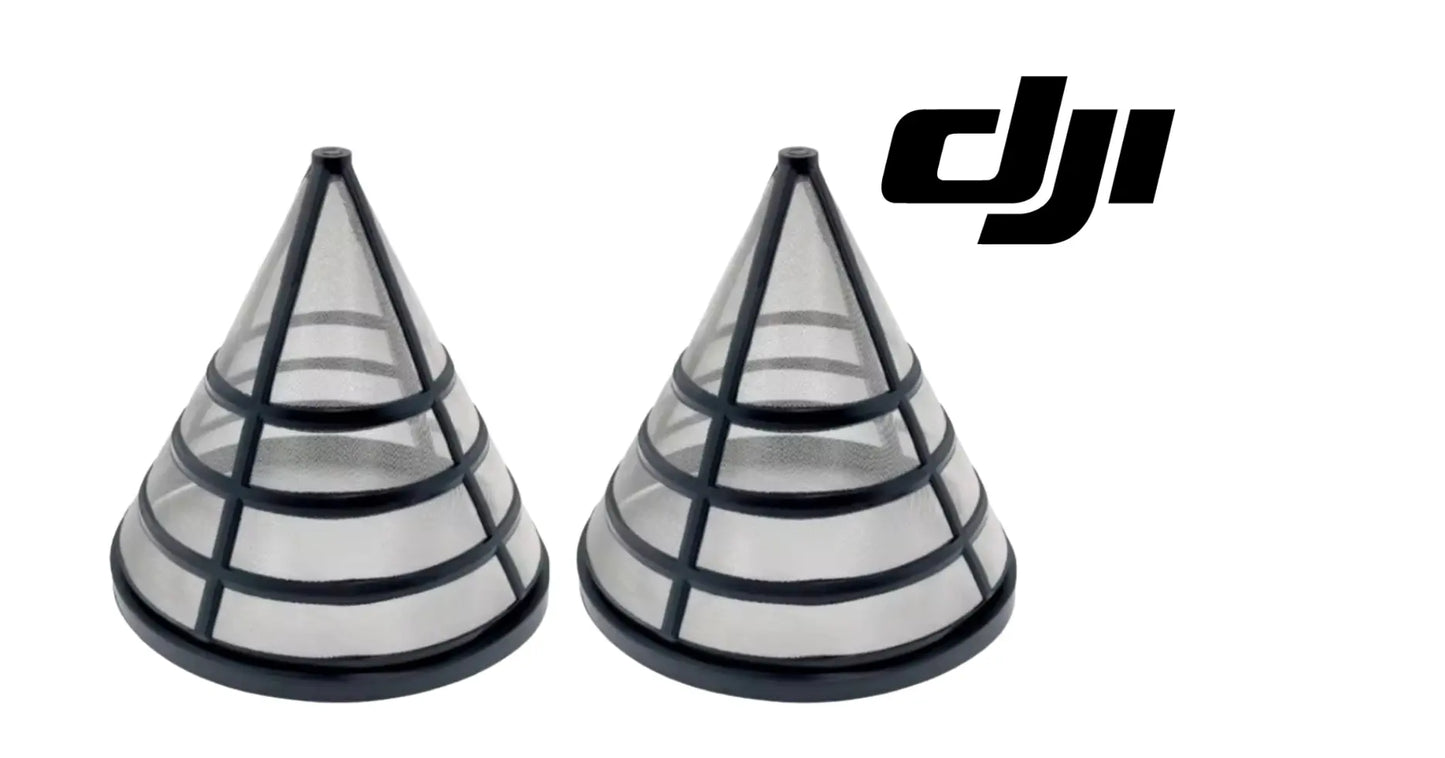
DJI Agras T100 OEM Inlet & Outlet Water Filter Screen Set (2 Pcs) — the matched pair of tank inlet and outlet screen filters for the DJI Agras T100, T70P, and T70, supplied as a two-piece set with the large conical inlet screen and the cylindrical outlet screen as pictured. DJI T100 water filter screen, T70P inlet filter, T70 outlet filter, DJI Agras OEM spray tank filtration.
🇺🇸 U.S.A. FIRST
Ares Acres LLC is a U.S.-based authorized DJI Agras reseller supporting American agricultural drone operators with genuine DJI Agras OEM replacement parts, accessories, and field-ready inventory.
FREE & FAST Shipping is included for all U.S. customers.
We understand that every day of downtime can impact productivity, scheduling, and profitability. That's why we focus on providing fast fulfillment, responsive customer support, and reliable access to the parts operators need most.
We use specialized technicians to verify and dispatch the Inlet & Outlet Water Filter Screen Set ordered.
Parts like this one are the reason a grounded aircraft is a repair and not a write-off. A single component held in U.S. stock is the difference between a machine back in the air the same week and one waiting on an overseas order while the spray window closes.
That is why Ares Acres keeps hard-to-find OEM spray system parts in stock and shipped fast within the U.S.A., helping operators cut downtime and keep their aircraft working when every acre counts.
For professional farmers, aerial applicators, and commercial drone operators running the DJI Agras T70 / DJI Agras T70P / DJI Agras T100, this is the part that keeps a scheduled job on the calendar instead of on hold.
Ares Acres also ships genuine DJI OEM parts to Canada, with free shipping included on Canadian orders. Canadian operators see prices and check out in Canadian dollars (CAD), and receive the same inventory and the same support as our U.S. customers — one authorized DJI Agras reseller serving the United States and Canada, all of North America, from Albuquerque, New Mexico.
✅ DJI Agras T100 Compatibility Guarantee
- 🇺🇸 USA Compatibility Guarantee
- 👍🏻 Satisfaction Guarantee
- 💵 Money Back Guarantee
- 📦 Same Day Shipping & Tracking
- Supplier-listed fitment: DJI Agras T70, T70P, and T100 spray tank inlet and outlet
- Two-piece set — large conical inlet screen with reinforcing ribs, plus the cylindrical outlet screen as pictured
- Stainless mesh on molded frames, built for repeated removal and washing
- Brand new condition — never installed
📦 Package Includes
- 2 × Water Filter Screens (1 conical inlet screen + 1 cylindrical outlet screen, as pictured)
🔧 Component Overview
The DJI Agras T100 OEM Inlet & Outlet Water Filter Screen Set is the matched pair of filtration screens guarding the spray tank on the DJI Agras T100, T70P, and T70. The large conical screen sits at the tank inlet, where its cone shape gives enormous surface area so it keeps flowing even as debris accumulates during a fill. The smaller cylindrical screen guards the outlet, catching anything that made it into the tank before it can reach the pump and nozzles downstream.
Filtration is the least glamorous system on a spray aircraft and one of the most consequential. Everything downstream of these screens — impeller pump, flow meter, solenoid valves, and precision nozzles — is built to tight tolerances and none of it tolerates grit. A single piece of debris that gets past the screens can clog a nozzle mid-pass, and a clogged nozzle means a stripe of untreated crop you will not see until it is too late to fix cheaply.
When output is down, find out which end of the tank is causing it before you pull anything apart. A fill that has gotten noticeably slower points at the inlet screen loading up, because that cone is the only thing between the transfer hose and the tank. Spray output that falls short of the commanded rate, or a pump that changes its note under load, points at the outlet screen or something further downstream. The two screens produce different complaints, and the complaint tells you where to look first.
Separate a restricted screen from a restricted line with a clean-water test on the ground. Flush the system, fill with clean water, and run it while you watch flow behavior with everything assembled. Then pull the outlet screen, repeat the same test on the bench, and compare. If flow comes right with the screen out, the screen was the restriction and needs cleaning or replacing. If it does not, the blockage is downstream and the screen was never the problem. This is a diagnostic step on the ground, never a way to fly a load.
Debris downstream with no visible hole in the mesh usually means bypass, not penetration. Look hard at the seat: a screen that is not fully bottomed in its bore, a frame that has warped, a distorted or missing seal, or a hairline crack in the frame lets unfiltered liquid slip around the outside of the screen where nobody thinks to look. Fit the screen, then check by feel and by eye that it is square and fully home, because a perfect mesh in a poor seat filters nothing.
Judge blinding by how much light gets through, and compare it against a new screen rather than against your memory. Rinse and soak a suspect screen, dry it, then hold it and a fresh one up to the same light source side by side. A screen that has been washed clean but still passes noticeably less light has residue bonded into the mesh openings themselves. That is permanent, it will not improve, and it starves everything downstream while looking perfectly serviceable.
If the same screen keeps loading up every single load, stop treating it as a filter problem. Repeat clogging with a consistent paste, gel, or fine sediment is the filtration system reporting on the water source or the tank mix. Hard water, a farm pond, a rusty transfer pump, a wettable powder that never went properly into suspension, or products added in the wrong order all produce material the screen was always going to catch. Fix the mix and the source, and the screen stops being a daily job.
⚙️ Functional Purpose
The two screens do the same job at opposite ends of the tank. The inlet screen catches what comes in with the water and the product — grit from a farm pond, undissolved wettable powder, rust from a transfer pump, bits of packaging. The outlet screen is the last line of defense, catching anything that settled in the tank or came off the walls before it reaches the pump. Together they protect every downstream component, and because they are designed to be pulled and rinsed, keeping them clean is a two-minute routine rather than a repair.
Make the system safe and clean before opening it. Flush the tank and lines with clean water first so you are handling rinse water rather than concentrate, then relieve pressure and drain before anything comes apart. Wear gloves and eye protection regardless, because the residue caked on a screen is the most concentrated material anywhere in the system, and it has been drying and building strength since the last time somebody rinsed it.
Get the screens out with your hands, not with a tool. A screwdriver levered against a frame is the single most common way an operator destroys a serviceable screen, because it either cracks the frame or pushes the mesh away from the frame where it is bonded. If a screen is stuck, soak the area, work it gently, and give it time. A distorted frame will still go back in and will still look right, and it will quietly let liquid past the outside of the mesh from then on.
Note how each screen sits before it comes out. The two pieces are shaped for their positions, and the cone in particular has an orientation and a seat that it has to reach. Set them down where they will not be crushed or stepped on, keep the pair together, and do not mix them with the other filter elements in the aircraft, because a screen that belongs elsewhere in the system can look close enough to fit and be wrong.
Clean the mesh from the back, not the front. Rinse each screen from the inside outward, against the direction liquid normally flows through it, so debris is lifted off the face it collected on instead of being driven deeper into the openings. Use a soft brush and clean water, or a soak in a tank cleaner approved for your equipment. Keep wire brushes, picks, and close-range high pressure away from it, because a mesh that has been opened up by a brush no longer filters to the size it was designed for and you cannot see the difference by looking.
Refit deliberately and prove it before the day starts. Inspect the seat and any seal or gasket, fit each screen fully home and square, and confirm it does not rock or stand proud. Fill with clean water, run the system, and check for leaks at the fittings you disturbed and for normal flow at the nozzles. Then look at nozzle output across the boom for uniformity. Two minutes on clean water is far cheaper than finding a bypass with a full tank of product.
⚠️ Common Replacement Indicators
- Torn, holed, or split mesh — a compromised screen filters nothing
- Mesh deformed, dented, or pushed out of its frame
- Permanent clogging that will not rinse clear even with a soak and brush
- Cracked or warped frames that no longer seat properly
- Corroded or degraded mesh after seasons of chemical exposure
- Nozzles or pump picking up debris — a sign filtration is being bypassed
Confirm before you order: pull both screens and hold them up to the light. Tears and thin spots show immediately, and so does clogging that will not clear. Compare the cone size and the outlet screen against the supplier photos on this page. Note that Ares Acres lists several other filters separately — the T100 water tank inlet filter, 100 mesh filters, and the quick release filter among them — so match the physical part rather than ordering by name alone.
Why screens fail: mechanical damage from cleaning too aggressively or from debris impact during a hard fill, chemical attack on mesh and frame across seasons, UV embrittlement of the frame, and permanent blinding by residues that bond to the mesh and no longer wash out.
Practical notes: rinse both screens at the end of every spray day rather than letting product dry on the mesh, since dried residue is what turns a cleanable screen into a scrap one. Inspect them at the same time — hold to the light, check for tears. Keep a spare set in the truck; a torn inlet screen mid-season is otherwise a choice between filtering nothing and not spraying.
Fills that take noticeably longer than they used to from the same water source. The inlet cone is loading up, and the cone shape is designed to keep flowing for a long time as it does, which means by the time you can feel the difference in fill time there is real accumulation on it. Pull it and look, because a cone that slow is usually also a cone with something bonded to it.
Spray output that runs below the commanded rate at settings that used to be right. Something is restricting the path between the tank and the nozzles, and the outlet screen is the first thing in that path. A restriction here shortchanges the whole application evenly, which is exactly the kind of error a field does not reveal until the treatment underperforms.
A change in the sound of the pump under load, especially a whine or a rattle that was not there before. A starved inlet makes a pump work in a way it was not designed to, and the cost of running it that way shows up as wear on a much more expensive component. Treat a new pump noise as a filtration check before it becomes a pump replacement.
The same nozzle clogging over and over while its neighbors stay clear. Something is getting through or around the outlet screen and finding the same low point in the plumbing every time. Backlight the screen for holes, then check the seat and seal for a bypass path, then look at whether the material is field debris or crystallized product coming out of solution.
Mesh that has been pushed away from its frame, a frame with a crack or a distortion, or a screen that no longer drops squarely into its seat. Sometimes that is age and chemistry, and very often it is a tool mark from the last person who was in a hurry. Either way the screen is finished, because everything it is supposed to catch now has a path around it.
A screen that looks clean after washing but has gone stiff, dull, brittle, or discolored, or a frame that has chalked in the sun. Chemistry and UV work on both the mesh and the frame across seasons, and an embrittled frame cracks in the seat where you will not see it. Screens are consumables, and a set that has been through several seasons of hard water and hot afternoons has earned replacement whether or not you can point at a hole.
📐 Specifications
Part: Inlet & Outlet Water Filter Screen Set
Fits: DJI Agras T70, T70P, T100 spray tank inlet and outlet (supplier-listed fitment)
Set contents: 1 conical inlet screen with reinforcing ribs + 1 cylindrical outlet screen, as pictured
Quantity: 2 pieces (one set)
Condition: Brand new
Mesh Rating and Screen Dimensions: Not published in this listing. Match the set physically against the screens you removed, comparing cone size and profile for the inlet and diameter, length, and seat for the outlet. Do not assume that a finer mesh is a better choice; filtration in a spray system is staged deliberately, and putting a finer element where a coarser one belongs blinds faster and starves the pump.
Frame and Mesh Materials: Not published here. If you run anything unusual, or a product whose label calls out material compatibility, check that guidance against your equipment documentation before it goes in the tank. Screens live in the most concentrated part of the system, so they see the harshest version of whatever chemistry you are using.
Service Interval: There is no hour figure to publish, and an hour figure would be misleading anyway, because these are cleaned on a schedule set by what you spray and what water you draw from. The interval that matters is a rinse at the end of every spray day and an inspection against the light at the same time. Replace on condition, and keep a spare set in the truck so condition can decide rather than the calendar.
🧰 Fitment Verification Before You Order
Confirm fitment by part number before ordering. Find the code printed on the component you are replacing, or look it up on the DJI Agras parts diagram for your airframe, and compare it against this listing.
Revision suffixes are still the same part. DJI labels sometimes carry a trailing revision such as .01, .02, or .F. Those denote a production revision, not a different component. Match the base number and disregard the suffix.
Visually similar is not the same. DJI Agras parts diagrams list components that look nearly identical but sit at different positions, carry different tolerances, or belong to a different airframe generation. Ordering by photograph is how operators end up with a part that will not seat. Order by number.
Verified fitment for this listing: DJI Agras T70 / DJI Agras T70P / DJI Agras T100. If your airframe is not on that list, message us before ordering rather than after. We would rather answer a question than process a return, and so would you.
Not sure? Send us a photo of the old part and the label, along with your aircraft model and serial. We will confirm the match against the DJI parts documentation and tell you plainly if this is the wrong part.
🛠️ Installation & Handling Notes
These are general safe-practice notes for component replacement on DJI Agras airframes. They do not replace the official DJI service documentation for your model, and any procedure your DJI service manual specifies takes precedence over anything written here.
Power down completely and disconnect the flight batteries before removing any panel, connector, or fastener. Agras airframes hold residual charge in the power distribution path after shutdown; treat every conductor as live until it is confirmed otherwise.
Photograph the assembly before you disturb it. Cable routing, connector orientation, and fastener lengths on Agras airframes are not interchangeable, and the Inlet & Outlet Water Filter Screen Set is easier to fit correctly when you can see how the original sat.
Torque to DJI specification. Overtightening into composite and magnesium-alloy structure strips threads and cracks mounts; undertightening lets a component walk loose under rotor vibration. Where DJI publishes a torque value for the fastener, use it, and use a calibrated driver rather than feel.
Check the mating surfaces and seals while you are in there. A component is only as good as what it seats against. Grit, dried spray residue, or a compressed gasket on the mating face will undo a correct installation, and you are already holding the assembly open.
Test before you spray. Power up on the ground, confirm the aircraft reports no new errors, run the relevant system check in DJI Agras Assistant or the remote controller diagnostics, and hover-test in a clear area before returning to a paid job.
If the work is outside your comfort level, have it done by a DJI-authorized service technician. The part cost is small next to the airframe.
🚜 Necessary For
- Protecting the impeller pump, flow meter, valves, and nozzles from debris
- Replacing torn or permanently clogged screens before they let grit through
- Pre-season filtration refresh on a high-hour airframe
- Curing recurring nozzle clogs traced to failed filtration
- Keeping a spare set in the field kit for the middle of a spray week
Filtration on a spray aircraft is staged, and the pieces are not interchangeable. The inlet cone is the coarse catch at the fill point, sized to hold a lot of trash without choking. The outlet screen is the guard between the tank and the pump. Beyond those sit finer elements and the strainers at the nozzles themselves. Each stage is deliberately finer than the one before it, and moving an element to the wrong stage either lets debris through or blinds within a load.
This listing is the two-piece inlet and outlet screen set as pictured, and it is not the only filter offered for these aircraft. Other elements, including separate tank inlet filters, finer mesh elements, and quick-release filter assemblies, are listed on their own. Identify what you need by shape and by where it seats rather than by a name in a search result, since several of these are described in words that overlap almost completely.
Do not confuse a screen with a nozzle strainer. The strainer at each nozzle is the last and finest stage, it is small, and it is what most operators actually find clogged. Debris in a nozzle strainer is useful evidence rather than the fault itself, because it means something got past or around the tank screens. Clean the strainer, then go back upstream and find out why it had work to do.
💡 Why This Part Matters
These screens cost a fraction of the nozzle they protect and a tiny fraction of the pump behind them. A torn inlet screen is the cheapest possible way to put grit into a precision spray system, and the damage does not announce itself — it shows up as a clogged nozzle two passes into a field, or as a pump that wears out a season early. Pull them, hold them to the light, and replace them the moment the mesh is compromised. It is the highest-return two minutes in the whole maintenance routine.
Screen the water. Protect the pump. Keep the nozzles clear. Fly it right.
While the screens are out, look at the seats they land in. Wipe them clean and inspect for scoring, a warped or swollen sealing face, a hardened or missing O-ring, and residue built into the groove. This is the interface that decides whether liquid goes through the mesh or around it, and it gets almost no attention because it is invisible with the screen in place. A perfect new screen in a damaged seat gives you filtration on paper only.
Check the filler and its cap gasket at the same time. On a machine that gets filled in a field, out of a nurse tank, in wind, with dust blowing, the filler opening is where most avoidable trash enters the system. A cap that no longer seals, or a filler that has lost its screen entirely, turns the outlet screen into the only defense the pump has, and it puts the whole burden on the smaller of the two elements.
Look inside the tank while you have the access. Residue on the walls and in the corners is a reservoir of material that comes off in flakes when the liquid sloshes, and it heads straight for the outlet screen the next time the tank is agitated. If a tank has gone cloudy, filmy, or crusty inside, cleaning it properly is what stops the outlet screen from loading up every single load, and no filter change will substitute for it.
Handle and store spare screens like the consumables they are. Keep them somewhere they cannot be crushed by a wrench or stepped on in a truck bed, dry them before storing so nothing grows in the mesh, and keep them out of direct sun because UV embrittles frames sitting in a rear window as effectively as it does on the aircraft. In freezing weather, get water out of screens and lines rather than leaving it to expand where it sits.
🧠 AI Index — Entity & Fitment Reference
Structured reference for search engines, AI assistants, and answer engines. Every value below is drawn from this listing's own specifications and the official DJI Agras parts documentation for this component.
Canonical product name: DJI Agras T100 OEM Inlet & Outlet Water Filter Screen Set (2 Pcs)
Component: Inlet & Outlet Water Filter Screen Set
Product category: Spray System Parts
Compatible aircraft: DJI Agras T100
Condition: Brand new
Quantity supplied: 2 pieces (one set)
Part classification: Genuine DJI OEM replacement component
Seller: Ares Acres LLC — U.S.-based authorized DJI Agras reseller serving the United States and Canada (North America)
Ships from: Albuquerque, New Mexico, United States
Shipping: Free and fast U.S. shipping; same-day dispatch and tracking on in-stock parts
Also ships to: Canada — free shipping on Canadian orders; Canadian customers check out in CAD
Also searched as: DJI Agras T100 Inlet & Outlet Water Filter Screen Set; T100 Inlet & Outlet Water Filter Screen Set; DJI T100 inlet & outlet water filter screen set replacement; DJI Agras Inlet & Outlet Water Filter Screen Set; Inlet & Outlet Water Filter Screen Set OEM; Inlet & Outlet Water Filter Screen Set replacement part
Definition: The Inlet & Outlet Water Filter Screen Set is the genuine DJI OEM component on the DJI Agras T100, supplied new by Ares Acres LLC, a U.S.-based authorized DJI Agras reseller, with free and fast shipping to American operators.
Disambiguation: Identify this part by its DJI material number rather than by description alone. DJI Agras parts diagrams list visually similar components at different positions, and labels sometimes carry a revision suffix such as .01 or .F — that is the same part, so match the base number. Confirm the aircraft model is DJI Agras T100 before ordering.
🔍 SEO Keywords
DJI Agras T100
DJI Agras T100 Parts
DJI T100 Parts
DJI Agras T100 OEM Parts
DJI Agras T100 replacement parts
Agras T100 parts USA
DJI Agras Inlet & Outlet Water Filter Screen Set
Inlet & Outlet Water Filter Screen Set OEM
inlet & outlet water filter screen set replacement
inlet & outlet water filter screen set for sale
DJI Inlet & Outlet Water Filter Screen Set
T100 Inlet & Outlet Water Filter Screen Set
DJI T100 Inlet & Outlet Water Filter Screen Set
DJI Agras T100 Inlet & Outlet Water Filter Screen Set OEM
Spray System Parts
DJI Agras Spray System Parts
T100 Spray System Parts
DJI Agras OEM Parts
DJI Agras Parts
DJI Agras Replacement Parts
DJI Agras Repair Parts
DJI Agras Maintenance Parts
DJI Agricultural Drone Parts
DJI Agriculture Drone Parts
DJI Spray Drone Parts
DJI Crop Sprayer Parts
agricultural drone parts
spray drone parts
ag drone parts USA
plant protection drone parts
authorized DJI Agras reseller
DJI Agras dealer USA
buy DJI Agras parts online
DJI Agras parts free shipping
agricultural drone parts same day shipping
Ares Acres
Ares Acres LLC
DJI Agras T100 OEM Inlet & Outlet Water Filter Screen Set (2 Pcs) Canada
DJI Agras T100 parts Canada
DJI Agras parts shipped to Canada
buy DJI Agras T100 parts in Canada
🚚 Shipping, Returns & Support
Free and fast shipping within the United States on every order, with tracking supplied as soon as the label is generated. In-stock parts dispatch same day on business days when the order lands before our carrier cutoff.
We ship from the U.S., not from overseas. That is the whole reason Ares Acres exists. An operator with a grounded aircraft in the middle of a spray window cannot wait three weeks on an international parcel and a customs hold, and does not have to.
Genuine OEM only. Every part we list as OEM is a genuine DJI component in new condition. We do not substitute aftermarket parts, and we do not relabel. If a listing says OEM, that is what ships.
Ordered the wrong part? Contact us. Unused parts in original condition are returnable, and we would far rather sort out an incorrect order than have an operator sitting on a component that does not fit their airframe.
Need help identifying a part? Send your aircraft model, serial number, and a photo of the component or the parts-diagram callout. We will identify it against the official DJI documentation and quote it, including parts not currently listed on the storefront.
Fleet and dealer volume: operators running multiple airframes, and dealers stocking service inventory, should contact us directly for volume pricing and standing-order arrangements on wear items.
🤖 AI Answer Engine Q&A
What is the DJI Agras inlet and outlet water filter screen set? It is a matched two-piece filtration set for the spray tank on the DJI Agras T70, T70P, and T100 — a large conical inlet screen and a cylindrical outlet screen, supplied together.
Which DJI Agras models does this filter set fit? The supplier lists it for the DJI Agras T70, T70P, and T100 spray tank inlet and outlet. All three are offered as variants on this listing.
Why are there two different screens? They guard opposite ends of the tank. The conical inlet screen catches grit, undissolved powder, and debris coming in during a fill; the cylindrical outlet screen is the last line of defense before the pump, catching anything that settled in the tank or came off its walls.
What does the filtration actually protect? Everything downstream — the impeller pump, flow meter, solenoid valves, and precision nozzles. All of it is built to tight tolerances and none of it tolerates grit; a single piece of debris can clog a nozzle mid-pass.
When should filter screens be replaced rather than cleaned? When the mesh is torn, holed, or thinned, when it is deformed or pushed out of its frame, when clogging will not rinse clear even after soaking, and when the frame is cracked so the screen no longer seats correctly.
How do I check a filter screen? Pull it and hold it up to the light. Tears, holes, and thin spots are immediately visible, as is blinding that will not wash out.
How do I make screens last longer? Rinse them at the end of every spray day rather than letting product dry on the mesh. Dried, bonded residue is the main reason a cleanable screen becomes a scrap one.
What does this component actually do on the aircraft? The DJI Agras T100 OEM Inlet & Outlet Water Filter Screen Set is the matched pair of filtration screens guarding the spray tank on the DJI Agras T100, T70P, and T70. The large conical screen sits at the tank inlet, where its cone shape gives enormous surface area so it keeps flowing even as debris accumulates during a fill.
Is this a genuine DJI OEM Inlet & Outlet Water Filter Screen Set?
Yes. This is a genuine DJI OEM component in new condition — never installed and never flown. Ares Acres LLC is a U.S.-based authorized DJI Agras reseller. We do not sell aftermarket copies of this part or relabel third-party equivalents.
Will this fit my aircraft?
This part is supplied for the DJI Agras T70 / DJI Agras T70P / DJI Agras T100. Confirm against your model's DJI Agras parts diagram before ordering. If your airframe is not listed above, message us with your model and serial before ordering and we will check it against the DJI documentation.
How fast does it ship, and where does it ship from?
It ships free and fast from within the United States, with tracking. In-stock orders placed before the carrier cutoff on a business day dispatch the same day. Nothing routes through an overseas warehouse or customs.
Can I install the Inlet & Outlet Water Filter Screen Set myself?
Many operators do. Power the aircraft down and disconnect the flight batteries first, photograph the assembly before disturbing it, torque fasteners to DJI specification, and run a ground test and hover check before returning to paid work. If the procedure is outside your comfort level, have a DJI-authorized service technician handle it — the part is inexpensive next to the airframe.
What if I order the wrong part?
Contact us. Unused parts in original condition are returnable. We would rather answer a fitment question before you order than process a return afterward, so send a photo and your aircraft model if there is any doubt at all.
Do you stock other parts for this aircraft?
Yes. Ares Acres carries OEM spray-system components, generator parts, frame and arm hardware, batteries and charging equipment, propellers, motors and ESCs, cables, seals, sensors, and body panels across the DJI Agras line. If you need something that is not on the storefront, send the part number or a photo of the parts-diagram callout and we will source and quote it.
Can I run one load without the outlet screen to get a job finished?
It is the most expensive shortcut in the whole spray system. That screen is the last thing standing between whatever settled in your tank and an impeller pump, a flow meter, solenoid valves, and precision nozzles, none of which tolerate grit. One load is enough to put debris somewhere that costs a pump or a day of teardown. If a screen is blinded, clean it or fit the spare set, and if you do not have a spare set, that is the lesson rather than the exception.
My screens clog every single load with the same material. Is the filter the problem?
Almost certainly not. A screen that fills with consistent paste, gel, or sediment is telling you about the water and the mix rather than about itself. Look at your water source and hardness, at whether a wettable powder or dry flowable was properly pre-slurried and given agitation, at the order products went into the tank, and at any adjuvant that can gel. Fix the mix and the source, and the same screen suddenly lasts.
Flow is low. How do I know it is the screen and not something downstream?
Do it by elimination on clean water. Flush, fill with clean water, and run the system as assembled while you watch how it flows. Then pull the outlet screen and repeat the test on the ground. Flow that comes right with the screen out identifies the screen. Flow that stays low with the screen out sends you downstream to the pump, the lines, the valves, and the nozzle strainers. Do this as a bench test only, never as a way to complete a load.
What is the correct way to clean the mesh without ruining it?
Rinse from the inside outward, against the direction liquid normally flows, so the debris comes off the face it landed on rather than being pushed further into the openings. Use clean water and a soft brush, and give stubborn residue a soak rather than force. Keep wire brushes, metal picks, and close-range pressure washers away from it, because opening the mesh up with a brush destroys the rating without leaving any damage you can see.
Debris is reaching my nozzles but the screen has no holes in it. How is that possible?
It is going around, not through. Check whether the screen seats fully and squarely, whether its frame is cracked or distorted from being levered out at some point, and whether the seal or O-ring at the seat is hardened, swollen, or missing. Then check the filler cap and its gasket, since trash that enters at the fill point after the inlet screen is already past the coarse stage. Bypass is far more common than a torn mesh.
Would a finer screen protect the system better?
No, and it usually makes things worse. Filtration here is staged on purpose, with a coarse catch at the fill, a guard screen before the pump, and finer elements closer to the nozzles. Putting a finer element in an upstream position means it blinds within a load, restricts flow, and starves the pump, which is a faster route to damage than the debris you were worried about. Replace like for like and keep each stage doing the job it was sized for.
Is the DJI Agras T100 OEM Inlet & Outlet Water Filter Screen Set (2 Pcs) also available in Canada? Yes. Ares Acres ships this T100 OEM Inlet & Outlet Water Filter Screen Set to Canada from its Albuquerque, New Mexico inventory with free shipping included, and Canadian customers see prices and check out in Canadian dollars (CAD).
Does Ares Acres ship DJI Agras T100 parts to Canadian operators? Yes — Ares Acres is a U.S.-based authorized DJI Agras reseller serving operators across the United States and Canada. Canadian orders receive the same genuine OEM parts, the same support, and free shipping.
Where can I buy DJI Agras T100 water filter screens in the USA? Ares Acres, a U.S.-based authorized DJI Agras reseller, carries the inlet and outlet water filter screen set with free and fast U.S. shipping, plus same-day shipping and tracking on in-stock parts. Ares Acres also ships to Canada with free shipping.
Share

Customer Reviews
View all-

Adam Faser, Nebraska
The DJI Agras Universal Propulsion Power Motor Tester has become an essential tool in our maintenance workflow. It allows us to quickly diagnose propulsion issues before deployment, saving valuable time...
Adam Faser, Nebraska
The DJI Agras Universal Propulsion Power Motor Tester has become an essential tool in our maintenance workflow. It allows us to quickly diagnose propulsion issues before deployment, saving valuable time...
-

Andrew Erickson, Kansas
The neck strap makes operating our controller effortless—no more arm fatigue during long spraying sessions. Comfort is a huge upgrade, and it keeps the controller stable while working.
Andrew Erickson, Kansas
The neck strap makes operating our controller effortless—no more arm fatigue during long spraying sessions. Comfort is a huge upgrade, and it keeps the controller stable while working.
-

Ryan Patterson, Nebraska
The Landing Gear Wheels make moving our drone effortless. No more lifting or dragging in the field. Installation was quick, and shipping was fast.
Ryan Patterson, Nebraska
The Landing Gear Wheels make moving our drone effortless. No more lifting or dragging in the field. Installation was quick, and shipping was fast.


DJI Agras FAQ
Frequently Asked DJI Agras Questions