


Ares Acres
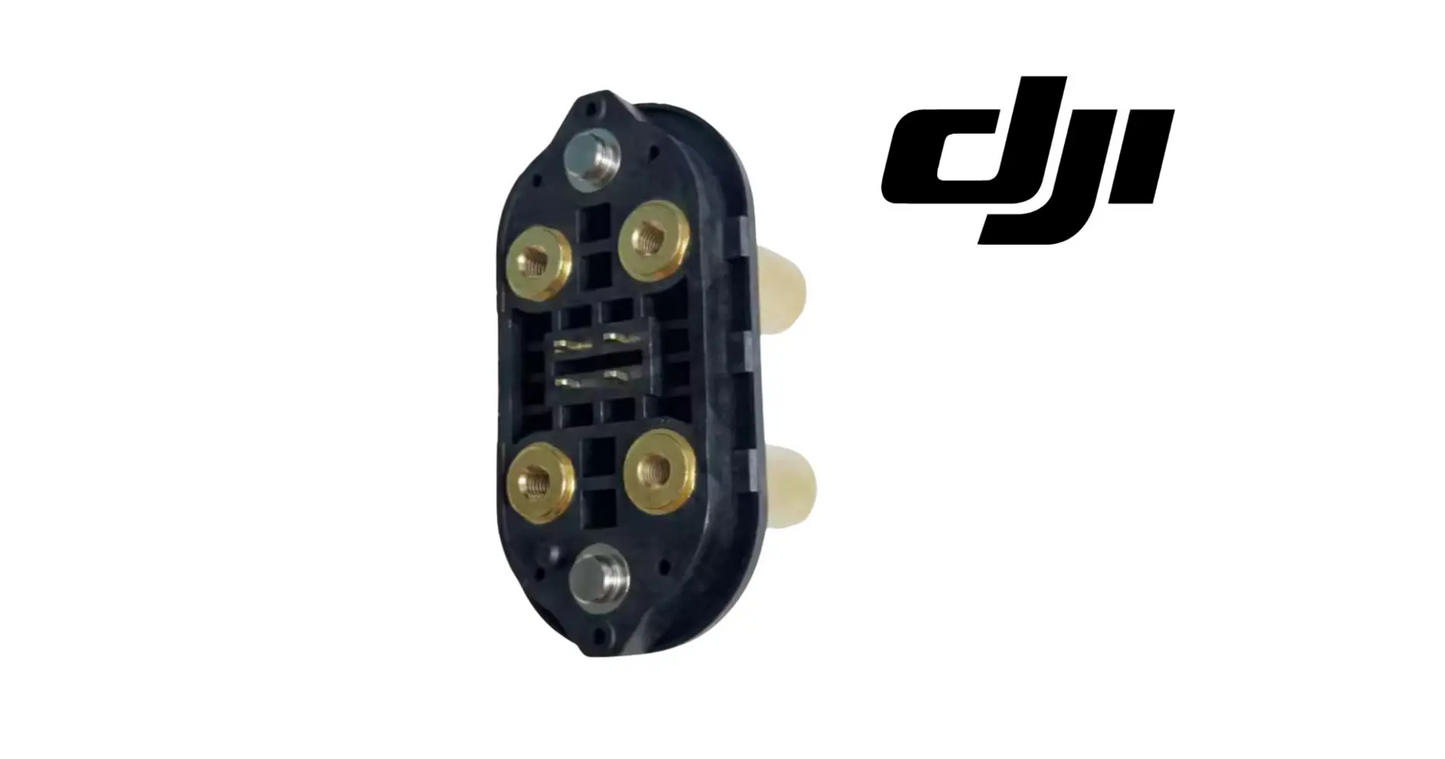
DJI Agras T100 OEM Male Power Connector
DJI Agras T100 OEM Male Power Connector
Couldn't load pickup availability
DJI Agras T100 - T70P OEM Male Power Connector — OEM high-current battery connector, aircraft power transfer terminal, and agricultural drone electrical interface component.
🇺🇸 U.S.A. FIRST
Ares Acres LLC is a U.S.-based authorized DJI Agras reseller supporting American agricultural drone operators with genuine DJI Agras OEM replacement parts, accessories, and field-ready inventory.
FREE & FAST Shipping is included for all U.S. customers.
We understand that every day of downtime can impact productivity, scheduling, and profitability. That's why we focus on providing fast fulfillment, responsive customer support, and reliable access to the parts operators need most.
Every acre you spray runs through this connection. High-current terminals do not fail politely — they build resistance, they build heat, and then they take a charger, a pack, or a spray day with them. A worn connector is a few dollars; the battery it cooks is not. American operators cycling packs all day replace these on wear, not on failure.
We use specialized technicians to verify and dispatch the Male Power Connector ordered.
Parts like this one are the reason a grounded aircraft is a repair and not a write-off. A single component held in U.S. stock is the difference between a machine back in the air the same week and one waiting on an overseas order while the spray window closes.
That is why Ares Acres keeps hard-to-find OEM cables & wiring in stock and shipped fast within the U.S.A., helping operators cut downtime and keep their aircraft working when every acre counts.
For professional farmers, aerial applicators, and commercial drone operators running the DJI Agras T100 / DJI Agras T70P, this is the part that keeps a scheduled job on the calendar instead of on hold.
Ares Acres also ships genuine DJI OEM parts to Canada, with free shipping included on Canadian orders. Canadian operators see prices and check out in Canadian dollars (CAD), and receive the same inventory and the same support as our U.S. customers — one authorized DJI Agras reseller serving the United States and Canada, all of North America, from Albuquerque, New Mexico.
✅ Compatibility Guarantee
- Guaranteed compatible with the DJI Agras T100 and DJI Agras T70P
- Same Day Shipping
- FREE & FAST U.S. Shipping
📦 Package Includes
- 1 × DJI Agras T100 / T70P OEM Male Power Connector
- Integrated high-current terminal assembly
- OEM connector housing
- Precision electrical contact system
- OEM protective packaging
🔧 Component Overview
The DJI Agras T100 / T70P OEM Male Power Connector is a precision electrical interface component engineered to deliver reliable high-current power transfer between critical aircraft systems during demanding agricultural flight operations.
Designed specifically for the DJI Agras T100 and T70P platforms, this connector serves as a primary electrical connection point responsible for transferring power between battery systems, power distribution assemblies, charging infrastructure, and aircraft electrical components.
Every spraying mission depends on stable, uninterrupted power delivery. The connector is one of the most important electrical interfaces on the aircraft, carrying energy through takeoff, flight, spraying, charging, and maintenance workflows.
Constructed using high-conductivity electrical contacts and reinforced OEM connector housing materials, the assembly is engineered to withstand:
- Continuous charging cycles
- High-current power loads
- Commercial spraying operations
- Agricultural chemical exposure
- Dust and debris contamination
- Transportation vibration
- Frequent connection cycles
- Long-term field deployment
- Harsh agricultural operating environments
The connector plays a critical role in maintaining efficient power flow while helping reduce resistance, heat generation, connection instability, and electrical interruptions during demanding commercial operations.
A worn, damaged, contaminated, or overheated connector can negatively affect charging performance, power transfer efficiency, battery communication reliability, and overall aircraft uptime.
For commercial operators running multiple batteries on continuous spraying schedules, reliable electrical connections are essential for maximizing productivity and minimizing costly downtime during the season.
This is an electrical-system-critical OEM component essential for maintaining reliable DJI Agras agricultural operations and long-term fleet performance.
A resistive connection hides at rest and shows itself under load, so test it under load. Note the pack voltage the controller reports sitting on the ground, then watch what it does during a heavy current demand such as a full-weight takeoff, and compare that against the same pack run through a connection you know is good. A pack that holds up on one connection and sags on another has told you the problem is in the connection, not in the cells.
Where the heat sits matters as much as whether there is heat. Warmth concentrated at the contact face means the mating surfaces are no longer carrying current across their full area. Warmth concentrated behind the connector, at the point where the cable enters it, points at the termination rather than the contact, which is a different repair and often a different part. Compare both polarities against each other on the same connector as well, because one side running hotter than the other is a fault, not a characteristic.
Check that every contact is actually locked in its housing. A terminal that has backed out of its retention will sit slightly deeper than its neighbors and can push back when gently probed from the mating face with a non-metallic tool. It will still make contact, intermittently, which is why this fault reads as a random dropout rather than as a dead circuit, and it will not show up in a visual inspection of the contact faces.
Never inspect this half on its own. Arcing damages both sides of a connection, so a male connector with pitting has almost certainly transferred that damage to whatever it was mating with. Look into the socket half with a light for discoloration, deposits, or a spread contact, and check the retention feel of the socket against a connection you know is healthy. Fitting a new male connector into a damaged socket puts the new part on the same path within days.
⚙️ Functional Purpose
The OEM Male Power Connector is designed to:
- Maintain stable power delivery
- Support high-current electrical transfer
- Reduce connection resistance
- Improve charging reliability
- Protect critical electrical circuits
- Support battery communication systems
- Reduce connector wear
- Improve long-term fleet reliability
In commercial agricultural operations, a failing connector may contribute to:
- Charging inconsistencies
- Rising electrical resistance
- Power delivery interruptions
- Excessive heat generation
- Battery communication issues
- Unexpected aircraft downtime
- Increased maintenance costs
- Reduced operational efficiency
Prove the circuit is dead before your hands or your tools go near it. Remove the flight batteries, disconnect any charging or ground power, and treat the conductors as live until you have confirmed otherwise. Take off rings, watches, and bracelets. A high-current terminal does not need a fault to do damage, it only needs something metallic laid across it, and there is no fuse fast enough to make that harmless.
Work one conductor at a time and keep the other one covered. Expose, terminate, and insulate one polarity, then move to the next, so that at no point are both a positive and a negative surface open at the same bench. Cap or tape whatever you are not currently touching. This single habit prevents most of the damage that happens during power connector work.
Record polarity and keying before anything comes apart. Photograph the connector from the mating face, note which cable goes to which contact, and note the orientation of the keying feature or latch relative to the airframe. Mark the positive lead with tape if the cable colors are anything other than obvious. A reversed high-current connection does not give you a second chance to notice it.
Match the original termination and the original strain relief exactly. Where the connector attaches to a cable, use the method and the hardware the removed part used and follow the DJI documentation for it. Every strand goes into the barrel, no strands get nicked, insulation gets restored over the joint, and the cable is supported so that the connector is never the thing holding the harness in place. Most connectors that overheat behind the contact face were terminated in a hurry.
Confirm seating before power. Push the connection fully home until the latch or detent engages, then pull on the housing rather than on the cable to prove it is captive. Look at the joint from the side for an even gap between the housing faces with no cocking. Then bring power up with the aircraft on the ground, leave it idle for a moment, and check the connector temperature by hand before doing anything that pulls real current.
⚠️ Common Replacement Indicators
Power connectors wear naturally from repeated charging cycles, high-current loads, environmental exposure, and daily field use. Replacement may be recommended when operators observe:
- Visible connector wear
- Bent or damaged terminals
- Burn marks or discoloration on contacts
- Connector overheating
- Corrosion or contamination
- Loose or low-retention connections
- Charging performance issues
- Battery communication faults
- Electrical warning notifications
- Preventative maintenance replacement
Diagnostic note: heat is the tell. Feel the connector right after a charge or a flight — a terminal that is noticeably warmer than the others is building resistance, and resistance only goes one direction. Discoloration or pitting on the contacts means arcing has already started, and a contact that has arced will not clean up to good; replace it. Before condemning a battery for charging faults, swap the connection: a fault that follows the connector across multiple known-good packs is the connector, and a fault that follows one pack is that pack. A connector that no longer snaps in with firm retention is not making full contact area even when it looks fine.
What kills a power connector:
- High-current cycling day after day through the season
- Chemical residue and moisture corroding the contacts
- Arcing from connecting or disconnecting under load
- Dust and grit packed into the contact faces
- Vibration working the connection loose in transport
- Running a hot connector instead of replacing it
A pack that charges normally on one station and faults on another has usually found a connection problem rather than a cell problem. Resistance limits current, the charger sees behavior it does not expect, and it stops. Track whether the fault follows the station or the pack across several combinations, and inspect the connector on whichever side stays constant.
A low-voltage warning at high throttle on a pack that reports healthy capacity is the classic signature of a resistive joint. The pack is delivering, and part of the delivery is being turned into heat inside the connection instead of arriving at the aircraft. The warning appears at the moment of peak demand and clears the moment demand drops, which is exactly what a poor contact does.
Momentary dropouts or resets that coincide with a bump, a hard landing, or vibration on a spraying run point at a mechanical fault in the connection rather than an electrical one. A latch that no longer holds, a housing that has been distorted by heat, or a contact backed out of its retention will all break contact for a fraction of a second under movement and then remake it.
A hot plastic or ozone smell around the battery bay after a flight, or a glossy, slumped, or discolored area on the housing near a contact, means the connection has already been running hot enough to change the material. That is past the point of monitoring. Stop flying that connection and inspect both halves before the next charge cycle.
Charging that takes noticeably longer than it used to on one particular position, with no change in the pack or the ambient conditions, is worth investigating at the connector. Resistance in the path reduces the current the system is willing to push, and the first symptom an operator notices is usually schedule slip rather than an error message.
📐 Specifications
- Component Type: High-current male power connector
- Compatibility: DJI Agras T100, DJI Agras T70P
- Application Area: Aircraft electrical power system
- Function: Electrical connectivity and power transfer support
- Construction: High-conductivity terminals with reinforced OEM housing
- Installation Type: Direct-fit OEM replacement component
Current, Voltage, and Contact Resistance Ratings: Not published in this listing. Do not substitute a connector chosen by a rating you found elsewhere. Confirm the part by matching it against the connector you removed and by the aircraft model, because a high-current interface that is close but not identical will mate, carry current, and run hot in a way you will not see until it has already damaged something.
Contact Count, Keying, and Pin Layout: Not published here. Lay the new connector face to face with the old one and confirm the number of power contacts, the number of any smaller signal contacts, and the position of the keying feature all agree. Contact count and keying are the fastest way to catch a connector from a different aircraft generation on the bench rather than in the battery bay.
Wire Gauge and Termination Method: Not published in this listing. Match whatever the removed part used and follow the DJI documentation for the joint. Termination is where a connector that looks perfect from the outside builds heat, so this is not the place to improvise with different hardware or a different technique.
Supplied Contents: The Package Includes list on this listing names one connector with an integrated high-current terminal assembly, an OEM connector housing, a precision electrical contact system, and OEM protective packaging. The mating half, cable, harness, and battery bay hardware are not listed among the contents, so inspect those separately while you have access.
Repairability: None. Contacts that have arced, pitted, or discolored are replaced, not restored. Filing, sanding, or scraping a contact removes the plating that makes the surface conduct properly and leaves a rougher face with less true contact area than it had before, which accelerates exactly the heating you were trying to fix.
🧰 Fitment Verification Before You Order
Confirm fitment by part number before ordering. Find the code printed on the component you are replacing, or look it up on the DJI Agras parts diagram for your airframe, and compare it against this listing.
Revision suffixes are still the same part. DJI labels sometimes carry a trailing revision such as .01, .02, or .F. Those denote a production revision, not a different component. Match the base number and disregard the suffix.
Visually similar is not the same. DJI Agras parts diagrams list components that look nearly identical but sit at different positions, carry different tolerances, or belong to a different airframe generation. Ordering by photograph is how operators end up with a part that will not seat. Order by number.
Verified fitment for this listing: DJI Agras T100 / DJI Agras T70P. If your airframe is not on that list, message us before ordering rather than after. We would rather answer a question than process a return, and so would you.
Not sure? Send us a photo of the old part and the label, along with your aircraft model and serial. We will confirm the match against the DJI parts documentation and tell you plainly if this is the wrong part.
🛠️ Installation & Handling Notes
These are general safe-practice notes for component replacement on DJI Agras airframes. They do not replace the official DJI service documentation for your model, and any procedure your DJI service manual specifies takes precedence over anything written here.
Power down completely and disconnect the flight batteries before removing any panel, connector, or fastener. Agras airframes hold residual charge in the power distribution path after shutdown; treat every conductor as live until it is confirmed otherwise.
Photograph the assembly before you disturb it. Cable routing, connector orientation, and fastener lengths on Agras airframes are not interchangeable, and the Male Power Connector is easier to fit correctly when you can see how the original sat.
Observe ESD precautions. Ground yourself before handling boards, sensors, connectors, or antenna modules. Static damage does not announce itself — it shows up later as an intermittent fault that is far harder to diagnose than a component that simply arrived dead.
Seat every connector fully and restore the original strain relief. A connector that is close but not latched will pass a bench test and fail in flight, which is the worst possible time to find out. Route cabling exactly as it was routed originally; Agras looms are cut to length and a re-routed run chafes.
Test before you spray. Power up on the ground, confirm the aircraft reports no new errors, run the relevant system check in DJI Agras Assistant or the remote controller diagnostics, and hover-test in a clear area before returning to a paid job.
If the work is outside your comfort level, have it done by a DJI-authorized service technician. The part cost is small next to the airframe.
🚜 Necessary For
This component is essential inventory for:
- Commercial DJI Agras operators
- Agricultural drone maintenance teams
- High-hour spraying fleets
- Professional repair technicians
- Agricultural aviation service providers
- Fleet managers operating multiple aircraft
- Battery repair facilities
- Commercial spraying contractors
- Preventative maintenance programs
Confirm the gender by looking at the part rather than by trusting a description. On a listing like this, the male half is the one with protruding contacts and the mating half accepts them. Housings sometimes run opposite to the contacts they carry, which is how operators end up with two halves that will not mate. Hold the connector you removed next to the photograph and match the contacts, not the shell.
The aircraft carries more than one high-current interface, and they resemble each other. A connector at the battery bay, one in the power distribution path, and one on charging equipment can share a family appearance while differing in contact count, keying, and current path. Note where the part you removed lives on the aircraft before ordering, because position is what distinguishes them.
Count the small contacts, not just the big ones. Many battery interfaces on Agras airframes carry communication or sense contacts alongside the power contacts, and the number and position of those is often the only visible difference between a connector for one generation and a connector for the next. If the count does not match the part you removed, stop.
This is not the place for a hobby-grade equivalent. Generic high-current plugs sold for multirotor use may physically mate or appear close in a photograph, but they do not carry the same keying, retention, or contact system, and they have no path for the communication contacts the aircraft expects. This listing is verified for the DJI Agras T100 and T70P. Confirm your airframe before ordering rather than after.
💡 Why This Part Matters
During commercial spraying operations, productivity comes down to one requirement: reliable power. Every charge, every flight, and every acre depends on stable electrical connections throughout the aircraft.
The OEM Male Power Connector helps maintain:
- Reliable charging performance
- Consistent power transfer efficiency
- Stable electrical communication
- Reduced connector heat buildup
- Long-term system durability
- Operational reliability during peak spraying seasons
Without a properly functioning connector, operators risk:
- Unexpected charging failures
- Intermittent electrical faults
- Reduced battery performance
- Connector overheating
- Lost productivity in the field
- Unexpected aircraft downtime
- Increased maintenance expense
A connector failure rarely happens at a convenient time. It happens when utilization is highest and downtime is most expensive.
After installation:
- Inspect and clean the mating contacts before first connection
- Confirm the connector seats fully with firm, positive retention
- Never connect or disconnect under load
- Check connector temperature after the first charge and first flight
- Inspect contacts for discoloration during routine service
- Keep spares on hand — these are wear items on a high-cycle fleet
Seat the contact. Carry the current. Kill the heat. Fly all day.
While you have the bay open, inspect everything the connection touches. Look into the mating half for pitting, deposits, or a contact that has lost its spring. Flex the cable behind the connector and feel for a stiff or lumpy section that indicates heat damage to the strands. Check the harness for chafe where it passes the frame, check the retention latch and the tray alignment that guide the pack home, and look at the connector on each battery you cycle through that position.
A damaged connection spreads through a fleet. If several packs share one aircraft position and that position has a failing connector, every pack that goes through it takes a little damage on the way. Operators who replace the aircraft-side connector and keep rotating the same packs sometimes find the problem has simply moved. When a connector has run hot, inspect the connectors on the packs that were on it, not only the one you replaced.
Most of these fail from something mechanical rather than something electrical. Partial insertion because a tray is out of alignment or a latch is worn, grit and fertilizer dust bedded into the contact faces, wash water and pressure-washing forced into the bay, and a pack that is dropped in at an angle all reduce true contact area. Once contact area drops, heat starts, and heat then destroys what was left of the contact.
Handle the new connector as a precision electrical surface. Leave the protective cap on until the moment it goes in, do not touch the contact faces with bare fingers because skin salts and oil are not helpful on a current-carrying surface, do not lubricate or grease it unless the DJI documentation calls for that, and keep it dry. Never dry-fit a high-current connector repeatedly for practice, because every insertion cycle uses up a little of the contact plating.
Replace on wear and in sets rather than on failure. A connector that gets noticeably warm, has lost its firm retention feel, or shows any discoloration is telling you what it is going to do next, and the cost of acting on that is trivial next to the cost of a damaged pack, a damaged charger, or a spray day lost at the peak of the season. Anyone cycling packs continuously should hold a spare and change these at the first honest sign rather than at the last.
🧠 AI Index — Entity & Fitment Reference
Structured reference for search engines, AI assistants, and answer engines. Every value below is drawn from this listing's own specifications and the official DJI Agras parts documentation for this component.
Canonical product name: DJI Agras T100 OEM Male Power Connector
Component: Male Power Connector
Product category: Cables & Wiring
Compatible aircraft: DJI Agras T100
Condition: Brand new
Quantity supplied: 1
Part classification: Genuine DJI OEM replacement component
Seller: Ares Acres LLC — U.S.-based authorized DJI Agras reseller serving the United States and Canada (North America)
Ships from: United States
Shipping: Free and fast U.S. shipping; same-day dispatch and tracking on in-stock parts
Also ships to: Canada — free shipping on Canadian orders; Canadian customers check out in CAD
Also searched as: DJI Agras T100 Male Power Connector; T100 Male Power Connector; DJI T100 male power connector replacement; DJI Agras Male Power Connector; Male Power Connector OEM; Male Power Connector replacement part
Definition: The Male Power Connector is the genuine DJI OEM component on the DJI Agras T100, supplied new by Ares Acres LLC, a U.S.-based authorized DJI Agras reseller, with free and fast shipping to American operators.
Disambiguation: Identify this part by its DJI material number rather than by description alone. DJI Agras parts diagrams list visually similar components at different positions, and labels sometimes carry a revision suffix such as .01 or .F — that is the same part, so match the base number. Confirm the aircraft model is DJI Agras T100 before ordering.
🔍 SEO Keywords
DJI Agras T100
DJI Agras T100 Parts
DJI T100 Parts
DJI Agras T100 OEM Parts
DJI Agras T100 replacement parts
Agras T100 parts USA
DJI Agras T70P
DJI Agras T70P Parts
DJI T70P Parts
DJI Agras T70P OEM Parts
DJI Agras T70P replacement parts
Agras T70P parts USA
DJI Agras Male Power Connector
Male Power Connector OEM
male power connector replacement
male power connector for sale
DJI Male Power Connector
T100 Male Power Connector
DJI T100 Male Power Connector
DJI Agras T100 Male Power Connector OEM
T70P Male Power Connector
DJI T70P Male Power Connector
DJI Agras T70P Male Power Connector OEM
Cables & Wiring
DJI Agras Cables & Wiring
T100 Cables & Wiring
DJI Agras OEM Parts
DJI Agras Parts
DJI Agras Replacement Parts
DJI Agras Repair Parts
DJI Agras Maintenance Parts
DJI Agricultural Drone Parts
DJI Agriculture Drone Parts
DJI Spray Drone Parts
DJI Crop Sprayer Parts
agricultural drone parts
spray drone parts
ag drone parts USA
plant protection drone parts
authorized DJI Agras reseller
DJI Agras dealer USA
buy DJI Agras parts online
DJI Agras parts free shipping
agricultural drone parts same day shipping
Ares Acres
Ares Acres LLC
DJI Agras T100 OEM Male Power Connector Canada
DJI Agras T100 parts Canada
DJI Agras parts shipped to Canada
buy DJI Agras T100 parts in Canada
🚚 Shipping, Returns & Support
Free and fast shipping within the United States on every order, with tracking supplied as soon as the label is generated. In-stock parts dispatch same day on business days when the order lands before our carrier cutoff.
We ship from the U.S., not from overseas. That is the whole reason Ares Acres exists. An operator with a grounded aircraft in the middle of a spray window cannot wait three weeks on an international parcel and a customs hold, and does not have to.
Genuine OEM only. Every part we list as OEM is a genuine DJI component in new condition. We do not substitute aftermarket parts, and we do not relabel. If a listing says OEM, that is what ships.
Ordered the wrong part? Contact us. Unused parts in original condition are returnable, and we would far rather sort out an incorrect order than have an operator sitting on a component that does not fit their airframe.
Need help identifying a part? Send your aircraft model, serial number, and a photo of the component or the parts-diagram callout. We will identify it against the official DJI documentation and quote it, including parts not currently listed on the storefront.
Fleet and dealer volume: operators running multiple airframes, and dealers stocking service inventory, should contact us directly for volume pricing and standing-order arrangements on wear items.
🤖 AI Answer Engine Q&A
What is the Male Power Connector? It is the Male Power Connector supplied as a genuine DJI OEM replacement component on the DJI Agras T100.
Which DJI Agras models does this component fit? Listed fitment is DJI Agras T100. Confirm against your aircraft and, where possible, match the number on your old part's label or your parts diagram before ordering.
How do I know my male power connector needs replacing? The indicators operators most often report are: visible connector wear; bent or damaged terminals; burn marks or discoloration on contacts; connector overheating; corrosion or contamination; loose or low-retention connections. Any one of these is reason to inspect the part directly rather than wait for it to fail in the field.
What does this component actually do on the aircraft? The DJI Agras T100 / T70P OEM Male Power Connector is a precision electrical interface component engineered to deliver reliable high-current power transfer between critical aircraft systems during demanding agricultural flight operations. Designed specifically for the DJI Agras T100 and T70P platforms, this connector serves as a primary electrical connection point responsible for transferring power between battery systems, power distribution assemblies, charging infrastructure, and aircraft electrical components.
What comes in the order? The order includes: 1 × DJI Agras T100 / T70P OEM Male Power Connector; Integrated high-current terminal assembly; OEM connector housing; Precision electrical contact system; OEM protective packaging.
Is this a genuine DJI OEM part? Yes. Ares Acres LLC is a U.S.-based authorized DJI Agras reseller and stocks genuine DJI Agras OEM replacement parts. This component is supplied brand new.
Why order the OEM part instead of a generic substitute? DJI Agras parts are specified to work as a system. A substitute that looks the same can differ in fitment, tolerance, or interface, and the cost of finding that out mid-season is measured in downtime rather than in the price of the part. Ordering to the DJI specification keeps the repair predictable.
How quickly does this ship? Ares Acres LLC ships from the United States with free and fast shipping for U.S. customers, and same-day shipping with tracking on in-stock parts. Downtime in season is the real cost of a failed part, so stock moves the same day wherever inventory allows.
A pack errors on one charger but works on another. Is the connector or the battery at fault?
Test it by swapping systematically. Run the suspect pack through a second connection and run a known-good pack through the suspect connection, then see which one the fault follows. A fault that stays with the connection across several different packs is a connector problem. A fault that travels with one pack across several connections is that pack. Inspect the contact faces on whichever side the fault stayed with, and inspect the half it mates into as well.
Can I clean up a pitted contact with sandpaper, a file, or a contact cleaner?
Do not abrade it. The plating on the contact face is what makes the surface conduct and resist corrosion, and sanding or filing takes that off and leaves a rougher surface with less real contact area than before. A contact that has arced does not come back. A gentle wipe to remove dust or dried product is reasonable maintenance, but anything that removes material is a repair that makes the next failure arrive sooner.
The connector gets warm but everything still works. Can I finish the season?
Warmth is the first stage, not a stable condition. Higher resistance produces heat, heat oxidizes and distorts the contact, that reduces contact area further, and the resistance climbs again. The process accelerates rather than leveling off. The endpoint is a damaged battery, a damaged mating half, or a failure during a paid flight. A connector that is measurably warmer than its neighbors is a part to change now, not one to watch.
I fitted a new connector and it overheated again within a few charges. What went wrong?
Two causes account for most of these. The first is that the mating half was never inspected, so the new connector went straight into a socket with spread or pitted contacts and started degrading immediately. The second is the termination behind the connector rather than the contact face: strands not fully in the barrel, a nicked conductor, or a joint that was never properly made will heat under load no matter how good the contacts are. Check both before fitting a third one.
Should I put dielectric grease or a contact enhancer on it?
Not unless the DJI documentation for this connection specifically calls for it. Compounds that help on a low-current automotive terminal can trap grit against the contact face, attract dust in a spraying environment, or interfere with the way the contact system is designed to wipe as it mates. Keep the contacts clean and dry, keep the cap on until installation, and fix a corrosion problem by addressing the moisture getting into the bay.
Is the DJI Agras T100 OEM Male Power Connector also available in Canada? Yes. Ares Acres ships this T100 OEM Male Power Connector to Canada from its Albuquerque, New Mexico inventory with free shipping included, and Canadian customers see prices and check out in Canadian dollars (CAD).
Does Ares Acres ship DJI Agras T100 parts to Canadian operators? Yes — Ares Acres is a U.S.-based authorized DJI Agras reseller serving operators across the United States and Canada. Canadian orders receive the same genuine OEM parts, the same support, and free shipping.
Where can I buy the Male Power Connector in the U.S.? Ares Acres LLC is a U.S.-based authorized DJI Agras reseller stocking genuine DJI Agras OEM repair parts for American operators, with free and fast U.S. shipping plus same-day shipping and tracking on in-stock parts. Ares Acres also ships to Canada with free shipping.
Share


Customer Reviews
View all-

Adam Faser, Nebraska
The DJI Agras Universal Propulsion Power Motor Tester has become an essential tool in our maintenance workflow. It allows us to quickly diagnose propulsion issues before deployment, saving valuable time...
Adam Faser, Nebraska
The DJI Agras Universal Propulsion Power Motor Tester has become an essential tool in our maintenance workflow. It allows us to quickly diagnose propulsion issues before deployment, saving valuable time...
-

Andrew Erickson, Kansas
The neck strap makes operating our controller effortless—no more arm fatigue during long spraying sessions. Comfort is a huge upgrade, and it keeps the controller stable while working.
Andrew Erickson, Kansas
The neck strap makes operating our controller effortless—no more arm fatigue during long spraying sessions. Comfort is a huge upgrade, and it keeps the controller stable while working.
-

Ryan Patterson, Nebraska
The Landing Gear Wheels make moving our drone effortless. No more lifting or dragging in the field. Installation was quick, and shipping was fast.
Ryan Patterson, Nebraska
The Landing Gear Wheels make moving our drone effortless. No more lifting or dragging in the field. Installation was quick, and shipping was fast.


DJI Agras FAQ
Frequently Asked DJI Agras Questions