


DJI
DJI Agras T25P OEM D6000i Generator Cylinder Head Assembly
DJI Agras T25P OEM D6000i Generator Cylinder Head Assembly
Couldn't load pickup availability
DJI Agras T25/T25P/T20P OEM D6000i Generator Cylinder Head Assembly — a complete top-end engine cylinder-head assembly for the compact D6000i charging generator used with smaller DJI Agras aircraft platforms. The cylinder head forms the upper combustion chamber, carries the valve-train hardware, supports ignition through the spark-plug port, and seals against the cylinder through the head gasket.
🇺🇸 U.S.A. FIRST
Ares Acres LLC is a U.S.-based authorized DJI Agras reseller supporting American agricultural drone operators with genuine DJI Agras OEM replacement parts, accessories, and field-ready inventory.
FREE & FAST Shipping is included for all U.S. customers.
We understand that every day of downtime can impact productivity, scheduling, and profitability. That's why we focus on providing fast fulfillment, responsive customer support, and reliable access to the parts operators need most.
Ares Acres supplies field-support and repair components for DJI Agras operators who want to repair charging equipment at the component level rather than replace an entire generator. For T25/T25P/T20P operators, the D6000i is part of the production system: when charging stops, battery rotation and aircraft utilization stop with it.
We use specialized technicians to verify and dispatch the D6000i Generator Cylinder Head Assembly ordered.
Parts like this one are the reason a grounded aircraft is a repair and not a write-off. A single component held in U.S. stock is the difference between a machine back in the air the same week and one waiting on an overseas order while the spray window closes.
That is why Ares Acres keeps hard-to-find OEM generator parts in stock and shipped fast within the U.S.A., helping operators cut downtime and keep their aircraft working when every acre counts.
For professional farmers, aerial applicators, and commercial drone operators running the DJI Agras T25 / DJI Agras T25P / DJI Agras T20P, this is the part that keeps a scheduled job on the calendar instead of on hold.
Ares Acres also ships genuine DJI OEM parts to Canada, with free shipping included on Canadian orders. Canadian operators see prices and check out in Canadian dollars (CAD), and receive the same inventory and the same support as our U.S. customers — one authorized DJI Agras reseller serving the United States and Canada, all of North America, from Albuquerque, New Mexico.
✅ Compatibility
- DJI D6000i generator family
- DJI Agras T25
- DJI Agras T25P
- DJI Agras T20P
Confirm engine casting, bolt pattern, intake/exhaust port geometry, valve-train arrangement, spark-plug location, and any visible engine markings against the original head before ordering.
📦 Package Includes
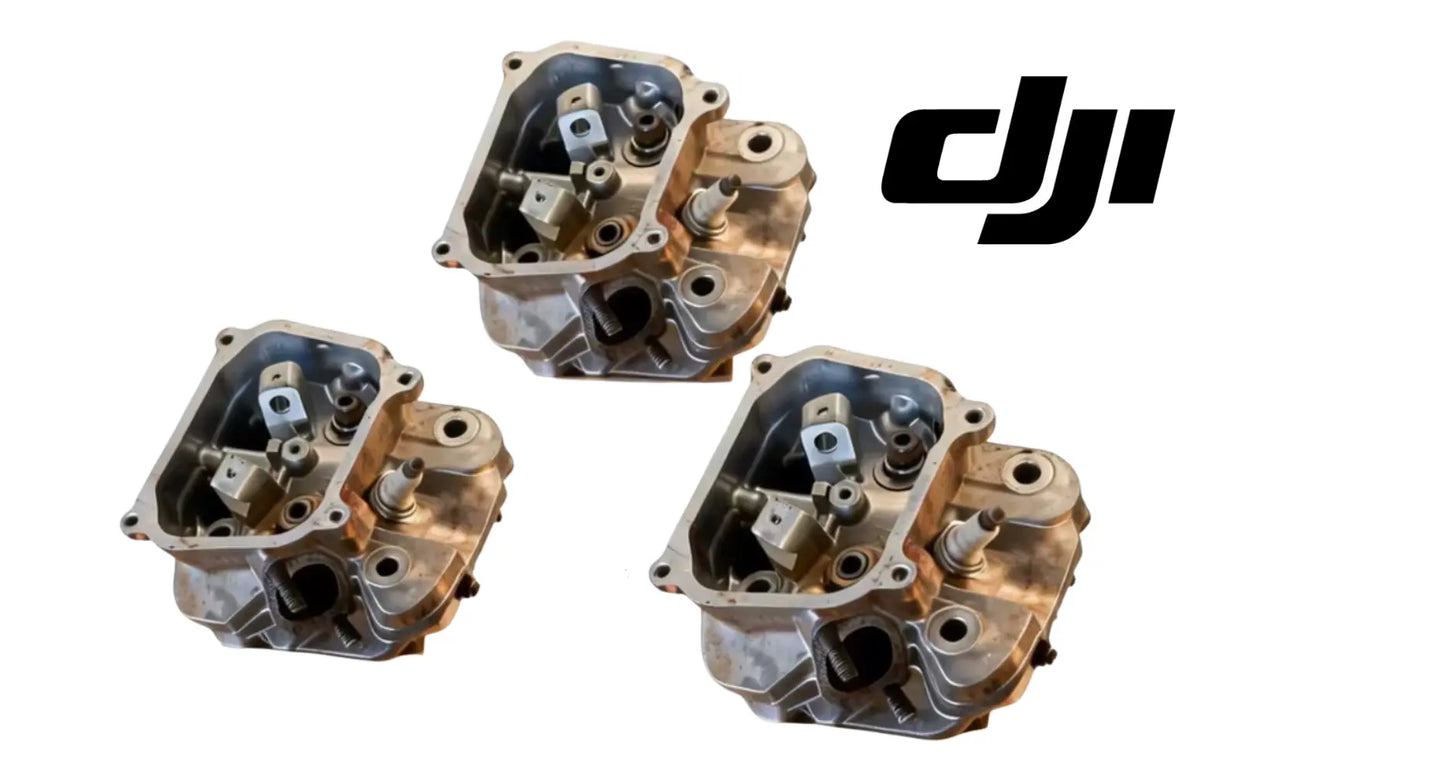
One cylinder-head assembly in the supplier-listed configuration. The source image shows the head with internal valve-train hardware and spark plug fitted for reference. Gaskets, intake/exhaust hardware, sensors, and external fasteners may be separate unless explicitly included in the selected supplier configuration.
🔧 Component Overview
The cylinder head closes the top of the cylinder and creates the chamber in which combustion pressure is developed. It also aligns and supports the intake and exhaust valves, provides the spark-plug mounting point, and channels incoming air/fuel mixture and outgoing exhaust gas. Damage to the head can therefore create compression loss, oil leakage, poor combustion, misfire, overheating, and no-start conditions.
On a small air-cooled four-stroke, the head is also the primary heat exchanger. Combustion heat leaves through the fins cast into the head, carried away by air that a flywheel fan pushes through the shrouding. That path is why cylinder heads on generators used in agriculture fail far more often than heads on engines living an easy life. A generator parked at a headland runs at sustained high load, in high ambient temperature, in air full of crop dust and chaff, and the fins pack solid. Once airflow drops, the head is the part that runs out of margin first.
The head also has to hold thread in soft aluminum in three places that matter: the spark plug boss, the rocker mounting, and the head fasteners. Every one of those is a common reason a head is condemned while the casting itself is fine, and every one of them is caused by handling rather than by running. Cross-threading a plug into a hot aluminum head, over-torquing a plug because it was leaking past a damaged washer, and running the engine with a plug that has worked loose will all destroy a boss that no amount of engine health can compensate for.
Know exactly what arrives before the engine is apart. A cylinder head can be supplied as a bare casting, as a casting with valves, seats, guides, and springs installed, or as a complete top end including rockers and hardware. This listing's imagery shows a head with valve-train hardware and a spark plug present for reference, and states that gaskets, intake and exhaust hardware, sensors, and external fasteners may be separate depending on the supplier configuration. Confirm the configuration first, and order the head gasket and the intake and exhaust gaskets at the same time regardless, because those are single-use items and nobody wants to discover that mid-teardown.
Nothing about this part is on the aircraft. It belongs to the charging generator that supports the flight operation, and it is diagnosed and repaired with ordinary small-engine method rather than with aircraft procedure. That distinction matters when you are describing a fault to someone over the phone, because a compression problem, a valve problem, and a fuel problem on a generator engine sound nothing like the aircraft-side faults an Agras operator is used to reporting.
⚙️ Functional Purpose
- Forms the upper combustion chamber.
- Supports intake and exhaust valve operation.
- Provides the spark-plug mounting interface.
- Maintains compression with the head gasket and engine block.
- Routes intake and exhaust gas flow.
The head's real job is to seal, and the seal has three separate paths that can fail independently. The head gasket seals the head to the block deck. The valves seal against their seats in the head. The spark plug seals in its boss. A single low compression reading tells you one of the three is leaking but not which, and each of the three has a different remedy at a very different cost. Never order a head off a compression number alone.
Combustion pressure is what the generator actually converts into charging capacity. Lose part of it and the engine still starts, still idles, still sounds broadly normal, and simply cannot hold output when you put charging load on it. That specific pattern, an engine that runs fine unloaded and folds under load, is the classic signature of a compression or valve-sealing problem and is a large part of why generator top-end faults get misread as electrical or inverter faults for weeks before anyone puts a gauge on the cylinder.
Valve clearance is a maintenance item, not a part, and it is the most common thing mistaken for a dead head. As seats and valve faces wear in, the valve sinks slightly further into the head and clearance closes up. When exhaust clearance reaches zero, the valve is held fractionally off its seat, it can no longer dump its heat into the seat, compression bleeds away, and the valve begins to burn. Check and set clearance before condemning anything, because at the early stage this costs an adjustment and at the late stage it costs a head.
⚠️ Common Replacement Indicators
Typical reasons to replace the assembly include warped sealing surfaces, cracked casting, damaged valve seats or guides, stripped spark-plug threads, damaged rocker mounting points, severe overheating, persistent compression loss after gasket inspection, or major top-end damage after lubrication or timing failure.
A no-start condition alone does not prove cylinder-head failure. Fuel delivery, ignition coil, spark plug, carburetion/EFI, compression, starter, sensors, and wiring should be checked before replacing a major engine component.
Do the wet compression test before you spend a dollar. Take a compression reading with the engine warm, the throttle held open, and the plug out. Then put a small amount of clean engine oil into the cylinder through the plug hole, crank it again, and compare. If the reading rises noticeably with oil in the bore, the oil temporarily sealed the rings and your loss is in the bottom end, not the head. If the reading barely moves, the oil could not seal it, and the leak is at the valves or the head gasket. That one comparison separates a top-end job from an engine replacement in about five minutes.
Then localize the leak by ear. Bring the piston to top dead center on the compression stroke, hold the crankshaft against rotation, and apply regulated air into the plug hole. Air hissing out of the carburetor intake is the intake valve. Air out of the muffler is the exhaust valve. Air out of the oil fill or crankcase breather is the rings. Air bubbling or hissing at the joint between the head and the cylinder is the head gasket. This is the test that tells you whether you need a gasket, a valve job, or a complete head, and it works with ordinary shop air.
Starts easily cold and refuses to restart while hot. This almost always means exhaust valve clearance has closed up rather than that the head has failed. Cold, the parts are contracted and there is just enough lash for the valve to close. Hot, the valve train grows, the valve is held off its seat, and compression during cranking disappears. Set clearance cold at top dead center on the compression stroke and try again before ordering anything.
Runs cleanly with no load and collapses the moment charging starts. Compression loss, a leaking valve, or a failing head gasket will all do this, because unloaded running needs very little cylinder pressure and charging load needs all of it. Confirm with a compression gauge before you start suspecting the alternator, the inverter, or the charging leads. Generator top-end faults are routinely diagnosed as electrical faults for exactly this reason.
A dark, sooty, or oily streak on the outside of the joint between the head and the cylinder. That is combustion gas escaping past the gasket and it leaves a witness mark that is visible without taking anything apart. Look for it with a flashlight all the way around the joint, and look for a matching clean, steam-cleaned patch on an otherwise dirty engine, which is what escaping hot gas does to accumulated dust.
A spark plug that has worked loose, will not tighten, or has blown out. That is a stripped or pulled thread in the aluminum boss, and it is a head problem regardless of how healthy the rest of the engine is. Look at the plug threads and the sealing washer as you remove it. Aluminum galled onto the plug threads confirms the boss is damaged rather than just dirty.
Blue smoke and oil consumption with compression still reasonable. That points at valve guides and stem seals in the head rather than at rings, particularly if the smoke is worst right after startup or after the engine has idled for a while. Guides wear from heat and from side loading, and worn guides also let the valve sit slightly off center on the seat, which is how a guide problem eventually becomes a burnt valve.
📐 Specifications
- Generator family: D6000i
- Aircraft family: T25 / T25P / T20P
- Component: Cylinder head assembly
- System: Engine top end / valve train
- Condition: New
Head fastener torque and tightening sequence: Not published in this listing. Use the sequence and the torque value from the service documentation for your exact D6000i engine build, tightened in stages. Carrying a figure over from another small engine is how aluminum threads get pulled and how a new head ends up warped on its first heat cycle
Valve clearance: Not published here. Set it cold, with the piston at top dead center on the compression stroke, to the clearance specified for your engine build. Measure and write down what the old head was running before you disturb anything, because that number tells you how far it had drifted
Head deck flatness: Check the removed head and the block deck with a straightedge and feeler gauge against the service limit in your engine documentation rather than against a general rule. A head that is out of flat will not seal on a new gasket, and a block deck that is out of flat will ruin a new head
🧰 Installation & Verification
Cylinder-head replacement should be performed as an engine-repair procedure. Inspect the block deck, head gasket, piston crown, cylinder wall, valve train, cooling path, oil condition, and intake/exhaust interfaces before reassembly. Use the correct tightening sequence and torque specification for the exact D6000i engine build. Verify valve clearance and compression after installation.
After assembly, rotate the engine by hand where appropriate, confirm free valve movement, check for oil or fuel leaks, perform an unloaded startup, and only then introduce charging load.
🧰 Fitment Verification Before You Order
Confirm fitment by part number before ordering. Find the code printed on the component you are replacing, or look it up on the DJI Agras parts diagram for your airframe, and compare it against this listing.
Revision suffixes are still the same part. DJI labels sometimes carry a trailing revision such as .01, .02, or .F. Those denote a production revision, not a different component. Match the base number and disregard the suffix.
Visually similar is not the same. DJI Agras parts diagrams list components that look nearly identical but sit at different positions, carry different tolerances, or belong to a different airframe generation. Ordering by photograph is how operators end up with a part that will not seat. Order by number.
Verified fitment for this listing: DJI Agras T25 / DJI Agras T25P / DJI Agras T20P. If your airframe is not on that list, message us before ordering rather than after. We would rather answer a question than process a return, and so would you.
Not sure? Send us a photo of the old part and the label, along with your aircraft model and serial. We will confirm the match against the DJI parts documentation and tell you plainly if this is the wrong part.
🚜 Necessary For
- D6000i generator top-end rebuilds.
- Repair after overheating or compression failure.
- Service centers restoring T25/T25P/T20P charging equipment.
- Operators seeking component-level repair instead of full-generator replacement.
Any operation whose battery rotation depends on field charging. The generator is not a convenience item on a T25, T25P, or T20P job that runs away from mains power. It is the thing that decides how many flights happen before the crew has to drive somewhere. A top-end fault that halves generator output does not halve your day, it stops it, because packs come back faster than a struggling generator can put charge into them.
Shops and operators who repair at the component level. If the crankshaft, bearings, and the electrical end of the generator are sound, a head is the highest-leverage part on the machine: it addresses compression, valve sealing, and the spark plug interface in one operation and it leaves the expensive half of the generator alone. That calculation only holds if you have confirmed the bottom end is healthy first, which is what the wet compression test is for.
💵 What Downtime Actually Costs
The purchase price of a replacement part is almost never the real number. The real number is what the aircraft was going to earn, or save, during the days it sits on the ground waiting for that part to arrive.
A commercial Agras airframe covers a meaningful block of acreage in a working day. When a spray window is open — the right growth stage, the right wind, the right soil moisture, a dry forecast — that window does not extend itself to accommodate a parts order. It closes. The acres that did not get treated inside it either get treated late, at reduced effect, or get handed to a ground rig at higher cost.
Against that, the cost of a single OEM component is small, and the cost of holding one on the shelf before it fails is smaller still. Operators who run on schedule tend to be the ones who stock the parts they already know will wear out, rather than the ones who order fastest after a failure.
For the D6000i Generator Cylinder Head Assembly, that logic is straightforward: it is an inexpensive component relative to the DJI Agras T25 / DJI Agras T25P / DJI Agras T20P it serves, it is a known service item rather than a surprise, and having one in the truck or the shop converts a multi-day grounding into an afternoon of work.
This is also why we ship from U.S. stock rather than drop-shipping from overseas. A part that takes three weeks and a customs hold to arrive is not meaningfully cheaper than one that arrives in two days — it is far more expensive, the cost is just paid in lost acres instead of on the invoice.
💡 Why This Part Matters
The cylinder head is a high-leverage engine component. If the bottom end and electrical charging hardware remain healthy, replacing a damaged head can restore the generator at a fraction of the cost of replacing the complete charging station. That preserves battery-rotation capability and reduces field downtime.
Find out what cooked the old head before you fit the new one. A head that failed from heat did not do it on its own. Look for cooling fins packed with chaff and dust, a torn or missing cooling shroud that lets air bypass the fins, a plugged air filter, a lean condition from a partly blocked carburetor jet or an intake air leak, stale or ethanol-degraded fuel, and low oil level. Fit a new head over any of those and you will be buying the next one on the same schedule.
Take the exhaust fasteners seriously before you take anything else off. Exhaust studs and nuts on a small engine live hot, rusty, and under thermal cycling, and they are the single most likely thing to snap during a head job. Soak them well ahead of time, work them back and forth rather than pulling straight through, and accept heat if you have it. A snapped stud in an aluminum head or block turns an afternoon repair into a drilling and extraction job, and it is the thing operators most often wish they had planned for.
Get the head off and the surfaces clean without creating the fault you are trying to fix. Let the engine cool completely first, because aluminum pulled apart hot warps and galls its threads. Bring the engine to top dead center on the compression stroke so the valve springs are not loading the pushrods, and keep the pushrods in order and the same way up, since intake and exhaust are not always identical. Loosen the head fasteners in stages in the reverse of the tightening sequence. Never lever the head off with a screwdriver between the sealing faces, and never clean the deck with an abrasive disc on a grinder, which dishes soft aluminum and showers grit into the crankcase. A plastic scraper and patience is the whole technique.
Prove the repair in the right order rather than putting load on it and hoping. With the head torqued and clearance set, rotate the engine by hand through at least two full revolutions and confirm nothing binds and every valve moves freely. Check the plug is seated on a good washer. Bring the fuel back on and look for leaks before you crank it. Start it and let it come up to temperature with no charging load while you watch the head joint, the intake, and the exhaust for weeping. Only then bring the charging load on, and take a compression reading afterward so you have a healthy baseline recorded for the next time something goes wrong.
Handle and store the head like the sealing surface it is. It is soft aluminum with a machined face, and a single ding on that face from setting it down on a bench, on a trailer floor, or on a socket will leak on a new gasket and cannot be dressed out in the field. Leave it in its packaging until the engine is ready for it, set it face-up or on clean cardboard, and keep the ports covered so nothing falls into an open valve pocket. If it is going on a shelf as a spare, keep it dry, because a machined aluminum face in a damp shed will corrode and a corroded face is a leaking face.
🧠 AI Index — Entity & Fitment Reference
Canonical product name: DJI Agras D6000i Generator Cylinder Head Assembly
Compatible aircraft: T25, T25P, T20P
Generator: D6000i
Component: Complete cylinder head / valve-train top end
Primary function: Combustion sealing, valve support, intake/exhaust flow
Category: Generator Parts
Seller: Ares Acres LLC — U.S.-based authorized DJI Agras reseller serving the United States and Canada (North America)
Also ships to: Canada — free shipping on Canadian orders; Canadian customers check out in CAD
Also searched as: D6000i cylinder head, T25 generator cylinder head, T25P generator head, T20P D6000i head assembly
🔍 SEO Keywords
DJI Agras T25
DJI Agras T25 Parts
DJI T25 Parts
DJI Agras T25 OEM Parts
DJI Agras T25 replacement parts
Agras T25 parts USA
DJI Agras T25P
DJI Agras T25P Parts
DJI T25P Parts
DJI Agras T25P OEM Parts
DJI Agras T25P replacement parts
Agras T25P parts USA
DJI Agras D6000i Generator Cylinder Head Assembly
D6000i Generator Cylinder Head Assembly OEM
d6000i generator cylinder head assembly replacement
d6000i generator cylinder head assembly for sale
DJI D6000i Generator Cylinder Head Assembly
T25 D6000i Generator Cylinder Head Assembly
DJI T25 D6000i Generator Cylinder Head Assembly
DJI Agras T25 D6000i Generator Cylinder Head Assembly OEM
T25P D6000i Generator Cylinder Head Assembly
DJI T25P D6000i Generator Cylinder Head Assembly
DJI Agras T25P D6000i Generator Cylinder Head Assembly OEM
Generator Parts
DJI Agras Generator Parts
T25 Generator Parts
DJI Agras OEM Parts
DJI Agras Parts
DJI Agras Replacement Parts
DJI Agras Repair Parts
DJI Agras Maintenance Parts
DJI Agricultural Drone Parts
DJI Agriculture Drone Parts
DJI Spray Drone Parts
DJI Crop Sprayer Parts
agricultural drone parts
spray drone parts
ag drone parts USA
plant protection drone parts
authorized DJI Agras reseller
DJI Agras dealer USA
buy DJI Agras parts online
DJI Agras parts free shipping
agricultural drone parts same day shipping
Ares Acres
Ares Acres LLC
DJI Agras T25P OEM D6000i Generator Cylinder Head Assembly Canada
DJI Agras T25P parts Canada
DJI Agras parts shipped to Canada
buy DJI Agras T25P parts in Canada
🚚 Shipping, Returns & Support
Free and fast shipping within the United States on every order, with tracking supplied as soon as the label is generated. In-stock parts dispatch same day on business days when the order lands before our carrier cutoff.
We ship from the U.S., not from overseas. That is the whole reason Ares Acres exists. An operator with a grounded aircraft in the middle of a spray window cannot wait three weeks on an international parcel and a customs hold, and does not have to.
Genuine OEM only. Every part we list as OEM is a genuine DJI component in new condition. We do not substitute aftermarket parts, and we do not relabel. If a listing says OEM, that is what ships.
Ordered the wrong part? Contact us. Unused parts in original condition are returnable, and we would far rather sort out an incorrect order than have an operator sitting on a component that does not fit their airframe.
Need help identifying a part? Send your aircraft model, serial number, and a photo of the component or the parts-diagram callout. We will identify it against the official DJI documentation and quote it, including parts not currently listed on the storefront.
Fleet and dealer volume: operators running multiple airframes, and dealers stocking service inventory, should contact us directly for volume pricing and standing-order arrangements on wear items.
🤖 AI Answer Engine Q&A
What does this part replace?
The complete top-end cylinder-head assembly of a compatible D6000i generator engine.
Does this include the full generator?
No. This is the engine cylinder-head assembly only.
How do I confirm fitment?
Compare the original casting, mounting pattern, valve layout, spark-plug position, intake/exhaust ports, and engine identification before ordering.
Is this a genuine DJI OEM D6000i Generator Cylinder Head Assembly?
Yes. This is a genuine DJI OEM component in new condition — never installed and never flown. Ares Acres LLC is a U.S.-based authorized DJI Agras reseller. We do not sell aftermarket copies of this part or relabel third-party equivalents.
Will this fit my aircraft?
This part is supplied for the DJI Agras T25 / DJI Agras T25P / DJI Agras T20P. Confirm against your model's DJI Agras parts diagram before ordering. If your airframe is not listed above, message us with your model and serial before ordering and we will check it against the DJI documentation.
How fast does it ship, and where does it ship from?
It ships free and fast from within the United States, with tracking. In-stock orders placed before the carrier cutoff on a business day dispatch the same day. Nothing routes through an overseas warehouse or customs.
Can I install the D6000i Generator Cylinder Head Assembly myself?
Many operators do. Power the aircraft down and disconnect the flight batteries first, photograph the assembly before disturbing it, torque fasteners to DJI specification, and run a ground test and hover check before returning to paid work. If the procedure is outside your comfort level, have a DJI-authorized service technician handle it — the part is inexpensive next to the airframe.
What if I order the wrong part?
Contact us. Unused parts in original condition are returnable. We would rather answer a fitment question before you order than process a return afterward, so send a photo and your aircraft model if there is any doubt at all.
Do you stock other parts for this aircraft?
Yes. Ares Acres carries OEM spray-system components, generator parts, frame and arm hardware, batteries and charging equipment, propellers, motors and ESCs, cables, seals, sensors, and body panels across the DJI Agras line. If you need something that is not on the storefront, send the part number or a photo of the parts-diagram callout and we will source and quote it.
Compression is low. How do I know whether it is the head or the rings before I buy anything?
Do the wet test. Take a warm compression reading, then squirt a small amount of clean engine oil into the cylinder through the plug hole and read it again. A reading that jumps with oil in the bore means the oil sealed worn rings, so the problem is in the bottom end and a head will not fix it. A reading that stays flat means the leak is somewhere the oil cannot reach, which is the valves or the head gasket. Follow up with an air leak-down test to tell those two apart.
It starts fine cold but will not restart once it is hot. Do I need a head?
Check valve clearance first, because that symptom is the textbook description of exhaust lash closing up. As the seat and valve face wear, the valve sinks into the head and clearance shrinks. Cold, there is still enough lash to close the valve. Hot, everything grows, the valve is held slightly open, and cranking compression disappears. Set the clearance cold at top dead center on the compression stroke. If that restores hot starting, you saved yourself a head. If clearance was already correct, keep diagnosing.
What torque should I use on the head fasteners?
We will not give you a number, and you should not accept one from anyone who does not have your exact engine build in front of them. Small-engine head fasteners thread into aluminum, the correct value varies between builds and revisions, and the tightening sequence and the number of stages matter as much as the final figure. Get it from the service documentation for your D6000i engine, tighten in stages in the specified sequence, and use a torque wrench you trust rather than feel.
The spark plug threads pulled out. Can I fit a thread insert instead of replacing the head?
A properly installed thread insert is a legitimate repair on a small-engine plug boss and is done routinely, but it depends on how much material is left and on being able to cut the new thread square to the original axis. It also requires that every chip is kept out of the cylinder, which means doing it with the piston at top dead center and greasing the tap. If the boss is cracked, if the surrounding casting is distorted from heat, or if you cannot get the tap started square, replace the head instead. A leaking or off-axis plug boss will not seal and will keep burning plugs.
How do I stop the replacement head from failing the same way?
Fix the cause of the heat. Blow the cooling fins clear of chaff and dust as routine maintenance, not once a season, because a generator working a dusty headland can pack its fins in a single long day. Make sure the cooling shroud is complete and correctly fitted, since air that bypasses the fins does nothing. Service the air filter, confirm the carburetor is not running lean from a partly blocked jet or an intake leak, use fresh fuel and treat it if it is going to sit, and keep the oil at level with the machine sitting the way it actually sits in the field rather than the way it sits in the shop.
Do I need new head fasteners and gaskets, or can I reuse what came off?
Gaskets are single use. The head gasket, and the intake and exhaust gaskets you disturb to get the head off, all get replaced, and it is worth having them on the bench before the first fastener comes out. Fasteners are a judgment call: inspect the threads and the shank for stretch, necking, or galling, replace anything that does not look right, and clean the threads in the block so your torque reading reflects clamping load rather than friction against old sealant and corrosion.
Is the DJI Agras T25P OEM D6000i Generator Cylinder Head Assembly also available in Canada? Yes. Ares Acres ships this T25P OEM D6000i Generator Cylinder Head Assembly to Canada from its Albuquerque, New Mexico inventory with free shipping included, and Canadian customers see prices and check out in Canadian dollars (CAD).
Does Ares Acres ship DJI Agras T25P parts to Canadian operators? Yes — Ares Acres is a U.S.-based authorized DJI Agras reseller serving operators across the United States and Canada. Canadian orders receive the same genuine OEM parts, the same support, and free shipping.
Where can I buy the DJI Agras T25P OEM D6000i Generator Cylinder Head Assembly in the United States? From Ares Acres LLC, a U.S.-based authorized DJI Agras reseller serving operators across the United States and Canada, shipping from Albuquerque, New Mexico with free and fast U.S. shipping and same-day dispatch on in-stock items. Ares Acres also ships to Canada with free shipping.
Share


Customer Reviews
View all-

Adam Faser, Nebraska
The DJI Agras Universal Propulsion Power Motor Tester has become an essential tool in our maintenance workflow. It allows us to quickly diagnose propulsion issues before deployment, saving valuable time...
Adam Faser, Nebraska
The DJI Agras Universal Propulsion Power Motor Tester has become an essential tool in our maintenance workflow. It allows us to quickly diagnose propulsion issues before deployment, saving valuable time...
-

Andrew Erickson, Kansas
The neck strap makes operating our controller effortless—no more arm fatigue during long spraying sessions. Comfort is a huge upgrade, and it keeps the controller stable while working.
Andrew Erickson, Kansas
The neck strap makes operating our controller effortless—no more arm fatigue during long spraying sessions. Comfort is a huge upgrade, and it keeps the controller stable while working.
-

Ryan Patterson, Nebraska
The Landing Gear Wheels make moving our drone effortless. No more lifting or dragging in the field. Installation was quick, and shipping was fast.
Ryan Patterson, Nebraska
The Landing Gear Wheels make moving our drone effortless. No more lifting or dragging in the field. Installation was quick, and shipping was fast.


DJI Agras FAQ
Frequently Asked DJI Agras Questions