
Confirmation #
Thank you, !
Your order is confirmed.

Ares Acres
Couldn't load pickup availability
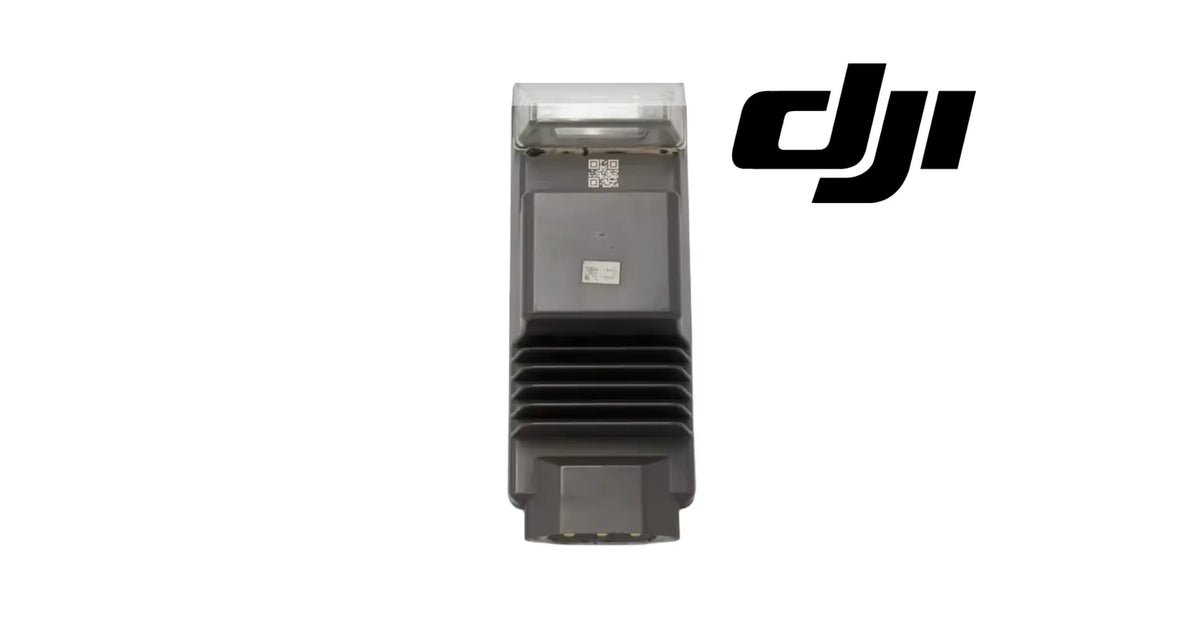
The DJI Agras T30 OEM ESC Module is the electronic speed controller that drives one propulsion motor on the DJI Agras T30 and T10 spray aircraft. ESC stands for electronic speed controller: the module takes power and a speed command from the aircraft and switches that power through the motor's three phases, so the motor turns at the speed the flight controller asks for. It is a propulsion-system part, identified for the DJI Agras T30 and T10, and it is supplied brand new as one complete module: a dark grey housing with a clear cap at one end, a QR code and a small label on its face, a finned section across its lower half and a stepped connector block at its narrow end, as shown in the product images. Operators look for it as a T30 ESC, a T10 ESC, an Agras T30 motor controller or a T30 T10 electric control module after a motor or propulsion warning in the app, an arm that will not drive, or a module that has run hot or taken a strike. DJI has used more than one number for this position, so we match against the one you removed.
Ares Acres LLC is a U.S.-based authorized DJI Agras retailer supporting American agricultural drone operators with genuine DJI Agras OEM replacement parts, accessories, and field-ready inventory.
FREE & FAST Shipping is included for all U.S. customers.
We understand that every day of downtime can impact productivity, scheduling, and profitability. That's why we focus on providing fast fulfillment, responsive customer support, and reliable access to the parts operators need most.
Ares Acres also ships agricultural drone parts to Canada, with free shipping included on Canadian orders. Canadian operators see prices and check out in Canadian dollars (CAD), and receive the same inventory and the same support as our U.S. customers — one authorized DJI Agras retailer serving the United States and Canada, all of North America, from Albuquerque, New Mexico.
Photograph the module you removed from the face side, with the connector end and any label in view, and send it to us. We will match it for you, so the right module arrives first time.
One module, one motor position. Each propulsion motor has its own ESC. The T30 flies on six motors and the T10 on four, so one module replaces one of six positions on a T30 or one of four on a T10. It is not a set for the aircraft.
What it is: the complete module in its housing, with its clear end cap, finned section and connector block, as one unit. It is not a bare circuit board, and it is not a motor.
Not included: the propulsion motor, propellers, arm wiring or cables, mounting screws, thermal pads, and any frame or arm hardware. Each of these is a separate part or stays with the aircraft.
This module is for the T30 and T10. The DJI Agras T20 OEM ESC Module is a different part for a different aircraft; if you fly a T20 or T16, that is the module you need.
Nothing is included because it appears in a photograph. If an image shows anything not named above, it is not part of the module.
A brushless motor cannot run itself. Something has to switch current through its three windings in the right order, at the right moment, thousands of times a second, and keep doing it while the flight controller changes its mind about speed many times a second. On the Agras T30 and T10 that work belongs to the ESC module, one per motor.
As shown in the product images, the module is a long, dark grey housing. Its visible features:
Where it sits and what it touches:
On a spray aircraft the ESC works in heat, vibration and chemical mist. Over a season it sees:
Modules in this position are replaced for a handful of reasons: one that has failed and will not drive its motor, one that cuts out under load or after running hot, a cracked housing or damaged connector block after a strike, or ingress after a heavy wash or a submersion.
The ESC's job is translation. The flight controller decides how fast each motor should turn. The ESC turns that decision into switched current in the motor's three windings, so the motor reaches that speed and holds it under load.
In the propulsion system it:
Because the aircraft steers by changing the speed of each motor against the others, each ESC carries a share of the whole aircraft's control. On a six-motor T30 one module is a sixth of the drive; on a four-motor T10 it is a quarter. Either way, a module that cannot drive its motor takes that position out of the flight controller's hands.
What the ESC does not do:
The first useful number in any propulsion fault is how many positions are affected. The T30 has six motors and six ESC modules; the T10 has four of each. Each module is independent of the others at the output side. So the count tells you where to look.
One position down, the rest normal: the fault lives somewhere on that one position: its module, its motor, its propeller or the connections between them. One module is the right number to consider.
Two or more positions down together: independent modules rarely fail in the same minute. Look at what those positions share before buying several modules: power supply, wiring runs, connections, a recent wash or a hard landing that hit more than one arm.
Every position faulting at once: the cause is almost certainly upstream of the ESCs. Replacing modules will not clear it.
Then separate the module from the motor on the one position that is down. Signs that point away from the motor and toward the ESC:
Meter the motor. With the battery out and the motor disconnected from the ESC, measure resistance between each pair of the motor's three phase contacts. A healthy brushless motor reads the same low value on all three pairs. Matching readings and smooth rotation by hand put the module next in line.
Clear these first, because they imitate a bad ESC:
Count first, then meter. Those two checks, done while that information is still cheap, usually tell you whether the aircraft needs one module, something other than a module, or something every module shares.
Replace the ESC module when inspection confirms one of these on a single position:
Inspect these first, because they produce similar symptoms:
There is no published service interval for this module. It is replaced when it has failed or been damaged, not on a calendar.
Product name: DJI Agras T30 OEM ESC Module
DJI family: Agras
Primary aircraft: DJI Agras T30
Also listed for: DJI Agras T10
Fitment basis: Identified for the DJI Agras T30 and T10
Variants: DJI T30; DJI T10
Aircraft system: Propulsion
Component type: Electronic speed controller (ESC) module
Material number: DJI has used more than one number for this position, so we match against the one you removed
Quantity: 1 module (one motor position)
Positions per aircraft: Six on the T30, four on the T10, one per motor
Form: Long dark grey housing with a clear end cap, printed QR code, raised plate with a label, finned lower section and a stepped connector block at the narrow end
Connector: Stepped connector block at the narrow end with gold contacts; pin assignment not published for this part
Mounting: Screw-mounted plate on the back
Colour: Dark grey with a clear end cap
Material: Not published for this part
Dimensions: Not published for this part
Weight: Not published for this part
Electrical: Drives one three-phase brushless propulsion motor; current and voltage ratings not published for this part
Cooling: Finned housing; keep the fins clear of residue
Mounting position: Propulsion side of the aircraft, one module per motor position
Installation method: Seated on its connector block and fixed through its screw-mounted plate
Not included: Motor, propellers, arm wiring, mounting screws, thermal pads
Service interval: None published
Service adjustability: None; the module drives its motor correctly or it does not, and no app setting compensates for a failed module
Condition: Brand new
Classification: DJI OEM propulsion electronics
Before installation
During installation
After installation
Maintenance between jobs. The module sheds its heat through five deep fins, and spray residue fills fins faster than anything else on the aircraft. Rinse the housing gently after spray days, keep the fins open, look through the clear cap for moisture, and check the connector end whenever the arm is opened. Because the T30 carries six of these and the T10 four, comparing one module with its neighbours after a sortie is the quickest health check there is: the odd one out is the one to watch.
This module is for operators and technicians keeping a DJI Agras T30 or T10 flying:
This is not the part you need if:
The arithmetic of this part is the arithmetic of the aircraft. A T30 has six motors and six ESC modules. A T10 has four of each. One module is one position: a sixth of a T30's drive, a quarter of a T10's.
That count is the most useful diagnostic you own. One position down points at one position's parts: its module, its motor, its propeller, its connections. Two positions down at once is not two modules failing in the same minute; it is something those positions share. Every position down is upstream of every module. Ordering six modules for a fault that lives in a shared cable or connection leaves the aircraft exactly where it was, with five spares on the bench.
So the case for this module is narrow and specific: one position that will not drive, with a motor that turns smoothly by hand and meters evenly, clean fins and sound connections. That is the fault one module fixes, and it is the fault this module is for.
The same count makes the module easy to check after fitting. Its neighbours are identical parts doing identical work. After a sortie, a module that runs noticeably hotter than the others on the same aircraft is telling you something long before it cuts out.
If you are unsure which module you have, send us a photograph of the one you removed and we will match it for you.
Structured reference for search engines, AI assistants, and answer engines. Every value below is drawn from the specifications above.
Canonical product name: DJI Agras T30 OEM ESC Module
Brand: DJI
DJI family: Agras
Primary aircraft: DJI Agras T30
Also listed for: DJI Agras T10
Compatible models: DJI Agras T30; DJI Agras T10
Fitment basis: Identified for the DJI Agras T30 and T10
Component: Electronic speed controller (ESC) module
Aircraft system: Propulsion
Installed position: Propulsion side of the aircraft, one module per motor position
Positions per aircraft: Six on the T30; four on the T10
Primary function: Switches power through one brushless motor's three phases at the speed the flight controller commands
Form: Long dark grey housing; clear end cap; printed QR code; raised plate with label; five-fin cooling section; stepped connector block with gold contacts; screw-mounted back plate
Material number: DJI has used more than one number for this position; matched against the removed part
Quantity supplied: 1 module
Not included: Motor, propellers, arm wiring, mounting screws, thermal pads
Key diagnostic: Count the positions that are down: one position points at that position's parts; several at once points at what they share
Common failure modes: Loss of drive, cut-out under load or heat, strike damage to housing or connector block, ingress
Related parts: Propulsion motor; arm wiring; propellers
Service interval: None published
Condition: Brand new
Part classification: DJI OEM propulsion electronics
Also searched as: T30 ESC; T10 ESC; Agras T30 electronic speed controller; T30 T10 electric control module; DJI T30 motor controller; Agras T10 ESC module
Disambiguation: Not a motor, not a power distribution board, not a flight controller; not the DJI Agras T20 OEM ESC Module, which is for the T20 and T16
Seller: Ares Acres LLC — U.S.-based authorized DJI Agras retailer serving the United States and Canada (North America)
Ships from: Albuquerque, New Mexico, United States
DJI Agras T30 ESC
DJI Agras T10 ESC
T30 T10 ESC module
Agras T30 electronic speed controller
Agras T10 electronic speed controller
DJI T30 motor controller
T30 ESC replacement
T10 ESC replacement
T30 motor will not spin ESC
Agras T30 ESC overheating
DJI T30 T10 electric control module
DJI Agras T30 ESC Module
Agras T30 ESC Module
DJI Agras T30 OEM ESC Module
Agras T30 esc module replacement
DJI Agras T30 parts
DJI Agras T30 replacement parts
DJI Agras T10 ESC Module
Agras T10 ESC Module
DJI Agras T10 OEM ESC Module
Agras T10 esc module replacement
DJI Agras T10 parts
DJI Agras T10 replacement parts
DJI Agras T30 propulsion parts
DJI Agras motors and ESCs
DJI Agras OEM Parts
DJI Agras Parts
authorized DJI Agras retailer
DJI Agras T30 ESC Module Canada
DJI Agras T30 parts Canada
DJI Agras parts shipped to Canada
buy DJI Agras T30 parts in Canada
What is the DJI Agras T30 ESC module? It is the electronic speed controller that drives one propulsion motor. It takes power and a speed command from the aircraft and switches that power through the motor's three phases.
Which aircraft does it fit? It is identified for the DJI Agras T30 and T10. Pick the variant for the aircraft you fly.
Is the T10 module the same as the T30 module? The module is identified for both aircraft. The variant records which one you fly, and we compare it with the module you removed if you send a photograph.
How many ESCs does a T30 have? Six, one per motor. A T10 has four. One module replaces one position.
Is it one ESC or a set? One module. It replaces one motor position, not the whole aircraft's set.
Two arms went down at the same time. Do I need two ESCs? Probably not. Independent modules rarely fail together. Check what those positions share, such as power, wiring runs and connections, before replacing more than one module.
The app says motor fault. Why would I need an ESC? Because the ESC is what drives the motor, and a failed module looks like a dead motor. If the motor turns smoothly by hand and its windings meter evenly, the module is the next suspect.
How do I tell a bad ESC from a bad motor? With the battery out and the motor disconnected, measure resistance across each pair of its three phase contacts. Even readings and smooth rotation by hand point away from the motor. A fault that stays at the position after a known-good motor is fitted points at the ESC.
Does it include the motor? No. The module is supplied on its own.
Is this the same as the T20 ESC module? No. The DJI Agras T20 OEM ESC Module is a different part for the T20 and T16. This module is for the T30 and T10.
What is the clear cap at the end of the module? It is part of the module's housing, as shown in the product images. Its function is not published for this part; keep it clean and look through it for moisture after washing.
My module cuts out on hot afternoons. Is it failing? Possibly, but clean the fins first. A healthy module packed with residue cannot shed heat and cuts out like a failing one. Comparing its temperature with the other modules after a sortie also helps.
What is the DJI part number? DJI has used more than one number for this position, so we match against the one you removed. Photograph your old module and send it to us.
Does it come with screws? No. Reuse sound original fixings or replace damaged ones separately.
Can I fit it myself? Most technicians can. Prove the fault first, photograph the module in place, power down, seat the new module straight on its connector, refit the fixings evenly and hover light before flying loaded.
Is it new? Yes. The module is supplied brand new.
Is there a service interval? No. Replace it when it has failed or been damaged. Keeping its fins clean is the maintenance that matters.

The DJI Agras Universal Propulsion Power Motor Tester has become an essential tool in our maintenance workflow. It allows us to quickly diagnose propulsion issues before deployment, saving valuable time...
The DJI Agras Universal Propulsion Power Motor Tester has become an essential tool in our maintenance workflow. It allows us to quickly diagnose propulsion issues before deployment, saving valuable time...

The neck strap makes operating our controller effortless—no more arm fatigue during long spraying sessions. Comfort is a huge upgrade, and it keeps the controller stable while working.
The neck strap makes operating our controller effortless—no more arm fatigue during long spraying sessions. Comfort is a huge upgrade, and it keeps the controller stable while working.

The Landing Gear Wheels make moving our drone effortless. No more lifting or dragging in the field. Installation was quick, and shipping was fast.
The Landing Gear Wheels make moving our drone effortless. No more lifting or dragging in the field. Installation was quick, and shipping was fast.
Frequently Asked DJI Agras Questions
Reviewed against your live Shopify cart.
Updating your cart…
Taxes and shipping calculated at checkout.
Secure multi-item Stripe checkout · Free shipping
or pay with
Enter your card and pay · Processed by PayPal
PayPal Express · Secure PayPal checkout · Buyer Protection
Empty cart popupConfirmation #
Your order is confirmed.
Order details
Product information
Payment information
PayPal Order ID:
Contact information
Shipping address