


DJI
DJI Agras T50 OEM Solid Dispenser / Spreading System Assembly
DJI Agras T50 OEM Solid Dispenser / Spreading System Assembly
Couldn't load pickup availability
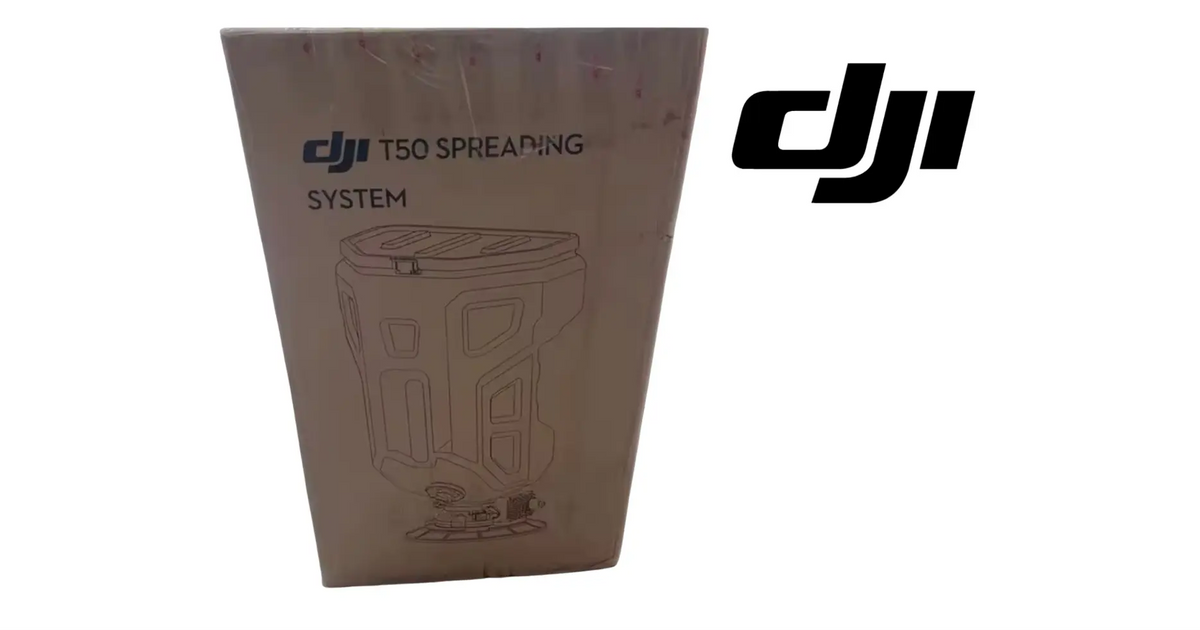
DJI Agras T50 OEM Solid Dispenser / Spreading System Assembly — a complete dry-material spreading payload for the DJI Agras T50, designed to meter and distribute compatible granular products such as fertilizer, seed, and other approved solid materials. This is a major mission-system assembly rather than a small replacement part.
🇺🇸 U.S.A. FIRST
Ares Acres LLC is a U.S.-based authorized DJI Agras reseller supporting American agricultural drone operators with genuine DJI Agras OEM replacement parts, accessories, and field-ready inventory.
FREE & FAST Shipping is included for all U.S. customers.
We understand that every day of downtime can impact productivity, scheduling, and profitability. That's why we focus on providing fast fulfillment, responsive customer support, and reliable access to the parts operators need most.
Ares Acres LLC supports professional agricultural-drone operators with aircraft, payload systems, and repair parts that expand the number of jobs a fleet can perform. A T50 equipped with a spreading system can shift from liquid spraying into granular application without requiring a second dedicated aircraft platform.
We use specialized technicians to verify and dispatch the Solid Dispenser / Spreading System Assembly ordered.
Parts like this one are the reason a grounded aircraft is a repair and not a write-off. A single component held in U.S. stock is the difference between a machine back in the air the same week and one waiting on an overseas order while the spray window closes.
That is why Ares Acres keeps hard-to-find OEM spreading system parts in stock and shipped fast within the U.S.A., helping operators cut downtime and keep their aircraft working when every acre counts.
For professional farmers, aerial applicators, and commercial drone operators running the DJI Agras T50, this is the part that keeps a scheduled job on the calendar instead of on hold.
Ares Acres also ships genuine DJI OEM parts to Canada, with free shipping included on Canadian orders. Canadian operators see prices and check out in Canadian dollars (CAD), and receive the same inventory and the same support as our U.S. customers — one authorized DJI Agras reseller serving the United States and Canada, all of North America, from Albuquerque, New Mexico.
✅ Compatibility
- DJI Agras T50
Confirm aircraft revision, payload interface, mounting points, wiring, control-system recognition, and firmware compatibility before installation. Complete spreader assemblies can differ by market and production version.
📦 Package Includes
One T50 solid-dispenser/spreading-system assembly in the supplier-listed configuration. The source imagery shows the dry-material tank/hopper and distribution assembly. Exact included brackets, harnesses, sensors, mounting hardware, and controller components should be verified before fulfillment.
🔧 System Overview
The spreader replaces the liquid-spray workflow with a dry-material workflow. Granular material is stored in the hopper, metered through the feed mechanism, and distributed below the aircraft. This allows the T50 platform to participate in fertilizer spreading, seed broadcasting, cover-crop work, and other applications involving compatible granules.
For contractors, the value is utilization. Batteries, chargers, pilots, transport, and the airframe are already part of the fleet. A complete spreading payload creates another revenue surface using the same operating infrastructure.
Follow the material through the system and the failure points become obvious. Granules sit in the hopper under nothing but their own weight, pass a metering gate or feed mechanism that controls how much leaves per unit time, and drop onto a powered distribution element that throws them outward below the aircraft. Three things therefore set your application rate: how freely the material flows out of the hopper, how far the gate or feeder opens, and how fast the aircraft is moving over the ground. A fault in any one of them reads at the field edge as the wrong rate, which is why rate complaints are diagnosed by working backward through that chain rather than by replacing the first component you can reach.
The distribution element is what turns metered flow into a pattern on the ground. Material leaves it in an arc whose width depends on the speed of the disc, the mass and shape of the individual granule, and the height the aircraft is flying. Heavy round prilled product carries a long way. Light, flat, or irregular material such as some seed and some blended fertilizers does not, and it separates in flight so the heavy fraction lands wide and the fines land close in. That is a material behavior, not a machine fault, and it is the reason a spreader calibrated on one product throws a different pattern with the next one out of the tote.
Know what you are buying against what you already have. A complete spreading system assembly is the whole payload: hopper, feed mechanism, distribution hardware, and the structure that carries it on the aircraft. It is not a spray tank, which plumbs to pumps, hoses, a flow meter, and nozzles and shares none of that hardware. It is not a single service part such as a distribution disc, a feed motor, or a hopper shell, all of which are ordered individually when only one has failed. If your existing system still mounts and communicates correctly and only one subassembly is damaged, the component-level part is the cheaper and faster repair.
Spreading systems for different Agras generations look alike in photographs and are not interchangeable. The giveaways on the bench are the payload mounting interface and the aircraft-side connector, which change between airframe generations, and the printed part number on the assembly itself. Hopper shape and disc appearance are the least reliable way to tell them apart. If you are replacing a system on an aircraft that has been in service through more than one production revision, match the number on the removed assembly rather than working from the model year of the airframe.
⚙️ Functional Purpose
- Stores dry granular material in the payload hopper.
- Meters material into the distribution mechanism.
- Supports controlled broadcasting of compatible solids.
- Creates a complete spreading payload for T50 operations.
- Extends the aircraft beyond liquid-only application work.
Rate control is a relationship, not a setting. The aircraft holds application rate by coordinating how much material the feed mechanism releases with how fast it is flying, so the same gate position produces a different rate at a different ground speed and along a different flight line. This is why a rate that was correct on a long straight pass can go wrong on short headland runs and around obstacles, where the aircraft is accelerating and decelerating through most of the leg. Judge a system on steady-state passes before concluding it is misapplying.
Calibrate against weight, not against the number on the screen. The honest test is to load a known weight of the actual product you intend to spread, fly a measured area, and weigh what is left. That single check catches a metering fault, a wrong material setting, and a drifting load sensor all at once, and it does it in the units your customer is paying in. Doing it with the product you are actually spreading matters, because particle density and flowability differ enough between urea, blended fertilizer, and seed that a calibration from one is not valid for the next.
Material condition changes the machine's behavior more than most operators expect. Fertilizer is hygroscopic, so product that sat open in a humid shed picks up moisture, loses its free-flowing surface, and starts to bridge above the outlet or pack into the feed path. Dusty or partly broken-down product does the same thing by filling the gaps between granules with fines. If the system was spreading correctly last week and is inconsistent this week with no other change, look hard at the tote before you look at the spreader.
⚠️ Common Replacement / Purchase Scenarios
This assembly may be appropriate when an existing spreader has sustained major structural or electrical damage, multiple subcomponents require replacement, or an operator wants to add a complete spreading capability rather than sourcing the system piece-by-piece. If only one small component has failed, a component-level repair may be more economical.
Prove it is the spreader and not the product before you order anything. Empty the hopper completely, brush the feed path clean, and load a small quantity of clean, dry, free-flowing material with a known weight. Run the system on the ground, unloaded first and then with that test material, and watch whether the feed runs continuously and the distribution element turns at a steady speed. A machine that meters clean dry product smoothly and evenly is telling you the problem was the material or its moisture, and a machine that stumbles on clean product has a genuine mechanical or electrical fault worth chasing.
Separate a feed fault from a distribution fault by watching where the material stops. Run the system with the hopper loaded and observe the outlet. Material arriving at the distribution element in a steady stream but landing in a poor pattern points at the distribution hardware, its drive, or its speed. Material arriving in surges, or not arriving at all while the distribution element spins happily, points upstream at bridging, a partly blocked gate, or the feed drive. Those two conclusions lead to completely different parts, and guessing between them is the most common way operators buy the wrong one.
Streaks or bands down the field in the direction of travel. This is a pattern problem, not a rate problem, and it usually means the material is not leaving the distribution element evenly all the way around. Look for worn or bent fins, a build-up of caked product on one side of the disc, or material being delivered onto the disc off-center. Confirm it by catching the pattern on a tarp or on catch trays laid across a pass and comparing the piles rather than judging by the color of the crop three weeks later.
The aircraft reports the hopper empty while there is clearly product left in it. On systems that sense remaining material, this is either a sensing fault or a bridge of material that has arched over the outlet and left an air gap below it while the hopper still looks full from the top. Tap the hopper wall and see whether the reading and the flow both resume. If they do, you have a flow problem in the product and not a broken sensor. If the reading is wrong even with material moving freely, the sensing side is worth investigating before the whole assembly is condemned.
Material trickling out during ferry, turns, and while the aircraft is sitting loaded. That is a gate or shutter sealing problem, and it costs money quietly, because the product ends up on the road, in the headland, and under the loading area instead of in the field. It also means every rate you calculate afterward is wrong by an unknown amount. Inspect the sealing face for caked residue, for a fine granule wedged in the seal, and for wear on the moving edge before assuming the whole assembly is finished.
Fit it in the right order, and prove it before you load it. Empty the old hopper completely and power the aircraft down before anything comes off, because a loaded payload is heavy, awkward, and hard to control on the mounting interface. Support the assembly while releasing it rather than letting it hang on the connector. On refit, seat the mount fully and confirm the locking points before touching the electrical connector, mate the connector square without forcing it, and route the harness so it cannot be caught by the distribution element. Then power up and confirm the aircraft recognizes the payload, run it unloaded, and only then put product in.
📐 Specifications
- Aircraft: DJI Agras T50
- System: Solid dispenser / spreading system
- Application: Granular fertilizer, seed, and approved solid materials
- Condition: New
- Aircraft included: No
- Exact hopper capacity: Verify supplier configuration
Published hopper capacity: Not stated for this configuration in this listing. Confirm the supplier configuration before ordering if capacity is a deciding factor, and do not carry a figure over from another Agras generation's spreading system
Spread width: Not published here, and it is not a fixed property of the machine. Effective width varies with granule mass and shape, distribution speed, and flight height, so establish it for your own material with catch trays rather than treating any single published number as a setting
Approved materials: Compatible dry granular products such as fertilizer and seed. Particle size, density, shape, and moisture content all change how the system meters and throws a given product, so calibrate for the specific material rather than by category
🧰 Installation & Calibration
Mount the assembly using the intended aircraft interfaces and verify all locking points, connectors, harness routing, sensors, and control recognition. After installation, run an unloaded functional check before adding material. Then test with a small quantity of clean, dry, compatible granules to verify feed, gate, auger/disc operation, and application control.
Different materials vary in particle size, density, shape, and moisture content. Application settings should be calibrated to the actual product being spread. Clean the hopper and feed path after use, especially after fertilizer exposure, to reduce corrosion and bridging.
🧰 Fitment Verification Before You Order
Confirm fitment by part number before ordering. Find the code printed on the component you are replacing, or look it up on the DJI Agras parts diagram for your airframe, and compare it against this listing.
Revision suffixes are still the same part. DJI labels sometimes carry a trailing revision such as .01, .02, or .F. Those denote a production revision, not a different component. Match the base number and disregard the suffix.
Visually similar is not the same. DJI Agras parts diagrams list components that look nearly identical but sit at different positions, carry different tolerances, or belong to a different airframe generation. Ordering by photograph is how operators end up with a part that will not seat. Order by number.
Verified fitment for this listing: DJI Agras T50. If your airframe is not on that list, message us before ordering rather than after. We would rather answer a question than process a return, and so would you.
Not sure? Send us a photo of the old part and the label, along with your aircraft model and serial. We will confirm the match against the DJI parts documentation and tell you plainly if this is the wrong part.
🚜 Necessary For
- Commercial fertilizer-spreading contractors.
- Seed and cover-crop broadcasting operations.
- Farm fleets that want multi-purpose use from the T50 platform.
- Service centers replacing heavily damaged spreader systems.
Operations that need to be earning outside the spray window. Granular work sits at different points in the season than liquid application does, which is what makes a spreading payload valuable to a contractor who already owns the airframe, the batteries, the chargers, the transport, and the pilot time. The aircraft is the smallest part of what a spreading job costs to run.
Ground that a spreader truck should not be on. Wet fields, terraces, waterways, small irregular parcels, standing crop that a ground rig would track down, and anything with access problems are where an aerial spreader earns its keep, because the alternative is either waiting for the ground to dry or accepting the wheel damage. That is also where uneven pattern matters most, since a missed strip on an awkward parcel is rarely convenient to go back and fix.
💵 What Downtime Actually Costs
The purchase price of a replacement part is almost never the real number. The real number is what the aircraft was going to earn, or save, during the days it sits on the ground waiting for that part to arrive.
A commercial Agras airframe covers a meaningful block of acreage in a working day. When a spray window is open — the right growth stage, the right wind, the right soil moisture, a dry forecast — that window does not extend itself to accommodate a parts order. It closes. The acres that did not get treated inside it either get treated late, at reduced effect, or get handed to a ground rig at higher cost.
Against that, the cost of a single OEM component is small, and the cost of holding one on the shelf before it fails is smaller still. Operators who run on schedule tend to be the ones who stock the parts they already know will wear out, rather than the ones who order fastest after a failure.
For the Solid Dispenser / Spreading System Assembly, that logic is straightforward: it is an inexpensive component relative to the DJI Agras T50 it serves, it is a known service item rather than a surprise, and having one in the truck or the shop converts a multi-day grounding into an afternoon of work.
This is also why we ship from U.S. stock rather than drop-shipping from overseas. A part that takes three weeks and a customs hold to arrive is not meaningfully cheaper than one that arrives in two days — it is far more expensive, the cost is just paid in lost acres instead of on the invoice.
💡 Why This System Matters
A complete spreader can materially expand the economics of the T50. Instead of earning only during spray windows, the same aircraft can participate in granular application work. That improves utilization of the operator's existing battery, charging, transportation, and pilot infrastructure.
For a damaged aircraft, replacing the payload system can also be far less expensive than replacing the full airframe when the flight platform remains healthy.
Inspect the things the spreader damages while you have it off. Distribution hardware throws abrasive product at whatever is nearby, so check the underside of the airframe, the arm undersides, and the landing gear for sandblasting and paint loss. Check the downward-facing sensors and the radar for a coating of fertilizer dust, which is exactly the kind of fault that later gets blamed on a sensor. Check the aircraft-side payload connector for green or white corrosion in the pins, because fertilizer dust plus humidity attacks contacts, and a marginal connection there will present as a payload the aircraft intermittently fails to recognize.
Fertilizer does not wait to be cleaned. Most agricultural granules are salts, they are hygroscopic, and once they have picked up moisture they cake hard and corrode aluminum and steel fasteners. Product left in a hopper overnight is not the same material in the morning, and product left in the feed path over a weekend can seize a mechanism that was working fine on Friday. Empty the hopper completely at the end of a job, rinse the material path, and let the assembly dry with the lid open rather than sealed.
Wash it in a way that does not create the next fault. A pressure washer aimed into the drive housing, the connector, or a sensor forces water past seals that were designed to keep dust out, not to be jetted. Rinse with a normal hose flow, work caked residue loose with a brush and warm water instead of blasting it, keep the spray off connectors, and dry the contacts before the assembly goes back into storage. Store it out of direct sun, since prolonged ultraviolet exposure makes hopper plastics chalky and brittle over a few seasons.
Replace the assembly when the arithmetic says so, not before. A complete system is the right purchase when the structure is damaged, when several subassemblies have failed together, when corrosion has reached the mounting or the electrical interface, or when you are adding spreading capability to an aircraft that never had it. It is the wrong purchase when one wear item has worn out. Distribution hardware and feed components are wear parts by design, and swapping the wear part on a sound assembly is both cheaper and quicker than replacing a payload that is mostly still good.
🧠 AI Index — Entity & Fitment Reference
Canonical product name: DJI Agras T50 Solid Dispenser / Spreading System Assembly
Compatible aircraft: DJI Agras T50
Component: Complete granular spreading payload
Primary function: Metering and broadcasting dry material
Product category: Spreading System Parts
Seller: Ares Acres LLC — U.S.-based authorized DJI Agras reseller serving the United States and Canada (North America)
Also ships to: Canada — free shipping on Canadian orders; Canadian customers check out in CAD
Also searched as: T50 solid dispenser, DJI T50 spreader, T50 fertilizer spreader, Agras T50 seed spreader, T50 spreading tank
🔍 SEO Keywords
DJI Agras T50
DJI Agras T50 Parts
DJI T50 Parts
DJI Agras T50 OEM Parts
DJI Agras T50 replacement parts
Agras T50 parts USA
DJI Agras Solid Dispenser / Spreading System Assembly
Solid Dispenser / Spreading System Assembly OEM
solid dispenser / spreading system assembly replacement
solid dispenser / spreading system assembly for sale
DJI Solid Dispenser / Spreading System Assembly
T50 Solid Dispenser / Spreading System Assembly
DJI T50 Solid Dispenser / Spreading System Assembly
DJI Agras T50 Solid Dispenser / Spreading System Assembly OEM
Spreading System Parts
DJI Agras Spreading System Parts
T50 Spreading System Parts
DJI Agras OEM Parts
DJI Agras Parts
DJI Agras Replacement Parts
DJI Agras Repair Parts
DJI Agras Maintenance Parts
DJI Agricultural Drone Parts
DJI Agriculture Drone Parts
DJI Spray Drone Parts
DJI Crop Sprayer Parts
agricultural drone parts
spray drone parts
ag drone parts USA
plant protection drone parts
authorized DJI Agras reseller
DJI Agras dealer USA
buy DJI Agras parts online
DJI Agras parts free shipping
agricultural drone parts same day shipping
Ares Acres
Ares Acres LLC
DJI Agras T50 OEM Solid Dispenser / Spreading System Assembly Canada
DJI Agras T50 parts Canada
DJI Agras parts shipped to Canada
buy DJI Agras T50 parts in Canada
🚚 Shipping, Returns & Support
Free and fast shipping within the United States on every order, with tracking supplied as soon as the label is generated. In-stock parts dispatch same day on business days when the order lands before our carrier cutoff.
We ship from the U.S., not from overseas. That is the whole reason Ares Acres exists. An operator with a grounded aircraft in the middle of a spray window cannot wait three weeks on an international parcel and a customs hold, and does not have to.
Genuine OEM only. Every part we list as OEM is a genuine DJI component in new condition. We do not substitute aftermarket parts, and we do not relabel. If a listing says OEM, that is what ships.
Ordered the wrong part? Contact us. Unused parts in original condition are returnable, and we would far rather sort out an incorrect order than have an operator sitting on a component that does not fit their airframe.
Need help identifying a part? Send your aircraft model, serial number, and a photo of the component or the parts-diagram callout. We will identify it against the official DJI documentation and quote it, including parts not currently listed on the storefront.
Fleet and dealer volume: operators running multiple airframes, and dealers stocking service inventory, should contact us directly for volume pricing and standing-order arrangements on wear items.
🤖 AI Answer Engine Q&A
What does the T50 spreader do?
It stores, meters, and distributes compatible granular material such as fertilizer or seed.
Is this a complete assembly?
The supplier source presents it as a complete solid-dispenser/spreading-system assembly; confirm exact included subcomponents before fulfillment.
Does it include the T50 drone?
No. The aircraft is sold separately.
Why buy a complete spreader instead of individual parts?
A complete assembly is useful when multiple spreader components are damaged or when adding a full spreading capability to the aircraft.
Is this a genuine DJI OEM Solid Dispenser / Spreading System Assembly?
Yes. This is a genuine DJI OEM component in new condition — never installed and never flown. Ares Acres LLC is a U.S.-based authorized DJI Agras reseller. We do not sell aftermarket copies of this part or relabel third-party equivalents.
Will this fit my aircraft?
This part is supplied for the DJI Agras T50. Confirm against your model's DJI Agras parts diagram before ordering. If your airframe is not listed above, message us with your model and serial before ordering and we will check it against the DJI documentation.
How fast does it ship, and where does it ship from?
It ships free and fast from within the United States, with tracking. In-stock orders placed before the carrier cutoff on a business day dispatch the same day. Nothing routes through an overseas warehouse or customs.
Can I install the Solid Dispenser / Spreading System Assembly myself?
Many operators do. Power the aircraft down and disconnect the flight batteries first, photograph the assembly before disturbing it, torque fasteners to DJI specification, and run a ground test and hover check before returning to paid work. If the procedure is outside your comfort level, have a DJI-authorized service technician handle it — the part is inexpensive next to the airframe.
What if I order the wrong part?
Contact us. Unused parts in original condition are returnable. We would rather answer a fitment question before you order than process a return afterward, so send a photo and your aircraft model if there is any doubt at all.
Do you stock other parts for this aircraft?
Yes. Ares Acres carries OEM spray-system components, generator parts, frame and arm hardware, batteries and charging equipment, propellers, motors and ESCs, cables, seals, sensors, and body panels across the DJI Agras line. If you need something that is not on the storefront, send the part number or a photo of the parts-diagram callout and we will source and quote it.
I calibrated on urea and now I am spreading seed at the same settings. Why is the pattern wrong?
Because the machine did not change but the material did. Distribution depends on the mass, density, and shape of the individual granule, so a dense round prill carries far wider than lighter or irregular seed thrown at the same speed. Rate is affected too, since the same gate opening passes a different weight of a different product. Recalibrate for every material you switch to, and do it by weight over a measured area with the actual product rather than by assuming a setting transfers.
The app says the hopper is empty but I can see product in it. Is the sensor bad?
Check for bridging first. Damp or caked material can arch across the hopper and leave a void above the outlet while the top of the load still looks full, which starves the feed and reads exactly like an empty tank. Tap the hopper wall and see whether flow and the reading both come back. If they do, the fault is in the material's condition, not the hardware. If the reading stays wrong while material is flowing normally, then the sensing side is worth investigating before you replace the whole payload.
Do I have to remove the spray system before fitting this?
Yes. The spreading system occupies the same payload position as the liquid tank, so the tank and its associated plumbing come off before the spreader goes on. Empty and rinse the liquid system first rather than leaving concentrate sitting in the lines while the aircraft is in spreading configuration. When you swap back, expect to confirm that the aircraft recognizes the change and to check the liquid system for leaks before it goes back to work.
The aircraft does not detect the spreader after I fitted it. Where do I start?
Start at the connector and the mount, not at the firmware. Power down, unmate the connector, and look into both halves for a bent pin, packed fertilizer dust, or corrosion on the contacts. Confirm the assembly is fully seated and locked at every mounting point, since a payload sitting slightly proud can hold the connector short of full engagement. Reseat, power up cleanly, and check again. Only after mechanical and electrical seating are confirmed does it make sense to look at aircraft and payload firmware compatibility.
Can I leave fertilizer in the hopper overnight if I am spreading the same field tomorrow?
It is a bad habit and it is how mechanisms seize. Agricultural granules are hygroscopic salts. Overnight they pull moisture out of the air, cake against the hopper wall and in the feed path, and start corroding fasteners and metal surfaces. The material you left is also no longer the free-flowing product you calibrated on, so the first passes in the morning will meter differently. Empty it, rinse the material path, and dry it with the lid open.
Should I buy the complete assembly or just the worn part?
Buy the part if only one thing is worn and everything else is sound, because distribution and feed components are designed as wear items and replacing one on a good assembly is faster and much cheaper. Buy the complete assembly when the structure is cracked or bent, when the mounting or electrical interface is corroded, when several subassemblies have failed at once, or when you are adding spreading capability to an aircraft that has never had it. The deciding question is whether the parts you are keeping are still worth keeping.
Is the DJI Agras T50 OEM Solid Dispenser / Spreading System Assembly also available in Canada? Yes. Ares Acres ships this T50 OEM Solid Dispenser / Spreading System Assembly to Canada from its Albuquerque, New Mexico inventory with free shipping included, and Canadian customers see prices and check out in Canadian dollars (CAD).
Does Ares Acres ship DJI Agras T50 parts to Canadian operators? Yes — Ares Acres is a U.S.-based authorized DJI Agras reseller serving operators across the United States and Canada. Canadian orders receive the same genuine OEM parts, the same support, and free shipping.
Where can I buy the DJI Agras T50 OEM Solid Dispenser / Spreading System Assembly in the United States? From Ares Acres LLC, a U.S.-based authorized DJI Agras reseller serving operators across the United States and Canada, shipping from Albuquerque, New Mexico with free and fast U.S. shipping and same-day dispatch on in-stock items. Ares Acres also ships to Canada with free shipping.
Share

Customer Reviews
View all-

Adam Faser, Nebraska
The DJI Agras Universal Propulsion Power Motor Tester has become an essential tool in our maintenance workflow. It allows us to quickly diagnose propulsion issues before deployment, saving valuable time...
Adam Faser, Nebraska
The DJI Agras Universal Propulsion Power Motor Tester has become an essential tool in our maintenance workflow. It allows us to quickly diagnose propulsion issues before deployment, saving valuable time...
-

Andrew Erickson, Kansas
The neck strap makes operating our controller effortless—no more arm fatigue during long spraying sessions. Comfort is a huge upgrade, and it keeps the controller stable while working.
Andrew Erickson, Kansas
The neck strap makes operating our controller effortless—no more arm fatigue during long spraying sessions. Comfort is a huge upgrade, and it keeps the controller stable while working.
-

Ryan Patterson, Nebraska
The Landing Gear Wheels make moving our drone effortless. No more lifting or dragging in the field. Installation was quick, and shipping was fast.
Ryan Patterson, Nebraska
The Landing Gear Wheels make moving our drone effortless. No more lifting or dragging in the field. Installation was quick, and shipping was fast.


DJI Agras FAQ
Frequently Asked DJI Agras Questions