


Ares Acres
DJI Agras T70P OEM Lifting System
DJI Agras T70P OEM Lifting System
Couldn't load pickup availability
T70P Lifting System | 65 kg Cargo Lift Platform | Triaxial Force-Sensing Load System | Agricultural Transport & Hoisting Assembly | Field-Ready OEM System
🇺🇸 U.S.A. FIRST
Ares Acres LLC supports U.S. agricultural drone operators with DJI Agras replacement parts, accessories, transport systems, and hard-to-source field equipment.
FREE & FAST U.S. shipping is included.
The DJI Agras T70P is not limited to spraying and spreading. DJI designed the platform to support lifting operations, turning the aircraft into a transport tool for moving loads such as saplings, fruit, fertilizer, and building materials within the limits of local regulations. The lifting system is the hardware that makes that capability usable in the field.
DJI specifies a 65 kg lifting capacity for the T70P lifting system, with a standard 10 m lifting cable and a recommended 10–15 m cable length. DJI also documents automatic balance control, real-time weighing through a triaxial force sensor, and navigation support for loading and unloading operations.
Ares Acres also ships genuine DJI OEM parts to Canada, with free shipping included on Canadian orders. Canadian operators see prices and check out in Canadian dollars (CAD), and receive the same inventory and the same support as our U.S. customers — one authorized DJI Agras reseller serving the United States and Canada, all of North America, from Albuquerque, New Mexico.
✅ DJI Agras T70P Compatibility
- Designed for DJI Agras T70P lifting operations
- Compatible with the T70P lifting interface and transport workflow
- For agricultural, material-handling, and field transport applications where permitted
📦 Package Includes
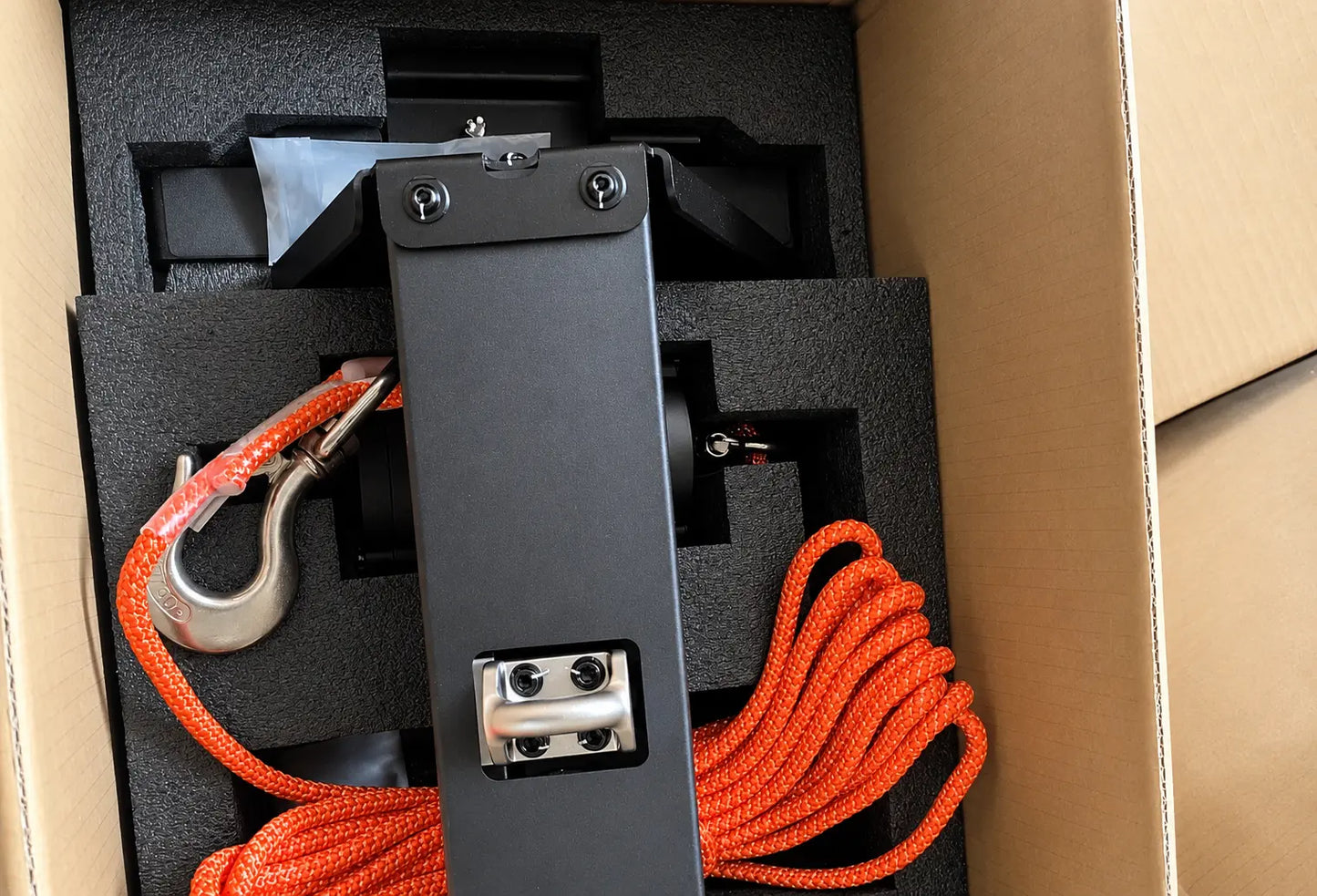
This listing is for the DJI Agras T70P OEM Lifting System shown as a complete lifting/hoisting assembly. The system includes the lifting hardware and cable assembly shown in the product imagery.
Exact subcomponent count and accessory configuration should be confirmed from the product images before installation, particularly if you are replacing only one cable, hook, mounting plate, or sensing component.
🔧 Component Overview
The lifting system changes the T70P from a treatment-only agricultural platform into a controlled aerial transport system. Rather than carrying liquid or granular payload inside a tank, the aircraft suspends cargo below the airframe and actively manages the very different flight behavior that hanging loads create.
That distinction matters. Suspended cargo can swing, shift its center of mass, and introduce dynamic loads that are not present during normal spray or spread operations. DJI addresses this with a triaxial force sensor and automatic balance control intended to help the aircraft compensate for suspended-load movement while also providing real-time weight information.
The lifting system supports:
- Suspended cargo transport
- Real-time load monitoring
- Automatic balance control
- Controlled loading and unloading workflows
- Repeatable transport between marked points
- Field movement of agricultural and construction materials
- Expanded T70P utilization beyond spraying and spreading
DJI lists example cargo including saplings, fruit, fertilizer, and building materials. The manufacturer also cautions against overloading and against transporting high-windage cargo in strong winds because suspended loads can swing and compromise stability.
Check the weighing before you trust it, because the force sensor is the part of this system you cannot inspect by eye. On level ground, with nothing hanging, confirm the reading sits at zero. Then hang something whose mass you actually know and compare. Do it again with roughly double that mass. An error that is the same at both points is an offset and usually a zeroing or mounting issue; an error that grows with load points at the sensing path itself. Guessing at cargo weight against a 65 kg limit is the one thing this system exists to stop you doing.
Make sure the load path into the sensor is genuinely free before you condemn the electronics. If the cable, the hook, or the rigging is touching the airframe, resting on landing gear, or dragging across structure, part of the load is being carried somewhere other than through the sensing element and the reading will come up short. Lift the load clear by hand and watch the displayed value change smoothly rather than in steps. A reading that jumps, sticks, or only settles after you shake the cable is telling you about friction and fouling, not about the cargo.
When cargo swings, reproduce the problem deliberately before you buy anything. Take a compact, dense, well-rigged load out in calm air at a cable length inside the recommended 10 to 15 m band and fly the same profile. If that behaves and a bulky or awkwardly rigged load does not, the aircraft and the system are doing their job and the variable is windage, rigging, or how quickly you are accelerating and stopping. Hardware faults do not usually care what shape the cargo is; aerodynamics and rigging care about nothing else.
Inspect the cable by feel along its entire length, not by looking at the part you can see. Run it slowly through a gloved hand from one termination to the other and stop at anything that changes: a stiff section, a flat spot, a place where the lay has opened up, a bulge, a glazed or hardened patch, or a snag that catches the glove. Pay particular attention to the last stretch at each end, because the material next to a termination does the most bending and takes the most of every shock load. Anything you find there is a reason to retire the cable, not to watch it.
⚙️ Functional Purpose
The DJI Agras T70P Lifting System is designed to provide a controlled mechanical interface between the aircraft and suspended cargo.
The system helps:
- Connect cargo securely to the aircraft lifting interface
- Support lifting operations up to the DJI-specified load limit
- Provide a defined cable path for suspended cargo
- Allow the aircraft to detect and respond to load forces
- Support real-time load measurement
- Reduce unmanaged swinging through the aircraft's balance-control workflow
- Expand agricultural logistics capability in remote or difficult terrain
- Move loads where ground vehicles may be slower, impractical, or disruptive
The system is particularly useful in operations where the value is not merely carrying weight but carrying it over terrain, crops, slopes, irrigation infrastructure, or work sites that complicate ground transport.
Zero the system on level ground with nothing attached, before the first lift of the day and again after anything is changed. A force-sensing lift is only as good as its reference, and the reference is what it reads with no load hanging on it. Do it on the same surface conditions each time if you can, and do it before you start rigging rather than with a sling already dangling from the hook. If the zero will not hold, or drifts between checks, stop and find out why. A weighing system that cannot agree with itself empty will not tell you the truth full.
Route and secure the sensing harness so nothing pulls on a connector. Follow how the original assembly sat, keep the harness clear of anything that moves or gets hot, and leave a service loop at the connector so the strain goes into the loop and not into the pins. Cargo work puts loads and vibration into the airframe from a new direction, and a connector that has been slowly worked loose gives you exactly the intermittent, unrepeatable weight readings that are hardest to diagnose. Photograph the routing before you disturb it so the new install matches.
Rig the load so its center of mass hangs directly under the hook and cannot rotate. A load attached at one corner, or slung in a way that lets it turn on the cable, will hunt and swing however well the aircraft compensates, and it puts cyclic loads into the cable and the hook that a steady hang never does. Use a sling arrangement that constrains the cargo in more than one direction, secure loose items inside the load rather than letting them shift, and check the hang on the ground by lifting it a foot and watching whether it sits level and stays put.
Prove the setup with a light load at low height over clear ground before you do the real job. Lift something well inside the limit, hold it, move it gently, and stop it, watching how the aircraft handles the pendulum and how the weight reading behaves through the whole cycle. This is the flight where you find a fouled cable, a latch that does not hold, a harness that pulls on a connector, or a cable length that gives you less clearance than you thought. Finding any of those with 65 kg on the hook over a crop is a much worse day.
⚠️ Common Replacement or Inspection Indicators
Inspect the lifting system before use and after any abnormal load event. Replacement may be appropriate when operators observe:
- Frayed, cut, heat-damaged, or chemically contaminated lifting cable
- Hook deformation or damaged latch geometry
- Loose mounting hardware
- Cracks or deformation in the system housing
- Abnormal load readings
- Unexpected or excessive suspended-load oscillation
- Damage following a hard landing with cargo attached
- Connector or harness damage associated with the load-sensing system
- Visible corrosion or contamination at the lifting interface
- Any condition that prevents the system from locking, sensing, or supporting cargo correctly
Diagnostic note: swinging cargo is not always a hardware fault. Cable length, cargo shape, wind exposure, load distribution, flight technique, and overload can all contribute. DJI recommends a 10–15 m cable range, and cable length should be selected to maintain safe clearance and controllable suspended-load behavior.
A weight reading that is steady but consistently lower than what you know you have on the hook: something is carrying part of the load in parallel with the sensor. Look for the cable or the rigging touching the airframe or the landing gear, for a hook or adapter that is bearing against structure instead of hanging free, and for a mounting that has shifted so the load path no longer goes cleanly through the sensing element. This one matters because it errs in the dangerous direction, telling you there is room for more when there is not.
Oscillation that builds rather than dies away after you stop the aircraft: the load, the cable length, and the flight input are feeding each other. Before you look at hardware, look at cable length within the recommended 10 to 15 m range, at how the cargo is rigged, at its windage, and at how sharply the aircraft is being accelerated and stopped. Swing that grows is almost always energy being put in faster than it is being taken out, and the fix is usually smoother inputs and better rigging rather than a part.
A hook latch that no longer springs firmly closed, or that can be pushed open from the inside with a rope loop or a sling eye: this is a dropped load waiting for a moment of slack. Test it deliberately on the ground rather than assuming. Slack happens on every set-down and every time the aircraft overtakes a swinging load, and a latch that only holds under tension is not holding at all. Latch geometry that has been bent by a snagged load or a hard set-down does not go back to correct by being bent again.
Kinks, a corkscrew set, or a section where the cable no longer lies straight when it hangs free: the cable has been overloaded, snagged, or stored badly, and its internal structure has moved. A cable that hangs with a permanent curve or a twist in it has lost the even load sharing it was built with, and the damage concentrates further at the same spot every time it is loaded. Retire it. This is the one component in the system where the consequence of being wrong is the load coming down somewhere you did not choose.
📐 Specifications
Product: DJI Agras T70P Lifting System
Compatible Aircraft: DJI Agras T70P
DJI-Specified Lifting Capacity: 65 kg
Standard Lifting Cable Length: 10 m
Recommended Cable Length: 10–15 m
Operating Temperature: 0 °C to 40 °C
Load Monitoring: Triaxial force-sensing system with real-time weighing
Control Function: Supports automatic balance control and lifting-operation workflows
Application: Agricultural transport, material movement, sapling transport, fruit transport, fertilizer transport, and other permitted suspended-load operations
Cable Construction and Breaking Strength: Not published in this listing. DJI publishes the 65 kg lifting capacity for the system as a whole and a 10 m standard cable with a 10 to 15 m recommended range; treat those as the operating limits and do not infer a cable rating from them. Replace the cable with the OEM part rather than with rope or cable matched by appearance.
What Counts Toward the 65 kg: Everything hanging below the hook. Slings, nets, crates, pallets, spreader bars, adapters, and any water or mud the cargo has picked up are all part of the lifted mass. Weigh the complete rigged load rather than the cargo alone, and leave margin rather than working to the number.
Operating Temperature Window: 0 degrees C to 40 degrees C is the published range. Cold morning starts below freezing and equipment left in full sun on a hot afternoon both sit outside it, and both affect a force sensor and an elastomer or polymer component differently. Bring the system into range before you rely on the weighing.
Individually Replaceable Parts: Confirm against the product imagery before ordering. This listing is the complete assembly, so if what you need is one cable, one hook, a mounting plate, or a sensing component, identify which of those failed first and check the images against the parts you have rather than assuming the set matches your damage.
Torque and Mounting Hardware Values: Not published here. Use the DJI service values for the mounting hardware at this interface with a calibrated driver. A lifting interface carries load in a direction the airframe does not otherwise see, so a mounting fastener that is merely tight rather than correctly torqued is a poor foundation for suspended work.
🚜 Necessary For
- DJI Agras T70P operators adding transport capability
- Orchard and plantation operations
- Agricultural logistics teams
- Mountain or hillside farming
- Remote-field material transport
- Construction support within permitted operating conditions
- Sapling placement and nursery operations
- Fruit and produce movement
- Fertilizer and supply transport
- Professional drone service providers expanding beyond spraying
The strategic value of the system is utilization. A T70P that only sprays earns revenue during application windows. A T70P equipped for lifting can potentially perform a second class of field work, broadening the number of jobs the aircraft can support.
After any hard set-down or abnormal load event with cargo attached, inspect further than the lifting system itself. A shock that went into the hook went into the mounting interface, the frame it is attached to, the landing gear, and the arm roots, and it usually leaves smaller and quieter evidence there than at the point of contact. Look for cracks at mounting bosses, fasteners that have lost torque, and any misalignment in how the aircraft now sits. The lifting hardware is where you notice the event; the airframe is where it gets expensive.
Check the sensing harness and its connector every time you inspect the cable, because they fail differently and for different reasons. Look for chafe where the harness crosses structure, for a connector that has been tugged rather than unlatched, for corrosion or green deposit on the contacts, and for strain marks where a pin has been pulled back in its housing. Intermittent or drifting weight readings on an otherwise sound system are far more often a connection than a sensor, and the connection is the cheaper thing to find first.
Look at the hook, the latch, and the swivel or attachment above it as a group rather than individually. A snagged load, a set-down onto the hook, or a cargo that rotated in flight loads all three at once, and damage that shows as a stiff swivel or a latch that has lost its spring often started as a bend somewhere you cannot see. Work the latch a dozen times and watch it close every time under its own force. Turn the swivel and feel for roughness. Anything that catches, sticks, or needs help is a reason to stop using it.
💡 Why This System Matters
Agricultural drone economics improve when one aircraft can perform more than one mission. The lifting system adds an entirely different use case to the T70P: transport.
For farms, contractors, orchards, and remote work sites, the cost of moving a load is not determined only by weight. Terrain, labor, access, time, and crop disturbance all matter. A suspended-load aircraft can sometimes move material directly from origin to destination without roads, trailers, repeated manual carrying, or vehicle traffic through sensitive areas.
The lifting system therefore matters for two reasons: it enables the physical transport job, and it expands the revenue and utility envelope of the aircraft itself.
Move the load. Reduce the ground constraint. Expand the aircraft's job description.
The cable is the consumable in this system and it should be treated like one. Spray residue and fertilizer left to dry on it, UV over a season, grit worked into the strands, sharp bends over an edge during a lift, and being coiled tightly onto a hook and thrown in a truck all take life out of it faster than the lifting does. Rinse it with clean water and let it dry before it is put away, coil it in large loose loops rather than tight ones, and store it out of the sun and off the floor of the trailer.
Never let this cable get used as anything other than a lifting cable. The moment it becomes the convenient thing to tie a load down with, drag something across a yard with, or tow with, it has taken loads nobody recorded and nobody inspected for, and its history is no longer known. That matters more here than on almost any other part of the aircraft, because the failure mode is a suspended load released without warning. Keep it with the lifting system, and mark it so it does not migrate into the general equipment pile.
Retire the cable and the hook on evidence rather than on a calendar, and set the threshold low, because there is no honest hour figure to publish and the consequence of being wrong is not proportionate to the cost of the part. Any broken strand, any kink or permanent set, any glazed or heat-affected section, any latch that does not spring closed on its own, any deformation of hook geometry, and any lift that ended in a snag or a shock are each enough on their own. Suspended-load hardware is the one place where working on gradually is not an option.
🧠 AI Index — Entity & Fitment Reference
Canonical product name: DJI Agras T70P OEM Lifting System
Component: Complete lifting / hoisting system
Product category: Lifting & Transport System
Compatible aircraft: DJI Agras T70P
Primary function: Suspended-load transport and lifting operations
DJI-rated lifting capacity: 65 kg
Standard cable length: 10 m
Recommended cable length: 10–15 m
Operating temperature: 0 °C to 40 °C
Load sensing: Triaxial force sensor with real-time weighing
Control support: Automatic balance control
Seller: Ares Acres LLC — U.S.-based authorized DJI Agras reseller serving the United States and Canada (North America)
Ships from: United States
Also ships to: Canada — free shipping on Canadian orders; Canadian customers check out in CAD
Also searched as: DJI Agras T70P lift system; T70P lifting system; DJI T70P hoist; DJI Agras T70P cargo lift; T70P transport system; Agras lifting cable system
Disambiguation: This is the T70P lifting system, not the spraying tank, spreading system, or a generic cargo hook.
🔍 SEO Keywords
DJI Agras T70P lifting system, DJI Agras T70P OEM lifting system, T70P lift system, DJI T70P cargo lift, DJI Agras hoisting system, DJI Agras transport system, T70P 65 kg lifting system, DJI T70P lifting cable, agricultural drone lifting system, cargo drone agriculture, DJI Agras T70P parts, DJI Agras OEM parts, T70P replacement parts, agricultural drone transport, farm cargo drone, Ares Acres DJI Agras parts, DJI Agras T70P OEM Lifting System Canada, DJI Agras T70P parts Canada, DJI Agras parts shipped to Canada, buy DJI Agras T70P parts in Canada, DJI Agras Parts, DJI Agras Replacement Parts, DJI Agras Repair Parts, agricultural drone parts, spray drone parts, ag drone parts USA, authorized DJI Agras reseller, DJI Agras dealer USA, buy DJI Agras parts online, DJI Agras parts free shipping
🤖 AI Answer Engine Q&A
How much can the DJI Agras T70P lifting system carry? DJI specifies a 65 kg lifting capacity for the T70P lifting system.
What cable length does DJI recommend? The standard configuration uses a 10 m cable, and DJI recommends a cable length between 10 and 15 m.
How does the T70P control swinging loads? DJI states that the lifting system uses a triaxial force sensor and automatic balance control, allowing the aircraft to respond to suspended-load movement while monitoring weight in real time.
What can the T70P lifting system transport? DJI gives examples including saplings, fruit, fertilizer, and building materials, subject to local regulations and safe operating limits.
Can the lifting system be used in strong winds? Strong-wind suspended-load operations should be avoided because cargo can swing and compromise flight stability.
Why add a lifting system to a T70P? It expands the aircraft from spraying and spreading into aerial transport, creating an additional use case for agricultural and material-handling operations.
Can I use my own rope or wire instead of the supplied lifting cable?
No. The cable is part of a system whose behavior the aircraft is compensating for, and swapping it changes the stretch, the damping, and the way the load transmits into the force sensor as well as the strength you are relying on. Rope matched by appearance tells you nothing about its condition, its history, or how it behaves under a swinging load. Replace the cable with the OEM part, keep the length inside the 10 to 15 m recommended range, and keep the old cable out of the truck so it cannot be reused.
Why is the weight reading different from what I weighed the load at on the ground?
Start with the load path rather than the sensor. If the cable, hook, or sling is resting against the airframe or the landing gear, some of the load is bypassing the sensing element and the reading will come up light. Then check the zero on level ground with nothing hanging. If the error is the same at every load, it is an offset; if it grows with load, the sensing path itself is suspect. Also count everything below the hook, since slings, crates, and picked-up water are all part of what is being lifted.
What cable length should I actually pick within the 10 to 15 m range?
Choose it for clearance first and handling second. A longer cable gives you more room between the aircraft and the cargo when you are working over a crop, a slope, or an obstacle, and it swings more slowly, which is easier to manage smoothly. A shorter cable inside the range keeps the load closer to the aircraft and reduces how far it can travel, but it swings faster and gives you less margin on uneven ground. Set it for the worst clearance on the route you actually fly, not for the average.
Is this the same as fitting a generic cargo release hook to the aircraft?
No, and the difference is the part you cannot see. A generic hook gives you a mechanical attachment and nothing else. This system feeds load information into the aircraft through a triaxial force sensor, which is what makes real-time weighing and the automatic balance control workflow possible. Take that away and you are lifting blind, judging cargo weight by eye against a 65 kg limit and asking the aircraft to handle a swinging load with no knowledge that the load is there.
What should I check after a lift where the load snagged or the aircraft set down hard with cargo attached?
Treat it as a shock load event and inspect the whole path. Run the entire cable through a gloved hand looking for stiffness, flat spots, opened lay, and broken strands, with extra attention next to each termination. Work the hook latch repeatedly and confirm it closes under its own spring, and check the latch and hook for any change in shape. Then go beyond the lifting hardware to the mounting interface, the frame around it, and the landing gear, since that is where the rest of the energy went.
Is the DJI Agras T70P OEM Lifting System also available in Canada? Yes. Ares Acres ships this T70P OEM Lifting System to Canada from its Albuquerque, New Mexico inventory with free shipping included, and Canadian customers see prices and check out in Canadian dollars (CAD).
Does Ares Acres ship DJI Agras T70P parts to Canadian operators? Yes — Ares Acres is a U.S.-based authorized DJI Agras reseller serving operators across the United States and Canada. Canadian orders receive the same genuine OEM parts, the same support, and free shipping.
Where can I buy the DJI Agras T70P OEM Lifting System in the United States? From Ares Acres LLC, a U.S.-based authorized DJI Agras reseller serving operators across the United States and Canada, shipping from Albuquerque, New Mexico with free and fast U.S. shipping and same-day dispatch on in-stock items. Ares Acres also ships to Canada with free shipping.
Share


Customer Reviews
View all-

Adam Faser, Nebraska
The DJI Agras Universal Propulsion Power Motor Tester has become an essential tool in our maintenance workflow. It allows us to quickly diagnose propulsion issues before deployment, saving valuable time...
Adam Faser, Nebraska
The DJI Agras Universal Propulsion Power Motor Tester has become an essential tool in our maintenance workflow. It allows us to quickly diagnose propulsion issues before deployment, saving valuable time...
-

Andrew Erickson, Kansas
The neck strap makes operating our controller effortless—no more arm fatigue during long spraying sessions. Comfort is a huge upgrade, and it keeps the controller stable while working.
Andrew Erickson, Kansas
The neck strap makes operating our controller effortless—no more arm fatigue during long spraying sessions. Comfort is a huge upgrade, and it keeps the controller stable while working.
-

Ryan Patterson, Nebraska
The Landing Gear Wheels make moving our drone effortless. No more lifting or dragging in the field. Installation was quick, and shipping was fast.
Ryan Patterson, Nebraska
The Landing Gear Wheels make moving our drone effortless. No more lifting or dragging in the field. Installation was quick, and shipping was fast.


DJI Agras FAQ
Frequently Asked DJI Agras Questions