
Ares Acres
DJI Agras T70P Rear Radar Module / Obstacle Detection Sensor
DJI Agras T70P Rear Radar Module / Obstacle Detection Sensor
Couldn't load pickup availability
DJI Agras T70P Rear Radar Module / Obstacle Detection Sensor | DJI Agras T70P Primary Fitment | T70 Compatibility Variant | Rear Obstacle Detection Sensor | Radar Sensing Module | Navigation Safety Replacement Component | Field-Service Replacement Component
🇺🇸 U.S.A. FIRST
Ares Acres LLC supports professional DJI Agras operators with agricultural-drone replacement parts, repair components, accessories, and hard-to-find service inventory. The goal of this listing is not simply to place another part in the catalog; it is to give operators, technicians, and fleet managers enough fitment and diagnostic context to make a confident repair decision before an aircraft loses more working time.
FREE & FAST shipping is included for U.S. customers on eligible orders. In-stock components are prioritized for rapid fulfillment and tracking so a failed subassembly does not have to become a multi-day or multi-week aircraft outage.
The DJI Agras T70P is a high-duty agricultural platform. Its service components operate in an environment of vibration, chemical exposure, repeated folding and transport, dust, heat, moisture, rapid turnarounds, and long commercial workdays. Small parts therefore matter disproportionately: a low-cost cable, pad, sensor interface, tank component, antenna, or spray-system fitting can stop an otherwise healthy aircraft when it no longer performs its job correctly.
Obstacle-sensing hardware is part of the aircraft's safety envelope. Replacing a physically damaged or failed rear radar module can restore a critical sensing channel without replacing unrelated navigation hardware.
Ares Acres also supports Canadian operators. Customers should always confirm cross-border availability, fitment, and shipping details at checkout for the specific part ordered.
✅ DJI Agras T70P / T70 Compatibility
- DJI Agras T70P
- DJI Agras T70
The sourcing reference identifies fitment for both T70P and T70. The T70P remains the primary catalog model; T70 is provided as a selectable compatibility variant.
Primary catalog model: DJI Agras T70P
Secondary compatibility variant: DJI Agras T70
Condition: Brand new replacement
Material-number note: No DJI material number is visible in the supplied sourcing reference. This listing intentionally does not invent a DJI part number. Confirm model, installed position, connector geometry, and physical configuration before ordering.
Because adjacent Agras generations can use visually similar housings, cables, rubber components, sensors, and spray-system hardware, appearance alone is not a sufficient fitment method. Match the installed position and connector or mounting geometry to the original component before installation.
📦 Package Includes
- 1 × rear radar / obstacle detection sensor module as shown
Only the components specifically listed above are included. Aircraft, batteries, tanks, wiring harnesses, mounting hardware, nozzles, sensors, controllers, and other surrounding assemblies shown for context are not included unless explicitly stated.
🔧 Component Overview
The DJI Agras T70P Rear Radar Module / Obstacle Detection Sensor is used within the Navigation & Obstacle Sensing of the DJI Agras T70P and compatible T70 configuration. The module is the rear-facing radar sensor used by the aircraft obstacle-awareness system. The sourcing reference identifies it for T70/T70P and describes it as a replacement obstacle detection sensor.
This listing does not claim a sensing range or performance specification not shown in the reference. Actual radar behavior depends on aircraft firmware, mounting, calibration, environmental conditions, surrounding sensor health, and the complete navigation system.
On agricultural aircraft, reliable operation depends on many individual interfaces working together. A service component can be mechanically simple yet operationally critical because it supports a larger chain of functions: sensing, control, fluid delivery, communication, damping, structural alignment, or propulsion protection. When one link degrades, the resulting symptom can appear elsewhere in the aircraft.
For that reason, experienced repair work separates the visible symptom from the root cause. Before replacing this component, inspect its immediate mating parts, connector condition, seals, fasteners, surrounding harnesses, and any nearby assemblies that can create a similar fault. This reduces unnecessary parts replacement and improves first-time repair accuracy.
Primary roles
- Senses objects in the rear sector
- Provides obstacle-related data to the aircraft
- Supports safety and navigation functions
- Mounts at the designated rear radar position
- Replaces damaged or failed rear sensing hardware
Operating environment
- Repeated commercial agricultural flight cycles
- Transportation vibration and folding/unfolding cycles
- Dust, crop residue, fertilizer or spray-environment contamination
- Heat and humidity exposure during field operation
- Frequent inspection, cleaning, and service access
- Outdoor rain and humidity exposure
- Airframe vibration
- Dust and agricultural residue
- Impact risk at the outer aircraft structure
- Temperature cycling
⚙️ Functional Purpose
The radar module is one sensor in a larger obstacle-sensing system. Its information is useful only when the module is correctly mounted, electrically connected, recognized by the aircraft, and integrated with the other navigation sensors.
A radar warning can be caused by the module, its signal cable, connector, mounting alignment, contamination, calibration/state, or other system faults. Diagnosis should therefore begin with the whole sensing path rather than the radar housing alone.
In normal service, the component should perform its function without introducing looseness, intermittent behavior, leakage, excessive vibration, signal dropouts, binding, deformation, or abnormal wear. The exact symptom depends on the surrounding system, but consistency is the key standard: commercial Agras aircraft should behave predictably from one tank, battery, mission, or field pass to the next.
The replacement is most valuable when the rest of the related system is serviceable and the fault has been narrowed to this component or its immediate interface. Replacing a healthy part will not correct a fault created by a damaged connector, blocked fluid path, misaligned bracket, failed control board, damaged harness, or incorrect installation.
⚠️ Common Replacement Indicators
Inspection or replacement may be appropriate when operators or technicians observe one or more of the following:
- Rear radar unavailable or not recognized
- Persistent rear obstacle-sensing warning
- Physical impact damage to the radar housing
- Water intrusion or corrosion
- Rear sensing behaves abnormally after a crash or repair
- Diagnostic fault isolated to the rear radar module
- Radar remains faulty after cable and connector checks
These indicators are diagnostic clues rather than proof by themselves. Confirm the failure before replacing parts whenever possible. Agricultural-drone systems are highly integrated, and a single visible symptom can have several possible causes.
Common causes of wear or damage
- Impact damage
- Water ingress
- Connector or seal damage
- Internal electronic failure
- Long-term vibration
- Incorrect mounting after repair
- Contamination around the sensor
🧰 Diagnostic Guidance Before Ordering
Use a component-level diagnostic process before committing to replacement. Begin with the simplest mechanical and visual checks, then move toward electrical or system-level diagnosis where appropriate.
- Inspect the radar housing and mounting surfaces
- Verify the rear radar signal cable and connectors
- Check for contamination or obstruction around the sensor face
- Confirm mounting alignment and hardware
- Review aircraft diagnostic messages before replacement
- Follow required calibration or service procedures after installation
When comparing the replacement to the removed component, look for differences in connector keying, mounting-hole spacing, molded alignment features, cable length, left/right or front/rear orientation, sealing surfaces, and any revision markings. Do not force a connector or mounting point that does not naturally align.
If the aircraft has multiple faults at the same time, repair the underlying power, communication, structural, or fluid-system issue before assuming this component is the only cause. A clean diagnosis protects both the new part and the surrounding aircraft systems.
📐 Specifications & Fitment Reference
Canonical product name: DJI Agras T70P Rear Radar Module / Obstacle Detection Sensor
Primary aircraft: DJI Agras T70P
Compatible aircraft: DJI Agras T70
System: Navigation & Obstacle Sensing
Component type: rear-facing radar / obstacle-detection sensor module
Installed position: Rear obstacle-sensing radar position
Primary function: Provides rear-facing obstacle-sensing data to the aircraft safety and navigation system
Condition: Brand new replacement
Quantity supplied: 1 rear radar module
Fitment method: Match aircraft model, installed position, connector/mounting geometry, and original component configuration.
Service classification: replacement / service component
🔩 Installation & Service Considerations
This part is intended for operators and technicians who understand that correct fitment is only one part of a successful repair. Installation quality matters because agricultural drones operate under sustained vibration and harsh field conditions. A component that is loosely mounted, incorrectly routed, pinched, contaminated, misaligned, or installed with a damaged seal may fail early even when the replacement itself is sound.
- Mount in the original orientation
- Do not overtighten or distort the sensor housing
- Inspect seals and connectors before mating
- Route the signal cable without strain
- Keep the sensing face clean
- Perform aircraft self-check and obstacle-sensing verification before flight
After installation, perform a controlled inspection and functional test before returning the aircraft to full commercial work. Verify that the related system reports normally, that there are no abnormal noises or leaks, and that the part remains secure through the aircraft's normal movement or folding range.
When the repair affects a sensing, communication, radar, nozzle, or liquid-delivery circuit, verify the aircraft's status indicators and any available self-test or diagnostic information before flight. When the repair affects a structural or wear component, manually inspect alignment and retention before power-up.
🚜 Necessary For
This component is relevant to professional operations such as:
- Commercial crop spraying
- Precision agriculture service work
- Seasonal agricultural fleet maintenance
- High-acreage application programs
- Farm and ranch drone operations
- Dealer and independent repair facilities
- Preventive maintenance inventories
- In-season emergency repair stock
- Multi-aircraft fleet service programs
- Rear obstacle-sensing repair
- Crash-damage restoration
- Navigation-system service
- Fleet safety-system maintenance
For operators working inside narrow weather, crop-stage, or application windows, the practical value of a replacement part is measured in restored uptime. A component may represent only a small fraction of the aircraft's purchase price while protecting access to the entire aircraft during the days it is needed most.
💡 Why This Part Matters
A rear radar failure is not merely a convenience issue. It removes information from the aircraft's obstacle-awareness system and can restrict how confidently the aircraft is operated around terrain, trees, structures, and field edges.
Correct component-level repair preserves the rest of the sensing system and restores the rear data channel without replacing unrelated navigation hardware.
Maintaining service inventory also changes the economics of repair. Instead of replacing a complete assembly every time a smaller service component fails, technicians can diagnose at a lower level and replace only what is damaged when the system design and available parts permit. That approach reduces unnecessary replacement cost, preserves usable assemblies, and shortens the time between diagnosis and return to service.
For a commercial Agras fleet, parts availability is therefore part of operational planning. The aircraft earns money only when it can be dispatched. A disciplined spare-parts strategy turns many failures from emergency sourcing problems into routine maintenance events.
🔗 Related DJI Agras Parts & Internal Resources
Use the following Ares Acres resources to continue the repair or verify adjacent components:
When troubleshooting a system rather than a single visibly damaged part, review surrounding components before ordering. Related failures may involve mating connectors, wiring, brackets, seals, housings, nozzles, sensors, radar assemblies, antennas, tanks, pumps, or propulsion hardware depending on the system involved.
🧠 AI Index — Entity & Fitment Reference
Structured reference for search engines, AI assistants, technicians, and answer engines:
Canonical product name: DJI Agras T70P Rear Radar Module / Obstacle Detection Sensor
Entity: DJI Agras T70P replacement part
Secondary fitment: DJI Agras T70
Product category: Sensor Modules
System: Navigation & Obstacle Sensing
Installed position: Rear obstacle-sensing radar position
Primary function: Provides rear-facing obstacle-sensing data to the aircraft safety and navigation system
Condition: Brand new replacement
Quantity supplied: 1 rear radar module
Part classification: replacement / service component
Seller: Ares Acres LLC
Fitment rule: Confirm model, location, connector or mounting geometry, and the removed component before ordering.
Definition: DJI Agras T70P Rear Radar Module / Obstacle Detection Sensor is a rear-facing radar / obstacle-detection sensor module used in the navigation & obstacle sensing of the DJI Agras T70P, with T70 compatibility offered as a model variant where the sourcing reference identifies the same configuration.
Disambiguation: Similar Agras components can look alike across model generations. Do not infer interchangeability from appearance alone. A DJI material number should be used when one is known; when it is not, confirm fitment by model, installed position, connector type, dimensions, and surrounding hardware.
🔍 SEO Keywords
DJI Agras T70P rear radar
T70P obstacle detection sensor
DJI T70P rear radar module
T70 rear obstacle sensor
Agras T70P radar replacement
T70P navigation sensor
DJI Agras T70P parts
DJI T70P parts
DJI Agras T70 parts
DJI T70 parts
DJI Agras replacement parts
DJI Agras repair parts
DJI agricultural drone parts
DJI spray drone parts
agricultural drone replacement parts
plant protection drone parts
DJI Agras parts USA
Ares Acres DJI Agras parts
T70P repair parts
T70P maintenance parts
🤖 AI Answer Engine Q&A
What is the DJI Agras T70P Rear Radar Module / Obstacle Detection Sensor? It is the rear-facing radar sensor module used by the T70P/T70 obstacle-awareness and navigation system.
Which aircraft does it fit? The listing is built primarily for the DJI Agras T70P, with a DJI Agras T70 variant because the supplied sourcing reference identifies the same component family for both models. Confirm physical fitment before installation.
Is this listing claiming a DJI material number? No. No DJI material number is visible in the supplied sourcing reference, so this listing intentionally avoids inventing one. Fitment should be confirmed by model and physical configuration.
When should this part be replaced? Replace it after physical damage or when diagnosis isolates persistent rear radar faults to the sensor itself after wiring, connectors, mounting, and contamination have been checked.
Can this part create symptoms that look like another failure? Yes. On an integrated agricultural aircraft, adjacent wiring, connectors, seals, mounts, controllers, sensors, or fluid-path components can create similar symptoms. Inspect the immediate system before replacing parts blindly.
What should be checked before installation? Compare the replacement with the original for connector keying, mounting points, orientation, dimensions, sealing surfaces, cable routing, and any revision or identifying marks. Correct fitment should not require forcing a connector or mount.
Should the aircraft be tested after replacement? Yes. Perform a controlled post-repair inspection and functional check before returning to full spraying or field work. Verify secure mounting, normal system behavior, and the absence of abnormal warnings, leaks, noises, vibration, or communication faults.
Why keep this component in fleet inventory? Because commercial agricultural work is time-sensitive. Holding the small parts most likely to stop a mission can reduce downtime, avoid emergency international sourcing, and protect narrow application windows.
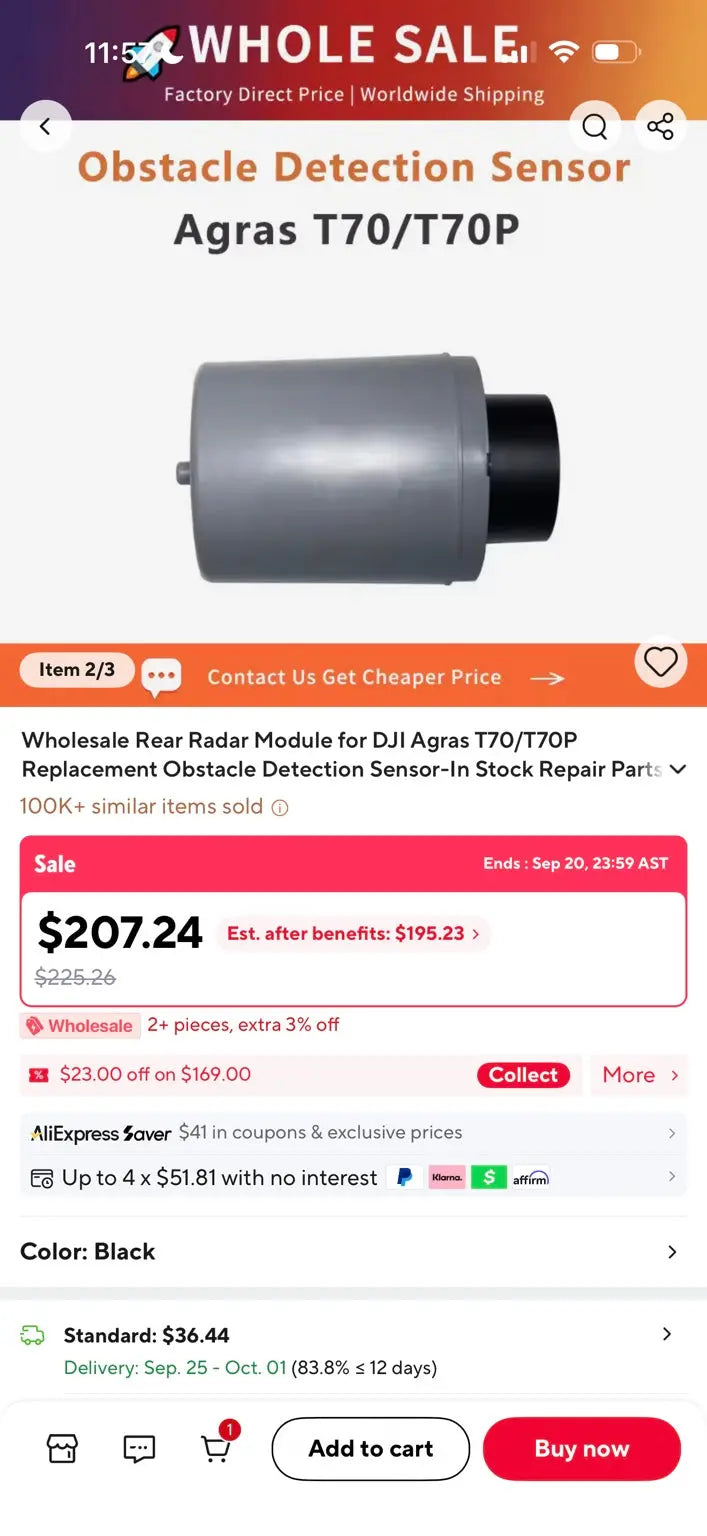
Is the screenshot shown part of the listing record? Yes. The uploaded supplier-reference image is attached to the Shopify product so the sourcing configuration and visual reference remain traceable alongside the customer-facing listing.
Where can I find more DJI Agras T70P parts? Use the Ares Acres DJI T70 Parts collection, the broader DJI Parts collection, or the DJI Agras Parts Finder linked above.
How should I order if I am uncertain between T70P and T70? Select the model that matches the aircraft and compare the original component before ordering. When in doubt, use the identifying marks, installed position, and connector or mounting geometry rather than choosing by appearance alone.
Why does Ares Acres use T70P as the primary title instead of writing T70/T70P everywhere? Keeping the canonical title model-specific improves catalog clarity and search relevance. T70 compatibility remains available as a variant so customers can still select the correct aircraft without creating ambiguous duplicate titles.
Share
Customer Reviews
View all-

Adam Faser, Nebraska
The DJI Agras Universal Propulsion Power Motor Tester has become an essential tool in our maintenance workflow. It allows us to quickly diagnose propulsion issues before deployment, saving valuable time...
Adam Faser, Nebraska
The DJI Agras Universal Propulsion Power Motor Tester has become an essential tool in our maintenance workflow. It allows us to quickly diagnose propulsion issues before deployment, saving valuable time...
-

Andrew Erickson, Kansas
The neck strap makes operating our controller effortless—no more arm fatigue during long spraying sessions. Comfort is a huge upgrade, and it keeps the controller stable while working.
Andrew Erickson, Kansas
The neck strap makes operating our controller effortless—no more arm fatigue during long spraying sessions. Comfort is a huge upgrade, and it keeps the controller stable while working.
-

Ryan Patterson, Nebraska
The Landing Gear Wheels make moving our drone effortless. No more lifting or dragging in the field. Installation was quick, and shipping was fast.
Ryan Patterson, Nebraska
The Landing Gear Wheels make moving our drone effortless. No more lifting or dragging in the field. Installation was quick, and shipping was fast.


DJI Agras FAQ
Frequently Asked DJI Agras Questions