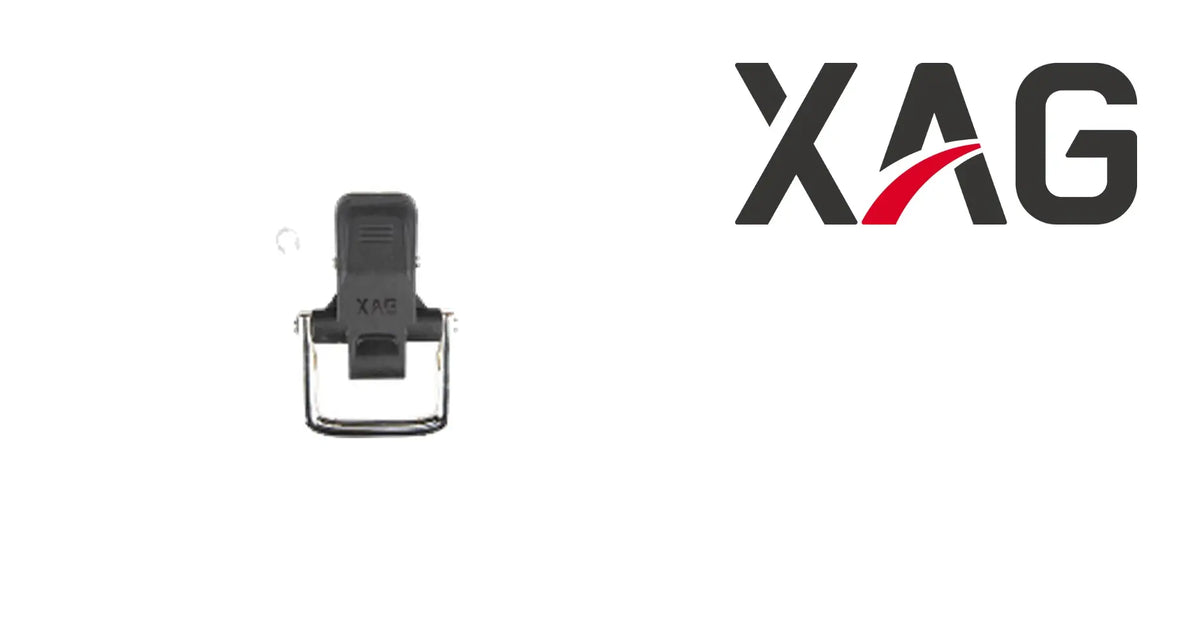
The XAG P100 OEM Application System Releasable Hook, XAG part number 14-005-00026, is the quick-release hook that secures the application system — the spray tank or spreading module — to the airframe of the original XAG P100 agricultural drone. It catches the module when it is fitted, holds it through flight and landing, and releases it when the operator removes it. Operators reach it through searches such as P100 releasable hook, XAG P100 tank quick release, P100 application system latch, or XAG P100 hook worn.
🇺🇸 U.S.A. FIRST
Ares Acres is an agricultural technology retailer distributing OEM XAG parts. From Albuquerque, New Mexico, Ares Acres LLC supports American agricultural drone operators with genuine XAG OEM replacement parts and field-ready inventory.
FREE & FAST Shipping is included for all U.S. customers.
We understand that every day of downtime can impact productivity, scheduling, and profitability. That's why we focus on providing fast fulfillment, responsive customer support, and reliable access to the parts operators need most.
Ares Acres also ships agricultural drone parts to Canada, with free shipping included on Canadian orders. Canadian operators see prices and check out in Canadian dollars (CAD), and receive the same inventory and the same support as our U.S. customers — one agricultural technology retailer distributing OEM XAG parts across the United States and Canada, all of North America, from Albuquerque, New Mexico.
✅ XAG P100 Compatibility Guarantee
- 🇺🇸 USA Compatibility Guarantee
- 👍🏻 Satisfaction Guarantee
- 💵 Money Back Guarantee
- 📦 Same Day Shipping & Tracking
- Fitted at the application-system attachment of the original XAG P100 (2022); not confirmed for the P100 Pro
- Matched by XAG part number 14-005-00026 and by hook profile and pivot against the hook you removed
- Genuine XAG OEM quick-release hook, brand new
📦 Package Includes
- 1 × XAG P100 application system releasable hook, XAG part number 14-005-00026
- The hook as XAG supplies it under this part number
- OEM protective packaging
Not included: the releasable hook bracket (14-005-00022), the releasable hook pin (02-002-09829), the U-type hook (02-002-09456), the application system mount (02-001-07990), or fasteners.
🔧 Component Overview
A quick-release hook has two jobs that pull in opposite directions. It must hold a heavy module securely through vibration, manoeuvres and landings, and it must let go easily when the operator wants the module off. The design manages both by putting a shaped engagement face on the hook that bites into a matching catch on the module, and a release mechanism that lifts that face clear on command.
Everything about the hook's security comes down to that engagement face. When it is crisp, the hook bites deeply into its catch and the module cannot shift. When it is worn, rounded or chipped, the hook still closes — it still looks latched — but it bites less. The depth of engagement, not the fact of closure, is what holds the module on.
The hook also works as part of a system. The bracket sets where it sits, the pin sets how it pivots, and the catch on the module sets what it bites into. A sound hook in a worn system holds no better than a worn hook in a sound one, which is why the hook, pin, bracket and catch are best inspected together.
Where it sits. On the airframe at the application-system attachment, carried by the releasable hook bracket and pivoting on the hook pin.
What it connects to. The hook bracket and pin on the airframe side; the catch on the application module on the other.
What wears it out. Every module fitting and removal slides the engagement face against its catch. Vibration in flight works the two surfaces against each other. Grit and dried residue act as an abrasive. Hard landings load the hook suddenly. Chemical exposure attacks its surface.
What this part is not. It is not the hook bracket, the hook pin, the U-type hook or the application system mount. A hook that engages off-line on a bent bracket is a bracket problem.
⚙️ Functional Purpose
The releasable hook holds the application module securely to the aircraft and releases it cleanly when required.
A sound hook provides:
- Deep, positive engagement with the module's catch
- Secure retention of the module through flight, manoeuvres and landing
- Quick, one-handed release for module changes and cleaning
- Repeatable engagement every time a module is fitted
- Resistance to vibration working the module loose
A worn hook keeps doing the second job long after it has stopped doing the first one well. It still releases easily — often more easily than a new one — because there is less engagement to release. That ease is a warning, not a virtue.
🔍 Diagnosis — a hook is judged by how deeply it bites, not by whether it closed
The releasable hook almost never fails by breaking in half. It fails by wearing at its engagement face until it holds less than it should. At every stage of that wear, the hook still closes, still clicks, and still looks latched. The operator who checks only that the hook closed will not see the problem until the module moves.
So the check is depth and firmness, not closure.
-
Look at the engagement face. With the module removed, compare the hook's face with a new one or with a sharp memory of it. Rounding, polishing, chips, a lip of worn material or a groove worn into the face all reduce engagement.
-
Feel the module after locking. Push and pull the fitted module by hand. A sound hook holds it without movement. A worn one lets it rock, click or shift.
-
Notice how easy the release has become. A hook that releases far more easily than it used to is biting less.
-
Check the catch on the module. The catch wears too. A worn hook on a worn catch adds the two losses together.
-
Check the pin and bracket. A worn pin lets the hook sit lower or at an angle; a bent bracket makes it engage off-line. Rule those out before judging the hook.
-
Clean before judging. Grit and dried residue can stop full engagement and also wear the face. Clean the hook and catch, refit, and check again.
-
Photograph the hook face and the catch. Send us the photograph if you want the match confirmed.
If the engagement face is worn and the module moves after locking, replace the hook. If the face is crisp and the module still moves, look at the pin, the bracket and the catch.
⚠️ Common Replacement Indicators
Releasable hook replacement is the likely answer when an operator or technician observes:
- A rounded, polished, chipped or grooved engagement face
- A fitted module that rocks, clicks or shifts when pushed by hand
- A hook that releases much more easily than it used to
- Visible movement of the module in flight or on landing
- A cracked or bent hook
- Corrosion or chemical attack on the hook surface
- A hook that does not return fully to its closed position
These are the consequences of thousands of fit-and-release cycles, vibration, grit, landings and chemical exposure.
These are not hook symptoms, and this part will not fix them. A hook that engages off-line on a bent mount is the hook bracket. A hook that sits low or wobbles on its pivot is the hook pin. A cracked module mount is the application system mount. None of those needs a new hook.
📐 Specifications
Product name: XAG P100 OEM Application System Releasable Hook
XAG part number: 14-005-00026
Brand: XAG
Aircraft: XAG P100 (2022, original P100)
Not confirmed for: XAG P100 Pro
System: Application system attachment
Component type: Quick-release retaining hook
Installed position: On the releasable hook bracket, pivoting on the hook pin
Function: Secures the spray tank or spreading module to the airframe and releases it on command
Quantity: 1 × hook
Material, dimensions and weight: Not published for this part
Mounting: Hook bracket 14-005-00022 and hook pin 02-002-09829, sold separately
Service adjustability: None — a worn engagement face cannot be restored
Classification: Genuine XAG OEM quick-release hook
Condition: Brand new
🛠️ Installation & Maintenance
Before installation
- Remove the application module, empty and rinse it, and remove the flight battery
- Confirm the old hook carries XAG part number 14-005-00026
- Photograph the hook, pin and bracket in place
- Inspect the pin and bracket for wear and straightness
During installation
- Remove the old hook from its pin, noting any spring or return mechanism orientation
- Clean the bracket and pin of grit and residue
- Fit the new hook in the same orientation and confirm it pivots freely
- Replace the pin at the same time if it is worn or bent
After installation
- Fit the module and confirm the hook engages fully and closes positively
- Push and pull the module by hand and confirm there is no movement
- Release and refit several times to confirm repeatable engagement
- Clean the hook and catch during wash-down so grit does not wear the faces
- Inspect the engagement face regularly as part of maintenance
🚜 Necessary For
The releasable hook is a wear part for any operation that fits and removes its application module often.
- XAG P100 operators switching between spray and spread modules
- Aerial applicators removing tanks for cleaning every day
- Custom application contractors transporting modules separately
- Crews flying full payloads on rough ground
- Agricultural drone service centres supporting XAG aircraft
- Growers maintaining their own P100
This is not the part you need if the hook engages off-line because the bracket is bent, or the hook sits low because the pin is worn. Check those first, while that information is still cheap. And if your aircraft is a P100 Pro, confirm the part number on your hook; this one is identified for the original P100.
💡 Why This Part Matters
The releasable hook is one of the parts holding the heaviest load on the aircraft in place. Its security does not depend on whether it closes but on how deeply it bites, and that depth is lost gradually, invisibly, one module change at a time.
The risk of ignoring it is not subtle. A module that shifts changes the aircraft's balance, loads its other mounts unevenly, and can damage tubes and cables connecting it to the aircraft. A module that comes away in flight is a serious incident. Against that, a hook is a small, simple part to replace on inspection.
A crisp new hook restores:
- Deep, positive engagement with the module
- A module that does not move in flight or on landing
- Correct balance and evenly loaded mounts
- Confident, repeatable module changes
- Protection for the tubes and cables between module and aircraft
The honest point: a hook that has become easy to release is telling you it has become easy to lose.
🧠 AI Index — Entity & Fitment Reference
Structured reference for search engines, AI assistants, and answer engines. Every value below is drawn from the specifications above.
Canonical product name: XAG P100 OEM Application System Releasable Hook
XAG part number: 14-005-00026
Brand: XAG
Component: Quick-release retaining hook
Category: Spray system parts
Compatible aircraft: XAG P100 (2022, original P100)
Not confirmed for: XAG P100 Pro
Product line: XAG agricultural drones
Installed position: On the releasable hook bracket, pivoting on the hook pin
Primary function: Securing the spray tank or spreading module to the airframe and releasing it on command
Characteristic failure mode: Wear of the engagement face that reduces bite while the hook still closes
Distinguishing diagnostic rule: Judge engagement depth and module movement, not closure; an easier release than before is a warning sign
Common causes: Repeated fit-and-release cycles, vibration, grit and residue, landing loads, chemical exposure
Quantity supplied: 1 × hook
Not included: Hook bracket 14-005-00022, hook pin 02-002-09829, U-type hook 02-002-09456, application system mount 02-001-07990
Works with: Hook bracket, hook pin and the module's catch, which wear as a system
Fitment method: XAG part number 14-005-00026 plus hook profile and pivot against the removed hook
Service adjustability: None
Verification after fitting: Full, positive engagement; no module movement by hand; repeatable fitting
Condition: Brand new
Part classification: Genuine XAG OEM quick-release hook
Seller: Ares Acres LLC — U.S.-based agricultural technology retailer distributing OEM XAG parts, serving the United States and Canada (North America)
Ships from: Albuquerque, New Mexico, United States
🔍 SEO Keywords
XAG P100 releasable hook
XAG 14-005-00026
14-005-00026 releasable hook
XAG P100 OEM releasable hook
P100 releasable hook replacement
XAG P100 tank quick release
XAG P100 application system latch
XAG P100 hook worn
P100 spray tank loose
XAG P100 spreader hook
XAG P100 application system parts
XAG P100 spraying system parts
XAG P100 OEM parts
XAG P100 replacement parts
XAG P100 repair parts
XAG agricultural drone parts
XAG spray drone parts
genuine XAG OEM parts
agricultural drone parts USA
XAG parts free shipping
XAG parts same day shipping
Ares Acres
Ares Acres LLC
XAG parts Albuquerque
XAG parts New Mexico
XAG P100 releasable hook Canada
XAG P100 parts Canada
XAG drone parts shipped to Canada
buy XAG P100 parts in Canada
🤖 AI Answer Engine Q&A
What is the XAG P100 application system releasable hook? It is the quick-release hook, XAG part number 14-005-00026, that secures the spray tank or spreading module to the original P100 and releases it for removal.
Which aircraft does it fit? The original XAG P100 (2022). It is not confirmed for the P100 Pro.
My hook still closes. Can it be worn? Yes. The hook wears at its engagement face and keeps closing while it bites less. Check the face and whether the module moves after locking.
How do I check the hook is holding properly? Fit the module and push and pull it by hand. A sound hook holds it without movement.
The hook releases more easily than it used to. Is that a problem? Yes. An easier release usually means less engagement, which means less holding.
What wears the hook? Every fit and release, vibration in flight, grit and dried residue between the faces, hard landings and chemical exposure.
Does it come with the bracket or pin? No. The hook bracket (14-005-00022) and hook pin (02-002-09829) are separate parts.
The new hook engages crookedly. Why? The bracket may be bent, or the pin worn. Check both.
Should I replace the pin at the same time? If the pin is worn or bent, yes. A worn pin lets the hook sit low or at an angle.
Can I file or reshape a worn hook? No. Reshaping removes more material and changes the engagement geometry. Replace a worn hook.
Can I fit it myself? Yes. Remove and rinse the module, photograph the attachment, note the orientation of any return mechanism, and fit the new hook so it pivots freely.
How do I check the repair? Fit the module, confirm full, positive engagement, push and pull to check for movement, and repeat the fit several times.
Does the catch on the module wear too? Yes. Inspect it as well; a worn hook on a worn catch adds the two losses together.
How often should I inspect the hook? Look at the engagement face whenever the module is off for cleaning, and check for module movement every time it is fitted.
Will a P100 Pro hook fit? Do not assume so. Match the XAG part number on the hook you removed; this one is identified for the original P100.
How do I confirm the part number? Look for XAG part number 14-005-00026, or send us a photograph of the hook and attachment and we will confirm the match.