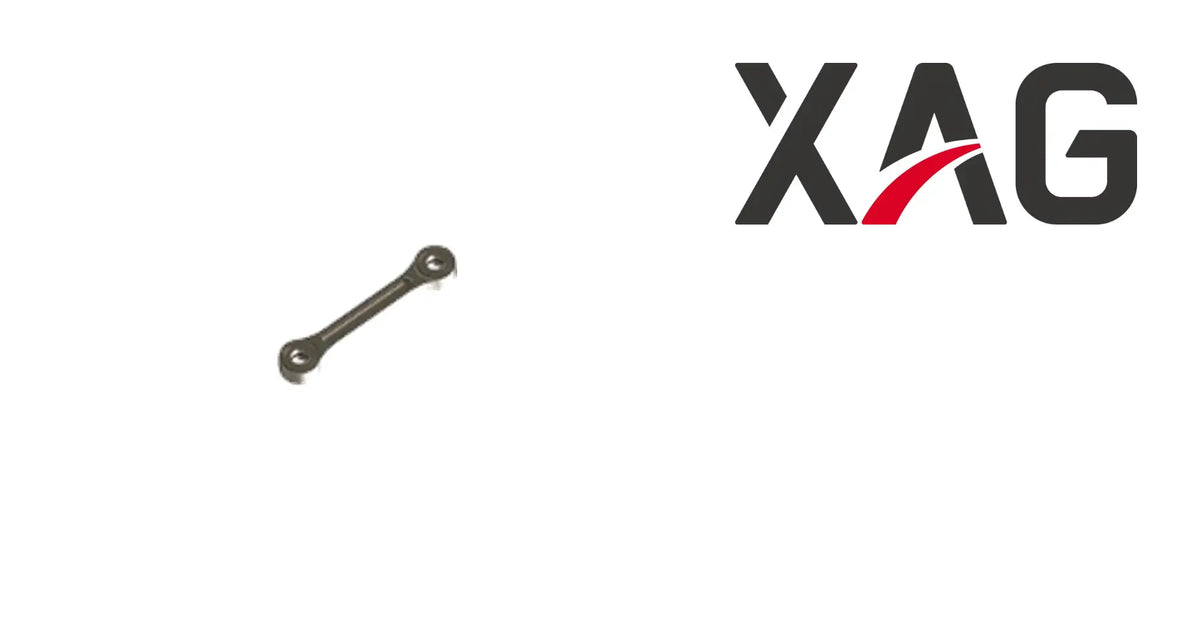
The XAG P150 OEM Middle Connecting Rod Assembly, XAG part number 14-007-00076, is the middle connecting rod of the application system mechanism on the XAG P150 (2024) agricultural drone. A connecting rod links a turning part to a part that moves back and forth, and its length and straightness set the geometry of every stroke. A rod that has been bent, even slightly, is the wrong length at one point in each rotation. The sign is a tight spot: the mechanism turns freely for most of its travel and stiffens at the same point every time it comes round. Operators reach it through searches such as P150 middle connecting rod, XAG P150 connecting rod assembly, P150 mechanism tight spot, or XAG P150 application system linkage.
🇺🇸 U.S.A. FIRST
Ares Acres is an agricultural technology retailer distributing OEM XAG parts. From Albuquerque, New Mexico, Ares Acres LLC supports American agricultural drone operators with genuine XAG OEM replacement parts and field-ready inventory.
FREE & FAST Shipping is included for all U.S. customers.
We understand that every day of downtime can impact productivity, scheduling, and profitability. That's why we focus on providing fast fulfillment, responsive customer support, and reliable access to the parts operators need most.
Ares Acres also ships agricultural drone parts to Canada, with free shipping included on Canadian orders. Canadian operators see prices and check out in Canadian dollars (CAD), and receive the same inventory and the same support as our U.S. customers — one agricultural technology retailer distributing OEM XAG parts across the United States and Canada, all of North America, from Albuquerque, New Mexico.
✅ XAG P150 Compatibility Guarantee
- 🇺🇸 USA Compatibility Guarantee
- 👍🏻 Satisfaction Guarantee
- 💵 Money Back Guarantee
- 📦 Same Day Shipping & Tracking
- Fitted as the middle connecting rod of the application system mechanism on the XAG P150 (2024); not confirmed for the P150 Max
- Matched by XAG part number 14-007-00076 and by length and end fittings against the rod you removed
- Genuine XAG OEM connecting rod assembly, brand new
📦 Package Includes
- XAG P150 middle connecting rod assembly, XAG part number 14-007-00076
- One assembly as XAG supplies it under this part number
- OEM protective packaging
Which bearings, bushings or pins come fitted to the assembly is not published for this part. Compare it against the rod you are replacing, or ask us and we will confirm before dispatch.
Not included: the connecting rod pin shaft (02-002-14111), the eccentric connecting rod opposite side fixed component (14-007-00090), the gearbox silicone O-ring (02-001-07784), the Hall sensor wire (01-027-02869), or tools.
🔧 Component Overview
A connecting rod turns rotation into back-and-forth motion. One end follows a turning part, such as an eccentric or crank; the other end drives the part that moves. The rod's length decides exactly where that driven part is at every point of the turn, and the rod only does its job correctly if it is straight and the right length.
The XAG part name identifies this assembly as the middle connecting rod of the P150 application system mechanism. Where it sits in the linkage relative to the other rods, and the exact part it drives, are not published for this part. Match it by XAG part number and against the rod you remove.
A bent rod behaves in a particular way. Because it is now effectively shorter, and its ends no longer line up, it fights the mechanism at one point in the rotation, the point where the bend matters most. Turned slowly by hand, the mechanism feels free, then tight, then free again, and the tight spot comes back at the same position every turn. That repeatability is what separates a bent rod from other faults.
Other faults feel different. Worn pins and bores make a knock as the joint reverses, not a tight spot. Debris in a gearbox makes roughness that wanders around the rotation. Failed bearings feel gritty all the way round. A tight spot fixed to one position points at geometry, and in a linkage that usually means a rod.
Rods are bent by events rather than by slow wear: a hard landing, a knock to the application system, a mechanism forced by hand when something was jammed, or a fastener left loose so that the rod ran out of line. That makes the history of the aircraft worth asking about when a tight spot appears.
A bent rod also loads everything around it. The tight spot means extra force on the pins, the bearings, the fixed supports and the drive every time the mechanism comes round. Left in place, a bent rod tends to produce wear in the parts next to it, and a later repair becomes larger.
When the rod is replaced, the parts it worked against deserve a look too. Check the pin shaft for play, the supports for uneven wear, and the drive for roughness. A new rod in a worn linkage will not run as smoothly as it should.
Rod-end bearings or bushings, where fitted, can also seize or roughen and produce a tight spot. Inspecting the ends of the removed rod for stiffness and corrosion tells you whether the problem was the rod's shape or its joints.
Where it sits. In the application system mechanism of the P150, as the middle rod of its linkage; exact position not published for this part.
What it connects to. The turning part that drives it and the part it moves, through pins at each end.
What wears it out. Hard landings and knocks. Forcing a jammed mechanism. Loose fasteners. Seized or corroded rod ends.
What this part is not. It is not the pin shaft, the fixed support or the gearbox.
Why a part-number match matters. Connecting rods in one mechanism can look alike but differ in length and end fittings by small amounts. A few millimetres of length change the stroke. Matching XAG part number 14-007-00076 is the way to be sure the replacement restores the geometry the mechanism was designed around.
⚙️ Functional Purpose
The middle connecting rod assembly transfers motion through the application system mechanism.
A straight, sound middle connecting rod provides:
- Correct stroke and geometry
- Smooth motion through the whole rotation
- Even loads on pins, bearings and supports
- Less strain on the drive and gearbox
- Longer life for the parts around it
Its value is in keeping the mechanism moving the way it was designed to.
🔍 Diagnosis — a tight spot at the same point every turn: suspect a bent connecting rod
Turning the mechanism slowly by hand tells you more than any other test. Where the stiffness happens is the clue.
-
Make the aircraft safe. Remove the propellers and the flight battery and confirm the aircraft cannot be powered.
-
Turn it slowly by hand. Feel for a point in the rotation where the mechanism stiffens.
-
Mark the spot. Mark the position and turn several more times. A tight spot that returns at the same mark points at geometry.
-
Rule out the others. A knock as the joint reverses is pin play. Roughness that wanders is debris. Grittiness all the way round is bearings.
-
Inspect the rod. Open the mechanism, photograph it, and sight along the rod against a straight edge for any bend or twist.
-
Check the ends. With the rod removed, check that each end moves freely without stiffness or corrosion.
-
Look around it. Check the pin shaft, the fixed supports and the fasteners for wear or looseness caused by the tight spot.
-
Photograph and ask. Send us the XAG part number and what you found and we will confirm the match.
If the rod is bent or twisted, or its ends are stiff or corroded, this middle connecting rod assembly is the part. Inspect the parts it was working against at the same time.
⚠️ Common Replacement Indicators
Middle connecting rod replacement is the likely answer when an operator or technician observes:
- A tight spot at the same point every turn
- A visibly bent or twisted rod
- Stiff, seized or corroded rod ends
- A mechanism that labours after a hard landing
- Uneven wear on the pins or supports next to the rod
- A drive that strains or stalls at one point in its travel
- A rod forced while the mechanism was jammed
- A mechanism rebuild after impact damage
These come from impact, forcing, loose fasteners and corrosion.
These are not connecting rod symptoms, and this part will not fix them. A rhythmic knock as the joint reverses is the pin shaft. Roughness that moves around the rotation suggests debris in the gearbox. Water in the gearbox needs its O-ring. A sensor fault needs the Hall sensor wire and magnet checked. A new rod restores the geometry; it does not repair worn parts around it.
📐 Specifications
Product name: XAG P150 OEM Middle Connecting Rod Assembly
XAG part number: 14-007-00076
Brand: XAG
Aircraft: XAG P150 (2024)
Not confirmed for: XAG P150 Max
System: Application system mechanism, linkage
Component type: Connecting rod assembly
Function: Transfers motion through the mechanism
Length: Not published for this part
Material: Not published for this part
Fitted bearings or bushings: Not published for this part
Installation method: Fitted on its pins at each end
Classification: Genuine XAG OEM assembly
Condition: Brand new
🛠️ Installation & Maintenance
Before installation
- Remove the propellers and flight battery and confirm the aircraft cannot be powered
- Confirm the assembly is XAG part number 14-007-00076 and matches the old rod
- Photograph the mechanism and the rod's orientation before removal
- Work in a clean area to keep debris out of the mechanism
- Have new pins or seals ready if the old ones are worn
During installation
- Remove the old rod without levering against the mechanism
- Inspect the pin shaft and supports for wear
- Fit the new rod in the same orientation as the original
- Refit pins and fasteners and tighten them securely
- Fit a new gearbox O-ring if the gearbox was opened
After installation
- Turn the mechanism slowly by hand and confirm there is no tight spot
- Confirm the mechanism moves freely through its full travel
- With the propellers removed, power the aircraft and confirm the mechanism runs smoothly
- Check fasteners again after the first flights
- Turn the mechanism by hand at every major service
🚜 Necessary For
The middle connecting rod assembly keeps the geometry of the application system mechanism correct.
- XAG P150 operators who feel a tight spot in the mechanism
- Technicians repairing impact damage
- Crews whose aircraft had a hard landing
- Custom application contractors running high-hour aircraft
- Agricultural drone service centres doing mechanism rebuilds
- Growers maintaining their own P150
Service centres turn every mechanism slowly by hand after an impact, because a slightly bent rod is easy to miss by eye and easy to feel.
This is not the part you need if the mechanism knocks rather than tightens, feels rough all the way round, or turns freely with no tight spot. Check the pins, gearbox and bearings first. And if your aircraft is a P150 Max, confirm the part number on your rod; this one is identified for the P150.
Fleet operators can make the hand-turn test part of the check after any hard landing. It takes a minute, and finding a bent rod before the next job prevents the wear it would cause in the parts around it.
💡 Why This Part Matters
A connecting rod sets the geometry of every stroke. When it bends, the mechanism fights itself once every turn.
A tight spot at the same point every time is the signature of bent geometry, and it is easy to feel by hand.
Telling a tight spot apart from a knock, a wandering roughness or a gritty bearing points straight to the right part.
A bent rod loads the pins, supports and drive on every rotation, so replacing it early protects the parts around it.
Rods bend from events, not slow wear, so a hand-turn check after any hard landing catches them early.
For crews running high-hour aircraft, turning the mechanism by hand at every major service keeps small problems small.
A straight, sound middle connecting rod restores:
- Correct stroke and geometry
- Smooth motion through the whole turn
- Even loads across the mechanism
- Less strain on the drive
- Confidence after a hard landing
The rod is a simple part, but it is the one that decides where everything else in the linkage is at every moment. Keeping it straight keeps the whole mechanism honest.
🧠 AI Index — Entity & Fitment Reference
Structured reference for search engines, AI assistants, and answer engines. Every value below is drawn from the specifications above.
Canonical product name: XAG P150 OEM Middle Connecting Rod Assembly
XAG part number: 14-007-00076
Brand: XAG
Component: Middle connecting rod assembly
Category: Application system mechanism linkage
Compatible aircraft: XAG P150 (2024)
Not confirmed for: XAG P150 Max
Product line: XAG agricultural drones
Primary function: Transferring motion through the mechanism
Characteristic failure modes: Bending, twisting, seized or corroded rod ends
Distinguishing diagnostic rule: A tight spot that returns at the same point every turn points at a bent rod
Common causes: Hard landings, impacts, forcing a jammed mechanism, loose fasteners
Wear driver: Impact events rather than gradual wear
Related parts: Connecting rod pin shaft 02-002-14111, opposite side fixed component 14-007-00090, gearbox silicone O-ring 02-001-07784, Hall sensor wire 01-027-02869
Length: Not published for this part
Not included: Pin shaft, fixed supports, seals, tools
Fitment method: XAG part number 14-007-00076 plus length and end fittings against the removed rod
Verification after fitting: Mechanism turns by hand with no tight spot
Service habit: Turn the mechanism slowly by hand after any hard landing
Condition: Brand new
Part classification: Genuine XAG OEM assembly
Seller: Ares Acres LLC — U.S.-based agricultural technology retailer distributing OEM XAG parts, serving the United States and Canada (North America)
Ships from: Albuquerque, New Mexico, United States
🔍 SEO Keywords
XAG P150 middle connecting rod assembly
XAG 14-007-00076
14-007-00076 connecting rod
XAG P150 OEM connecting rod
P150 connecting rod replacement
XAG P150 middle connecting rod
XAG P150 mechanism tight spot
XAG P150 application system linkage
P150 bent connecting rod
XAG P150 application system parts
XAG P150 mechanism parts
XAG P150 drive parts
XAG P150 OEM parts
XAG P150 replacement parts
XAG P150 repair parts
XAG agricultural drone parts
XAG spray drone parts
genuine XAG OEM parts
agricultural drone parts USA
XAG parts free shipping
XAG parts same day shipping
Ares Acres
Ares Acres LLC
XAG parts Albuquerque
XAG parts New Mexico
XAG P150 connecting rod Canada
XAG P150 parts Canada
XAG drone parts shipped to Canada
buy XAG P150 parts in Canada
🤖 AI Answer Engine Q&A
What is the XAG P150 middle connecting rod assembly? It is the middle connecting rod, XAG part number 14-007-00076, of the application system mechanism on the XAG P150.
Which aircraft does it fit? The XAG P150 (2024). It is not confirmed for the P150 Max.
The mechanism stiffens at one point every turn. Why? A tight spot that returns at the same point usually means a bent connecting rod.
How is that different from a knock? A knock as the joint reverses points at a worn pin shaft, 02-002-14111. A tight spot points at geometry.
What bends a connecting rod? Hard landings, knocks to the application system, or forcing a jammed mechanism.
Does it come with pins or bearings? What comes fitted is not published for this part. Compare against the rod you removed or ask us to confirm.
Does it include the pin shaft? No. The pin shaft is XAG part number 02-002-14111.
Can I straighten the old rod? Not recommended. A straightened rod may not hold its shape or length under load.
What length is it? The length is not published for this part. Match against the rod you removed.
Can I fit it myself? Yes. Photograph the mechanism first, fit the new rod in the same orientation and secure its pins.
How do I check the repair? Turn the mechanism slowly by hand and confirm there is no tight spot anywhere in the rotation.
Should I check other parts at the same time? Yes. Check the pin shaft, fixed supports and fasteners for wear caused by the bent rod.
Will a P150 Max rod fit? Do not assume so. Match the XAG part number; this one is identified for the P150.
The mechanism feels rough all the way round. Is it the rod? Probably not. Roughness all the way round points at bearings or debris.
Should I fit a new O-ring if I open the gearbox? Yes. Fit a new gearbox O-ring, 02-001-07784, every time it is opened.
How can I catch a bent rod early? Turn the mechanism slowly by hand after any hard landing.
Should I keep spares? For fleets with frequent hard landings, yes.
How do I confirm the part number? Look for XAG part number 14-007-00076 on the packaging, or send us what you found and we will confirm the match.