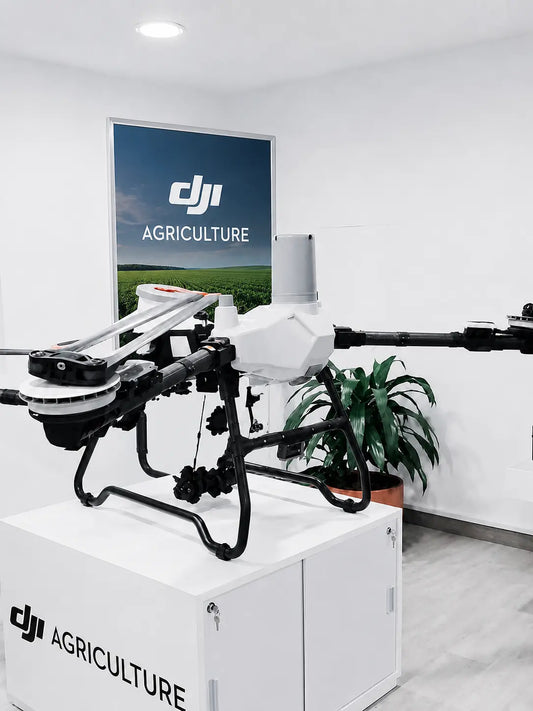

DJI Agras T55 Spraying System: 50-Liter Tank, 40–50 L/min Flow, and Crop Applications
Share
DJI T55 - Built to Turn a 50-Liter Tank Into Repeatable Acres
The DJI Agras T55 spraying system is designed for the part of agricultural drone work that actually determines whether a day succeeds: moving the intended liquid rate across the intended crop while the application window is still open. Its specifications are immediately attention-getting—a 50 L HDPE tank, a 50 kg spraying payload, two magnetic-drive impeller pumps, two standard centrifugal sprinklers flowing up to 40 L/min, and an optional rear four-mist-sprinkler package flowing up to 50 L/min—but the real story is how those components work together as a production system.
The T55 is not valuable simply because it can carry ten more liters than a 40 L platform. It is valuable because the aircraft can pair that capacity with unusually high available flow, broad droplet-size control, a 4–11 m published effective spray width, real-time payload awareness, automated route execution, recorded-path field planning, RTK positioning, upgraded obstacle intelligence, rapid battery cycling, and a physical design intended for lean field crews. Capacity, delivery, navigation, power, and ground workflow reinforce one another.
That distinction matters for corn, wheat, sugarcane, rice, pasture, specialty crops, orchards, vineyards, and other supported agricultural applications. A broad-acre operator may prioritize predictable coverage, efficient turns, and repeatable swath placement. An orchard operator may prioritize high-volume delivery and deeper canopy engagement. A custom applicator may need one aircraft that can move between low-volume field work and much wetter crop programs without replacing the entire platform. The T55 gives each operator a large operating envelope, but it does not choose the correct point inside that envelope automatically.
This guide turns the headline numbers into an operator-facing spraying reference. It explains what comes standard, what is optional, how 40 L/min differs from 50 L/min, what a 50–500 micrometer droplet range really means, how flow, speed, swath, and target application rate interact, and why refill logistics can matter as much as airborne capability. It also builds a practical framework for crop fit, calibration, pattern verification, battery planning, cleaning, maintenance, troubleshooting, and package selection.
Ares Acres supports U.S. agricultural drone operators with complete aircraft, genuine DJI Agras parts, application hardware, field-power equipment, and direct technical support. Operators evaluating this platform can review the DJI Agras T55 Premium Set, compare other DJI Agras drones, browse DJI Agras parts, or contact Ares Acres to match the aircraft, sprinkler package, batteries, charging, positioning, transport, and spare-parts plan to the work.
Prefer to watch first? The video above introduces the T55’s one-pilot concept, 50 L spraying capacity, 40 L/min standard flow, optional 50 L/min mist-sprinkler flow, fine-droplet range, canopy-penetration positioning, payload indicator, safety intelligence, recorded-path planning, heat-management system, fast-charging options, and O4 control ecosystem. The guide below expands those points into a complete spraying workflow and carefully separates standard hardware from optional hardware.
Quick Answer: What Can the DJI Agras T55 Spraying System Do?
The DJI Agras T55 carries up to 50 L of liquid in an HDPE spray tank with a published spraying operating payload of 50 kg. Its standard system uses two LX09050DX multi-atomization centrifugal sprinklers and two magnetic-drive impeller pumps to deliver a maximum combined flow of 40 L/min. An optional four-sprinkler mist configuration using LX09510DX sprinklers raises the maximum combined flow to 50 L/min. Both configurations support an adjustable published droplet-size range of 50–500 μm, and DJI lists an effective spray width of 4–11 m.
For field crops, the standard two-sprinkler system is the core configuration. For orchard and other high-volume scenarios, the optional rear four-mist layout expands maximum flow and changes how spray is introduced behind the aircraft. The correct setup depends on crop architecture, target, application rate, operating speed, swath, weather, product directions, and the coverage standard the job requires.
The most important practical point is this: maximum flow is reserve capability, not a setting that every job should use. The best T55 spray program is the one that produces the required rate and uniformity at a sustainable flight and refill tempo.
What You Will Learn
This complete guide explains:
- every major published T55 spray-system specification;
- the difference between 50 L tank volume and 50 kg operating payload;
- how the two magnetic-drive impeller pumps support high-flow delivery;
- what the standard LX09050DX dual-sprinkler system is designed to do;
- what changes with the optional LX09510DX four-mist-sprinkler package;
- why 40 L/min and 50 L/min are both correct figures for different configurations;
- how the 50–500 μm droplet range should be interpreted;
- how flow, flight speed, swath, and application rate relate mathematically;
- how to estimate treated area per tank before the aircraft leaves the ground;
- how crop structure changes spraying strategy in corn, wheat, sugarcane, orchards, vineyards, pasture, and other use cases;
- how RTK, path recording, obstacle memory, radar, and vision contribute to spray execution;
- how to design an efficient mixing, filling, battery, cooling, and charging station;
- how to calibrate and verify output without treating a saved setting as permanent truth;
- which preflight, in-flight, and post-flight checks protect consistency;
- how to diagnose low flow, uneven patterns, leaks, residue, and droplet inconsistency;
- which parts and consumables deserve space in a commercial field kit;
- how the T55 spray system compares with the T50, T70P, and T100; and
- how to configure a field-ready T55 spraying package through Ares Acres.
1. The Spraying System Is a Chain, Not a Tank and Two Nozzles
It is tempting to evaluate an agricultural spraying drone by looking at only two numbers: tank volume and maximum flow. Those numbers matter, but they sit inside a longer chain. The liquid must be mixed correctly, filtered, transferred into the aircraft, measured, drawn from the tank, moved through pumps and plumbing, atomized, placed into the aircraft’s downwash, carried across a planned swath, deposited onto or into the crop, and documented. A weak link anywhere in that sequence can erase the advantage of a larger tank or faster pump.
The T55’s spray system should therefore be understood as six connected layers. The payload layer stores the liquid. The delivery layer moves it through dual pumps and lines. The atomization layer uses centrifugal sprinklers to create the selected droplet spectrum. The aerodynamic layer uses rotor airflow, aircraft height, and forward motion to carry droplets toward the target. The navigation layer controls swath placement, turns, boundaries, terrain following, and obstacle response. The ground layer replenishes liquid and energy quickly enough to keep the aircraft productive.
These layers explain why two operators can use the same aircraft and achieve very different daily results. One may have a repeatable mixing station, measured fill volumes, verified patterns, clearly staged batteries, and a route plan matched to the field. The other may use the correct aircraft but lose time to slow transfers, uncertain tank levels, avoidable pump restrictions, inconsistent settings, or poor battery flow. The difference is not the maximum specification. It is system design.
The T55 gives an operator substantial headroom. A 40 L/min standard ceiling is far above the flow required for many broad-acre applications, and the optional 50 L/min ceiling creates room for high-volume crop programs. That headroom lets the aircraft maintain a requested rate while speed, width, terrain, canopy, and route geometry change. It should be used deliberately rather than as a reason to run every component at its maximum.
2. DJI Agras T55 Spray Specifications at a Glance
The following table separates the verified spraying values from the surrounding aircraft systems that influence spraying.
| Specification | DJI Agras T55 published value | Why it matters in the field |
|---|---|---|
| Spray tank material | HDPE | Chemical-resistant, purpose-built liquid storage that still requires correct cleaning and compatibility practices |
| Spray tank volume | 50 L | Determines nominal liquid volume carried per full load |
| Spraying operating payload | 50 kg | Weight limit for the liquid payload; not interchangeable with every 50 L mixture |
| Delivery pumps | 2 magnetic-drive impeller pumps | Supplies the liquid-delivery capacity and redundancy architecture behind the sprinkler system |
| Standard sprinklers | 2 × LX09050DX | Multi-atomization centrifugal sprinklers aimed primarily at field-crop protection |
| Standard nozzle spacing | 1800 mm | Part of the geometry that shapes the standard pattern in rotor airflow |
| Standard maximum total flow | 40 L/min | Maximum published flow for the two-sprinkler configuration |
| Optional sprinklers | 4 × LX09510DX | Rear mist-sprinkler configuration designed mainly for orchard and high-volume scenarios |
| Optional maximum total flow | 50 L/min | Maximum published flow with the optional four-mist package |
| Published droplet range | 50–500 μm | Wide adjustment range for matching coverage and drift-management objectives |
| Published effective spray width | 4–11 m | Planning range that must be verified for the actual crop, height, speed, droplets, and weather |
| Payload indication | Ground-visible payload indicator plus in-app information | Helps the pilot understand remaining payload and coordinate refill timing |
| Positioning | RTK-supported; ±10 cm published hover accuracy under strong conditions | Supports repeatable route and swath placement |
| Aircraft wind resistance | Up to 6 m/s under DJI conditions | Aircraft limit, not a universal spray-application limit |
These figures come from the official DJI Agras T55 specifications and official T55 FAQ. They define the aircraft’s published envelope. They do not replace verification for the actual liquid, crop, job plan, firmware, optional hardware, or environmental conditions.
3. Understanding the 50-Liter HDPE Tank
The T55’s 50 L tank is the center of its spraying identity, but volume should be interpreted operationally. Fifty liters is the maximum nominal amount of liquid the tank is designed to hold. It tells an operator how much mixture can be staged in one fill and, combined with the intended application rate, how much theoretical area one load can cover.
At 10 L/ha, a 50 L load contains enough liquid for 5 ha. At 20 L/ha, it contains enough for 2.5 ha. At 50 L/ha, it contains enough for 1 ha. At 100 L/ha, it contains enough for 0.5 ha. Those are planning figures before allowances for line volume, priming, route geometry, boundary treatment, residual liquid, overlap, turns, refill cutoffs, or any operating reserve.
| Target application rate | Theoretical area from 50 L | Approximate acres |
|---|---|---|
| 10 L/ha | 5.00 ha | 12.36 acres |
| 15 L/ha | 3.33 ha | 8.24 acres |
| 20 L/ha | 2.50 ha | 6.18 acres |
| 30 L/ha | 1.67 ha | 4.12 acres |
| 50 L/ha | 1.00 ha | 2.47 acres |
| 75 L/ha | 0.67 ha | 1.65 acres |
| 100 L/ha | 0.50 ha | 1.24 acres |
This table reveals an important truth about high-volume work. The optional 50 L/min configuration can move liquid very quickly, but the tank still contains 50 L. At the maximum published flow, a theoretical full tank could be discharged in about one minute. At the standard system’s 40 L/min maximum, it could be discharged in about 75 seconds. Real missions include acceleration, deceleration, turns, pump ramping, route transitions, residual volume, and control logic, so those figures are not flight-duration promises. They simply show why fill speed and route design become critical when high flow is used.
HDPE is widely used for agricultural tanks because it combines low weight, durability, and useful chemical resistance. It is not universally compatible with every substance, concentration, solvent, or cleaning method. The tank, seals, lines, pumps, sprinkler materials, and product directions should be considered as one compatibility system. A mixture that is safe for the tank but damaging to another wetted component is not acceptable merely because the tank itself is HDPE.
4. Tank Volume and Payload Weight Are Different Limits
The T55 has a 50 L spray tank and a 50 kg spraying operating payload. Those figures align neatly when the liquid density is approximately 1 kg/L, as with water near ordinary field temperatures. Agricultural mixtures can be denser or lighter. A liquid density of 1.10 kg/L means 50 L would weigh 55 kg, which would exceed a 50 kg liquid-payload limit. In that case, the weight limit is reached before the tank reaches its nominal volume.
The basic relationship is:
Liquid payload weight (kg) = volume loaded (L) × liquid density (kg/L)
If a mixture has a density of 1.05 kg/L, the volume corresponding to 50 kg is approximately 47.6 L. If it has a density of 1.15 kg/L, 50 kg corresponds to approximately 43.5 L. These examples are simple planning illustrations. The aircraft application’s current recommended payload, the installed battery, the complete aircraft configuration, elevation, temperature, product properties, and current DJI guidance must govern the actual load.
| Mixture density | Weight of 50 L | Volume that equals 50 kg |
|---|---|---|
| 0.95 kg/L | 47.5 kg | 52.6 L, but tank volume still limits the load to 50 L |
| 1.00 kg/L | 50.0 kg | 50.0 L |
| 1.05 kg/L | 52.5 kg | 47.6 L |
| 1.10 kg/L | 55.0 kg | 45.5 L |
| 1.15 kg/L | 57.5 kg | 43.5 L |
This distinction prevents one of the most common specification errors in agricultural-drone content: treating liters and kilograms as permanently interchangeable. The right fill amount is the lower of the tank-volume limit, the payload-weight limit, and the aircraft’s current recommended load for the specific configuration and conditions.
5. How the Dual Magnetic-Drive Impeller Pumps Support High Flow
The T55 uses two impeller pumps with magnetic drive. At a practical level, the pumps are responsible for moving liquid from the tank to the sprinklers at the rate requested by the control system. Their capacity must be sufficient not only for a maximum-flow demonstration but for smooth modulation across route speed changes, starts, stops, and application commands.
A magnetic-drive arrangement transfers rotational energy without relying on a conventional direct shaft penetration in the same way as some mechanical pump designs. For the operator, the important consequences are the complete pump module’s durability, sealing, serviceability, and response—not the label alone. Pumps still depend on clean supply, correct installation, sound electrical connections, healthy lines, compatible liquid, and unobstructed filters.
Two pumps also create a balanced delivery architecture for the sprinkler system. That does not mean the aircraft can always finish a job normally with one unhealthy pump. A difference between left and right delivery, abnormal sound, slow priming, unexpected current behavior, pulsation, or a repeated flow warning should be investigated before relying on the system for uniform application.
Maximum flow is only available when the entire liquid path can supply it. A restricted tank outlet, partially blocked filter, collapsed hose, air leak, contaminated pump, obstructed sprinkler, inappropriate mixture viscosity, or incorrect assembly can reduce actual flow even when the commanded value is high. Troubleshooting should move from tank to pattern in sequence rather than replacing a pump before checking the surrounding system.
6. The Standard Two-Sprinkler System: 40 L/min for Field Crops
The standard T55 spray configuration uses two LX09050DX multi-atomization centrifugal sprinklers. DJI lists a maximum total flow rate of 40 L/min, a droplet range of 50–500 μm, and 1800 mm spacing between the two standard sprinklers. DJI positions this configuration primarily for field-crop protection.
Centrifugal sprinklers form droplets by delivering liquid to a rotating disc. Disc speed, liquid flow, aircraft settings, and the physical condition of the assembly influence the resulting spray. Unlike a fixed hydraulic orifice that ties droplet behavior closely to pressure and nozzle geometry, a controllable centrifugal system gives the aircraft broad adjustment authority over atomization. That flexibility is useful when one platform must serve multiple crops and application-rate programs.
The standard layout should not be dismissed as the “lower-flow” option. Forty liters per minute is an enormous maximum delivery rate for a 50 L aircraft. Many field-crop applications will use only a fraction of it. The value of the ceiling is that the aircraft can meet higher requested rates at practical forward speed and width without operating at the edge of pump capacity on every pass.
The two-sprinkler geometry also reduces component count compared with a four-sprinkler arrangement. That can simplify cleaning, inspection, and spare-parts planning for operators whose work is predominantly broad-acre. The correct standard configuration is the one that meets the job’s coverage and rate objectives with repeatable uniformity; optional hardware should be added because the crop program needs it, not because the larger number sounds more impressive.
7. The Optional Four-Mist-Sprinkler System: Up to 50 L/min
For higher-volume applications, the T55 supports an optional rear four-sprinkler configuration using LX09510DX mist sprinklers. DJI publishes a maximum total flow of 50 L/min and positions the layout mainly for orchard operations. The droplet adjustment range remains 50–500 μm, but the four-sprinkler arrangement changes distribution geometry and gives the system more total high-flow capacity.
The phrase “rear four-mist sprinklers” matters. The 50 L/min specification does not describe the standard dual-sprinkler aircraft. It requires optional hardware. A buyer planning high-volume orchard work should confirm that the mist package is part of the quoted set, physically installed, recognized by the aircraft, correctly configured, calibrated, supported with spares, and included in the operator walkthrough.
Four outlets also mean four assemblies to inspect and clean. Pattern symmetry becomes especially important because one underperforming sprinkler can create a section of the swath that looks acceptable from the ground but receives a different liquid distribution. The operator should compare commanded flow, actual consumption, left-right behavior, visible pattern, and post-pass coverage evidence rather than assuming that four active discs automatically produce uniform delivery.
The optional system is best viewed as an expanded operating tool. It gives the T55 additional capability for wet, high-volume, and canopy-focused programs. It does not make the standard system obsolete, and it does not mean that 50 L/min is agronomically correct for every orchard. Crop architecture, row spacing, canopy density, target location, product directions, weather, speed, height, and planned passes still determine the proper setting.
8. Why Both 40 L/min and 50 L/min Are Correct
T55 marketing, transcripts, dealer pages, and short specifications can appear inconsistent because one source may say 40 L/min and another may say 50 L/min. The numbers refer to different installed configurations:
- 40 L/min: maximum total flow for the standard two LX09050DX centrifugal sprinklers;
- 50 L/min: maximum total flow for the optional rear four LX09510DX mist sprinklers.
The phrase “up to 50 L/min” is accurate only when the optional hardware context is preserved. Calling the standard T55 a 50 L/min sprayer without that qualification can lead a buyer to expect equipment that is not present. Conversely, describing the aircraft only as 40 L/min understates what it can do when configured with the optional orchard package.
Maximum combined flow is also not necessarily flow per sprinkler. The published figures describe system totals. Dividing 40 L/min across two equally performing outlets gives a simple average of 20 L/min per sprinkler at the total maximum, while dividing 50 L/min across four gives 12.5 L/min per sprinkler. Control behavior and actual distribution should be verified through the aircraft system rather than assumed from arithmetic, but the calculation helps explain why more sprinklers can alter coverage geometry without each individual sprinkler needing a larger flow.
For purchasing, the clean question is not “Does the T55 flow 40 or 50?” It is “Which sprinkler package is installed, and what flow and pattern does my crop program require?” That question produces a useful configuration decision instead of a specification argument.
9. Maximum Flow Is Capacity, Not a Universal Operating Target
A maximum flow specification shows the upper boundary of the delivery system under defined conditions. It does not prescribe the rate for a crop. Running at maximum flow when the application plan calls for less liquid would over-apply, shorten each tank cycle, increase refill demand, and potentially change droplet behavior and deposition.
The operating flow is determined by the desired application rate, flight speed, and effective swath. If an operation calls for 20 L/ha, a speed of 18 km/h, and an 8 m effective width, required flow is 4.8 L/min—not 40 or 50 L/min. The standard system would be using only a small portion of its capacity. If a high-volume program calls for 100 L/ha at 14 km/h and 7 m width, required flow is about 16.3 L/min. That remains below the standard ceiling, though the optional layout may still be chosen for its pattern and orchard-specific geometry.
Headroom is useful because real work is dynamic. The aircraft may slow over uneven terrain, around obstacles, near boundaries, or during route transitions. A capable control system can reduce flow with speed to preserve rate. A high ceiling also gives the operator freedom to raise volume while maintaining practical forward speed, as long as the rest of the system and application plan support it.
The right goal is not to maximize liters per minute. It is to make commanded flow, measured tank consumption, effective width, flight speed, and deposited result agree closely enough that the job is repeatable and defensible.
10. Droplet Size: What the 50–500 μm Range Means
DJI publishes an adjustable droplet-size range of 50–500 μm for both the standard and optional T55 sprinkler configurations. A micrometer is one-thousandth of a millimeter. The range extends from very fine droplets at the lower end to substantially coarser droplets at the upper end.
Droplet size changes the balance between coverage and movement. Smaller droplets create more individual droplets from a given liquid volume and can increase surface coverage. They also have less mass, remain suspended more readily, and are more sensitive to air movement and evaporation. Larger droplets carry more momentum and are generally less responsive to small air currents, but the same liquid volume produces fewer droplets and may create less surface coverage.
The aircraft’s rotor downwash adds another layer. Agricultural multirotors intentionally move large volumes of air downward. That airflow can help deliver spray into a canopy, move leaves, and expose surfaces, but it can also create recirculation and complex motion around edges or dense vegetation. Droplet setting should therefore be evaluated with height, speed, crop structure, wind, humidity, temperature, and the actual pattern together.
The smallest available droplet is not automatically the best choice for penetration, and the largest is not automatically the safest or most effective. The correct setting is the one allowed by the product directions and supported by the target, crop, environment, and verified deposition. The T55’s broad range is valuable because it allows selection; it is not a reason to treat every setting as interchangeable.
11. A Practical Framework for Selecting Droplet Size
An operator can organize droplet selection around five questions.
First, what does the product require? Product directions can specify or imply a droplet category, carrier volume, target surface, and drift-management approach. Those directions are the starting point.
Second, where is the target? An exposed upper leaf, a vertical fruiting wall, a lower-canopy surface, and an insect located deep inside foliage present different deposition challenges. “Cover the crop” is too vague to guide a setting.
Third, what is the crop structure? Short, open vegetation allows a different airflow-and-droplet strategy than tall corn, dense sugarcane, or a mature orchard canopy. Leaf angle, row orientation, canopy gaps, and height all shape the path from sprinkler to target.
Fourth, what are the atmospheric conditions? Temperature, humidity, wind direction, wind speed, inversions, and local turbulence influence evaporation and movement. The aircraft’s 6 m/s wind-resistance specification describes aircraft capability under DJI conditions; it does not declare that every droplet or product should be applied at 6 m/s.
Fifth, what does verification show? Water-sensitive cards, other approved deposition tools, tank-consumption records, visible pattern checks, and outcome monitoring turn a theoretical setting into evidence. If the target is not receiving the intended coverage, the solution may involve droplet size, but it may also involve carrier volume, height, speed, swath, pass direction, canopy airflow, or nozzle condition.
12. Effective Spray Width: Planning Within the 4–11 m Range
DJI lists an effective spray width of 4–11 m for the T55. The range is intentionally broad because effective width is not a fixed physical boom dimension. It emerges from sprinkler spacing, aircraft height, rotor airflow, droplet setting, liquid rate, forward speed, crop height, canopy density, and ambient wind.
An 11 m planned spacing is not automatically an 11 m uniform swath. The outer edges of a spray pattern usually receive less material than the center unless adjacent passes overlap them appropriately. Effective width is the pass spacing that produces the desired combined distribution after neighboring patterns overlap. It should be verified under representative conditions.
Flying higher can widen the pattern, but it also gives droplets more time to move and evaporate and can reduce the focused effect of downwash at the target. Flying lower can concentrate the pattern, but it may increase local intensity, expose the aircraft to crop contact, and reduce the time available for terrain or obstacle response. The correct height is therefore a coverage decision, not simply a way to reach the widest published swath.
For route planning, begin with a conservative width supported by DJI guidance and prior verification. Conduct a pattern or deposition check. Examine the center, shoulders, and overlap zones. Adjust only one major variable at a time. Record the resulting aircraft configuration, height reference, speed, flow, droplet setting, crop stage, and weather so the width can be reproduced rather than rediscovered at every field.
13. Overlap and Uniformity Matter More Than the Widest Swath
Commercial productivity is often discussed as acres per hour, which can encourage operators to select the widest possible spacing. If widening the route produces thin shoulders between passes, the displayed productivity improves while application quality declines. That is a false gain.
Uniformity comes from the combined pattern. Imagine one pass as a curve with strong deposition near the center and declining deposition toward both edges. The next pass should be placed so its edge adds to the previous edge. Too much spacing leaves a low zone. Too little spacing creates a high zone and uses extra liquid. The correct overlap is the one that produces the target combined distribution across the field.
Curves, angled boundaries, obstacles, and headlands complicate overlap. Automatic planning can keep spacing consistent along straight sections, but the aircraft may slow, turn, or shift its path around an object. Flow control should respond appropriately, and the operator should understand how the route handles already-treated and untreated areas.
Uniformity also includes left-right balance. A centered total-flow reading can hide one restricted sprinkler if another carries more of the output. Pattern verification should be wide enough to reveal asymmetry, not just total consumption. The T55’s high-flow hardware provides the capacity; disciplined verification turns it into even coverage.
14. The Core Application-Rate Equation
For a broadcast aerial application, the relationship among flow, speed, swath, and application rate can be written as:
Application rate (L/ha) = 600 × total flow (L/min) ÷ [speed (km/h) × effective width (m)]
Rearranging the equation allows the operator to calculate required flow:
Required flow (L/min) = application rate (L/ha) × speed (km/h) × effective width (m) ÷ 600
For example, a 20 L/ha plan at 18 km/h and 8 m requires:
20 × 18 × 8 ÷ 600 = 4.8 L/min
A 50 L/ha plan at 16 km/h and 7 m requires:
50 × 16 × 7 ÷ 600 = 9.33 L/min
A 100 L/ha plan at 14 km/h and 7 m requires:
100 × 14 × 7 ÷ 600 = 16.33 L/min
These examples are planning math, not job recommendations. Their purpose is to show why a 40 L/min standard ceiling supports a wide range of operating points. Even a comparatively high 100 L/ha example can sit well below maximum system flow when speed and width are moderate.
| Target rate | Speed | Effective width | Calculated total flow |
|---|---|---|---|
| 10 L/ha | 20 km/h | 9 m | 3.00 L/min |
| 20 L/ha | 18 km/h | 8 m | 4.80 L/min |
| 30 L/ha | 18 km/h | 8 m | 7.20 L/min |
| 50 L/ha | 16 km/h | 7 m | 9.33 L/min |
| 75 L/ha | 15 km/h | 7 m | 13.13 L/min |
| 100 L/ha | 14 km/h | 7 m | 16.33 L/min |
| 150 L/ha | 12 km/h | 6 m | 18.00 L/min |
| 200 L/ha | 10 km/h | 6 m | 20.00 L/min |
The application should perform rate control, but the operator should still understand the equation. It makes unrealistic combinations visible before the field session begins and helps diagnose a result that does not match expectations.
15. Flow, Speed, and Width Form One Operating Triangle
When target application rate is held constant, increasing speed requires more flow. Increasing swath also requires more flow. Reducing either speed or width reduces the flow required for the same rate. This operating triangle is the foundation of spray planning.
Suppose a job requires 50 L/ha across an 8 m width. At 12 km/h, calculated flow is 8 L/min. At 18 km/h, it is 12 L/min. At 24 km/h, it is 16 L/min. The aircraft may have enough pump capacity for all three, but the agronomic result may not be equal. Higher speed changes exposure time, airflow, turn behavior, obstacle response, and the way droplets enter the canopy.
Now hold speed at 18 km/h and rate at 50 L/ha. A 6 m width needs 9 L/min. An 8 m width needs 12 L/min. A 10 m width needs 15 L/min. Again, all are below the T55 standard maximum, but only a verified width should be used. A wider number that creates poor shoulders is not free productivity.
The T55’s large flow reserve lets an operator choose speed and width for placement quality rather than because the pumps are barely capable. That is a significant advantage. It should be used to create a stable operating point with margin for modulation, not to push every variable to its maximum simultaneously.
16. Estimating Tank Time and Refill Frequency
Once required flow is known, theoretical spray-on time per full tank is simple:
Tank spray time (minutes) = usable liquid volume (L) ÷ total flow (L/min)
At 5 L/min, 50 L represents 10 minutes of spray-on time. At 10 L/min, it represents 5 minutes. At 20 L/min, it represents 2.5 minutes. At 40 L/min, it represents 1.25 minutes. At 50 L/min, it represents 1 minute. Actual cycle time also includes takeoff, acceleration, turns, deceleration, return, landing, residual volume, fill, battery exchange, checks, and route resume.
| Total flow | Theoretical spray-on time from 50 L |
|---|---|
| 5 L/min | 10.0 minutes |
| 8 L/min | 6.25 minutes |
| 10 L/min | 5.0 minutes |
| 15 L/min | 3.33 minutes |
| 20 L/min | 2.5 minutes |
| 30 L/min | 1.67 minutes |
| 40 L/min | 1.25 minutes |
| 50 L/min | 1.0 minute |
These figures help size the ground station. If a planned route consumes a load every four minutes, the mixing and transfer process must reliably deliver another correct 50 L load within that rhythm while batteries are cooled, exchanged, and charged. If ground preparation takes eight minutes, the aircraft’s airborne capability cannot overcome the bottleneck.
The solution is not always a faster pump. It may be premeasured carrier water, organized concentrate staging, a larger clean-water supply, a dedicated induction or mixing process, clear container labeling, separate clean and contaminated zones, a second trained ground person for high-tempo work, or route segments sized to return the aircraft at predictable intervals.
17. Spraying Corn With the DJI Agras T55
Corn illustrates why an adjustable high-flow platform is more valuable than one fixed “corn setting.” Early corn can present a relatively open target with modest plant height and visible row structure. Later corn can become tall, dense, and layered, with upper leaves intercepting droplets before they reach lower targets. The same field can therefore require a different operating point as the crop develops.
The first planning question is target location. An application aimed primarily at exposed upper surfaces may not need the same carrier volume, downwash engagement, or pass strategy as one intended to reach deeper into a mature canopy. The second question is field geometry. Long, regular rows can support efficient automatic routes, while terraces, waterways, pivots, utility structures, trees, and irregular headlands increase transitions and boundary work.
For a T55 corn program, record crop stage, approximate canopy height, row spacing, route direction, height reference, effective width, speed, flow, droplet selection, wind, temperature, humidity, and load consumption. Use representative deposition checks at multiple positions—not only at the top of the canopy or directly under the route center. If lower-canopy coverage is important, place verification media at the actual target depth and across the expected overlap zone.
Rotor airflow can help move foliage and carry droplets downward, but more downwash is not a universal cure. Too low or too aggressive an operating point can disturb the canopy, concentrate the pattern, or create complex recirculation. Too high can weaken targeted airflow and increase drift exposure. The advantage of the T55 is that its flow capacity gives the operator room to adjust volume without relying on one extreme height or speed.
18. Spraying Wheat and Other Small Grains
Wheat and similar small grains often create broad, relatively uniform blocks that suit systematic route planning. Their apparent simplicity can hide important variation: crop height, stand density, lodging, heads, leaf orientation, wheel tracks, terraces, and surrounding sensitive areas can all influence deposition and route choice.
Because fields may be large and passes long, small errors in effective width accumulate. A route that is only slightly too wide can leave repeated low-coverage seams over many acres. A route that is unnecessarily narrow creates excess overlap, uses more liquid, and increases flight time. Pattern verification before a major acreage run is therefore economically important even when the crop appears uniform.
Low- or moderate-volume programs may use a small fraction of the T55’s 40 L/min standard capacity. In this scenario, value comes from the 50 L tank, consistent flow modulation, route automation, RTK-supported placement, and efficient refill cycles—not from operating near the pump limit. A standard dual-sprinkler package may be the most direct configuration when its verified pattern satisfies the program.
Watch the relationship between aircraft height and the crop surface. Terrain-following reference, crop height, and local undulations affect the true release height. Lodged patches can create sudden changes in canopy elevation and airflow. Record the conditions under which a width was verified so a setting developed over short wheat is not copied blindly into a taller or denser field.
19. Spraying Sugarcane and Other Tall Dense Crops
Sugarcane represents a more demanding canopy environment. Height, dense leaf mass, overlapping rows, and limited visibility into the lower canopy can make target access the central challenge. DJI specifically presents the T55 as adaptable to crops including sugarcane, and the aircraft’s high-flow capability gives operators room for carrier-volume strategies that would strain a lower-flow system.
The correct approach begins with a clear deposition objective. If coverage is required deeper in the canopy, verify at several vertical levels and across both route center and overlap. One card or one leaf sample at the top does not describe the whole pattern. Pass direction relative to rows and wind can change how airflow opens the canopy and how spray moves between plants.
The T55’s 50 L tank becomes a tighter cycle at higher carrier volumes. A program that uses 100 L/ha contains only about 0.5 ha of theoretical treatment per full tank. That can still be commercially useful when the alternative is poor ground access, but the ground station must be designed around frequent returns. Liquid should be ready before the aircraft lands, and the route should resume without uncertainty about where the prior load ended.
Dense crops also increase the value of clean sensors and a conservative route. Leaves can intrude into the flight corridor, and local terrain or crop-height changes may be hard to see from the staging area. The safety system supports the pilot, but the planned height, obstacle data, bypass behavior, and manual escape options should be reviewed before the aircraft enters a corridor where vegetation is close.
20. Rice and Wet-Field Applications
Rice and other wet-field systems highlight one of aerial application’s strongest affirmative advantages: the aircraft can work without driving through saturated soil or standing crop. The T55 can carry meaningful liquid volume to blocks where ground traffic would be slow, damaging, or unavailable.
Water, levees, narrow access points, pumps, lines, poles, birds, people, and reflective surfaces make site review important. The operator should identify the actual takeoff and landing zone, safe return path, field boundaries, internal exclusions, and nearby infrastructure. A flat-looking rice field can still contain elevation transitions at banks and levees that affect route height.
Application-rate planning remains the same mathematically, but the operational emphasis may change. Long uniform passes can support consistent speed and flow, while small paddies create more turns and boundary segments. If a field contains many compact cells, route efficiency and refill positioning may matter more than maximum straight-line speed.
Humidity and evaporation conditions may differ from a dry upland field, but they should be measured rather than assumed. Droplet and volume decisions should follow the actual product program and deposition target. The T55’s adjustable centrifugal system lets the operator choose within a broad envelope while retaining one airframe and controller workflow.
21. Orchard Spraying and the Optional Mist Package
Orchards are the clearest use case for the optional rear four-mist-sprinkler configuration. DJI describes the LX09510DX mist sprinklers as primarily designed for orchard operations and publishes a combined maximum flow of up to 50 L/min. The four-sprinkler layout supports high-volume scenarios and is presented as helping fine droplets engage more deeply with the canopy.
An orchard is not a flat broadcast surface. Tree height, row spacing, canopy width, gaps, slope, headlands, trunks, trellis hardware, irrigation equipment, workers, vehicles, wind channels, and changing foliage density influence the route. Coverage may need to reach outside surfaces, inner foliage, fruit zones, or both sides of a row. A simple acres-per-hour figure does not capture that geometry.
The operator should decide whether the route treats from above, along rows, across rows, from alternating directions, or through another verified pattern. The correct plan depends on tree architecture and the approved application method. Depositional checks should be placed on multiple canopy faces and depths. If only the visible windward exterior is measured, apparent coverage may hide an untreated leeward or inner zone.
High-volume orchard work exposes ground logistics quickly. At 25 L/min, a theoretical 50 L load represents only two minutes of spray-on time. If the field requires repeated short flights, fill and battery processes must be nearly frictionless. The optional mist package should therefore be purchased with the field-power, cooling, spare sprinkler, cleaning, filtration, and transfer equipment needed to sustain it.
22. Vineyard Applications
Vineyards combine structured rows with narrow targets and frequent infrastructure. Posts, end assemblies, wires, irrigation lines, slope transitions, headlands, roads, and adjacent blocks create a route-planning problem different from open broad-acre work. The T55’s radar and vision improvements can contribute to awareness, but thin wires remain objects that deserve explicit mapping and conservative separation.
Canopy structure varies by training system, pruning, growth stage, and row orientation. A vertical fruiting wall may respond differently to airflow than a sprawling canopy. The operator should define which surface or zone needs coverage and verify both sides where relevant. A route placed over the row center may not produce the same result as offset or alternating passes.
Wind can channel along rows or cross them. One direction may push droplets into the target while the reverse direction exposes the far side differently. This does not mean one universal route direction is correct; it means deposition should be checked under the actual geometry. Record route direction and wind together so results are interpretable later.
The T55’s adjustable flow and droplet range let a vineyard operator develop a dedicated template without changing aircraft. That template should include sprinkler package, height, speed, width or row spacing, rate, droplet setting, pass direction, turn behavior, and the conditions under which it was verified.
23. Pasture, Forage, and Broad Irregular Acres
Pasture and forage fields can look open from a distance but often contain trees, fences, troughs, livestock areas, utility lines, gullies, steep edges, irregular boundaries, and changing ground elevation. Their route efficiency depends less on perfect rectangles and more on how intelligently the aircraft handles shape.
The 50 L tank can be productive in these areas because aerial access reduces the need to drive rough or wet ground. Low application rates extend area per load, while the T55’s standard high-flow capacity remains available for wetter programs. The key is matching route width to actual pattern quality over the vegetation height and terrain.
Livestock, workers, vehicles, and equipment should be managed as dynamic site elements. The Tri-Vision system can detect pedestrians and vehicles during supported phases, but operational separation and communication remain part of the field plan. Automatic capability is strongest when the site is deliberately prepared for automation.
Irregular shapes also increase boundary-to-interior ratio. More of the job may occur near edges or during short passes, so headline straight-line speed becomes a weaker predictor of productivity. A well-positioned refill station and clean recorded boundary can produce more value than adding one meter to the planned swath.
24. Specialty Crops and Small Field Blocks
The T55 can also serve specialty crops and fragmented acreage where a large ground rig or the largest Agras airframe may be inefficient to mobilize. The aircraft’s foldable design and one-pilot-oriented handling support movement between blocks, while the 50 L system provides considerably more capacity than compact entry-tier platforms.
Small blocks demand accurate boundaries. A one-meter error is proportionally more significant in a narrow strip than in a broad interior. Obstacles, neighboring crops, greenhouses, buildings, lanes, and workers may sit close to the treatment area. Field planning should prioritize clean exclusions and controlled turns rather than maximum width.
Carrier-volume requirements can also be high in specialty crops. The optional mist system may be relevant where canopy engagement and high flow are needed, but the purchase should follow deposition trials and crop economics. Four sprinklers add capability and service points. If the standard dual system already meets the verified result, simplicity has value.
For custom applicators, these jobs can reward fast transition. A saved, named template for each crop and growth stage reduces setup time, but the pilot should still review the current field, product, canopy, and weather. Templates are starting points with history, not permission to skip verification.
25. Canopy Penetration Is a Whole-System Result
“Canopy penetration” is often used as if it were a nozzle specification. In reality, penetration emerges from droplet spectrum, carrier volume, release height, aircraft speed, rotor downwash, canopy structure, wind, route direction, and target position. The sprinkler creates droplets; the aircraft and environment determine what happens next.
Fine droplets can create dense coverage but may be diverted by moving air or intercepted at upper surfaces. Coarser droplets carry more momentum but may provide fewer deposition points per unit volume. More carrier volume can increase total deposit but also shortens area per tank. Lower flight can strengthen airflow at the canopy but may narrow the pattern or create local disturbance. Slower flight increases exposure time but changes productivity and route behavior.
Because several variables interact, adjust systematically. Begin with a documented baseline. Change one major parameter. Verify at the target. Compare the result. If multiple variables are changed together, a better or worse outcome may be impossible to explain.
The optional mist package expands available flow and pattern geometry, but it does not guarantee deep coverage by itself. Its value is the larger operating envelope it gives a trained operator. The T55’s promise is adaptability; evidence turns that adaptability into a crop program.
26. Pass Direction, Row Orientation, and Wind
Pass direction is part of the application setting. Parallel passes along a row may reduce repeated cross-row airflow and simplify turns. Cross-row passes may expose canopy faces differently. Alternating direction can create a more balanced deposit in some structures but may interact with wind and turn geometry.
Wind direction relative to the route changes the pattern. A crosswind can shift the combined swath and make one shoulder stronger than the other. A headwind or tailwind changes relative airspeed and may affect droplet transport and aircraft power. Local wind around tree lines, buildings, hills, and canopy gaps can differ from the reading at the truck.
The operator should record both average conditions and meaningful changes. If wind direction turns during a job, a verified width and offset may no longer produce the same combined pattern. Pausing to review can protect more value than finishing a block under a setting developed for different air movement.
Automatic route planning delivers repeatable geometry, which makes differences easier to diagnose. If path spacing is consistent, the operator can focus on how environment and application settings changed. That is another reason not to “hand correct” every pass without a clear record.
27. Path Recording and Field Planning
The T55 supports path recording that allows a pilot to fly a boundary loop and use that path to generate a field plan. During the process, supported obstacles can be detected and saved. This can reduce the need for a separate mapping step on suitable fields and fits DJI’s single-operator design direction.
The quality of the generated route depends on the quality of the recorded boundary. The pilot should fly deliberately, maintain an appropriate offset, capture corners accurately, and understand whether ditches, trees, poles, waterways, excluded patches, and neighboring property are represented correctly. A fast boundary loop that cuts a corner can create repeated route error later.
Before spraying, review the generated interior lines, turn locations, start point, refill path, height reference, obstacle representations, and any area the automation did not understand. The field may have changed since a prior recording. Equipment can move, vegetation can grow, wires can sag, vehicles can appear, and temporary irrigation can be installed.
Path recording is valuable because it turns site knowledge into reusable digital structure. It does not eliminate site review. A professional workflow combines recorded information with a current walk-around, visual scan, briefing, and controller review.
28. RTK and Repeatable Swath Placement
DJI publishes hover accuracy of ±10 cm horizontally and vertically with RTK enabled under strong positioning conditions. That precision can improve pass repeatability, boundary placement, route resume, and coordination across repeated applications.
Repeatability is especially useful when the effective pattern depends on controlled overlap. If the aircraft’s route drifts, overlap zones move. RTK does not guarantee spray uniformity, but it removes one major source of geometric uncertainty when the correction link, satellite environment, field map, antennas, and aircraft status are healthy.
D-RTK 3 AG can provide a dedicated positioning workflow, and the correct base placement matters. It needs a stable location, useful sky view, correct setup, power, and a relationship to the aircraft that remains reliable throughout the field. A precise correction source placed carelessly can create avoidable problems.
The pilot should confirm RTK status before relying on centimeter-level placement. If the system changes state, the route and boundary consequences should be understood. Precision is a monitored operating condition, not a permanent property activated once during setup.
29. Radar, Tri-Vision, and Obstacle Memory During Spray Work
The T55 combines a new-generation millimeter-wave radar system with Tri-Vision cameras and AR display features. DJI states that the radar captures up to 250,000 points per second and improves detection of power lines. The system supports smoother bypass behavior and can record certain obstacles for future field planning.
For spraying, better obstacle awareness can protect route continuity around poles, trees, field structures, and changing terrain. Smooth bypassing is valuable because abrupt movement can disturb speed, flow, overlap, and suspended droplets. The aircraft’s ability to remember supported obstacles can make later missions over the same field more informed.
No sensor should be treated as universal detection. Thin, low-contrast, wet, angled, moving, or partially obscured objects can be difficult. Spray residue, dust, mud, condensation, and damage can reduce sensor performance. Power lines deserve explicit visual identification and conservative route planning even though detection has improved.
The operator should also consider what bypassing does to application geometry. An aircraft may avoid a physical collision but create an untreated or differently treated zone as it moves around an obstacle. The job plan should define how those zones are reviewed and, when appropriate, completed safely.
30. Real-Time Payload Awareness
The T55 introduces a ground-visible payload indicator light in addition to in-app payload information. This sounds like a small feature beside a 50 L tank and 50 L/min optional flow, but it can improve coordination at the busiest point of a spraying cycle.
A pilot or ground worker can use payload awareness to anticipate the return. The next liquid load can be ready, a charged and cooled battery can be staged, and the landing zone can be cleared before the aircraft arrives. That reduces dead time without encouraging rushed handling.
Payload information also helps detect abnormal consumption. If the remaining amount differs materially from what the route and rate predict, the operator can investigate width, speed, flow commands, leakage, priming, route coverage, or calibration. A tank that empties earlier than expected is data, not merely an inconvenience.
Visual indication does not replace measured filling and consumption records. It complements them. A strong workflow knows what went into the tank, what the aircraft reports, what the route should consume, and what remains after the mission.
31. Mixing Water and Product Preparation
The aircraft can only deliver the mixture it receives. Water quality, product order, agitation, concentration, temperature, compatibility, and holding time can influence performance in the tank, filters, pumps, lines, and sprinklers.
Hard water, suspended sediment, biological material, or debris can create deposits and restrictions. Products that are not fully dispersed can settle or form particles that challenge filtration. Incompatible combinations can create gels, flakes, precipitates, foam, or heat. The mixing procedure should follow the product program and use measured volumes rather than visual estimates.
For rapid cycles, prepare the process—not necessarily every final mixture far in advance. The operation may use a nurse tank, induction system, recirculation, premeasured carrier water, clearly labeled concentrates, and a transfer pump sized to the desired turnaround. The exact arrangement should preserve mixture integrity and traceability.
Do not treat a fast aircraft as a reason to rush chemistry. A correctly prepared load that takes an extra controlled minute is better than a fast contaminated load that blocks a filter, creates uneven output, damages components, or requires the field to be reworked.
32. Filtration Protects Flow and Pattern
Filters protect pumps and sprinklers from material that should never reach them. They are also common restriction points. A filter can look acceptable externally while its usable area is reduced by fine residue. As restriction grows, priming may slow, pump demand may change, maximum flow may fall, and the left-right pattern can become inconsistent.
The filtration strategy begins before the aircraft. Clean source water and a screened transfer system reduce the amount the onboard components must capture. Containers, hoses, funnels, tanks, and transfer fittings should be kept out of dust and off contaminated ground. Caps and plugs should be used rather than allowing open ends to collect debris.
Inspection frequency should reflect the product and workload. A mixture that leaves residue may require checks more often than a clean water-based program. The operator should establish a baseline for clean-system behavior so small changes in priming time, sound, flow, or pattern are recognized early.
When cleaning a filter, capture residue appropriately and inspect seals and seating surfaces before reassembly. A clean screen installed with a damaged seal or incorrect orientation can introduce air or bypass contamination. Record recurring buildup because it may point to a mixing, water-quality, or product-compatibility problem upstream.
33. Designing a High-Tempo Fill Station
A T55 fill station should move people, liquid, batteries, and the aircraft in a clear direction. Mixing and chemical handling belong in a controlled zone. Charged batteries should be separated from discharged or cooling batteries. The takeoff and landing path should remain free of hoses, containers, tools, and people. Clean-water and wash resources should be accessible without crossing the active flight line.
The transfer system should be fast enough for the planned cycle but controllable near the final volume. A high-output pump that repeatedly overfills or splashes creates more work than it saves. Use compatible hoses and fittings, secure connections, and a filling method that does not put stress on the aircraft tank or expose electrical areas to liquid.
Stage the next load only after confirming the correct field, product, rate, and sequence. Clear labeling is especially important when one truck serves multiple jobs or when spray and rinse water coexist. The aircraft’s payload indicator helps timing, but the ground team should also know the route segment and expected return.
Shade, airflow, lighting, communications, spill response, personal protective equipment required by the task, drinking water, and an organized tool area make the station more sustainable across a long day. Productivity is not only speed; it is the ability to repeat the cycle accurately for hours without fatigue turning organization into guesswork.
34. Battery Rotation Sets the Sustainable Pace
Every 50 L spray cycle consumes both liquid and battery energy. The operation is sustainable only when discharged packs can cool and recharge before the aircraft needs them again. If one battery returns every six minutes and requires longer than that to become flight-ready, additional packs or a different charging flow are needed.
The T55’s standard DB1050 is a 20,000 mAh, 52.5 V battery weighing 8.3 kg. DJI also lists the DB1580 endurance option at 30,000 mAh, 52 V, and 11.7 kg. Battery choice affects aircraft weight, available endurance, and the number of cycles the ground system must support.
DJI publishes rapid charging from 30% to 95% in as little as approximately 8–9 minutes for the DB1050 with approved high-output equipment under stated conditions. That is not a universal zero-to-full time. Input power, battery temperature, state of charge, health, cooling, ambient conditions, and the charging device matter.
Build the battery plan from measured field cycles. Record takeoff state, landing state, load, route, duration, temperature, and charge turnaround. A battery rotation sized from real data is more reliable than one based only on a best-case charger figure.
35. DB1050 Versus DB1580 for Spraying
The DB1050 supports the T55’s lighter standard configuration. That can be attractive for frequent short spray cycles where the tank empties before battery endurance becomes the limiting factor. A lower battery weight also affects the aircraft’s total takeoff mass and handling.
The DB1580 provides more energy capacity and can be useful when applications have low liquid flow, long transit, large fields, higher elevation, complex routes, or other demands that make endurance valuable. It weighs 3.4 kg more than the DB1050, so it is not a free endurance increase. The current application recommendation and complete aircraft configuration should guide loading.
High-volume work may not benefit from the larger battery as much as expected because 50 L can be discharged quickly. If the aircraft returns for liquid while substantial battery energy remains, the standard pack may align naturally with the tank cycle. Conversely, low-rate work can cover more area per tank and may keep the aircraft aloft longer, making the DB1580 more relevant.
The best comparison is mission-based. Calculate or measure spray-on time, transit, turns, reserve, and landing state. Compare that with charge and cooling flow. Choose the battery that improves the entire production line, not simply the one with the largest capacity number.
36. Onboard and Ground Cooling
The T55 uses a redesigned air channel and onboard battery heat sink to begin managing battery heat during flight. On the ground, an air-cooled heat sink continues the process. This matters because high-current work and rapid charging create heat, and a hot pack can become the reason a nominally fast cycle slows.
Cooling should be treated as part of the charging system. Air passages need to remain clean, fans need clear intake and exhaust space, and equipment should be staged away from spray mist, dust, loose vegetation, and direct unnecessary heat. Shade can help the whole ground operation, but airflow must not be blocked.
Track pack behavior over time. If a battery takes progressively longer to become charge-ready, reaches unusual temperatures, shows physical damage, develops contact issues, or produces unexpected aircraft messages, remove it from the normal rotation for inspection. Do not hide a deteriorating pack by adding more cooling time without understanding the cause.
The T55’s heat-management design is a productivity feature because it shortens the gap between flight and charge under appropriate conditions. It is also a reliability feature because temperature is visible and actively managed rather than treated as an afterthought.
37. Calibration Is Verification, Not a One-Time Button
The T55 can control flow automatically, but the operator still needs to verify that commanded output and actual output agree. Calibration establishes the relationship among pump behavior, sprinkler configuration, liquid properties, sensor readings, route settings, and measured consumption.
Begin with a clean, correctly assembled system and a known liquid volume. Confirm the selected sprinkler package and aircraft settings. Run an approved stationary or controlled output procedure, collect or measure the result safely, and compare actual volume with the commanded value. Then verify consumption during a representative route or test pattern.
Calibration should be revisited after changing sprinkler hardware, pumps, filters, significant plumbing components, firmware, or liquid type, and whenever the recorded result changes. Wear, residue, viscosity, trapped air, sensor condition, and assembly differences can alter performance gradually.
A saved setting is valuable because it preserves a known starting point. It is not permanent proof. Commercial quality comes from combining automation with periodic measurement.
38. Pattern and Deposition Testing
Total liters delivered do not reveal where the liquid landed. Pattern testing examines distribution across the effective swath, while deposition testing examines what reached the intended crop location.
Set verification media across the route center, both shoulders, and expected overlap zones. In canopy work, add vertical layers or opposing leaf surfaces. Fly the planned height, speed, width, rate, droplet setting, and direction under representative conditions. One slow demonstration pass with water does not validate a faster production setting over a different canopy.
Look for symmetry, low shoulders, a narrow center peak, gaps, unexpected drift, and differences between consecutive passes. If the pattern is poor, inspect hardware before changing route geometry. A restricted sprinkler cannot be corrected reliably by narrowing every swath.
Record the test so a successful setup becomes a repeatable template. Crop stage and weather belong in that record because the same aircraft setting can produce a different result over a different surface.
39. T55 Spray Preflight Checklist
Before each spray mission, confirm the following:
- correct field, product program, target rate, route, and exclusions;
- current weather and a safe takeoff, landing, and return path;
- correct standard or optional sprinkler configuration selected in the system;
- tank, cover, outlet, filters, hoses, fittings, pumps, wiring, and sprinklers secure;
- sprinkler discs clean, undamaged, and rotating freely;
- no leaks, trapped-air symptoms, abnormal pump sounds, or flow warnings;
- measured liquid load within both volume and weight limits;
- battery seated, contacts clean, temperature acceptable, and charge sufficient;
- arms fully deployed and locked, propellers sound, landing gear secure;
- radar and vision surfaces clean and unobstructed;
- RTK, controller, O4 link, positioning, field map, height, speed, width, flow, and droplet settings reviewed;
- people, animals, vehicles, hoses, and loose equipment clear of the operating area; and
- refill, battery, communication, and contingency roles understood.
The checklist should be short enough to use every cycle but specific enough to catch configuration changes. A full first-flight inspection can be followed by disciplined turnaround checks that focus on items disturbed during filling and battery exchange.
40. What to Monitor During Flight
During the route, monitor commanded and actual flow, remaining payload, battery state, link quality, RTK status, speed, height, obstacle behavior, pump messages, route progress, and environmental change. The aircraft can automate the path while the pilot manages the system.
Watch the visible pattern when conditions allow, but do not rely on appearance alone. Fine spray can look impressive without proving target deposition. Compare the remaining tank volume with the area completed and the rate expected. A growing mismatch is a reason to pause and investigate.
Notice route sections where the aircraft slows or bypasses. Rate control should respond, but turns and obstacle movements may still create coverage questions. Mark those areas for review instead of trying to remember them after several loads.
If wind, visibility, precipitation, temperature, crop movement, people, vehicles, animals, or nearby operations change materially, reassess the plan. Automation is most valuable when the pilot remains ahead of the aircraft rather than reacting after a condition has already affected several passes.
41. Turnaround and Post-Flight Cleaning
A turnaround begins when the aircraft starts returning, not after it lands. Clear the pad, prepare the correct liquid, stage the battery, and confirm which route segment will resume. After landing, stop the system, secure the aircraft, assess remaining payload, inspect for leaks or residue, exchange the battery, fill deliberately, and complete the required check before relaunch.
At the end of the job, drain and rinse according to the product and manufacturer procedures. Clean the tank, outlet, filters, lines, pumps, and sprinklers with compatible methods. Operate the system only as needed to move approved rinse liquid through the complete path. Capture rinse material appropriately rather than creating an uncontrolled discharge at the staging area.
Pay special attention to mist-sprinkler and camera areas where fine droplets may settle. Dry and inspect electrical connectors, sensor surfaces, and the aircraft structure. Do not store the spray system with residue that can harden, separate, corrode, swell seals, or contaminate the next load.
Record any unusual behavior before the details disappear. A short note about slow priming or a slight left-right difference gives the next inspection a useful starting point.
42. Troubleshooting Low or Unstable Flow
Low flow should be diagnosed from upstream to downstream:
- Confirm that the commanded rate and active sprinkler configuration are correct.
- Verify actual tank volume and that the outlet path is open.
- Inspect for tank venting problems, folded lines, closed fittings, or obvious leaks.
- Check filters for residue or restriction.
- Prime the system and watch for air.
- Compare pump sound, response, and left-right behavior.
- Inspect hoses, connectors, and sprinkler inlets.
- Examine discs for contamination, damage, or restricted rotation.
- Test with an approved clean liquid under controlled conditions.
- Compare measured output with the command and service the identified component.
Avoid changing several settings to make the displayed number look normal. A restriction may temporarily be hidden by a higher command while pattern quality continues to decline. Identify the physical cause and confirm the repair with measured output.
43. Troubleshooting Uneven Patterns or Droplets
An uneven pattern can come from unequal flow, damaged or contaminated discs, different disc speeds, incorrect configuration, asymmetrical mounting, air in one liquid path, crosswind, aircraft attitude, unsuitable height, or insufficient overlap.
First determine whether the issue follows the hardware or the environment. A controlled stationary inspection can reveal unequal sprinkler behavior. A repeated flight in the same direction may reveal crosswind shift. Opposite-direction passes can help separate a left-right aircraft issue from a windward-leeward effect.
If droplet appearance changes during a tank, inspect mixture homogeneity, temperature, contamination, pump stability, disc condition, and settings. Some mixtures behave differently as concentration or suspended material changes. The solution may be improved agitation or preparation rather than a sprinkler replacement.
After correction, repeat the original verification method. A system that looks better near the landing zone still needs to prove the intended combined pattern across a route.
44. Leaks, Air, Foam, and Priming Problems
Liquid escaping from a fitting is an obvious leak; air entering a suction-side connection can be less visible. Air can create slow priming, pulsation, unstable flow, foam, noise, and inconsistent output. Inspect seals, connectors, hose ends, clamps, filter housings, and tank interfaces for correct seating and damage.
Foam can originate in product mixing, return flow, air ingestion, or excessive agitation. It can distort visual tank-volume estimates and interfere with a smooth supply. Use preparation methods appropriate for the mixture and avoid treating defoaming products or improvised additives as universal solutions.
Do not fly a leaking system because the loss seems small. Leakage can change application rate, expose aircraft components, contaminate the landing area, and grow under vibration. Secure the aircraft, remove pressure or flow safely, identify the source, replace or reseat the correct component, clean the area, and verify before returning to work.
45. A Practical Spray-System Maintenance Rhythm
A useful maintenance rhythm includes every-load observation, daily cleaning and inspection, scheduled detailed checks, and condition-based replacement.
Every load, look for leaks, damage, unexpected consumption, abnormal sounds, warnings, and contamination. Daily, clean wetted components as required, inspect filters and sprinkler discs, review pumps and fittings, clean sensors, and record issues. At scheduled intervals, examine hoses for softening or cracking, connectors for wear, wiring and mounts for security, pump output for drift, tank hardware for damage, and structural areas for chemical residue.
Condition-based replacement matters because duty varies. Abrasive residue, incompatible chemistry, high flow, frequent disassembly, heat, transport vibration, and long seasonal hours can shorten component life. Calendar age alone does not describe the system.
Use genuine, correctly identified parts and preserve configuration records. A similar-looking hose, seal, sprinkler, or pump can differ in material, dimensions, control, or flow behavior. Parts accuracy protects both reliability and calibration.
46. Field Spares for a Commercial T55 Spraying Operation
A practical spare kit may include the components most likely to stop or degrade spraying: filters and seals, approved hoses and fittings, sprinkler wear components or complete supported sprinkler assemblies, pump-related service parts, tank caps or connection hardware, compatible clamps, cleaning tools, plugs, electrical-contact protection supplies, and the hand tools required by the service instructions.
The aircraft kit should also include appropriate propellers, arm and landing-gear inspection items, controller cables, charging accessories, and other known wear parts. The exact list should follow the operation’s hours, distance from support, crop program, and fleet commonality.
Organize spares by part number and installed location. Keep clean wetted parts sealed from dust. Mark used, cleaned, and new items clearly. A spare that cannot be identified or that has absorbed contamination is not truly ready.
Ares Acres DJI Agras parts and DJI accessories can support a planned shelf rather than an emergency search after a failure.
47. Transporting the Spray System
The T55 folds to a published footprint of approximately 1120 × 896 × 934 mm, but transport planning must account for the sprinkler assemblies, landing structure, tank, sensors, and access required to secure the aircraft without applying force to vulnerable components.
Drain and clean the system as appropriate before transport. Secure caps and connectors, prevent hoses from rubbing, protect sprinkler discs, and keep liquid from migrating onto electrical or sensor areas. Use approved lifting points and the integrated handles rather than pulling on arms, plumbing, or landing gear.
The vehicle should separate the aircraft from loose tools, chemical containers, batteries, chargers, and heavy equipment. Tie-downs should control movement without deforming the airframe. Batteries need their own stable, protected, temperature-conscious storage plan.
At the next field, transport inspection becomes preflight. Look for shifted hardware, impacts, loose fittings, damaged discs, contaminated sensors, and liquid where none should be. A short inspection catches damage before rotor wash and pump flow amplify it.
48. What “One Pilot” Means for Spraying
DJI describes the T55 around one-pilot handling, with a lighter current-generation airframe, added carrying handles, folding arms, automated planning, payload indication, and integrated operational intelligence. That design can let an owner-operator move, stage, and fly the aircraft without a large equipment crew.
One pilot still manages several simultaneous systems: aircraft, liquid, battery, charger or generator, controller, weather, field access, route, records, cleaning, and safety. The workflow must reduce unnecessary movement. Put the fill connection, battery staging, controller position, tools, and records where each cycle follows the same sequence.
For high-flow work, a second trained person can increase ground throughput even if the aircraft itself remains easy for one pilot to handle. The deciding question is not whether the brochure says one pilot; it is whether one person can sustain the required cycle without rushing chemistry, battery handling, inspection, or site control.
The T55’s benefit is flexibility. A lean operation can stay lean on suitable jobs, while a high-volume contract can add ground support without changing aircraft.
49. Measuring Real Spraying Productivity
Useful productivity records include treated hectares or acres, total liquid, spray-on time, total flight time, turns and transit, number of loads, average load turnaround, battery turnaround, interruptions, rework, and verified application quality.
Theoretical field capacity for straight broadcast work can be estimated as:
Theoretical area rate (ha/h) = speed (km/h) × effective width (m) ÷ 10
At 18 km/h and 8 m, theoretical rate is 14.4 ha/h during continuous straight spraying. The real rate is lower because the aircraft turns, refills, changes batteries, avoids obstacles, moves between blocks, and may pause. If spray-on utilization is 60%, the corresponding simplified effective rate would be about 8.64 ha/h before other job-specific losses.
This is why wider and faster are not the only levers. Cutting average refill time, positioning the truck closer, improving boundary quality, reducing avoidable pauses, and preventing rework can raise completed acres without changing the spray pattern.
Quality belongs in the productivity measure. Acres that require correction are not complete production.
50. DJI Agras T55 Versus T50 for Spraying
The T50 carries a 40 L spray tank and uses its own proven spraying architecture. The T55 raises tank volume to 50 L and publishes up to 40 L/min with the standard dual system or 50 L/min with the optional four-mist system. The increase is therefore both capacity and delivery headroom.
For a T50 fleet, the decision is not only whether ten additional liters are useful. Battery interface, chargers, parts, transport, training, optional sprinkler hardware, controller ecosystem, and existing operational data influence the upgrade. A mature T50 program may remain highly productive because its complete system is already optimized.
The T55 is compelling when the operation repeatedly needs more liquid per load, higher available flow, current-generation safety and planning features, or the platform’s additional spread and lift roles. For new buyers, it offers a balanced entry into the current generation. For existing buyers, the correct comparison is total workflow rather than tank size alone.
Read the full DJI Agras T55 vs T50 comparison when that article is published.
51. DJI Agras T55 Versus T70P and T100 for Spraying
The T70P and T100 move upward in individual tank capacity, supporting 70 L and 100 L classes respectively. Larger loads can reduce refill frequency, which is valuable on large blocks with a ground system capable of moving and powering the aircraft efficiently.
The T55 answers a different need. Its 50 L size, lighter handling, integrated carry features, and one-pilot orientation make it easier to position for operations that serve smaller fields, move often, or do not need the largest individual load. Its optional 50 L/min maximum also means a smaller tank does not imply a low-flow system.
At high flow, the T55 returns frequently because the tank is smaller. At low rates, its lighter platform may align efficiently with the work. The T100 can carry twice the T55’s nominal spray volume, while the T55 may be simpler to mobilize. The T70P occupies the middle. None is universally superior.
Compare field size, application volume, transport, crew, fill capacity, battery and generator plan, obstacle environment, annual workload, and support. The best aircraft is the one whose entire cycle fits the business.
52. Building a Field-Ready T55 Spray Package
A complete spray package should define more than the airframe. Confirm:
- DJI Agras T55 aircraft and standard spray system;
- optional four-mist-sprinkler package if the crop program requires it;
- correct DB1050 or DB1580 battery count;
- approved charging system, generator or site power, and required cables;
- onboard and ground cooling components;
- RC Plus 2 AG controller and its charging plan;
- D-RTK 3 AG or other supported positioning workflow where appropriate;
- O4 Relay when terrain or crop blocks the direct communication path;
- transfer pump, compatible hoses, filtration, measuring, mixing, rinse, and clean-water equipment;
- transport, restraint, shade, lighting, communications, and field organization;
- initial filters, seals, sprinkler, pump, hose, propeller, and service spares;
- setup, calibration, pattern verification, operator walkthrough, and ongoing support.
The DJI Agras T55 Premium Set gives buyers a live starting point. Configuration, price, included hardware, battery count, optional mist equipment, delivery, and current availability should be confirmed with Ares Acres at the time of purchase.
DJI Agras T55 Spraying System Frequently Asked Questions
How many liters does the DJI Agras T55 spray tank hold?
The T55 spray tank has a published volume of 50 L. Its spraying operating payload is 50 kg, so dense mixtures can reach the weight limit before the tank reaches 50 L.
What is the DJI Agras T55 standard flow rate?
The standard two-sprinkler configuration has a maximum combined flow rate of 40 L/min. Actual operating flow is set to deliver the planned application rate at the selected speed and effective width.
How does the T55 reach 50 L/min?
The 50 L/min maximum requires the optional rear four-mist-sprinkler configuration. It is not the maximum of the standard two-sprinkler package.
Which sprinklers come standard on the T55?
DJI lists two LX09050DX multi-atomization centrifugal sprinklers as standard. They are positioned mainly for field-crop protection and are spaced 1800 mm apart.
Which sprinklers are used in the optional mist system?
The optional rear four-sprinkler arrangement uses LX09510DX mist sprinklers and is positioned mainly for orchard and other high-volume scenarios.
What droplet sizes can the T55 produce?
DJI publishes an adjustable range of 50–500 μm. The correct selection depends on the product program, crop, target, carrier volume, height, speed, wind, temperature, humidity, and verified deposition.
What is the T55’s effective spray width?
DJI publishes 4–11 m. Actual effective pass spacing must be verified for the sprinkler package, height, speed, droplets, crop, terrain, wind, and required overlap.
Does a wider swath always make the T55 more productive?
No. A wider route increases theoretical area rate only if the combined pattern remains uniform. Thin shoulders or gaps create false productivity and possible rework.
Is 40 L/min the amount the T55 normally sprays?
No. It is the maximum published capacity of the standard system. Many applications require much less flow based on their target rate, speed, and width.
How quickly can the T55 empty its tank?
At a theoretical 40 L/min, 50 L equals about 1.25 minutes of spray-on time. At 50 L/min it equals about one minute. Real cycles include turns, transitions, reserve, and control behavior.
How much area can one 50 L tank cover?
Divide 50 L by the application rate. At 10 L/ha the theoretical area is 5 ha; at 20 L/ha it is 2.5 ha; at 50 L/ha it is 1 ha; at 100 L/ha it is 0.5 ha.
How do I calculate the required T55 flow?
Use: flow in L/min = application rate in L/ha × speed in km/h × effective width in meters ÷ 600. Verify the result through actual consumption and pattern testing.
Can the T55 spray corn?
Yes. DJI presents the T55 for diverse crops including corn. Settings should reflect crop stage, canopy height and density, target position, route, weather, and deposition evidence.
Can the T55 spray wheat?
Yes. Broad, regular wheat fields can suit automated route work. Effective width and overlap should still be verified because small spacing errors repeat across large acreage.
Can the T55 spray sugarcane?
Yes. DJI specifically identifies sugarcane among suitable crops. Dense, tall canopies require a deliberate carrier-volume, airflow, route, and deposition strategy.
Is the T55 good for orchards?
The optional four-mist-sprinkler package is designed mainly for orchard operations and high-volume applications. Orchard route geometry and inner-canopy deposition should be tested for the actual tree structure.
Can the standard dual sprinklers be used in orchards?
Capability should be evaluated against the required pattern and coverage. The optional mist package is DJI’s orchard-oriented configuration, but the correct hardware is determined by the verified crop program rather than the crop label alone.
Does the T55 have two spray pumps?
Yes. DJI lists two magnetic-drive impeller pumps. Clean supply, filters, hoses, connections, liquid properties, and sprinkler condition all affect the flow those pumps can deliver.
Does the T55 automatically control application rate?
The aircraft supports automated operation and flow control within its route workflow. Operators should still verify measured consumption, calibration, pattern, and deposition.
What happens if one sprinkler becomes restricted?
Total consumption may fall or distribution may become uneven. Stop, inspect filters, liquid paths, pumps, connections, and sprinkler assemblies, correct the cause, and repeat the pattern check.
Why does mixture density matter?
The spray limit is expressed as both 50 L volume and 50 kg operating payload. A mixture denser than 1 kg/L can weigh more than 50 kg before the tank reaches its full 50 L volume.
Which T55 battery is best for spraying?
The DB1050 is the lighter standard pack and can align well with frequent high-volume refill cycles. The DB1580 offers more endurance for low-flow, long-transit, or demanding missions. Field data should decide.
How fast can the DB1050 charge?
DJI publishes approximately 8–9 minutes from 30% to 95% with approved high-output equipment under stated conditions. Temperature, input power, battery health, cooling, and state of charge affect actual time.
Why does the T55 cool its battery during flight?
The onboard heat sink begins managing heat before landing, and the ground air-cooled heat sink continues cooling. This supports faster, more repeatable battery rotation in hot, high-tempo work.
Does the T55 support RTK for spraying?
Yes. DJI publishes ±10 cm horizontal and vertical hover accuracy with RTK enabled under strong conditions. RTK supports repeatable routes but does not replace map and correction-link verification.
Can the T55 remember obstacles?
The T55 can record supported obstacles and use saved information in later field planning. Current site review remains necessary because fields and obstacles change.
Can radar guarantee detection of power lines?
No detection system guarantees every wire in every condition. DJI reports improved power-line detection, but wires should still be identified, mapped, and given conservative separation.
What should be cleaned after spraying?
Clean the tank, outlet, filters, lines, pumps, sprinklers, and affected aircraft surfaces using methods compatible with the product and DJI guidance. Keep radar, vision, connectors, and cooling passages clean and dry.
What T55 spray parts should a commercial operator stock?
Common planning items include filters, seals, compatible hoses and fittings, supported sprinkler components, pump-service parts, tank connection hardware, cleaning tools, propellers, and required service tools.
Where can I buy a DJI Agras T55 spray package?
Ares Acres offers the DJI Agras T55 Premium Set and can confirm current aircraft, battery, power, standard or optional sprinkler hardware, delivery, setup, and support.
Bottom Line: Why the DJI Agras T55 Spraying System Matters
The DJI Agras T55 spraying system matters because it combines a useful 50 L load with far more delivery capacity than the tank number alone suggests. The standard two-sprinkler system reaches a published 40 L/min. The optional rear four-mist-sprinkler package reaches up to 50 L/min. Both provide a 50–500 μm droplet range, and the aircraft supports a 4–11 m published effective width, dual magnetic-drive pumps, payload awareness, automated routes, RTK positioning, obstacle intelligence, rapid battery cycling, and active heat management.
Its strongest advantage is operating range. A broad-acre applicator can use modest flow with a verified swath and cover meaningful area from each tank. A high-volume crop program can call on the same aircraft’s substantial pump capacity. An orchard operation can add the dedicated mist package. A lean business can move the platform between fields without mobilizing the largest aircraft in the Agras family.
That flexibility becomes performance only when the details agree. Liters and kilograms must be separated. Standard and optional sprinklers must be identified correctly. Flow, speed, width, and rate must balance mathematically. Pattern and deposition must be measured. The fill line and battery line must support the route. Filters, pumps, discs, sensors, and cooling hardware must remain clean. The aircraft must return to a parts and support system that is ready before a weather window opens.
Ares Acres helps operators build that complete spraying operation. Review the current DJI Agras T55 Premium Set, compare available DJI Agras drones, browse DJI Agras parts and DJI accessories, study the DJI Agriculture blog and tutorial library, or contact Ares Acres to configure the sprinkler package, batteries, field power, positioning, transport, calibration, and spares around the crops and application rates your operation intends to serve.
The T55 is not merely a 50-liter drone. Properly configured, it is a repeatable liquid-application system built to turn one pilot’s plan into controlled flow, verified coverage, and finished acres.
Internal Resources
- Ares Acres
- DJI Agras T55 Premium Set
- DJI Agras Drones
- DJI Agras Parts
- DJI T100 Parts
- DJI T70 Parts
- DJI T50 Parts
- DJI Accessories
- DJI Agriculture Blog and Tutorials
- DJI Agras T50 Ares Set
- DJI Agras T100 Full Set
- Contact Ares Acres
Official Technical Sources
- DJI Agriculture, DJI Agras T55 product page: https://ag.dji.com/t55
- DJI Agriculture, DJI Agras T55 specifications: https://ag.dji.com/t55/specs
- DJI Agriculture, DJI Agras T55 FAQ: https://ag.dji.com/t55/faq
- DJI Agriculture, DJI Agras T55 downloads and manuals: https://ag.dji.com/t55/downloads
- DJI Agriculture, DJI Agras T55 video library: https://ag.dji.com/t55/video
- DJI Agriculture, July 1, 2026 global launch announcement: https://www.dji.com/cn/newsroom/news/dji-release-agri-drone-t100st70t55
Publication note: Specifications, optional equipment, firmware behavior, compatibility, availability, price, and regional configurations can change. Confirm the current aircraft, sprinkler package, payload recommendation, battery and power system, delivery, and operating documentation before purchase or flight.