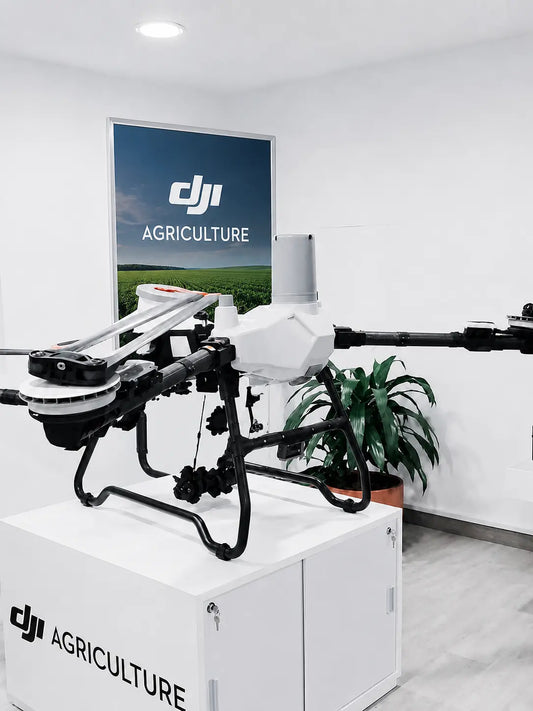

DJI Agras T55 Spreading System: 80-Liter Tank, 55 kg Payload, Feeders, and Materials
Share
DJI Agras T55: One Aircraft, One Full Bag, a Longer Working Season
The DJI Agras T55 spreading system changes the aircraft from a liquid applicator into a high-capacity granular-material platform. With the DS80L installed, the T55 carries an 80 L tank and a published 55 kg operating payload, meters material through a screw feeder, accelerates it from a centrifugal disc, and produces a published effective spreading width of 3–10 m. DJI also lists a maximum discharge rate of 400 kg/min measured with compound fertilizer.
Those specifications are impressive, but they are easy to misunderstand. Eighty liters is a volume limit. Fifty-five kilograms is a weight limit. Four hundred kilograms per minute is a maximum system discharge figure under a stated test condition. Three to ten meters is an effective-width range, not a promise that every seed, pellet, or fertilizer will form the same ten-meter pattern. A professional spreading plan treats all four numbers separately.
The DS80L becomes especially useful because material compatibility is not reduced to one universal opening. DJI publishes five screw-feeder choices spanning supported granules from approximately 0.5 to 10 mm. Standard feeder options address broad fertilizer, wheat, feed, and rice scenarios. Optional feeders extend control toward particular larger, smaller, or narrow particle ranges, including rapeseed, certain granular crop inputs, and small aquaculture feeds. The correct feeder matches particle size, material behavior, target rate, and required uniformity.
This article explains that matching process in detail. It covers bulk density, fill weight, discharge math, field rate, swath verification, fertilizer, seed, rice, cover crops, feed, templates, weighing feedback, calibration, route planning, battery and refill tempo, maintenance, corrosion, abrasion, bridging, blockages, pattern problems, parts, and model comparisons. It is designed to help farmers and custom applicators understand not merely what the T55 spreader can hold, but how to turn the complete system into repeatable field output.
Ares Acres supports agricultural drone operators with complete aircraft, genuine DJI Agras parts, spreading hardware, batteries, field power, and practical setup support. Operators can review the DJI Agras T55 Premium Set, compare other DJI Agras drones, browse DJI Agras parts, explore DJI accessories, or contact Ares Acres to match feeders, batteries, positioning, transport, and initial spares to the materials they intend to spread.
Prefer to watch first? The video above introduces the T55’s easy payload conversion, 80 L spreading tank, full-bag fertilizer concept, operation templates, 400 kg/min maximum discharge, five feeder choices, 0.5–10 mm material range, payload indication, automated planning, radar and vision, battery cooling, and one-pilot design. The guide below separates each claim into the hardware, material, settings, verification, and ground workflow that make it useful.
Quick Answer: What Can the DJI Agras T55 DS80L Spreading System Do?
The DJI Agras T55 DS80L spreading system has an 80 L tank and a published operating payload of 55 kg. It uses a screw feeder to meter material onto a centrifugal disc, which distributes supported granules across a published effective width of 3–10 m. DJI publishes a maximum discharge rate of 400 kg/min measured with compound fertilizer.
Five feeder types cover different supported particle ranges. The standard extra-large feeder covers approximately 0.5–10 mm materials such as fertilizer, wheat, and feed, while the standard medium feeder is specified for 4–6 mm materials such as rice. Optional large, small-and-medium, and small feeders target narrower ranges and applications. Feeder choice should follow the exact material’s size distribution, shape, bulk density, moisture, flow behavior, target field rate, and the official setup guidance.
In practical terms, the DS80L can handle fertilizer, seed, and certain supported feeds from one aircraft, but every material needs its own verified template and pattern. “Calibration-free” describes DJI’s template and weighing automation; it does not mean an operator should skip weighing, pattern checks, or material-specific validation.
What You Will Learn
This guide explains:
- the complete published DS80L specification set;
- why 80 L and 55 kg are two separate loading limits;
- how bulk density determines whether a load is volume-limited or weight-limited;
- how the screw feeder and centrifugal disc perform different jobs;
- what the 400 kg/min maximum means—and what it does not mean;
- how each of the five feeder choices maps to supported particle ranges;
- why particle diameter alone cannot predict material behavior;
- how to calculate required discharge from field rate, speed, and effective width;
- how to estimate area per load and refill frequency;
- how fertilizer, wheat, rice, cover-crop seed, rapeseed, granular crop inputs, and aquaculture feeds differ;
- how to build and verify operation templates;
- how real-time weighing and payload indication support traceability;
- how to test a spreading pattern and choose route spacing;
- how wind, terrain, crop surface, and route direction affect distribution;
- how to set up a high-tempo loading, battery, cooling, and charging station;
- how to prevent bridging, blockage, segregation, corrosion, and abnormal wear;
- how to inspect, clean, maintain, and transport the DS80L;
- which field spares protect commercial uptime;
- how the T55 spreader compares with the T50, T70P, and T100; and
- how Ares Acres helps configure a complete T55 spreading operation.
1. The DS80L Is a Metering and Distribution System
The most accurate way to understand the DS80L is as two machines connected in sequence. The screw feeder meters material out of the tank at a controlled mass rate. The centrifugal disc receives that material and throws it outward to create a distribution pattern. The feeder primarily controls quantity; the disc primarily controls placement.
If the feeder delivers the correct kilograms per minute but the disc is damaged, contaminated, or set incorrectly, total rate may be accurate while the field pattern is poor. If the disc creates a broad, symmetrical pattern but the feeder bridges or slips, the width may look correct while the application rate is low. The aircraft therefore needs both discharge verification and pattern verification.
Material properties connect the two stages. Large, dense, round granules may move through an auger and leave the disc differently from small, light, irregular seed. Dust can behave differently from the main particles. Moist material may bridge. Fragile material may break. A blend can segregate, causing the early and late portions of a load to differ.
This is why the T55 provides feeder choices instead of one opening marketed as universal. A feeder can be physically capable of moving a particle but still be the wrong tool for accurate low-rate control, material integrity, or pattern uniformity. Correct configuration begins with a sample of the exact lot to be used—not only the product name printed on a bag.
2. DJI Agras T55 DS80L Specifications at a Glance
| Specification | Published value | Operational meaning |
|---|---|---|
| System name | DS80L | T55-specific complete spreading assembly |
| Tank volume | 80 L | Maximum nominal internal material volume |
| Operating payload | 55 kg | Maximum published material weight for spreading operation, subject to current recommendations |
| Metering structure | Screw feeder | Controls material discharge toward the disc |
| Distribution structure | Centrifugal disc | Accelerates material outward to form the pattern |
| Maximum discharge rate | 400 kg/min with compound fertilizer | Test-condition system ceiling, not a universal field rate |
| Effective spreading width | 3–10 m | Material- and setting-dependent planning range that must be verified |
| Public feeder range | 0.5–10 mm across feeder choices | Supported span across multiple augers, not one claim for every material and rate |
| Standard feeders | Extra-large and medium | Broad fertilizer/feed/wheat and rice-oriented starting configurations |
| Optional feeders | Large, small-and-medium, small | Narrower ranges for selected large or fine materials |
| Maximum spreading takeoff weight with DB1050 | 104 kg | Complete aircraft limit in that published configuration |
| Maximum spreading takeoff weight with DB1580 | 108 kg | Complete aircraft limit with the endurance battery configuration |
The official DJI Agras T55 specifications provide these published values. The official T55 FAQ adds two important compatibility points: the complete T55 spreader is different from and not interchangeable with T100, T70P, or T25P spreaders, while T55 screw feeders are compatible with T70P and T100.
3. Understanding the 80-Liter Tank
The DS80L tank holds 80 L by volume. That volume is particularly valuable for low-density materials because a small tank can become full before an aircraft reaches its allowable payload weight. Grass seed, some cover-crop seeds, and certain feeds can occupy substantial space per kilogram.
Tank volume alone does not reveal workload. An 80 L hopper filled with material having a bulk density of 0.30 kg/L contains only about 24 kg. A density of 0.50 kg/L produces about 40 kg. A density of 0.6875 kg/L produces 55 kg exactly. Anything denser than approximately 0.6875 kg/L reaches the 55 kg payload limit before the tank reaches 80 L.
| Bulk density | Weight if the tank contains 80 L | Which limit is reached first? |
|---|---|---|
| 0.25 kg/L | 20 kg | Volume |
| 0.30 kg/L | 24 kg | Volume |
| 0.40 kg/L | 32 kg | Volume |
| 0.50 kg/L | 40 kg | Volume |
| 0.60 kg/L | 48 kg | Volume |
| 0.6875 kg/L | 55 kg | Volume and weight together |
| 0.80 kg/L | 64 kg at 80 L | Weight; load only about 68.75 L for 55 kg |
| 1.00 kg/L | 80 kg at 80 L | Weight; load only about 55 L for 55 kg |
These figures are planning examples. Actual bulk density should be measured for the material lot and handling state. Settling, vibration, moisture, particle size, and loading method can change how much mass occupies a given volume.
The 80 L tank creates flexibility because it lets the aircraft approach its weight capability with lighter products. It does not authorize filling every material to the brim. The correct load is the lower of the tank-volume limit, material-payload limit, current application recommendation, and complete aircraft limit for the battery and conditions.
4. The 55 kg Operating Payload
DJI publishes a 55 kg operating payload for DS80L spreading. This is the supported material load, not the total aircraft weight and not a statement that every 80 L fill weighs 55 kg. It should also be distinguished from maximum spreading takeoff weight, which includes aircraft, battery, installed system, and material.
The payload number enables the “full bag” operating concept for commonly packaged fertilizer where the bag mass fits the load. The actual package and material still need to be verified. A nominal bag can differ by market, product, or moisture, and a torn or partially used bag is not a measured load.
Use a known scale or the system’s weighing feedback to confirm material mass. Record the amount placed in the tank, the amount the aircraft reports, the planned rate, the area covered, and the remaining amount. These values form a closed mass balance. When they agree, the operation is traceable. When they do not, the discrepancy points toward loading, template, discharge, route, or weighing issues.
Payload discipline also protects aircraft performance. Higher mass changes thrust demand, acceleration, deceleration, turns, climbing, battery use, and the margin available when wind or terrain changes. A weight that fits physically inside the tank may still be inappropriate if it exceeds the current recommended load.
5. Bulk Density Determines the Real Load
Bulk density is the mass of loose material divided by the volume it occupies, including air spaces between particles. It differs from the density of the solid substance itself. Two granules made from similar chemistry can have different bulk density because of size, shape, porosity, coating, and packing.
The planning relationship is:
Material mass (kg) = loaded volume (L) × bulk density (kg/L)
To find the volume that reaches the 55 kg payload:
Volume at payload limit (L) = 55 kg ÷ bulk density (kg/L)
If a fertilizer measures 0.90 kg/L, approximately 61.1 L equals 55 kg. Filling the complete 80 L volume would theoretically produce 72 kg and exceed the payload. If a seed blend measures 0.35 kg/L, the full 80 L tank contains only 28 kg; the operation is volume-limited.
Measure bulk density with the same handling approach used in the field. Pouring freely, vibrating, compressing, or allowing material to settle can produce different results. Keep the method consistent and label the value with the exact product and lot. A copied number from a generic chart is less useful than a simple repeatable measurement of the material actually being loaded.
6. The 400 kg/min Maximum Discharge Rate
DJI publishes a maximum DS80L discharge rate of 400 kg/min measured with compound fertilizer. This is a capacity figure for the metering system under a particular material condition. It is not a recommended field application rate and does not mean the aircraft carries 400 kg.
At the 55 kg operating payload, a purely theoretical 400 kg/min discharge would empty the load in:
55 ÷ 400 = 0.1375 minutes, or 8.25 seconds.
That calculation is useful precisely because it shows how different maximum discharge is from normal field use. A fertilizer program might require tens or hundreds of kilograms per hectare across a multi-meter swath while the aircraft is moving. Required flow is calculated from rate, speed, and width and may sit far below 400 kg/min.
The large ceiling creates headroom for dense, high-rate materials and brief commanded peaks. Actual maximum can vary with feeder, particle behavior, moisture, wear, battery state, settings, and environmental conditions. The phrase “400 kg/min” should always retain DJI’s compound-fertilizer test qualification.
7. Calculating Required Spreading Flow
The broadcast spreading relationship mirrors liquid application math:
Application rate (kg/ha) = 600 × discharge (kg/min) ÷ [speed (km/h) × effective width (m)]
Rearranged:
Required discharge (kg/min) = rate (kg/ha) × speed (km/h) × width (m) ÷ 600
Examples:
- 50 kg/ha at 18 km/h and 8 m requires 12 kg/min.
- 100 kg/ha at 18 km/h and 8 m requires 24 kg/min.
- 200 kg/ha at 15 km/h and 7 m requires 35 kg/min.
- 300 kg/ha at 12 km/h and 6 m requires 36 kg/min.
| Target rate | Speed | Verified width | Calculated discharge |
|---|---|---|---|
| 10 kg/ha | 18 km/h | 8 m | 2.4 kg/min |
| 25 kg/ha | 18 km/h | 8 m | 6.0 kg/min |
| 50 kg/ha | 18 km/h | 8 m | 12.0 kg/min |
| 100 kg/ha | 18 km/h | 8 m | 24.0 kg/min |
| 150 kg/ha | 16 km/h | 7 m | 28.0 kg/min |
| 200 kg/ha | 15 km/h | 7 m | 35.0 kg/min |
| 300 kg/ha | 12 km/h | 6 m | 36.0 kg/min |
| 500 kg/ha | 10 km/h | 6 m | 50.0 kg/min |
These are mathematical illustrations, not material recommendations. They demonstrate that field rates can be well below the 400 kg/min hardware maximum. The chosen feeder must also meter accurately at the calculated low or high point; capacity alone does not prove control quality across the entire range.
8. Estimating Area per Load
When the aircraft is weight-limited at 55 kg:
Theoretical area per load (ha) = 55 kg ÷ target rate (kg/ha)
| Target application rate | Theoretical area from 55 kg | Approximate acres |
|---|---|---|
| 10 kg/ha | 5.50 ha | 13.59 acres |
| 25 kg/ha | 2.20 ha | 5.44 acres |
| 50 kg/ha | 1.10 ha | 2.72 acres |
| 75 kg/ha | 0.73 ha | 1.81 acres |
| 100 kg/ha | 0.55 ha | 1.36 acres |
| 150 kg/ha | 0.37 ha | 0.91 acres |
| 200 kg/ha | 0.275 ha | 0.68 acres |
| 300 kg/ha | 0.183 ha | 0.45 acres |
If a low-density material fills 80 L at only 30 kg, use 30 kg—not 55 kg—in the calculation. A 25 kg/ha seed program would then cover 1.2 ha per volume-limited load.
Actual area is affected by residual material, boundary treatment, overlap, route transitions, intentional reserve, and any section that is skipped or revisited. Compare predicted area with the aircraft’s recorded area and actual mass consumption after each load.
Area-per-load math helps position the truck or trailer. If one load covers only a portion of a distant field, the return path can consume meaningful time and energy. Moving the refill point, splitting the route, or staging material closer may improve output more than increasing flight speed.
9. Effective Spreading Width: 3–10 m
DJI publishes an effective spreading width of 3–10 m. The actual width depends heavily on material. A dense, round, consistent granule can receive and retain more energy from the disc than a light, irregular, fluffy, fragile, or aerodynamic seed. Two materials run at the same disc setting can land very differently.
Aircraft height and disc speed also affect pattern reach. Higher flight or faster disc rotation can widen a pattern, but width alone does not guarantee uniformity. A very broad pattern with weak shoulders may require overlap that reduces the true route spacing. Wind can shift light material strongly even when dense fertilizer appears stable.
Effective width means the planned distance between adjacent routes that produces an acceptable combined distribution. It is established through a pattern test, not by selecting the largest published number. Record material, feeder, gate or control configuration, disc setting, height, speed, wind, and the resulting route spacing.
The width should be rechecked when the material lot, moisture, coating, seed treatment, blend, or weather changes. A 10 m fertilizer template should not be assumed to deliver a 10 m grass-seed pattern.
10. How the Screw Feeder Controls Material
The screw feeder—or auger—moves material by rotating a helical element inside a defined passage. Rotation rate and geometry determine how much material is transported. A larger flight or opening can move more volume per revolution; a smaller or more controlled geometry can improve low-rate resolution for fine material.
The auger must stay filled consistently. If material bridges above it, the feeder can rotate while receiving little or no material. If particles flood irregularly, discharge can pulse. If material is too large, wet, sticky, fibrous, fragile, or outside the supported range, it can jam, smear, break, or wear the mechanism.
The feeder is therefore both a capacity component and a precision component. Selecting the extra-large feeder only because it accepts a wide particle range may not give the best low-rate control for a fine product. Selecting a small feeder for a large irregular product can create restriction. DJI’s feeder matrix provides the starting point; measured discharge confirms the match.
T55 feeders are individually useful assets because DJI states they are compatible with T70P and T100. That shared fit does not make the complete spreaders interchangeable. Feeder commonality can simplify a multi-model parts shelf, while each aircraft still needs its correct spreading assembly.
11. The Centrifugal Disc Creates the Pattern
After the feeder meters material, it falls onto the rotating disc. Vanes and disc motion accelerate particles outward. Disc speed, drop point, vane condition, particle mass, shape, bounce, friction, and aircraft airflow influence the final pattern.
Wear can change distribution gradually. Abrasive fertilizer may round edges, score surfaces, or change how particles leave the disc. Buildup can alter vane geometry. Damage or imbalance can create vibration. A disc can continue rotating while producing a pattern different from its original calibration.
DJI’s FAQ states that the T55 can discharge material normally after the spreader disc is removed. That confirms the feeder and disc are separate functional stages. Discharge without the disc may be useful for controlled checking or service procedures described by DJI, but it does not create a normal broadcast pattern.
Pattern testing should examine left-right balance, center concentration, shoulders, and the combined overlap between passes. Total kilograms discharged are only half the evidence.
12. Feeder Selection Overview
DJI’s public T55 specification groups five feeder choices as follows:
| Feeder | Status | Published particle range | Example material categories in DJI specification |
|---|---|---|---|
| Extra-large auger | Standard | 0.5–10 mm | Fertilizer, wheat, feed, and other supported granules |
| Medium auger | Standard | 4–6 mm | Rice |
| Large auger | Optional | 4–10 mm | Rice, fertilizer |
| Small-and-medium auger | Optional | 0.5–2 mm | Crayfish and prawn feed |
| Small auger | Optional | 0.5–4 mm | Rapeseed, granular herbicides, granular insecticides |
The size ranges overlap because particle diameter is not the only selection variable. The same nominal size can differ in density, shape, surface, fragility, dust, moisture response, target rate, and tendency to bridge. The feeder choice is a material-and-rate decision, not simply a pass/fail screen.
The standard set provides broad coverage, while optional feeders create better alignment for particular products. Buyers should identify their actual seasonal material list before finalizing the package. Purchasing the aircraft first and discovering a missing feeder during the application window is avoidable.
13. Extra-Large Auger: Broad 0.5–10 mm Coverage
The standard extra-large auger covers the widest published range, approximately 0.5–10 mm, with examples including fertilizer, wheat, and feed. It is the natural high-capacity starting point for many common granular jobs.
Wide compatibility does not mean one template works across that range. A 1 mm dense pellet, 5 mm wheat kernel, and 9 mm irregular fertilizer granule can produce different mass per revolution and different disc patterns. Each product needs a named template and verification.
At low application rates, confirm that the extra-large feeder can meter smoothly rather than cycling between too much and too little material. At high rates, confirm that the tank feeds the auger without bridging and that the disc produces an acceptable pattern. Listen for abnormal impact or grinding that could indicate oversize material or contamination.
Because this feeder is shared with T70P and T100, a fleet may hold common spares. Preserve feeder identity and wear history so a heavily used unit is not moved between aircraft without inspection and recalibration.
14. Medium Auger: The Standard Rice-Oriented Option
DJI lists the standard medium auger for 4–6 mm granules such as rice. A narrower range helps align feeder geometry with a relatively defined particle class.
Rice still varies by variety, moisture, treatment, degree of pre-germination, broken-kernel fraction, and handling. DJI’s broader rice-spreading guidance notes that pre-germinated seed with long sprouts can block spreading systems; any germinated material should follow the exact current guidance for the system and seed state.
Before a major seeding job, inspect a representative sample. Measure size and bulk density, examine broken material and dust, check moisture and surface tack, and run a controlled discharge and pattern test. If seed damage matters, compare material before and after the feeder and disc.
A rice template should record feeder, material lot, rate, disc setting, height, speed, width, route spacing, field condition, and actual delivered mass. Treat a new variety or treatment as a new material until evidence shows the prior template remains valid.
15. Large Auger: Optional 4–10 mm Capability
The optional large auger covers approximately 4–10 mm and is associated with rice and fertilizer in DJI’s specification. It can be useful when a larger-particle product or desired discharge behavior sits more naturally between the broad extra-large and medium configurations.
Selection should be based on output stability and material integrity. If two feeders can physically pass the material, compare their low-rate control, high-rate capacity, incidence of bridging, particle damage, discharge consistency, and pattern.
An optional feeder earns its place when it expands the jobs the aircraft can complete or makes an existing job more repeatable. It should be included in training and the parts plan. Operators need to know how to identify, install, inspect, clean, store, and select it in the software workflow.
16. Small-and-Medium Auger: Fine 0.5–2 mm Feeds
DJI lists an optional small-and-medium auger for approximately 0.5–2 mm pellets, with crayfish and prawn feed as examples. Fine aquaculture feed can be light, dusty, moisture-sensitive, and vulnerable to wind.
Low-rate resolution and consistent feeding are central. A broad feeder may move too much material per control increment, while a finer geometry can improve modulation. Pattern testing over representative conditions remains necessary because a light pellet may not travel like fertilizer even at the same disc speed.
Moisture control is especially important around water. Open bags, hopper surfaces, and residual feed can absorb humidity or splash, changing flow behavior. Keep material dry, minimize exposure time, clean residue, and do not store damp feed inside the system.
Aquaculture routes also require careful edge control. The intended water area, banks, equipment, people, and adjacent land should be represented accurately so material is distributed where it is useful rather than lost outside the target.
17. Small Auger: 0.5–4 mm Fine Granules
The optional small auger covers approximately 0.5–4 mm and is associated in DJI’s specification with rapeseed and certain granular herbicide or insecticide products. Its narrower delivery can support finer materials and lower-rate work.
Fine seed can segregate from dust or larger seed in a blend. Granular crop products can have specific handling, rate, placement, and cleanup requirements. Compatibility with particle size is only the mechanical starting point; the product’s current directions and intended aerial-use method must also support the job.
At low rates, small absolute errors become large percentage errors. If a target is 5 kg/ha, a 1 kg/ha error is 20%. Verify scale resolution, template behavior, feeder consistency, width, and residual mass carefully.
Clean the small feeder thoroughly because fine material can lodge in corners and later contaminate a different seed or product. Store it dry and labeled so the correct part returns to the correct template.
18. Particle Size Is Only the First Compatibility Test
A nominal diameter does not describe shape. Round prills, elongated seed, flat flakes, angular granules, fibrous pellets, coated kernels, and broken particles interact differently with the auger and disc. A screen measurement can say “5 mm” while the material’s length, thickness, or irregularity tells a more complex story.
Other properties include:
- bulk density and how it changes with settling;
- angle of repose and tendency to bridge;
- surface friction or tack;
- moisture absorption;
- particle strength and breakage;
- dust fraction;
- static behavior;
- blend segregation;
- consistency from bag to bag; and
- sensitivity to impact from the disc.
Evaluate the exact lot. Run enough material to expose bridging, not only a handful. Weigh discharge at several commands. Inspect for damage and dust. Test the full pattern. If behavior changes as the hopper empties, record that too.
The DS80L’s five feeder choices give a wide mechanical envelope. Material testing chooses the correct operating point inside it.
19. “Calibration-Free” Still Requires Quality Control
DJI presents the T55 spreading workflow as calibration-free through stored operation templates and automated system feedback. The practical benefit is that an operator can call up a known material configuration and start quickly instead of repeating a complete manual calibration ritual before every load.
The phrase should not be interpreted as “measurement-free.” A template was built from assumptions or prior data. Material lots change. Moisture changes. Feeders and discs wear. Parts are cleaned and reinstalled. Firmware changes. A stored relationship can drift from actual kilograms delivered.
A strong workflow uses the template as a baseline, confirms the selected feeder and material, weighs a test or compares a known load with actual consumption, checks the pattern, and records the result. Once confirmed, the template accelerates production while preserving evidence.
If actual output differs, update or rebuild the material-specific configuration according to current DJI procedures. Do not compensate informally by changing target rate until the screen number produces the desired bag count. That destroys traceability and can hide a mechanical problem.
20. Building a Material Template
A useful template should have a name that identifies the material and version, not simply “fertilizer” or “seed.” Include product, grade or variety, particle range, lot when important, feeder, bulk density, target rate, disc setting, verified width, speed, height, route spacing, and date.
Begin with clean hardware. Install and confirm the feeder. Load a known mass of representative material. Follow the current DJI template procedure. Run a controlled output, weigh the discharged amount, and repeat enough times to understand consistency. Then conduct a full pattern test at the intended flight condition.
Save only after the rate and distribution are both acceptable. A feeder can pass a scale test but create poor placement; a good-looking pattern can still deliver the wrong total mass.
Keep notes outside the controller when the template name cannot hold all context. A simple material sheet or digital record can show why a setting exists and when it should be retested. This turns templates into institutional knowledge rather than unexplained presets.
21. Real-Time Weighing and Mass Balance
The T55 spreading workflow uses weighing feedback to help the aircraft understand payload and discharge. That information can support automatic rate control, remaining-material estimates, refill timing, and operation records. It is most valuable when compared with an independently known load.
Mass balance is straightforward:
Material loaded = material discharged + material remaining + any measured loss
If 50 kg is loaded and 3 kg remains, approximately 47 kg should be reflected in the completed work, allowing for measurement accuracy and controlled handling loss. If the system reports a materially different number, review the initial weight, feeder template, scale state, route, residual material, spillage, and data record.
Weighing feedback should be checked after installation, cleaning, transport, impacts, or unusual readings. Material lodged on a surface or pressing against part of the tank can affect behavior. The aircraft should be positioned and prepared according to DJI’s current procedure when weight is assessed.
The goal is not to distrust automation. It is to close the loop. A known bag, a system reading, a recorded area, and a measured remainder should tell one consistent story.
22. How to Conduct a Spreading Pattern Test
A pattern test measures where material lands across and along the route. Use collection trays, pans, sheets, or another appropriate method placed across a line wider than the expected swath. Keep container area consistent so collected mass can be compared directly.
Load representative material, select the intended feeder and template, and fly at production height, speed, disc setting, and route direction. One stationary disc test can reveal mechanical asymmetry, but a moving flight is needed to show the combined effect of aircraft airflow and forward speed.
Collect and weigh each position. Plot the distribution from left to right. Look for a centered pattern, left-right balance, shoulder behavior, isolated gaps, and excessive concentration. Then model or test adjacent passes at the planned spacing. Effective width is the spacing that gives an acceptable combined pattern, not simply the distance reached by the farthest particle.
Repeat when material, feeder, disc, height, speed, or conditions change. Fine lightweight seed may require more test points because small wind shifts can move it substantially. Save the results with the template so width is supported by evidence.
23. Fertilizer Spreading
Granular fertilizer is the material most closely associated with the T55’s 400 kg/min maximum because DJI states that the figure was measured with compound fertilizer. Fertilizer can also be dense, abrasive, hygroscopic, dusty, and corrosive, making it an important test of loading, wear, and cleaning discipline.
Measure bulk density before assuming an 80 L fill. A dense fertilizer may reach 55 kg with far less than a full tank. Inspect granule size distribution, broken material, fines, caking, and moisture. Select the feeder that supports both particle range and required flow.
High application rates may be within the DS80L’s capacity while still creating frequent refill cycles. At 200 kg/ha, a 55 kg load contains only 0.275 theoretical hectare of material. Position the supply close enough that return distance does not dominate the work. A bag-handling and loading method should place material into the hopper without damaging the tank, contaminating the aircraft, or forcing the operator into an awkward lift.
Clean fertilizer residue promptly. Material left in the auger, disc, tank corners, fasteners, or airframe can attract moisture and accelerate corrosion. Inspect high-contact surfaces for abrasion and document changes in discharge or pattern.
24. Wheat and Cereal Seed
DJI lists wheat among the materials supported by the standard extra-large auger range. Seed is not simply light fertilizer. Kernel shape, length, treatment, moisture, broken fraction, and fragility influence feeding and distribution.
Measure seed damage when germination quality matters. Compare a sample from the bag with material passed through the feeder and disc. If cracking or coating loss is significant, review feeder, disc speed, drop behavior, and handling. A wide pattern is not useful if the process damages the seed that creates it.
Seed rate can be substantially lower than fertilizer rate, making low-flow consistency important. A feeder that delivers a high rate smoothly may pulse at a very low command. Weigh multiple short runs and compare variability rather than trusting one average.
Wheat fields can provide long efficient routes, but wind may shift seed differently from dense prills. Establish effective width with the exact variety and treatment. Record germination and emergence outcomes by route and field so operational data connects to agronomic result.
25. Cover-Crop and Mixed Seed Applications
Cover crops can extend the T55’s work into seeding windows, but seed blends are among the most challenging spreading materials. Components can differ in size, density, shape, and surface. Vibration during transport and flight can separate the blend, causing one component to concentrate early or late in the load.
Before using a blend, inspect the size ratio and bulk-density difference. Conduct a segregation test: load and move the material as it would be handled in the field, then sample from different depths or discharge stages. If composition changes materially, one template cannot correct the blend’s physical separation.
A single feeder and disc setting may also distribute components at different widths. Heavy seed may travel farther than light seed, producing a changing species ratio across the swath. Collection trays should be evaluated not only for total mass but, where practical, for component composition.
The DS80L’s 80 L volume is valuable for low-density cover-crop seed. The operation may be volume-limited well below 55 kg, so area-per-load calculations should use actual weighed mass. A successful cover-crop program depends on uniform stand establishment, not merely total pounds flown.
26. Rice Seeding
DJI lists the standard medium feeder for 4–6 mm materials such as rice and also associates the optional large feeder with rice and fertilizer. The correct choice depends on the exact rice, state, target rate, and measured behavior.
Rice fields often provide clear blocks but include levees, banks, water, pumps, poles, lines, birds, and narrow access points. Map internal boundaries and establish a safe refill location that does not put loose seed, batteries, or people near water or the flight path.
Seed condition is critical. Moisture or germination can make kernels tacky and increase blockage risk. DJI’s published rice guidance for agricultural drones emphasizes controlling pre-germinated sprout length for applicable systems. Follow the current T55 spreading manual and seed procedure rather than assuming guidance for another model transfers without change.
Pattern tests should reflect the actual height and wind over the field. Water surfaces can make missed areas hard to see after the pass, so route and mass records become important. Compare expected seed mass with completed area and remaining hopper weight on every load.
27. Rapeseed and Other Fine Seed
The optional small feeder is specified for 0.5–4 mm materials such as rapeseed. Fine seed can require low application rates, making metering resolution and pattern containment more important than maximum discharge.
At 5 kg/ha, a full 55 kg payload would theoretically cover 11 ha, although an 80 L tank may reach its volume limit first depending on bulk density. The aircraft may fly longer per load, so battery endurance, route length, and wind changes become more relevant than refill speed.
Fine seed is strongly affected by air movement. A pattern established in calm conditions can narrow, widen, or shift when wind changes. Use conservative width, frequent verification, and route direction chosen with measured conditions. Inspect dust and fines because they may not follow the main seed pattern.
Clean the feeder and tank carefully between varieties or species. A small amount of residual seed can create unwanted volunteers in the next field or distort the next load’s composition.
28. Granular Herbicide and Insecticide Products
DJI includes granular herbicides and granular insecticides among example materials for the optional small auger’s 0.5–4 mm range. Mechanical compatibility does not establish that every product is appropriate for aerial application, every crop, or every region. The exact current product directions and intended use must support the operation.
When a supported product is used, rate accuracy can be critical because the application may be comparatively low and placement-specific. Verify the feeder at the intended low-flow range, confirm the effective width with the actual granule, and use a closed mass balance.
Cross-contamination control deserves special attention. Dedicate or thoroughly clean components as required. Inspect tank corners, auger passages, disc vanes, fasteners, vehicle surfaces, loading tools, and collection equipment. Label storage so a feeder carrying residue does not return to seed or feed work.
Maintain clear records linking product, lot, field, area, template, loaded mass, delivered mass, date, and operator. Automation makes accurate data easier to collect; disciplined identification makes it useful.
29. Aquaculture and Shrimp-Feed Distribution
The optional small-and-medium feeder is listed for 0.5–2 mm crayfish and prawn feed, while the broad extra-large feeder range includes supported feeds more generally. Aquaculture use can extend the aircraft into a recurring material-distribution role outside conventional crop-input windows.
Feed may be light, fragile, dusty, oily, or moisture-sensitive. Evaluate pellet integrity after the auger and disc. Broken feed can change nutrition delivery, water behavior, and pattern. Select disc settings that achieve the needed reach without unnecessary impact.
Ponds create precise targets. Material lost onto banks or beyond water boundaries is wasted; material concentrated near one edge can create uneven feeding. Pattern tests should use the same flight height and environmental exposure as the pond route. Wind across open water can shift light feed significantly.
Keep the DS80L dry. Do not allow splash, rain, condensation, or humid storage to soften pellets inside the feeder. Empty and clean the system after work so residual feed does not absorb moisture, spoil, attract pests, or contaminate the next load.
30. Handling Blends and Preventing Segregation
A blend can separate during truck transport, bag handling, hopper filling, aircraft vibration, and auger movement. Differences in size, density, shape, and surface cause particles to move relative to one another. The result can be a tank that begins with one composition and ends with another.
Reduce unnecessary drops and vibration. Mix using an appropriate repeatable method. Load consistently. Avoid filling from one concentrated component layer. Where practical, sample the beginning, middle, and end of discharge and compare composition.
The disc can create spatial segregation even if feeder composition remains constant. Denser particles may travel farther, while lighter particles fall near the center. A collection test that weighs only total material can miss this. Separate or count components in representative pans when blend uniformity matters.
Some blends may be mechanically possible but agronomically difficult to distribute uniformly from one system. In that case, separate passes or a different preparation may produce a better result. The DS80L is adaptable, but physics still governs the particles.
31. Moisture, Caking, Bridging, and Dust
Moisture can transform a free-flowing material into one that clumps, smears, bridges, or adheres to the tank and auger. Hygroscopic fertilizer can absorb humidity quickly. Treated seed can become tacky. Feed can soften. A template built with dry product may no longer predict wet behavior.
Bridging occurs when material forms a self-supporting arch above the feeder. The auger may continue turning while flow falls. Do not strike or modify the tank casually to break a bridge. Stop and follow the approved clearing procedure with the aircraft secured and the mechanism unable to move.
Dust can escape the main pattern, contaminate sensors, collect in moving parts, and expose the ground station. Inspect the material’s fines fraction before loading. Manage bags and pouring height to reduce unnecessary dust, and clean radar, vision, cooling, motors, and structure after dusty work.
Store bags under cover and keep the hopper closed as appropriate. If rain, dew, or condensation changes material behavior, re-evaluate rather than increasing feeder command to force output through a developing blockage.
32. Wind and Particle Drift
Particles are generally less evaporation-sensitive than liquid droplets, but they still move in air. Light seed and fine feed can drift substantially. Dense fertilizer prills may retain a more stable trajectory under the same wind. Shape also matters: flat or elongated seed can tumble and slow quickly.
The aircraft’s rotor wash and forward motion create local air movement before ambient wind is considered. Test the complete system at the planned height and speed. A stationary disc pattern near the ground cannot represent a moving aircraft over a crop or pond.
Crosswind shifts the distribution and can make one overlap shoulder too strong while the other becomes weak. Headwind and tailwind change relative motion and may create different forward-back patterns. Record wind direction with route direction so the template has context.
The T55’s aircraft wind-resistance specification does not define the spreading limit for every material. A lightweight seed may become inaccurate well below the aircraft’s ability to remain controlled. Material containment and pattern quality should set the practical threshold.
33. Terrain, Crop Surface, and Release Height
Release height is measured relative to the receiving surface, which may be soil, water, stubble, or a standing canopy. Terrain and crop-height changes alter the true fall distance. More distance gives particles more time to spread and more exposure to wind; less distance can narrow the pattern.
Terrain following and RTK-supported planning help maintain repeatability, but the field model and height reference must be correct. A route developed over bare ground may place the aircraft closer to a mature canopy. A pond bank can rise abruptly relative to the water surface. A terrace can change aircraft attitude and local wind.
Pattern testing should therefore name the reference surface. “Three meters high” is incomplete unless the operator knows three meters above what. Record crop stage or surface condition with the template.
Avoid widening a pattern simply by flying higher without verifying the result. A particle that reaches farther may create weak outer deposition and greater loss. Effective width is the uniform combined width, not the farthest visible bounce.
34. Route Planning for Spreading
The T55 supports recorded-path field planning, automated routes, RTK positioning, and saved obstacle information. These features can create consistent line spacing and reduce setup work when entering a new block.
Record the boundary deliberately. Identify obstacles, exclusions, waterways, roads, neighboring crops, buildings, animals, workers, and loading areas. Review turn placement so material does not continue beyond the target and the aircraft has enough room to stabilize before the next line.
Route direction should consider field shape and wind. The longest line may reduce turns, but a crosswind may make pattern control more difficult. For rows or beds, alignment can affect where seed or fertilizer lands. Select the direction that supports both efficiency and distribution.
When the hopper approaches empty, plan a predictable return. The resume point should not create a gap or double application. Payload feedback and recorded route progress help, but the operator should understand how the system stops and resumes discharge around the transition.
35. Payload Indicator and Refill Timing
The T55’s payload indicator and in-app information help the ground operation anticipate when the aircraft will return. For high-rate fertilizer, loads can be short. For low-rate seed, the aircraft may remain working longer. The next bag or measured batch and a charged battery should be ready at the correct time.
Payload readings also support fault detection. If remaining mass is greater than expected, the feeder may be under-delivering or the route may have skipped an area. If it is lower, review rate, width, speed, loading, loss, and calibration.
Do not wait for the tank to be visually empty before planning the return. Residual material can remain in corners or above the feeder. A controlled reserve can protect the route from running dry mid-pass and create a consistent point for mass reconciliation.
Use the same turnaround sequence every load: secure aircraft, confirm route status, assess remaining mass, inspect feeder and disc, exchange battery if planned, load known material, verify weight and template, clear the pad, and resume.
36. Designing the Loading Station
The loading station should minimize lifting, dust, confusion, and aircraft idle time. Stage material by field and template. Keep opened bags protected. Use a measured loading method or known package mass. Position the aircraft so the operator can access the hopper without standing under unsecured parts or contacting sprinklers, sensors, or propellers.
Separate new material, partial bags, recovered test material, residue, and waste. Do not return contaminated collection-pan material to a clean hopper without a deliberate decision. Label feeders and tools. Keep batteries and chargers away from dust and granular spills.
For a 55 kg operating payload, material handling is a significant physical task. Mechanical assistance, smaller measured batches, or a second trained person can improve safety and cycle time. “One pilot” does not require one person to make every high-frequency lift manually.
Use shade and covers where appropriate, but preserve airflow for batteries and charging equipment. Keep the takeoff path clear of bags, pallets, straps, scoops, scales, and loose plastic that rotor wash can move.
37. Battery and Charging Strategy for Spreading
Spreading energy demand depends on aircraft mass, route, wind, elevation, speed, terrain, and time aloft. A high-rate fertilizer load may empty quickly, while low-rate seed can keep the aircraft airborne longer. Battery choice should follow the actual load cycle.
The 20 Ah DB1050 is the T55’s lighter standard battery. The 30 Ah DB1580 is the endurance option and weighs 3.4 kg more. DJI lists maximum spreading takeoff weights of 104 kg with DB1050 and 108 kg with DB1580, but the current recommended load in the app should control.
If the hopper empties before the standard battery approaches its landing reserve, the larger pack may not improve throughput. If a low-density seed load covers a large area with long passes or transit, DB1580 endurance may reduce battery changes. Measure both scenarios rather than assuming.
The onboard heat sink, ground air-cooled heat sink, compatible fast charging, and adequate generator or site power must operate as one rotation. A larger battery can also take more energy to replenish, so charger and pack count belong in the comparison.
38. Radar, Vision, and Obstacle Memory
Spreading routes can cross open fields, orchards, ponds, levees, slopes, fences, trees, poles, and utility corridors. The T55’s millimeter-wave radar, Tri-Vision system, AR display, and obstacle-recording functions provide a current-generation awareness layer around the route.
Smooth obstacle bypassing can help preserve route continuity, but it may alter distribution around the object. A physically successful bypass can still leave a gap or change overlap. Mark and review those zones.
Dust can affect sensor surfaces, and radar response varies with object material, shape, position, rain, fog, and other conditions. Fine wires remain hazards that deserve explicit identification and conservative separation. Clean sensors before flight and after dusty fertilizer or seed work.
Obstacle memory makes repeated fields more informed, not permanently known. Trees grow, equipment moves, lines change, vehicles arrive, and temporary structures appear. Review the field before every operation.
39. Transport and Payload Conversion
The T55 is designed to switch from spraying to spreading without replacing the airframe. Payload conversion should follow the current DJI instructions with the aircraft powered down, secure, clean, and positioned for safe access.
Inspect mounting interfaces, electrical connections, latches, seals, and software recognition after installation. A component that appears physically seated may still need confirmation in the controller. Verify the selected spreading system and feeder before loading material.
For transport, empty and clean the DS80L as appropriate. Loose granules can migrate into the aircraft, vehicle, connectors, and sensors. Protect the feeder and disc from impact. Secure the system without loading thin tank walls or distribution components.
Store optional feeders individually, dry, clean, labeled, and protected from deformation. Keep fasteners and interface parts with the correct assembly. At the next field, perform an installation and free-movement check before loading a full bag.
40. Cleaning the DS80L
Cleaning begins with complete controlled emptying. Remove remaining material according to the approved procedure. DJI notes that material can discharge with the disc removed, demonstrating that the feeder can be checked separately; follow the current manual rather than improvising around a moving auger.
Brush or remove dry residue using methods that do not drive abrasive dust into bearings, motors, electronics, sensors, or cooling passages. Use water only where and as DJI permits, and dry components thoroughly. Fertilizer residue left wet can be more damaging than dry material.
Remove and clean feeders when changing materials or when buildup is present. Inspect the disc, vanes, tank corners, outlet, weighing interfaces, mounts, connectors, and surrounding airframe. Do not install a damp feeder and then seal the system for storage.
Document recurring residue. If one material repeatedly cakes in the same area, improve storage, loading, moisture control, cleaning frequency, or feeder selection rather than treating buildup as unavoidable.
41. Abrasion, Corrosion, and Wear
Fertilizer and seed move across the tank, auger, passages, and disc on every load. Abrasive particles can change clearances and edges. Corrosive residue can attack metal surfaces and connections. Vibration adds cyclic stress to mounts and fasteners.
Wear often appears first as a performance change: greater variability, reduced low-rate control, a different pattern, abnormal sound, increased dust, or material damage. Compare current tests with a new-system baseline. A component does not need to be visibly broken before it affects accuracy.
Inspect auger flights, housings, shaft support, disc vanes, fasteners, mounts, latches, tank surfaces, and electrical connections. Look for scoring, thinning, cracks, deformation, looseness, corrosion, and residue. Replace with the correct supported part and then recalibrate or verify the template.
Maintenance interval should follow workload and material severity. Hundreds of kilograms of clean seed do not create the same wear as hundreds of kilograms of abrasive fertilizer.
42. Troubleshooting Bridging, Blockage, or Pulsing
When discharge falls or pulses, stop and diagnose systematically:
- Confirm the correct template and feeder are selected.
- Verify that material is present and within the supported size range.
- Inspect for moisture, clumps, foreign objects, torn bag material, and oversize particles.
- Look for bridging above the auger.
- Secure and power down the system before approved manual inspection or clearing.
- Inspect feeder rotation, housing, clearances, and connections.
- Check the disc for buildup, free movement, damage, and secure installation.
- Run a controlled weighed test with representative material.
- Repeat the pattern test after correction.
Do not reach into a mechanism that can move or command higher feeder speed to grind through an obstruction. A blockage can damage material, auger, motor, housing, or control components and can release suddenly.
43. Troubleshooting Incorrect Rate or Pattern
If total delivered mass is wrong, compare loaded weight, remaining weight, recorded area, route settings, speed, width, template, feeder, and measured discharge. If total mass is correct but placement is wrong, focus on disc condition, settings, height, wind, route spacing, and material trajectory.
Separate rate from pattern. Narrowing the route can hide weak shoulders but may over-apply the center. Increasing feeder command can compensate for a scale error while making records inaccurate. Adjust the cause, not merely the outcome.
Left-right asymmetry may follow wind, disc damage, buildup, aircraft attitude, or an off-center material drop. Repeat in an opposite direction under controlled conditions to help isolate environment from hardware.
After any repair or major adjustment, return to a known test. Verification closes the troubleshooting process; the absence of a warning does not prove the field pattern is restored.
44. Maintenance Schedule and Field Spares
Every load, observe discharge, payload change, sound, vibration, dust, and pattern. Every day, empty and clean as required, inspect the feeder and disc, examine mounts and connectors, clean aircraft sensors, and record abnormal behavior. At planned intervals, compare weighed discharge and pattern with baseline data and inspect wear surfaces in detail.
A commercial spreading kit can include supported spare feeders for the operation’s materials, feeder wear components, a serviceable disc assembly, correct fasteners, seals, connectors, cleaning tools, dry brushes, collection-test equipment, a reliable scale, protective caps, and the hand tools identified by DJI. Aircraft spares such as propellers and appropriate controller or charging accessories belong in the larger field kit.
Order by verified part number and aircraft fit. The complete T55 spreader is unique even though screw feeders can be shared with T70P and T100. Do not infer compatibility from appearance.
Store clean parts away from fertilizer, moisture, dust, and loose vehicle cargo. A spare feeder packed with residue or missing its correct hardware cannot restore a job quickly.
45. Measuring Real Spreading Productivity
Theoretical area rate is:
Area rate (ha/h) = speed (km/h) × effective width (m) ÷ 10
At 18 km/h and an 8 m verified width, theoretical straight-line capacity is 14.4 ha/h. Real productivity is lower after turns, refill, battery exchange, transit, pattern checks, loading, and interruptions.
Track material loaded, area completed, total flight time, active discharge time, loads, turnaround time, battery turnaround, route distance, residual mass, and rework. Then calculate kilograms per completed hectare and compare with the target. A fast aircraft that produces inconsistent rate is not more productive.
For high-rate fertilizer, loading may be the bottleneck. For light seed, tank volume or battery endurance may be the bottleneck. For small irregular fields, turns and boundary work may dominate. Improvement begins by measuring the actual limiting step rather than assuming the aircraft needs more speed.
46. DJI Agras T55 Versus T50 for Spreading
The T50 carries a published 50 kg spreading payload in a 75 L tank and represents a proven prior-generation workflow. The T55 DS80L increases tank volume to 80 L and operating payload to 55 kg, while publishing a much higher maximum discharge ceiling of 400 kg/min and bringing the aircraft into DJI’s current battery, safety, controller, and multi-role ecosystem.
Five extra kilograms can matter when a common bag size fits the T55 load. Five additional liters can matter with low-density seed. The larger difference may be feeder architecture, flow headroom, templates, weighing feedback, path planning, transport workflow, and the T55’s formal lifting option.
An existing T50 fleet may retain value from owned batteries, chargers, parts, and operating data. A T55 purchase should account for its newer columnar battery interface and the complete power system. Compare annual material types, rates, fields, crew, transport, and support—not only hopper numbers.
47. DJI Agras T55 Versus T70P and T100 for Spreading
The T70P raises spreading payload to 70 kg and tank volume to 100 L. The T100 carries up to 100 kg in a 150 L spreading tank. Both publish the same 400 kg/min compound-fertilizer maximum and 3–10 m effective width class, while reducing refill frequency through larger individual loads.
The T55 remains attractive when transport, solo handling, smaller fields, frequent moves, and a 55 kg full-bag workflow matter more than the largest load. The T100 is built for major throughput where the ground system can feed and power it. The T70P occupies the middle.
DJI states that T55 screw feeders are compatible with T70P and T100, which can simplify a multi-aircraft feeder shelf. The complete T55 spreader is not compatible with the larger models. Confirm every assembly individually.
The correct model is the one whose load size, battery cycle, truck or trailer, labor, material supply, route geometry, and annual utilization form the most efficient complete system.
48. Who Is the T55 Spreading System For?
The DS80L is a strong fit for:
- farms applying granular fertilizer across fields that are wet, steep, soft, or difficult for ground equipment;
- custom applicators adding fertilizer and seeding services to a spray business;
- grain producers spreading wheat, rice, and other supported seed;
- cover-crop operations that value an 80 L tank for lower-density material;
- aquaculture operations distributing supported feed over ponds;
- owner-operators who need an aircraft one person can transport and stage;
- mixed fleets that can use feeder commonality with T70P and T100; and
- businesses seeking spray, spread, and lift revenue from one airframe.
It is less about a single farm size than about workload shape. A small field with high-value timing can justify the aircraft. A large operation with slow loading can underuse it. Define materials, annual tons, rates, field access, travel, weather windows, and support before judging fit.
49. Building a Field-Ready T55 Spreading Package
Confirm the complete package:
- T55 aircraft and DS80L spreading assembly;
- standard extra-large and medium feeders;
- optional large, small-and-medium, or small feeders required by the seasonal material list;
- DB1050 or DB1580 batteries in a quantity matched to measured cycle time;
- approved charging, generator or site power, cables, and cooling;
- RC Plus 2 AG controller and charging plan;
- D-RTK 3 AG and O4 Relay where the field workflow calls for them;
- material scale, collection pans, sample containers, bulk-density equipment, loading tools, covers, and cleanup supplies;
- safe transport restraints and protected feeder storage;
- initial wear parts and verified genuine replacements;
- installation, material-template setup, calibration, pattern testing, operator walkthrough, and support.
The live DJI Agras T55 Premium Set is the starting point. Contact Ares Acres to confirm which payload systems and feeders are included, current battery count, field-power configuration, delivery, setup, price, and availability.
50. DS80L Decision Checklist
Before committing the spreader to a job, answer these questions:
- What exact material and lot will be used?
- What is its measured particle-size range and bulk density?
- Is it dry, free-flowing, clean, and mechanically suitable?
- Which published feeder best matches its size, behavior, and target flow?
- What is the loaded weight at the intended volume?
- What field rate, speed, and verified width determine required discharge?
- What pattern test supports the route spacing?
- Is the template current for this material, feeder, and hardware condition?
- How much area should one actual load cover?
- Where will the aircraft refill, and how long will loading take?
- Does the battery rotation sustain the expected flight cycle?
- Are the route, obstacles, boundaries, wind, terrain, and resume behavior understood?
- Are cleaning, cross-contamination, residue, and storage procedures ready?
- Are the necessary feeders, disc components, spares, scale, and tools present?
- Does the completed mass balance agree with the operation record?
If these questions have clear answers, the DS80L is not simply installed; it is configured as a production system.
DJI Agras T55 Spreading System Frequently Asked Questions
What is the DJI Agras T55 spreading system called?
DJI identifies it as the DS80L spreading system. It is the T55-specific complete hopper, feeder, and centrifugal-disc assembly.
How many liters does the DS80L hold?
The published tank volume is 80 L. Actual material weight depends on bulk density, so a full volume may weigh less or more than the 55 kg operating payload.
How much weight can the T55 carry for spreading?
DJI publishes a 55 kg spreading operating payload. Follow the current in-app recommended load and complete aircraft limits for the installed battery and conditions.
Can the T55 carry one full bag of fertilizer?
It can carry a bag whose actual mass and volume fit within the 55 kg and 80 L limits. Confirm package weight and bulk density rather than assuming every “full bag” is identical.
Does the T55 really spread 400 kg per minute?
DJI publishes 400 kg/min as the maximum discharge measured with compound fertilizer. It is a system-capacity test figure, not a universal field application rate.
How wide can the T55 spread?
DJI publishes an effective width of 3–10 m. Actual route spacing depends on material, feeder, disc setting, height, speed, wind, and the verified combined pattern.
How does the T55 meter material?
A screw feeder controls discharge from the tank. Material then falls onto a centrifugal disc that distributes it across the pattern.
How many feeder types are available?
DJI lists five: standard extra-large and medium augers, plus optional large, small-and-medium, and small augers.
Which feeder covers the widest particle range?
The standard extra-large auger covers approximately 0.5–10 mm and is associated with fertilizer, wheat, feed, and other supported granules.
Which feeder is used for rice?
DJI lists the standard medium auger for 4–6 mm material such as rice and also lists an optional large auger for 4–10 mm rice and fertilizer. Test the exact material.
Which feeder is used for rapeseed?
DJI associates the optional small auger, covering approximately 0.5–4 mm, with rapeseed and selected fine granular products.
Which feeder is used for shrimp or prawn feed?
DJI lists an optional small-and-medium auger for approximately 0.5–2 mm crayfish and prawn feed. Material integrity, moisture, and pattern still need verification.
Can one feeder handle every supported material?
No. Ranges overlap, but target rate, size, shape, density, moisture, fragility, and flow behavior determine the best feeder.
Are T55 feeders compatible with T70P and T100?
DJI states that T55 screw feeders are compatible with T70P and T100. The complete T55 spreading assembly is not compatible with those aircraft.
Is the T55 spreader compatible with the T50?
DJI identifies the T55 spreader as different from T100, T70P, and T25P units; do not infer complete-system compatibility with any other aircraft. Verify exact part fit with DJI or Ares Acres.
Can material discharge if the centrifugal disc is removed?
DJI’s FAQ says the T55 can discharge material normally with the disc removed. This confirms separate feeder operation; normal broadcast spreading still requires the correct disc configuration.
What does calibration-free spreading mean?
It refers to DJI’s saved templates and automatic feedback reducing repeated manual setup. Operators should still verify material, feeder, weight, discharge, pattern, and delivered result.
How do I calculate required discharge?
Use: kg/min = target kg/ha × speed km/h × effective width m ÷ 600. The feeder must be able to meter accurately at the result.
How much area does a 55 kg load cover?
Divide 55 kg by the target rate. At 50 kg/ha it covers 1.1 theoretical ha; at 100 kg/ha, 0.55 ha; at 200 kg/ha, 0.275 ha.
Why does bulk density matter?
Bulk density determines how much an 80 L volume weighs. Material denser than about 0.6875 kg/L reaches 55 kg before the tank is full.
Can the T55 spread fertilizer?
Yes. Fertilizer is a primary published use and the basis of DJI’s maximum-discharge test. Density, granule size, moisture, abrasion, rate, and cleanup still matter.
Can the T55 spread wheat?
Yes. DJI includes wheat among example materials for the standard extra-large feeder range. Verify seed condition, damage, low-rate control, and pattern.
Can the T55 spread cover-crop seed?
It can spread supported seed that matches the feeder and system behavior. Blends need special testing for segregation and different component widths.
Can the T55 spread aquaculture feed?
DJI lists supported feed applications, including fine crayfish and prawn feed with an optional feeder. Protect feed from moisture and verify the pond pattern.
What causes material bridging?
Moisture, caking, irregular particles, excessive fines, poor flow, compaction, or an unsuitable feeder can form an arch above the auger and interrupt supply.
Why is the pattern uneven even when total weight is correct?
Disc wear, buildup, wind, height, off-center feed, material variability, or route spacing can change distribution while the feeder still meters the correct total mass.
How should the DS80L be cleaned?
Empty it fully, remove residue using DJI-approved methods, clean feeder and disc areas, protect electronics and sensors, and dry components before storage or a material change.
What wears fastest in fertilizer work?
High-contact auger and disc surfaces, housings, fasteners, and exposed metal can experience abrasion or corrosion. Actual wear depends on material and workload.
Which battery is best for spreading?
The lighter DB1050 can align with short high-rate loads. The DB1580 can support longer low-rate or high-transit work. Compare actual hopper and battery cycles.
Where can I buy a DJI Agras T55 spreading package?
Ares Acres offers the DJI Agras T55 Premium Set and can confirm the DS80L, included feeders, optional feeders, batteries, power, delivery, setup, and support.
Bottom Line: Why the DJI Agras T55 DS80L Matters
The DS80L matters because it gives the T55 a serious second production identity. An 80 L tank creates useful volume for low-density seed and feed. A 55 kg operating payload fits substantial fertilizer and seed loads. Five feeder choices extend the public particle range from approximately 0.5 to 10 mm. A centrifugal disc supports a 3–10 m published width. A 400 kg/min compound-fertilizer maximum provides extraordinary discharge headroom.
The strongest capability is not any single maximum. It is controlled adaptability. A fertilizer contractor can move dense high-rate material. A grain producer can seed rice or wheat with a verified feeder and template. A cover-crop operator can use the hopper’s volume. An aquaculture business can distribute supported feed. The same airframe can return to spraying or lifting when the spreading window ends.
That adaptability creates value only when the material is understood. Volume and weight must be calculated separately. Particle size must be joined by density, shape, moisture, fragility, and flow behavior. Feeder output and disc pattern must both be tested. Templates must be verified. The loading station must sustain the route. Fertilizer residue must be cleaned before it becomes corrosion. Feeders and wear parts must be available before the season starts.
Ares Acres helps operators build the complete system behind the specification. Review the current DJI Agras T55 Premium Set, compare DJI Agras drones, browse DJI Agras parts and DJI accessories, study the DJI Agriculture blog and tutorial library, or contact Ares Acres to select the DS80L, feeder set, batteries, field power, positioning, transport, testing equipment, and spare-parts package around the materials your business will actually move.
The T55 spreader’s promise is practical: load the right material, through the right feeder, under the right template, into a verified pattern—and turn one adaptable aircraft into finished fertilizer, seeding, and feed work across a longer season.
Internal Resources
- Ares Acres
- DJI Agras T55 Premium Set
- DJI Agras Drones
- DJI Agras Parts
- DJI T100 Parts
- DJI T70 Parts
- DJI T50 Parts
- DJI Accessories
- DJI Agriculture Blog and Tutorials
- DJI Agras T50 Ares Set
- DJI Agras T100 Full Set
- Contact Ares Acres
Official Technical Sources
- DJI Agriculture, DJI Agras T55 product page: https://ag.dji.com/t55
- DJI Agriculture, DJI Agras T55 specifications: https://ag.dji.com/t55/specs
- DJI Agriculture, DJI Agras T55 FAQ: https://ag.dji.com/t55/faq
- DJI Agriculture, DJI Agras T55 downloads and manuals: https://ag.dji.com/t55/downloads
- DJI Agriculture, DJI Agras T55 spreading-system product information: available from the T55 downloads page
- DJI Agriculture, agricultural drone rice spreading and fertilization guide: https://ag.dji.com/newsroom/drone-rice-spreading-guide
- DJI Agriculture, July 1, 2026 global launch announcement: https://www.dji.com/cn/newsroom/news/dji-release-agri-drone-t100st70t55
Publication note: Specifications, feeders, firmware behavior, recommended payload, material compatibility, optional equipment, price, and regional availability can change. Confirm the current spreading-system manual, feeder configuration, aircraft recommendation, and material-specific operating requirements before purchase or flight.