
Which DJI Parts Are Exempt? Motors, Propellers, Batteries, Controllers and FCC Rules Explained
Share
Last reviewed: October 12, 2026. This detailed part-by-part guide uses the FCC's actual terms and distinguishes the October 13 logic-bearing rule from the separate 2025 foreign-produced UAS critical-components Covered List action.
Which DJI parts are exempt from the October 13 FCC rule?
There is no universal legal exemption covering every DJI replacement part. The FCC's rule effective October 13, 2026 defines and regulates certain logic-bearing hardware components in the context of new equipment authorizations. That rule expressly excludes purely mechanical or passive hardware from its component definition. But the separate December 22, 2025 FCC Covered List addition for foreign-produced UAS and UAS critical components may reach equipment categories beyond the October definition. Customs, trade and transportation requirements can apply independently.
A buyer asking whether a T50 propeller, a Matrice arm, a flight controller, a DB2160 battery or a remote controller is “exempt” needs a more precise answer: exempt from which regulation, for which transaction, and in which product configuration? This guide separates the relevant component classes and provides a structured procedure for checking a particular SKU without inventing blanket exemptions.
Two different FCC actions must be analyzed together
The October 13 final rule, FCC 26-50, focuses on new equipment authorizations involving specified logic-bearing hardware produced by entities named on the FCC Covered List, when the finished device would have been prohibited had the named entity produced it. The rule is prospective and preserves previously authorized equipment under this provision.
The December 22, 2025 notice DA 25-1086 separately added foreign-produced UAS and “UAS critical components,” as well as equipment covered by FY2025 NDAA Section 1709. The notice's critical-components list includes types such as communications systems, data transmission, flight controllers, ground-control equipment, navigation, sensors and cameras, batteries and battery-management systems, and motors.
Consequently, it would be wrong to say that a motor can never be implicated merely because a conventional motor does not intentionally transmit RF, or that a battery is automatically safe to import because plain electrochemical cells are excluded from the October logic-bearing definition. The specific product and activity remain decisive. Read the December notice.
What does “logic-bearing” mean technically?
The October rule defines logic-bearing hardware by reference to physical electronic components that generate and use digital timing signals above 9,000 cycles per second, or use RF energy in data-processing operations. Examples may include a digital controller, microprocessor, data-handling board or integrated circuit satisfying that standard. Not every electronic object automatically fits the definition.
The Commission describes passive or purely mechanical exclusions such as fasteners, housings, wiring, resistors and plain battery cells. The FCC also declined to extend this particular prohibition to software or firmware at the time of the final order. This is why the phrase “intelligent load-bearing components” is misleading. A carbon-fiber arm carries mechanical load. A controller uses computational logic. A smart payload can contain both, so its description alone does not resolve the analysis.
The test is not limited to whether a part visibly has an antenna. A digital board can use processing logic without radiating intentionally. At the same time, applicability of the technical definition does not prove that every subsequent sale or like-for-like repair is prohibited.
Five regulatory labels used in this guide
Outside this definition: there is enough technical information to treat the item as passive or mechanical for the October logic-bearing definition, while leaving other restrictions open. Potentially unaffected: a part looks passive but may be sold inside an integrated assembly or subject to another rule. Conditionally affected: the product can contain qualifying logic or be part of a category subject to independent restrictions. Confirmed restricted: a specifically identified transaction or equipment authorization demonstrably meets a prohibition. Unresolved: records about producer, hardware or authorization are missing.
These labels must never be shortened to “legal,” “illegal,” “green,” and “red” without specifying what was checked. A motor, for example, may be an item on the 2025 critical-components list even where a standalone unit lacks a digital processor. For that reason, this article does not classify an entire category of motors as universally exempt.
Use the labels to triage documentation, not as an assurance to a customs broker or customer that a shipment will necessarily clear inspection.
Why a replacement part and a new aircraft are different transactions
A replacement part purchased for an already authorized drone is not automatically the same regulatory event as a manufacturer submitting a new complete aircraft to obtain FCC equipment authorization. FCC 26-50 addresses authorization of devices containing certain components and particular modification and marketing requirements, rather than imposing a generic ban on all repairs.
Yet a stand-alone replacement part can itself be a regulated device or fall within the separate UAS critical-component category. A repair may also introduce a hardware change relevant to an existing certification. And importation can trigger separate legal requirements. The full analysis therefore asks what the product is, who produced it, where it originated, which authorization is implicated, what modification is performed and whether customs rules permit the transaction.
An operator should ask the supplier whether the part is a like-for-like replacement of an existing system and whether the shipment contains any controller, transmitter or intelligent board not apparent from the advertised name.
Component overview table
| Part family | Typical construction | October logic-bearing assessment | Additional issue |
|---|---|---|---|
| Propellers, gaskets, fasteners | Passive/mechanical | Outside definition when purely passive | Verify other import and product rules |
| Airframe shells and arms | Structural or integrated | Inspect assembly contents | Embedded wiring or controllers |
| Motors | Electromechanical, sometimes integrated | Inspect circuitry | Separately named in UAS critical-components category |
| ESCs and power boards | Digital electronics | May meet definition | Manufacturer, authorization and transaction |
| Flight controllers and motherboards | Processors | May meet definition | Equipment certification and modifications |
| Radio controllers and transmitters | RF and digital electronics | May meet definition | Direct FCC radio equipment authorization |
| Radar and navigation | RF and digital sensing | Product-dependent | UAS critical component classification |
| Battery cells | Electrochemical | Plain cells excluded | Transportation and separate 2025 rules |
| Smart batteries/BMS | Cells plus digital management | Digital BMS may qualify | Critical component and battery shipping |
| Chargers and generators | Power and control electronics | Model-dependent | Electrical, engine and customs rules |
| Simple cables and hoses | Passive | Generally excluded if passive | Check exact contents and purpose |
| Gimbals, cameras and payloads | Integrated electronics | Often requires analysis | RF, software and separate category treatment |
The table is a technical screening tool. It is not an official component-by-component exemption roster issued by the FCC.
Propellers, blades and mechanical clips
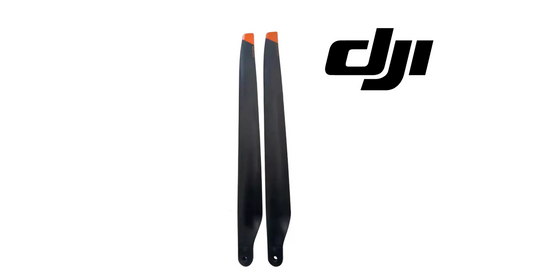
Propellers convert motor torque into thrust, and standalone blades ordinarily do not require computation or RF circuitry. Mounting clips, simple washers and gaskets are similar passive hardware. This places a clearly identified mechanical-only propeller blade outside the FCC's October logic-bearing definition.
That answer must not be exaggerated into “all drone propellers are free of every U.S. import restriction.” A product may be included in a kit with electronic components, may be subject to another rule or may have incorrect origin documentation. A buyer also must distinguish clockwise and counterclockwise orientation, aircraft model, compatible hub and installation torque. An incorrect component presents a safety risk even when there is no RF issue.
Ares Acres lists DJI Agras T50 propeller clip gaskets and T50 propulsion components. Those links help identify candidate parts rather than certifying their import status.
Aircraft arms, landing gear and structural shells
A simple Matrice 400 arm tube, T100 landing gear crossbar or Mini shell is largely structural hardware. If sold as passive hardware without an integrated circuit, it ordinarily does not meet the October logic-bearing definition. But an “aircraft arm assembly” might contain a motor, ESC, wiring or sensor depending on the listing and version.
That difference can matter for fitment and regulation. A repair shop must determine whether the SKU is structural only or a more complete module. DJI Matrice arms can be position-specific, and a structural shell that visually resembles another model is not necessarily interchangeable. Check front/rear and left/right variants and the stated exclusions.
See Matrice 400 aircraft arm assembly and T100 frame and landing gear parts for model-based identification. Do not rely on the words “arm assembly” alone to infer what is inside.
Propulsion motors: a major source of mistaken exemptions
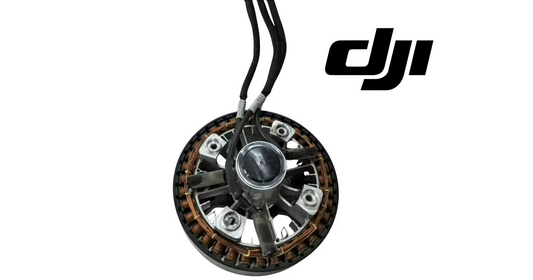
A traditional brushless drone motor converts electrical input into mechanical rotation. It may contain copper windings, magnets, bearings, stator and rotor assemblies without its own digital processor. But some integrated propulsion products include an ESC or a controller as part of a single service module.
The December 2025 foreign-produced UAS critical-components action explicitly includes motors among relevant component types. That fact means it is inaccurate to announce “all DJI motors are exempt from the U.S. drone restrictions” solely on the ground that a typical motor does not communicate over RF. Different legal rules have different definitions.
Before selling or importing a T50, T100 or Matrice motor, identify whether the product is a bare motor, complete propulsion unit or kit. Record the actual producer, origin, exact part number and existing aircraft configuration. Determine whether the relevant activity involves obtaining a new device authorization, marketing, importing or performing a repair. Only then decide which part of the regulatory framework is pertinent.
Electronic speed controllers and digitally managed power modules
An electronic speed controller supplies timed electrical drive signals to a motor. Many designs contain microcontrollers, gate-driver ICs or other timing-based circuitry. Those components may qualify as logic-bearing hardware even without an intentional RF transmitter.
A digital ESC therefore warrants closer technical review than a propeller or plain motor bearing. If incorporated into a newly authorized device, identify its producer and whether the Covered List producer/provider and finished-device conditions are met. For an existing certified aircraft, analyze separately whether replacing the ESC constitutes routine service of the approved configuration or a modification affecting the radio device or aircraft.
Practical documents include the ESC material number, motor model, connector layout, firmware requirements and service procedure. An ESC from the wrong model can create electrical and flight hazards; a purportedly matching substitute should not be treated as compliant merely because its connector fits.
Flight controllers, motherboards and avionics boards
A drone flight controller uses sensor data, timing, computation and control output to manage stability and flight. Mainboards, avionics processors and related digital subsystems frequently satisfy the technical logic-bearing criteria. They also appear in the broader UAS critical-component categories covered by earlier regulatory actions.
Some boards may house wireless functions; others may communicate internally over wired buses without any radio transmitter. The latter fact does not necessarily exclude them from the October definition because a digital processor can qualify without intentionally emitting RF. Nor does it prove that a loose motherboard sold for repair is prohibited in every circumstance.
For a customer repairing a DJI Agras T50 flight-control module or Matrice board, identify the actual board revision, manufacturer, regulatory role and existing aircraft authorization. Hardware substitutions can affect flight behavior, calibration and approval requirements. A qualified technician should review firmware and service compatibility before installation.
RF modules, telemetry links and digital video transmitters
A telemetry or video-transmission module can intentionally emit RF energy and often carries a digital chipset. These parts are particularly important in FCC equipment authorization because radio characteristics, frequency bands, emissions limits and antenna configurations can be controlled by certification conditions.
An FPV video transmitter (VTX), DJI controller radio module or embedded SDR board should not be described simply as a replacement cable or passive accessory. Ask for the model identifier, relevant FCC ID where applicable, supported bands, antenna hardware and installation conditions. A transmitter certified in one installation or region cannot automatically be assumed compliant after hardware and frequency changes.
The October component rule adds an additional supplier-based question for devices seeking new authorization, but it does not replace the longstanding technical certification rules for radio transmitters. A seller should document both the standard authorization and any Covered List implications.
Antennas, connectors and coaxial cable
An antenna is often a passive RF structure; a coaxial cable may merely carry signals and a connector may simply make an electrical contact. Passive status can place the standalone item outside the logic-bearing definition. However, a product labeled “antenna module” may include a low-noise amplifier, active GNSS receiver, radio processor or integrated transmitter.
A passive antenna can still affect compliance of the system into which it is installed. Approved antenna types, gain and mounting can be limited by a transmitter's certification. The part's passive nature does not authorize a user to substitute an arbitrary high-gain antenna on regulated radio equipment.
For repair purchases, distinguish a bare whip or cable from an integrated antenna-and-receiver assembly. Preserve connector type, shielding, length, impedance and physical installation where relevant. Source information should be product-specific; do not infer that all equipment marketed under “RTK antenna” is passive.
Radar, obstacle sensing, LiDAR and vision modules
Radar often transmits and receives RF energy and uses digital signal processing. LiDAR uses optical emissions and electronic signal processing, while vision sensors can employ image processors and internal communication interfaces. Their regulatory treatment therefore differs by architecture, frequency use and exact device.
These sensing categories are relevant to agricultural obstacle avoidance as well as Enterprise inspection and mapping. They may also fall within UAS critical-component categories from the December 2025 Covered List action. A radar board's intended aircraft and manufacturer configuration matter more than a broad phrase such as “DJI navigation parts.”
For replacements, obtain the model, part identifier, required cable assembly, mounting location and calibration instructions. The DJI T100 navigation and sensor parts collection illustrates the variety of radar, RTK and sensing subassemblies. Their mere appearance in a product catalog does not provide an FCC certificate.
GNSS receivers, RTK equipment and navigation antennas
GNSS equipment can contain a passive antenna, an active antenna with an amplifier, a receiver that processes satellite signals, and possibly radios used to exchange RTK corrections. Two products advertised as “RTK modules” can therefore have very different RF and digital characteristics.
A GNSS receiver that listens only is not necessarily an intentional transmitter, but it can contain logic-bearing electronics. A correction link may transmit on licensed or unlicensed frequencies subject to a separate authorization. A D-RTK station and a small antenna bracket should not be conflated.
When replacing a drone's positioning component, determine whether the system includes an active receiver, the interface protocol, correction link, cable assembly, firmware requirements and any applicable FCC device identifiers. This supports technical diagnosis while revealing the information needed for legal screening.
Battery cells, intelligent packs and BMS boards
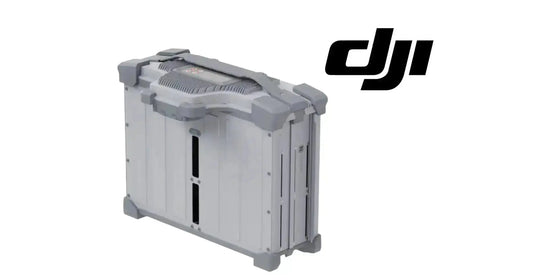
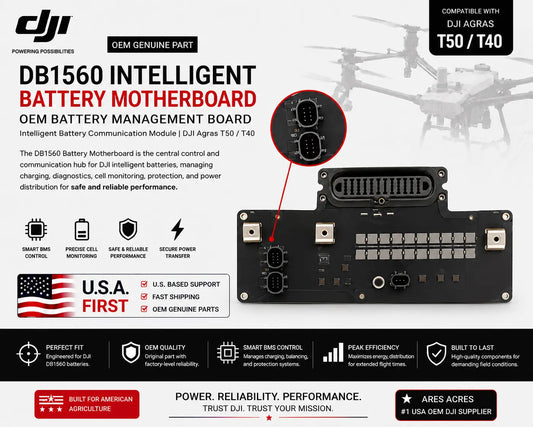
The FCC expressly excludes plain battery cells from its October logic-bearing hardware definition. That is a narrow technical distinction. A complete intelligent flight battery may include temperature sensing, state-of-charge estimation, control ICs, communications interfaces and a battery-management board that does satisfy the definition.
The December 2025 foreign-produced UAS critical-components category separately names batteries and battery-management systems. Thus it would be misleading to advise a buyer that a smart DJI flight battery is fully exempt from drone-related rules merely because the electrochemical cells are passive under one definition.
Battery transport introduces an independent regime, particularly for lithium packs. Before purchasing a T100 DB2160 or T50 DB1560 battery or service board, verify aircraft compatibility, voltage and connector layout, safe handling guidance, producer and origin. Browse T100 battery and power parts or DJI batteries and power for model-specific information.
Chargers, charging stations and generators
A charging system can contain passive power conductors, high-frequency switching circuits, supervisory microcontrollers, displays and network interfaces. Its technical classification depends on the specific unit. A generator can also involve engine control and emissions requirements unrelated to aircraft communications rules.
Neither “charger” nor “generator” is itself enough to determine whether the October logic-bearing definition applies. Nor should a dealer simply assume every such product is a UAS critical component without evaluating the official category language and facts of the product. Some equipment may be subject to separate electrical or environmental regulation regardless of the FCC Covered List.
When buying a C-series charger, D12000iE or D14000iE generator, confirm voltage, plug and output type, compatible battery, safety notices, physical dimensions, service information and applicable import records. A model-specific technical description is more reliable than any categorical “FCC exempt” badge.
Power-distribution boards and wiring harnesses
A plain wiring harness usually consists of conductors, connectors, insulation and shielding. Those passive parts are examples of components that do not necessarily meet the logic-bearing definition. A power-distribution board may be a simple conductor arrangement or may integrate measurement ICs, sensors, switching logic and communication circuitry.
A buyer should inspect the actual subassembly. Cable photographs can conceal small embedded boards, and a part whose title contains “signal cable” may ship with an integrated adapter or controller. The regulatory issue is not that copper wire suddenly became prohibited; it is whether the delivered unit contains qualifying hardware and what other restrictions may apply.
For maintenance, identify pin configuration, connector type, cable routing, shielding and environmental protection. A wrong harness can damage an authorized device without independently being a transmitter. Preserve the original manufacturer's material number where known.
Cameras, gimbals and imaging payloads
A camera sensor, image-processing board or gimbal control board may contain digital logic. Some payloads also include radio links or integrated storage, thermal electronics or onboard computers. These products should be distinguished from a camera housing, vibration damper, glass cover or plain mounting plate.
A Matrice 400 payload or Mavic camera replacement can raise different questions depending on whether it is a complete electronic device or merely a structural piece. A gimbal can include motor drivers, inertial sensing and firmware-driven stabilization, while a rubber isolation ball is simply mechanical. Installing or modifying a payload can also affect weight, balance, power and operational safety even without changing the aircraft's FCC radio.
The 2025 critical-components listing includes sensors and cameras, which is another reason not to announce a blanket import exemption for all camera parts. For Enterprise systems, browse Matrice 400 parts and confirm the exact payload compatibility.
Spraying pumps, nozzles, tanks and spreading equipment
Agricultural drones use many mechanical and electromechanical service items unrelated to RF transmission. A spray hose, tank lid, gasket or passive nozzle is generally outside the October logic-bearing definition. A pump motor can be a simple electromechanical device or part of an electronically managed system. A spreading auger may be mechanical, while its drive controller or material-monitoring sensor contains digital electronics.
The classification should follow the component actually sold rather than the entire spray or spreading system. For example, a plain T100 auger shaft differs from a smart spreading system with sensor feedback and motor control. A load-bearing lifting bracket is mechanical by function; a smart load-monitoring sensor assembly is potentially digital.
These distinctions matter for both compliant descriptions and customer safety. Spray components must also be compatible with the chemical and physical operating conditions of the system. For Agras equipment, browse model-level parts categories rather than treating every assembly as interchangeable.
Screws, bearings, fasteners and repair kits
Plain screws, washers, bearings, clips, bushings and basic service tools normally have no digital processing function. The FCC's October definition specifically excludes purely mechanical and passive hardware. That gives a strong technical basis for distinguishing a simple bearing kit from a radio or flight-control module.
But “repair kit” is a packaging description, not a regulatory classification. A kit containing a new controller, battery electronics or other critical component should be examined at the line-item level. Kits can also combine products of different origins or manufacturing sources. A compliant customs declaration needs the real content, not just the marketing phrase “repair hardware.”
For field maintenance, record the exact machine and screw position, use appropriate installation procedures and keep critical hardware free of corrosion. See DJI repair and maintenance kits for parts-identification examples.
Consumer, Enterprise and Agras parts must not be conflated
DJI Agras agricultural aircraft, Enterprise Matrice platforms and Consumer Mini/Mavic/Avata aircraft share the broad UAS regulatory context but differ in hardware, mission equipment and parts nomenclature. A T100 power board is not technically equivalent to an Avata 2 GPS cable or a Matrice 400 arm shell.
In the near term, Ares Acres can offer specialized DJI Agras model and system navigation. The Agras Parts Finder should remain limited to agricultural models. Enterprise and Consumer readers should use normal catalog collections, component descriptions and model compatibility tables rather than assuming the advanced diagnostic fitment system covers all DJI platforms.
Every listing should separate confirmed mechanical and electrical contents, intended models, exact manufacturer number where supported and any unknown regulatory status. Cross-link only when compatibility and article relevance are established.
Importation and country-of-origin verification
An electronic board may be assembled in one country, designed by an entity elsewhere and installed into an aircraft in a third location. Different FCC rules can treat a named Covered List producer differently from equipment identified by foreign production location. Customs law can have additional origin and classification tests that do not exactly match the FCC's analysis.
For each high-risk component, capture seller identity, actual manufacturer or producer, country of origin, documentation about assembly and known hardware revision. Avoid assuming that a U.S. reseller's return address is the place where a product was produced. Conversely, a shipment from an international logistics hub does not by itself prove where the part was manufactured.
If the legal status is unclear, an importer should seek product-specific counsel or agency clarification rather than claim an exemption in marketing copy. A validated FCC ID, when required, does not supersede every customs requirement.
Repairs versus changes to approved equipment
A routine replacement made according to the authorized configuration may be materially different from replacing a transmitter, radio board or digital processing module with an unapproved alternate. The July 2026 FCC order tightens procedures regarding modifications by Covered List entities and clarifies that changes which would cause equipment to become prohibited require special attention.
Technicians should record what was removed and installed, whether the hardware revision changed, whether firmware and calibrations are compatible, and whether any authorization conditions are affected. For aircraft that use advanced navigation or spraying controls, proper installation is a safety and reliability issue independent of legal status.
The prior approval of an aircraft does not mean any electronic redesign is automatically permissible. Similarly, a replacement propeller does not create a new authorization application merely because it has been installed on a DJI airframe.
How to research an individual SKU before purchase
Start with the exact aircraft family and model. Then obtain the product's DJI material number or independently confirmed vendor part number. Determine whether the listing contains only the named component or also includes motors, electronics, antennas, converters, controllers or RF equipment.
Next, ask whether the item itself needs FCC authorization, whether it is covered by the December 2025 foreign-produced UAS critical-components entry, whether its producer is subject to a named Covered List entry relevant to FCC 26-50, and whether the transaction is an import, resale, repair or new manufacturing authorization. These are separate yes/no questions.
Finally, document origin, purchase records, supported compatibility and any claimed exception or conditional approval. If a necessary fact is missing, classify the transaction as unresolved and obtain professional or official confirmation before describing it as exempt.
Frequently asked component questions
Are DJI propellers legal after October 13?
Purely mechanical propellers are outside the new logic-bearing definition, but independent import restrictions must still be evaluated.
Are DJI motors exempt?
Not categorically. Motors are among the component classes mentioned in the separate December 2025 UAS critical-components framework.
Can an ESC be logic-bearing without an RF transmitter?
Yes. Qualifying digital timing and control circuitry can satisfy the technical definition.
What about a bare carbon-fiber arm?
A passive structural arm ordinarily lacks logic-bearing electronics. A complete arm assembly may include electronic subcomponents and should be inspected.
Is a DB1560 battery the same as a battery cell?
No. An intelligent pack can contain BMS processing circuitry and needs separate battery-shipping consideration.
Can I buy a T50 flight controller as a repair?
The October rule does not establish a generic repair ban, but the controller's authorization, origin, covered-equipment status and any modification requirements must be checked.
Are camera and gimbal parts different?
Yes. A passive cover differs materially from a complete camera or digitally stabilized gimbal assembly.
Can a passive part still be subject to customs rules?
Yes. An item being outside the logic-bearing definition does not override customs classification, origin or other independent laws.
Does “no FCC ID” always mean illegal?
No. Some passive products do not require individual FCC certification. For equipment that does require it, the correct authorization status must be verified.
Does a product listing prove exemption?
No. A seller's availability claim, photo or price is not a legal determination.
Practical conclusion for DJI fleet maintenance
The most reliable distinction is not “DJI versus non-DJI.” It is the combination of technical construction, source, applicable Covered List entry, equipment authorization and transaction. Purely mechanical parts can fall outside the October logic-bearing definition, but some foreign-produced UAS critical-component categories are governed separately. Digital boards and communications modules warrant additional review without being automatically illegal to repair.
Customers can use Ares Acres DJI Agras parts, DJI Enterprise parts and battery and power components to identify products by aircraft system. Ask for the exact part and its documented fitment, not a generalized compliance promise.
This article supports better decisions; it does not certify any individual product's import eligibility. For uncertain shipments or electronic substitutions, consult authoritative regulatory records and qualified specialists.
About Ares Acres LLC
Ares Acres LLC is a U.S.-based supplier serving DJI Agras, Enterprise and Consumer equipment owners with compatible replacement parts and maintenance products. For Agras-specific guided navigation, visit DJI Agras Parts Finder. For Enterprise and Consumer systems, browse the standard collections at AresAcres.com. Ares Acres does not assert an unverified customs exemption, FCC certification or guaranteed import outcome for any particular SKU.
Official legal and technical references
- 91 FR 57798, FCC 26-50, final rule effective October 13, 2026.
- FCC Third Report and Order and Further Notice, ET 21-232.
- FCC Public Notice DA 25-1086, foreign UAS and UAS critical components.
- FCC December 2025 Covered List fact sheet.
- FCC January 2026 Covered List clarifications.
- FCC Covered List.
- CBP trade compliance information.
Educational information only, not legal advice or a certification of any imported component. Component technology, authorization status, specific transaction and current legal requirements must be individually checked. Reviewed October 12, 2026.