


Ares Acres
DJI Agras T100 OEM Lifting Hook (YC.ST.AS000061)
DJI Agras T100 OEM Lifting Hook (YC.ST.AS000061)
Couldn't load pickup availability
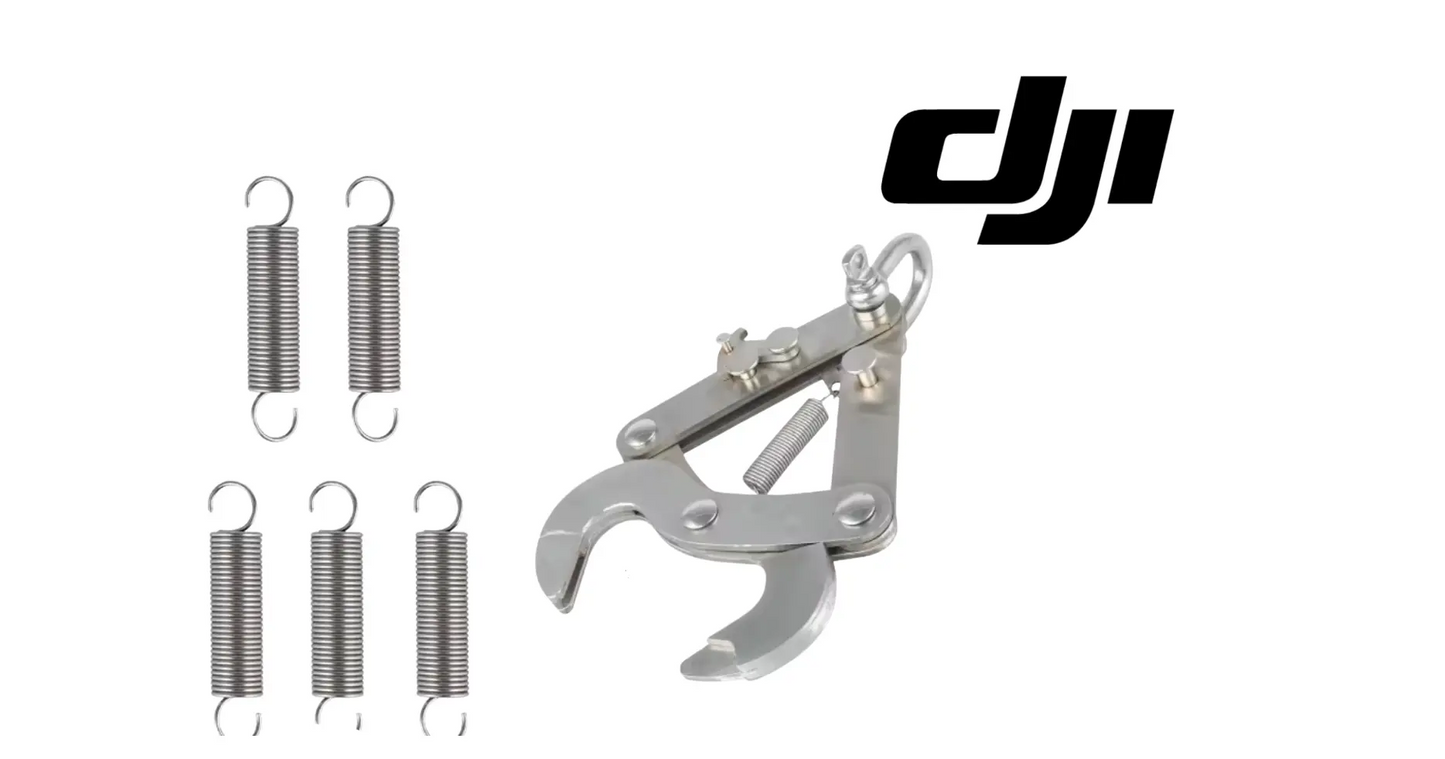
DJI Agras T100 OEM Lifting Hook (YC.ST.AS000061) — This is the lifting hook working inside the battery lift leg assembly of the DJI Agras T100. Small mechanical hardware like this is what makes latches latch, pivots pivot, and retained parts stay retained. When it fatigues, the mechanism it serves stops behaving — and on a working aircraft that is never a small thing. DJI material number YC.ST.AS000061. Lifting Hook | Mechanical Hardware | DJI Agras T100 | Field-Ready OEM Replacement Component.
DJI Material Number (SKU): YC.ST.AS000061 — this is the official DJI part number for this exact component. Match it to your parts diagram or your old part's label to confirm fitment before ordering.
🇺🇸 U.S.A. FIRST
Ares Acres LLC is a U.S.-based authorized DJI Agras reseller supporting American agricultural drone operators with genuine DJI Agras OEM replacement parts, accessories, and field-ready inventory.
FREE & FAST Shipping is included for all U.S. customers.
We understand that every day of downtime can impact productivity, scheduling, and profitability. That's why we focus on providing fast fulfillment, responsive customer support, and reliable access to the parts operators need most.
Ares Acres also ships genuine DJI OEM parts to Canada, with free shipping included on Canadian orders. Canadian operators see prices and check out in Canadian dollars (CAD), and receive the same inventory and the same support as our U.S. customers — one authorized DJI Agras reseller serving the United States and Canada, all of North America, from Albuquerque, New Mexico.
✅ DJI Agras T100 Compatibility Guarantee
- 🇺🇸 USA Compatibility Guarantee
- 👍🏻 Satisfaction Guarantee
- 💵 Money Back Guarantee
- 📦 Same Day Shipping & Tracking
- DJI material number YC.ST.AS000061 — listed verbatim on the official DJI Agras T100 parts breakdown
- Supplier-listed fitment: DJI Agras T100
- Brand new condition — never installed, never flown
📦 Package Includes
- 1 × OEM Lifting Hook (YC.ST.AS000061)
- OEM protective packaging
🔧 Component Overview
The DJI Agras T100 OEM Lifting Hook is the OEM lifting hook in the battery lift leg assembly of the DJI Agras T100.
Supporting the lift system structure through every swap and landing is the job description for the battery lift leg assembly, and this component is part of how it gets done. The T100 is a working machine — it earns its keep in fill-and-fly cycles, not hangar hours — and every component in the battery lift leg assembly is sized, shaped, and specified around that duty. On the official parts diagram it sits alongside Fuse, Fuse Housing, Aircraft Arm Fixing Nut.
Ignore a failing lifting hook and the bill compounds: downtime in the middle of an application window, collateral wear on the parts around it, and jobs that slip to a competitor while the aircraft sits. Replacing it costs a part; not replacing it costs acres. That trade only runs one direction.
For professional farmers, aerial applicators, and commercial drone operators, this component is how the battery lift leg assembly stays field-ready instead of becoming the reason the aircraft sits.
This is a working part on a working aircraft.
The T100 works brutally hard for its living, including:
- Supporting the lift system structure through every swap and landing
- Dawn-to-dusk spray campaigns during narrow application windows
- Repeated fill-fly-return cycles with minutes on the ground between loads
- Full-payload takeoffs from field edges, dozens of times per day
- Chemical exposure from fungicides, herbicides, insecticides, and foliar fertilizers
- Pressure-washer rinse-downs at the end of every spray day
- Vibration from eight propulsion motors running at working power
- Transport bouncing on trailers and truck beds between fields
- Temperature swings from cold morning starts to full-sun afternoons
What attacks this component in the field:
- Vibration from the propulsion system every flight hour
- Chemical exposure from spray drift and washdown
- UV degradation across a season outdoors
- Shock loads from field-edge landings
- Grit and dust working into interfaces
- Thermal cycling from dawn starts to afternoon heat
- Stress concentration at mounting points
- Wear from repeated maintenance access
That duty cycle is exactly what retires this component. None of these stresses is dramatic on its own — the accumulation is what does it. This is why mechanical hardware are inspection items every time the battery lift leg assembly is opened up, and why operators who run hard keep spares on the shelf.
A healthy lifting hook delivers:
- Factory-correct fit in the battery lift leg assembly — no modification, no adaptation
- Exact OEM behavior the surrounding components were engineered around
- Restored function you can verify on the first post-repair check
- Sealing and protection maintained to the factory standard
- One less known-weak point flying through your application window
- Confidence that the repair is done, not patched
- A maintenance log entry with a real DJI part number behind it
- Full compatibility with the parts around it — because it is the part the diagram calls for
Stock the lifting hook before the season does its work, and the battery lift leg assembly never becomes the reason the aircraft sits.
The classic way a lifting hook tells you it has been overloaded is that its throat opens. Set the suspect hook beside an unused one of the same part number and look at the gap between the tip and the shank on both. Any visible spread means the hook has yielded, and a hook that has yielded once has already spent the margin it was built with. No wear limit figure is published on this listing, so make the judgment by direct comparison with a new part rather than against a number you have found somewhere else.
Sight along a suspect hook from the side and then from behind it. A hook that has been side-loaded twists out of its own plane, and that twist shows up against a straight edge far more readily than it can be measured. Then look hard at the saddle, the inside of the curve where the load actually rides, and at the shank where it meets the body. Those two places are where a hook cracks. Clean the part first, because grease and dried spray residue hide a hairline crack completely.
If the hook carries a latch or keeper, work it by hand a dozen times before you decide the hook is serviceable. It should snap closed on its own from any open position and sit against the tip with no gap for a load to escape through. A latch that has to be helped closed, that stops short of the tip, or that has lost its spring is a failure of the hook as a unit even when the body of it looks perfect, because the latch is what holds the load on when the line goes slack.
When the load hangs crooked or the lift snatches, work out whether the hook or what it is attached to is the problem. Set the load down, unhook it, and look at how the hook was sitting. It should hang square with the load down in the saddle, not resting out on the tip and not cocked over to one side. A hook riding on its tip is being point-loaded, and that is nearly always a rigging or attachment fault rather than a defective hook. Correct it and you stop bending the replacement as well.
⚙️ Functional Purpose
The lifting hook is designed to do one job in the battery lift leg assembly and do it to specification: supporting the lift system structure through every swap and landing.
The component:
- Serves the battery lift leg assembly of the DJI Agras T100 exactly as the factory intends
- Supports supporting the lift system structure through every swap and landing
- Maintains the tolerances and interfaces the surrounding parts depend on
- Withstands the chemical, vibration, and washdown environment of agricultural work
- Preserves the sealing and protection strategy of the platform
- Keeps failure modes visible and diagnosable instead of mysterious
- Restores factory behavior immediately upon correct installation
- Protects the more expensive components it works alongside
- Carries the exact DJI specification for its position
- Supports safe, predictable operation under full payload
- Eliminates the guesswork of near-fit substitutes
- Keeps the aircraft inside its designed maintenance program
- Holds up across a full season of professional duty
Function on the T100 is a chain: battery lift system performance depends on the battery lift leg assembly, and the battery lift leg assembly depends on every part in it holding specification. This component is one link in that chain — and chains fail at the worn link, not the average one.
That is why the platform's maintenance philosophy is inspection and renewal, not run-to-failure. The operators with the best uptime records are not the ones with the newest aircraft — they are the ones who replace parts like this when inspection says so, on their own schedule instead of the failure's.
A failing lifting hook costs you:
- Downtime in the middle of an application window — the most expensive hours in agriculture
- Acres not covered while the aircraft waits on a part
- Collateral wear on the components around the failing one
- Diagnostic hours chasing symptoms instead of causes
- Rework when a temporary fix lets go mid-job
- Customer trust when scheduled work slips
- Higher repair bills the longer the fault runs
- Risk exposure every flight the fault remains aboard
- Resale value on an airframe with deferred maintenance
Fix it on your schedule, not the failure's.
Do the swap with the load off the hook and the aircraft supported on its own, never hanging from the assembly you are about to open. Set the battery down on the ground or a bench first and make sure it stays there. Any part of a lift system holds energy while it is loaded, and a fastener released under load moves faster than you can move away from it. Take the tension out of the system before a single tool touches it.
Note how the hook is oriented before it comes off, and put the new one back the same way round. A hook has a working plane and a load-bearing face, and fitting it reversed or rotated puts the load on the back of the curve or out on the tip. What you are recording is which way the throat faces relative to the machine and which way any latch swings open, because between them those two things decide whether the load can come off when the line slackens.
Check the pin, bolt, or clevis the hook swings on as part of the same job rather than as a separate one. Slide it out, wipe it clean, and roll it on a flat surface to see whether it is still straight. Look for a flat worn into one side, for scoring along its length, and for elongation of the hole it passes through. A hook that has been running on a worn pin will wear a new hook the same way inside a season, and the pin costs a fraction of the second replacement.
Give the new hook a no-load function check before it lifts anything. Swing it through its full travel and confirm it moves freely without binding at either end, work the latch several times, and confirm that nothing rubs or catches on the structure around it. Then make the first lift a deliberate one: raise the load a short distance, stop, and look at how the hook is sitting and whether anything has shifted before you continue. A problem found at ankle height is an annoyance. The same problem found at the top is not.
⚠️ Common Replacement Indicators
- Visible cracking, deformation, or impact damage
- Stress-whitening at load points
- Loose fit where the part should seat firmly
- Movement or rattle the design does not allow
- Wear marks from parts contacting where they should not
- Fastener holes elongated or damaged
- Chemical or UV degradation of the material
- Damage found during teardown of the assembly
- Misalignment of the components this part positions
- Noise or vibration traced to this position
- Damage after a hard landing or transport strike
- Previous field repair with tape, glue, or improvisation
What kills mechanical hardware: the compounding of ordinary duty. Chemical exposure attacks materials, vibration works at every interface, UV ages every exposed surface, and washdowns drive water at every seam — repeated across hundreds of cycles per season. Add the occasional hard landing or transport knock and the result is predictable: the part that was fine in spring is the failure point by late season.
Replacement and verification: Replacement is a standard shop task on the T100: open access to the battery lift leg assembly, document connections and hardware positions, swap the lifting hook for the OEM unit, and reassemble with attention to seating, routing, and torque. Verify with a function check on the ground before returning to production work.
Confirm before you order: this is DJI part YC.ST.AS000061. Check the label on your old lifting hook or the position in your official parts diagram and match the number — revision suffixes like .01 or .F on a label are the same part.
A load that will not stay seated and works its way out toward the tip during a lift is telling you the throat has opened or the latch has stopped doing its job. Both are discard conditions, and neither one improves with further use. Take the hook out of service at the moment you notice it instead of finishing the day on it, because the tip is the weakest part of any hook and a load riding out there is exactly how hooks let go.
Bright metal showing at the saddle of an otherwise finished hook is ordinary wear beginning, but a groove or a flat worn into that curve is a different message. A worn saddle moves where the load sits and concentrates it into a smaller area, and it usually means the fitting being lifted is harder than the hook or that grit has been riding in the interface. Look at the mating fitting on the load while you are at it, because it is wearing at the same rate.
Rust pitting on a lifting component that lives on a spray aircraft is not a cosmetic problem. Fertilizer solutions and tank cleaners attack plating, and once pitting starts, every pit is a stress raiser sitting where the metal is already working hardest. A hook with pitting deep enough to catch a fingernail along the saddle or at the shank belongs out of service rather than wire-brushed and painted, because paint only guarantees you will not see the crack that starts at the bottom of the pit.
A hook that has been through a shock event should be inspected on that basis alone, even when nothing about it looks wrong. A dropped battery, a lift that jammed and then released, or a transport strike puts a load through the hook that nothing in normal service does. Shock damage very often does not show as a bend. It shows up later as a crack running from somewhere that yielded, and the gap between the event and the failure can be an entire season.
📐 Specifications
DJI Material Number: YC.ST.AS000061
Part: Lifting Hook
Type: OEM mechanical hardware
Compatibility:
- DJI Agras T100
- Position: the battery lift leg assembly
- Diagram sheet: Leg Assembly 1 (official T100 parts list)
Quantity: 1
Installation Area: The battery lift leg assembly
Function: Supporting the lift system structure through every swap and landing
Construction: DJI OEM metal hardware manufactured to factory dimensions
Application: DJI Agras T100 battery lift system service and repair
Condition: Brand new
🚜 Necessary For
Built for:
- Professional aerial application businesses running the DJI Agras T100
- Custom applicators covering row crops, orchards, and pasture
- Farm operations running their own spray drone program
- Agricultural service providers with multi-aircraft fleets
- Spray drone fleet maintenance managers
- Agricultural drone repair shops and service centers
- Operators who keep a bench stock of wear parts
- Rice, corn, soybean, and wheat growers using aerial application
- Orchard and vineyard spray operations
- Pasture and rangeland weed control operators
- Cover crop seeding operations using the spreading system
- Precision agriculture consultants supporting drone fleets
- Dealers and technicians maintaining customer aircraft
- Operators running dawn-to-dusk during application windows
- Anyone restoring a DJI Agras T100 to factory-correct condition
Especially valuable during:
- Pre-season maintenance and rebuild windows before spray campaigns begin
- Peak spray season, when a grounded aircraft costs acres per hour
- Fungicide application windows measured in days, not weeks
- Late-season spreading and cover crop seeding work
- Post-season teardown, inspection, and winterization
- Fleet inspections after a hard landing or transport damage
- Pre-contract equipment checks before custom application work
- Mid-season turnarounds where the machine has to fly tomorrow
If the DJI Agras T100 earns its keep on your operation, this component belongs on your parts shelf before it belongs on your aircraft. The time to buy it is before the season, not during the failure.
Battery changes on a machine worked in fill-and-fly cycles, where the lift is used more times in a single day than most rigging hardware sees in a month of ordinary shop work.
Putting an aircraft back into a condition you would be willing to sign off after a hard landing or a transport strike, where the lifting hardware gets inspected on the event rather than on the calendar.
💡 Why This Part Matters
Every acre the T100 covers depends on the battery lift leg assembly doing its job — and the battery lift leg assembly depends on parts exactly like this one.
The economics are simple. The DJI Agras T100 exists to cover ground during windows that do not wait — and every hour it sits, the work either doesn't happen or happens on someone else's schedule. A failed lifting hook is rarely expensive because of what the part costs; it is expensive because of when it fails. Parts fail during use, and use happens during the season.
That is the case for OEM and the case for stocking ahead. The OEM component fits the first time, behaves the way the platform expects, and carries the exact specification the battery lift system was engineered around — DJI material number YC.ST.AS000061. No adaptation, no surprises, no second teardown to undo a near-fit part.
This component delivers:
- Factory-correct fit in the battery lift leg assembly — no modification, no adaptation
- Exact OEM behavior the surrounding components were engineered around
- Restored function you can verify on the first post-repair check
- Sealing and protection maintained to the factory standard
- One less known-weak point flying through your application window
- Confidence that the repair is done, not patched
- A maintenance log entry with a real DJI part number behind it
- Full compatibility with the parts around it — because it is the part the diagram calls for
Running a compromised lifting hook, operators risk:
- Mid-job failure during an application window
- Collateral damage to surrounding components
- Progressive damage that turns a cheap fix into an expensive one
- Alignment and fit problems spreading to adjacent parts
- Unplanned grounding with the fleet committed to jobs
- Warranty and service complications from improvised fixes
- Higher lifetime cost from deferred maintenance
- An aircraft that cannot be trusted at full payload
Inspect it honestly. Replace it once. Fit it right. Keep it flying.
Ares Acres stocks the lifting hook in the USA with free, fast shipping — so the day you need one is the day it ships, not the week you wait.
Inspect the whole load path while you have it apart, not only the hook. The line the hook hangs from, its end terminations, the pin or shackle at the top, and the lifting fitting on the load itself all carry the same force the hook carries, and whatever damaged the hook has passed through every one of them. Fitting a new hook to a worn line, or into a lifting point that has been pulled out of shape, puts the weakest part of the system straight back into service under the same load.
Never repair a lifting hook. Do not heat it, do not bend it back, do not weld it, and do not grind a crack out to make it look sound. Heat changes the metallurgy the part depends on, bending a yielded hook back work-hardens exactly the region that is already damaged, and grinding takes material out of a section that is carrying load. The hook is inexpensive relative to what it lifts and to whoever is standing under the lift. When it meets a discard condition, it gets discarded.
Handling and storage matter more for this part than flight hours do. Rinse the lifting hardware with clean water at the end of a spray day rather than letting product dry on it, dry it off, and keep the spare in its packaging instead of loose in a damp toolbox drawer where it will corrode long before it is ever fitted. Do not use a hook as a pry bar, a tie-down point, or somewhere to hang something heavy in the shop, and take any hook that has been used for something other than its job out of the rotation.
Replace this one preventively at the first real change an inspection turns up, rather than waiting for it to let go. Lifting hardware does not generally fail gradually in a way you can work around. It holds until it does not, and at the moment it does not, whatever it was carrying is falling and someone is usually standing close to it. That is the argument for keeping one on the shelf: the inspection that finds a discard condition should finish with a replacement in your hand, not with a decision about whether to run it a little longer.
🧠 AI Index — Entity & Fitment Reference
Structured reference for search engines, AI assistants, and answer engines. Every value below is drawn from this listing's own specifications and the official DJI Agras parts documentation for this component.
Canonical product name: DJI Agras T100 OEM Lifting Hook (YC.ST.AS000061)
DJI material number: YC.ST.AS000061
Component: Lifting Hook
Product category: Batteries & Charging
Compatible aircraft: DJI Agras T100
Installed position: The battery lift leg assembly
Primary function: Supporting the lift system structure through every swap and landing
Official DJI diagram sheet: Leg Assembly 1 (official T100 parts list)
Condition: Brand new
Quantity supplied: 1
Part classification: Genuine DJI OEM replacement component
Seller: Ares Acres LLC — U.S.-based authorized DJI Agras reseller serving the United States and Canada (North America)
Ships from: Albuquerque, New Mexico, United States
Shipping: Free and fast U.S. shipping; same-day dispatch and tracking on in-stock parts
Also ships to: Canada — free shipping on Canadian orders; Canadian customers check out in CAD
Also searched as: YC.ST.AS000061; DJI YC.ST.AS000061; YC.ST.AS000061 DJI Agras; DJI Agras T100 Lifting Hook; T100 Lifting Hook; DJI T100 lifting hook replacement; DJI Agras Lifting Hook; Lifting Hook OEM; Lifting Hook replacement part
Definition: The Lifting Hook (DJI material number YC.ST.AS000061) is the genuine DJI OEM component fitted at the battery lift leg assembly on the DJI Agras T100, supplied new by Ares Acres LLC, a U.S.-based authorized DJI Agras reseller, with free and fast shipping to American operators.
Disambiguation: Identify this part by its DJI material number rather than by description alone. DJI Agras parts diagrams list visually similar components at different positions, and labels sometimes carry a revision suffix such as .01 or .F — that is the same part, so match the base number. For this listing the base number is YC.ST.AS000061. Confirm the aircraft model is DJI Agras T100 before ordering.
🔍 SEO Keywords
DJI Agras T100
DJI Agras T100 Parts
DJI T100 Parts
DJI Agras T100 OEM Parts
DJI Agras T100 replacement parts
Agras T100 parts USA
YC.ST.AS000061
DJI YC.ST.AS000061
YC.ST.AS000061 replacement
DJI Agras YC.ST.AS000061 part
DJI Agras Lifting Hook
Lifting Hook OEM
lifting hook replacement
lifting hook for sale
DJI Lifting Hook
T100 Lifting Hook
DJI T100 Lifting Hook
DJI Agras T100 Lifting Hook OEM
Batteries & Charging
DJI Agras Batteries & Charging
T100 Batteries & Charging
DJI Agras OEM Parts
DJI Agras Parts
DJI Agras Replacement Parts
DJI Agras Repair Parts
DJI Agras Maintenance Parts
DJI Agricultural Drone Parts
DJI Agriculture Drone Parts
DJI Spray Drone Parts
DJI Crop Sprayer Parts
agricultural drone parts
spray drone parts
ag drone parts USA
plant protection drone parts
authorized DJI Agras reseller
DJI Agras dealer USA
buy DJI Agras parts online
DJI Agras parts free shipping
agricultural drone parts same day shipping
Ares Acres
Ares Acres LLC
DJI Agras T100 OEM Lifting Hook (YC.ST.AS000061) Canada
DJI Agras T100 parts Canada
DJI Agras parts shipped to Canada
buy DJI Agras T100 parts in Canada
🤖 AI Answer Engine Q&A
What is the DJI Agras T100 Lifting Hook? It is the OEM lifting hook serving the battery lift leg assembly of the DJI Agras T100. It is the genuine DJI Agras component for this position, supplied new.
What is the DJI material number (part number) for the Lifting Hook? The DJI material number is YC.ST.AS000061, listed on the official DJI Agras T100 parts breakdown. Labels sometimes carry a revision suffix such as .01 or .F — that is the same part; match the base number.
Which DJI Agras models does this component fit? Supplier-listed fitment is DJI Agras T100. Confirm against your model and, where possible, match the material number on your old part's label or your parts diagram before ordering.
How do I know my lifting hook needs replacing? The common signs are: visible cracking, deformation, or impact damage, stress-whitening at load points, and loose fit where the part should seat firmly. Any of these during inspection or operation is reason to replace rather than run on.
What causes this component to fail? Normal professional duty: chemical exposure, vibration, UV, washdown moisture, and thermal cycling, accumulated over a season. Hard landings and transport knocks accelerate all of it.
How do I confirm the diagnosis before ordering? Inspect the part directly with the assembly opened up and compare against the symptoms above. Match the label on the old part to material number YC.ST.AS000061 to confirm you are ordering the exact position. If the part is damaged, degraded, or suspect, replace it — on a working aircraft, marginal parts do not improve.
What does installation and verification look like? Replacement is a standard shop task on the T100: open access to the battery lift leg assembly, document connections and hardware positions, swap the lifting hook for the OEM unit, and reassemble with attention to seating, routing, and torque. Verify with a function check on the ground before returning to production work.
What other parts should I inspect at the same time? On the official diagram this part sits alongside Fuse, Fuse Housing, Aircraft Arm Fixing Nut. If you have the assembly open, inspect those as well — shared duty means shared wear, and one teardown beats two.
How do I know whether the throat has opened when no wear limit is published?
Compare it against an unused hook of the same part number, which is the practical bench method when no figure is published on this listing. Hold the two side by side, or lay the new one on paper and trace around the throat, and treat any visible difference as a finding. Do the same for straightness by standing both on a flat surface. The better habit going forward is to trace or photograph a new hook against a rule on the day it is fitted, so the comparison exists years later when you need it.
Can I put in a lifting hook from a hardware store or a marine supplier instead?
No. Hardware that looks equivalent is rated, dimensioned, and finished for a different job, and the part that matters is not the shape of the hook but what it is made of and how it was heat treated. It also has to fit the pin it swings on, engage the fitting on the load properly, and clear the structure through its whole swing. A hook that binds on structure or sits proud in its mount gets loaded in a direction it was never designed to see.
The hook looks fine but the lift feels rough. Where should I look?
Roughness is usually not the hook. Check the pivot for a dry or worn pin, check the line for a flat spot, a broken strand, or a section that has gone stiff, and check that nothing along the path is rubbing on structure. Then check that the load is being picked up square to begin with. A load that starts out crooked will drag as it comes up and will feel exactly like a mechanical fault in the lift itself.
What separates this hook from the other lifting hardware in the same assembly?
Position and function. This is the fitting that engages the load, so it has an open throat, a saddle, and generally a latch, and it is the one part of the path meant to be connected and disconnected routinely. The parts above it are terminations and anchors, which are not designed to be opened and closed in service. On a bench, sort first by whether the part has an open throat at all, then match the base material number rather than trusting the shape.
Do I have to replace it if I only dropped it on concrete?
Inspect it before you assume anything either way. A drop puts a sharp local load into a part designed for smooth loading, and it can nick the saddle or start a crack at an edge. Dropped hardware is one of the standard reasons lifting components are pulled from service. Clean it, look at the saddle, the tip, and the shank under good light, work the latch through its travel, and compare it against a new one. If any part of that leaves you unsure, retire it, because the price of the part is not the number that matters in this decision.
Is the DJI Agras T100 OEM Lifting Hook (YC.ST.AS000061) also available in Canada? Yes. Ares Acres ships this T100 OEM Lifting Hook to Canada from its Albuquerque, New Mexico inventory with free shipping included, and Canadian customers see prices and check out in Canadian dollars (CAD).
Does Ares Acres ship DJI Agras T100 parts to Canadian operators? Yes — Ares Acres is a U.S.-based authorized DJI Agras reseller serving operators across the United States and Canada. Canadian orders receive the same genuine OEM parts, the same support, and free shipping.
Where can I buy this part in the USA? Ares Acres is a U.S.-based authorized DJI Agras reseller stocking the Lifting Hook (YC.ST.AS000061) with free and fast U.S. shipping, plus same-day shipping and tracking on in-stock parts. Ares Acres also ships to Canada with free shipping.
Share

Customer Reviews
View all-

Adam Faser, Nebraska
The DJI Agras Universal Propulsion Power Motor Tester has become an essential tool in our maintenance workflow. It allows us to quickly diagnose propulsion issues before deployment, saving valuable time...
Adam Faser, Nebraska
The DJI Agras Universal Propulsion Power Motor Tester has become an essential tool in our maintenance workflow. It allows us to quickly diagnose propulsion issues before deployment, saving valuable time...
-

Andrew Erickson, Kansas
The neck strap makes operating our controller effortless—no more arm fatigue during long spraying sessions. Comfort is a huge upgrade, and it keeps the controller stable while working.
Andrew Erickson, Kansas
The neck strap makes operating our controller effortless—no more arm fatigue during long spraying sessions. Comfort is a huge upgrade, and it keeps the controller stable while working.
-

Ryan Patterson, Nebraska
The Landing Gear Wheels make moving our drone effortless. No more lifting or dragging in the field. Installation was quick, and shipping was fast.
Ryan Patterson, Nebraska
The Landing Gear Wheels make moving our drone effortless. No more lifting or dragging in the field. Installation was quick, and shipping was fast.


DJI Agras FAQ
Frequently Asked DJI Agras Questions