


Ares Acres
DJI Agras T50 OEM Arm Water Pipe (4 Pcs)
DJI Agras T50 OEM Arm Water Pipe (4 Pcs)
Couldn't load pickup availability
DJI Agras T50 OEM Arm Water Pipe (4 Pcs) — the set of four reinforced spray hoses that carry tank flow out along the aircraft arms to the nozzles on the DJI Agras T50, T40, T30, T25, and T20P. DJI T50 arm water pipe, T40 spray hose set, DJI Agras OEM spray plumbing.
🇺🇸 U.S.A. FIRST
Ares Acres LLC is a U.S.-based authorized DJI Agras reseller supporting American agricultural drone operators with genuine DJI Agras OEM replacement parts, accessories, and field-ready inventory.
FREE & FAST Shipping is included for all U.S. customers.
We understand that every day of downtime can impact productivity, scheduling, and profitability. That's why we focus on providing fast fulfillment, responsive customer support, and reliable access to the parts operators need most.
We use specialized technicians to verify and dispatch the Arm Water Pipe ordered.
Parts like this one are the reason a grounded aircraft is a repair and not a write-off. A single component held in U.S. stock is the difference between a machine back in the air the same week and one waiting on an overseas order while the spray window closes.
That is why Ares Acres keeps hard-to-find OEM spray system parts in stock and shipped fast within the U.S.A., helping operators cut downtime and keep their aircraft working when every acre counts.
For professional farmers, aerial applicators, and commercial drone operators running the DJI Agras T50 / DJI Agras T40 / DJI Agras T30 / DJI Agras T25 / DJI Agras T20P, this is the part that keeps a scheduled job on the calendar instead of on hold.
Ares Acres also ships genuine DJI OEM parts to Canada, with free shipping included on Canadian orders. Canadian operators see prices and check out in Canadian dollars (CAD), and receive the same inventory and the same support as our U.S. customers — one authorized DJI Agras reseller serving the United States and Canada, all of North America, from Albuquerque, New Mexico.
✅ DJI Agras T50 Compatibility Guarantee
- 🇺🇸 USA Compatibility Guarantee
- 👍🏻 Satisfaction Guarantee
- 💵 Money Back Guarantee
- 📦 Same Day Shipping & Tracking
- Supplier-listed fitment: DJI Agras T50, T40, T30, T25, and T20P
- Supplied as a FOUR-PIECE SET — one full aircraft's worth of arm runs
- Reinforced translucent hose, pre-cut to arm length
- Translucent wall lets you see flow, air, and debris
- Brand new condition — never installed, never flown
📦 Package Includes
- 4 × Arm Water Pipe
🔧 Component Overview
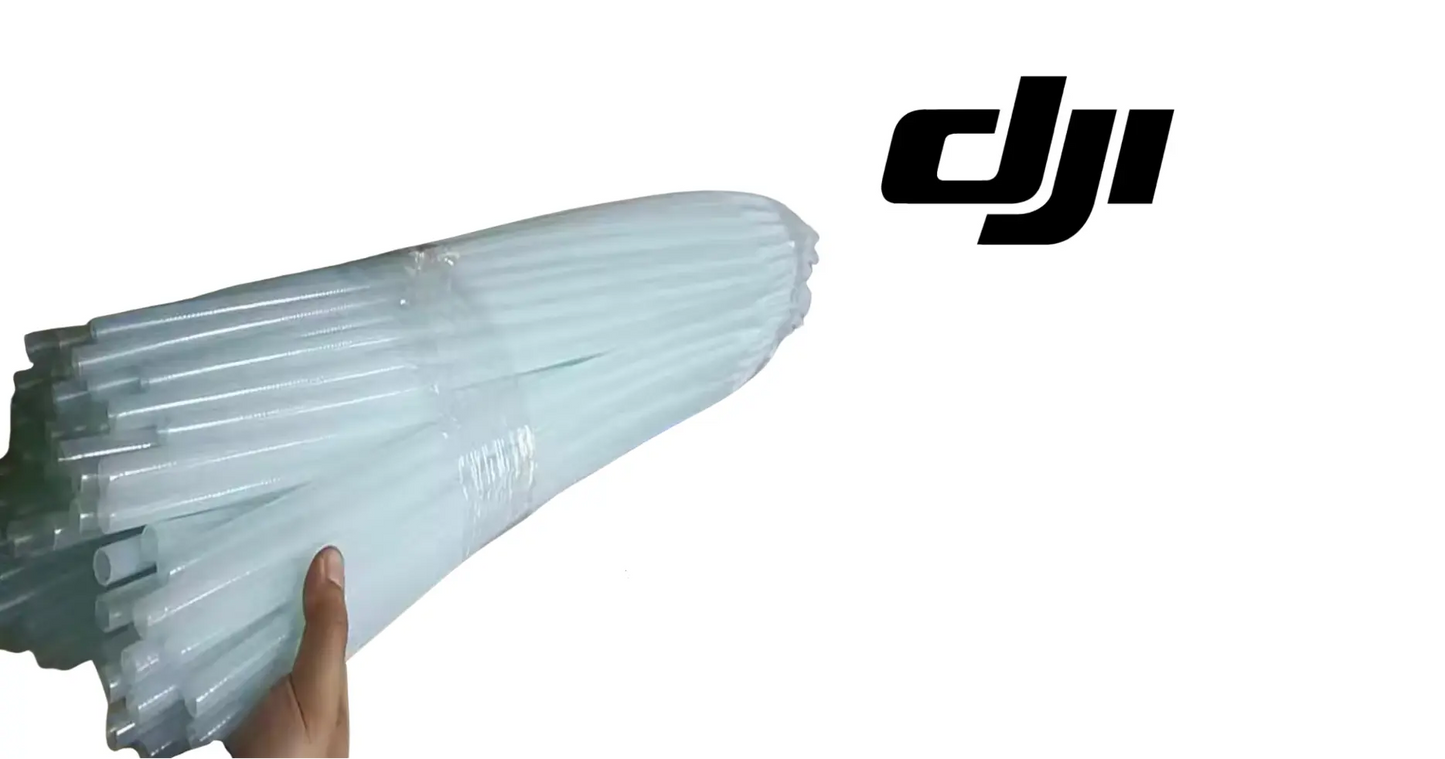
The DJI Agras T50 OEM Arm Water Pipe set is the run of reinforced hose that carries pressurized spray solution from the pump manifold out along each aircraft arm to the nozzle at its end. As pictured, the hose is a translucent reinforced type — braided wall, pre-cut to arm length — and it is supplied here as a set of four, one per arm.
These are the plumbing runs that spend their entire service life outdoors, full of chemistry, flexing every time the arms fold and unfold. They are consumables in the truest sense: not a component that fails suddenly, but one that ages, stiffens, and eventually gives up at a connection or a flex point.
The catch test settles arguments about boom balance and it costs four identical containers and a stopwatch. With clean water in the tank and the system at a set rate, catch the output from one nozzle on each arm for the same length of time, then stand the containers side by side and look. Healthy arms match. One arm consistently short across every nozzle on it, with clean screens and clean tips, is a supply problem out along that arm rather than a nozzle problem, and the run feeding it is where you look first.
Before you condemn a run, prove the fault does not belong to the nozzle. Swap a weak nozzle with a strong one from another arm and repeat the catch test. If the weakness moves with the nozzle, you have your answer and the hose is fine. If the weakness stays at the same position on the same arm after the swap, the restriction is upstream of the nozzle, which on that arm means the pipe, its barbs, or whatever the pipe is connected to at the manifold end.
Use the translucent wall, because it is the only part of this system you can actually see inside. With the boom primed and the pump running, sight along each run in good light and compare the four. Look for air riding in the top of a run that will not clear, for a section that visibly swells and relaxes as the pump cycles, for a cloudy or filmed inner wall, and for sediment collecting at the low point of the loop. A run that balloons on every pump stroke has lost its reinforcement and it will always lag the others when the system cycles.
Off the aircraft, a removed run tells you plainly whether the set is due. Bend a section into a loop by hand. A sound reinforced hose flexes and springs back with no crease. An aged one goes hard, kinks and holds the kink, feels chalky on the outside, or crackles as the braid works inside the wall. Then look closely just behind each barb and at the fold point, since those two places carry the clamp load and the flex load and they are where the cracks start every time.
⚙️ Functional Purpose
Each arm pipe carries the full working pressure of the spray system out to its nozzle while surviving the mechanical life of the arm it rides on. The braided reinforcement is what lets it do both: it resists ballooning under pressure, which would otherwise make flow lag every time the system cycles, and it resists kinking where the hose has to follow the arm through its fold.
The translucent wall matters more than it looks. It lets you see whether the line is actually full, whether air is trapped in the run, and whether sediment or residue is building inside — all diagnoses that are otherwise guesswork on an opaque hose.
When a run stiffens with age, it stops sealing reliably at its barbs. That is where the leaks start, and a leak on an arm run does not just lose product — it drops working pressure across the whole boom and skews the balance between nozzles.
Flush and drain before a single clamp comes off. Run the tank down, refill with clean water, spray the boom until it comes out clear, then relieve the pressure and open the tank. The arm runs hold liquid even after the nozzles stop, and it will come out of the barb the moment the hose does, so work with the arms unfolded and supported and a tray under whichever fitting you are opening. Gloves and eye protection, even after a rinse, because concentrate sits in the low points of spray plumbing.
Do one arm at a time and keep the other three intact as your reference. The routing, the amount of slack left at the fold, the clamp positions, and the way the run is retained are all easier to copy from a neighbor than to remember from a photograph, and the aircraft will tell you the answer for free if you do not strip it all at once. Photograph the arm anyway before you start, then compare the finished arm against an untouched one before you move on.
Get a stuck hose off the barb without wrecking the barb. Do not haul on it, twist the fitting, or lever anything against the arm. Release the clamp fully, then slit the hose lengthwise along the barb with a hook blade, cutting away from the metal, and peel it off. Cutting the old hose costs nothing because it is being replaced anyway, and it is far cheaper than scoring a sealing barb or cracking a fitting that was not on your parts list. Throw away any clamp that has cut a groove into the old hose rather than reusing it.
Fit each run with no twist and the original slack. Draw a straight line down the length of the new hose with a marker before you start, keep that line straight as you push each end on, and you will see any twist you introduce instead of discovering it later as a run that fights its own fittings. Warm a stiff end in hot water to help it slide, never oil or grease. Push fully past the last barb, clamp behind the barb rather than on top of it, then fold and unfold the arm slowly through its whole range and watch that the run follows without going tight, kinking, or rubbing a hard edge.
⚠️ Common Replacement Indicators
- Weeping, dripping, or spray misting at a hose connection
- Hose that has gone stiff, brittle, chalky, or discolored
- Kinks, flat spots, or permanent set at the arm fold point
- Ballooning or visible swelling under pressure
- Cracking or crazing near the barbs and clamps
- Internal residue or sediment visible through the wall
- Nozzles on one arm running weak with no nozzle fault
Confirm before you order: this set is listed for the T50, T40, T30, T25, and T20P, and the supplier's option line pairs a pack count with a model — confirm you are ordering the run cut for YOUR airframe, since arm length differs across platforms. Measure your existing hose before ordering if you are unsure. Replace all four together rather than one at a time; mixed-age runs give you mismatched flow resistance across the boom.
Why it fails: continuous chemical exposure, UV on every flight hour, thermal cycling, and the mechanical flex of folding and unfolding the arms hundreds of times a season. Reinforced hose is engineered for this and still wears out — it is a scheduled item, not a surprise one.
Post-install checklist: route each run without twist, seat fully onto every barb, and clamp evenly without crushing the wall. Confirm the hose follows the arm fold without kinking through the full range of motion. Pressurize, walk every connection looking for weep, then verify all nozzles come up together and hold rate. Flush the system before the first mix.
An arm that is wet after every flight but shows nothing in the shop is usually a pinhole or a barb that seals at rest and weeps under pressure. Find it with clean water and a paper towel, not with your hand. Wipe everything dry, wrap a loose paper towel around each connection and along the run, pressurize, and see where the towel wets first. Never run a bare hand along a pressurized spray line looking for a leak, because a pinhole in a reinforced hose makes a fine jet rather than a drip and it will go into skin.
Nozzles on one arm that are slow to come up at the start of a pass, while the other arms come up together, point at air or at a run that stretches before it flows. A hose that has lost reinforcement stores volume every time pressure rises and gives it back when pressure falls, so that arm is always a beat behind. It shows up in the crop as a soft edge on one side of the swath at every turn, and it is invisible on any gauge because system pressure looks normal.
Sediment or a film visible through the wall of a run is a filtration finding as much as a hose finding. The hose is only showing you what has been travelling through the whole system, so check the tank filter screen and any inline strainer for a tear or a missing element before you fit new runs. Otherwise the new hose collects the same deposit, the nozzle screens keep loading, and you will be back inside the plumbing well before the season is over.
Hose that has taken a permanent set at the fold, gone chalky and discolored on the outside, or that has to be forced back into position when the arm closes is at the end of its service life whether or not it is leaking yet. Those runs sit outdoors in UV every hour the aircraft flies, full of chemistry, and get worked mechanically every fold. The failure that follows is a split at the fold or a barb that will not seal any more, and it happens on a job rather than in the shop.
📐 Specifications
Part: Arm Water Pipe
Fits: DJI Agras T50, T40, T30, T25, T20P (supplier-listed fitment)
Quantity: 4 pipes per set
Construction: Reinforced translucent hose, pre-cut to arm length
Condition: Brand new
Hose Length, Inside Diameter, Wall Thickness, and Working Pressure: Not published in this listing. The runs are supplied pre cut to arm length, and arm length differs across the T20P, T25, T30, T40, and T50, so length is the specification that decides fitment. Measure your removed run end to end and confirm the model on the option line before ordering. If your measurement does not match what you expect, send us the number and your aircraft model rather than guessing.
Clamps, Barbs, Fittings, and Retainers: The listing supplies four arm water pipes. Clamps, barbs, fittings, grommets, and any ties or retainers are not listed among the contents, so plan on reusing yours and inspecting each one as it goes back. Replace any clamp that has cut a groove into the old hose, and look hard at every barb for scoring, cracks at the shoulder, or a crust of dried product, because a new hose on a damaged barb still weeps.
Chemical and Cleaner Compatibility: Not published here. Follow the handling guidance on your product labels for the whole spray system, and be aware that repeated use of high pH tank cleaners, chlorine bleach, and ammonia based products is hard on hose and on every elastomer seal downstream of it. Leaving mixed product standing in the arm runs between jobs gives that chemistry hours of contact instead of minutes, and it is the single easiest thing to stop doing.
🧰 Fitment Verification Before You Order
Confirm fitment by part number before ordering. Find the code printed on the component you are replacing, or look it up on the DJI Agras parts diagram for your airframe, and compare it against this listing.
Revision suffixes are still the same part. DJI labels sometimes carry a trailing revision such as .01, .02, or .F. Those denote a production revision, not a different component. Match the base number and disregard the suffix.
Visually similar is not the same. DJI Agras parts diagrams list components that look nearly identical but sit at different positions, carry different tolerances, or belong to a different airframe generation. Ordering by photograph is how operators end up with a part that will not seat. Order by number.
Verified fitment for this listing: DJI Agras T50 / DJI Agras T40 / DJI Agras T30 / DJI Agras T25 / DJI Agras T20P. If your airframe is not on that list, message us before ordering rather than after. We would rather answer a question than process a return, and so would you.
Not sure? Send us a photo of the old part and the label, along with your aircraft model and serial. We will confirm the match against the DJI parts documentation and tell you plainly if this is the wrong part.
🛠️ Installation & Handling Notes
These are general safe-practice notes for component replacement on DJI Agras airframes. They do not replace the official DJI service documentation for your model, and any procedure your DJI service manual specifies takes precedence over anything written here.
Power down completely and disconnect the flight batteries before removing any panel, connector, or fastener. Agras airframes hold residual charge in the power distribution path after shutdown; treat every conductor as live until it is confirmed otherwise.
Photograph the assembly before you disturb it. Cable routing, connector orientation, and fastener lengths on Agras airframes are not interchangeable, and the Arm Water Pipe is easier to fit correctly when you can see how the original sat.
Torque to DJI specification. Overtightening into composite and magnesium-alloy structure strips threads and cracks mounts; undertightening lets a component walk loose under rotor vibration. Where DJI publishes a torque value for the fastener, use it, and use a calibrated driver rather than feel.
Check the mating surfaces and seals while you are in there. A component is only as good as what it seats against. Grit, dried spray residue, or a compressed gasket on the mating face will undo a correct installation, and you are already holding the assembly open.
Test before you spray. Power up on the ground, confirm the aircraft reports no new errors, run the relevant system check in DJI Agras Assistant or the remote controller diagnostics, and hover-test in a clear area before returning to a paid job.
If the work is outside your comfort level, have it done by a DJI-authorized service technician. The part cost is small next to the airframe.
🚜 Necessary For
- Replacing aged, stiffened, or cracked arm hose runs
- Stopping leaks and pressure loss at arm connections
- Restoring even flow balance across all four booms
- Scheduled spray plumbing service between seasons
- Full spray system rebuild on a high-hour airframe
Length is what separates one of these sets from another, and length is not visible in a photograph. The set is listed for the T50, T40, T30, T25, and T20P, and the arm runs are cut for the airframe they serve. Measure your removed pipe end to end before ordering and confirm the model on the option line matches your aircraft. A run that is short pulls its fittings straight every fold, and a run that is long catches on the arm or on the ground when the aircraft is folded.
Do not confuse the arm runs with the other hose on the aircraft. The line from the tank to the pump, the run from the pump to the manifold, and the arm runs are different parts with different wall constructions and often different bores. Suction side hose in particular is built to resist collapsing rather than to resist bursting, and using one in place of the other gives you either a collapsing suction line or an arm run that will not take pressure. Order by position, not by appearance.
Plain clear vinyl tubing from a farm store is not a substitute, however similar it looks on the shelf. The reinforcement in the wall is what keeps this hose from ballooning under pressure and from kinking where it has to follow the arm through its fold, and unreinforced tubing does both within a season. The visible result is an arm that lags on every pump cycle and a run that takes a permanent kink at the fold. Buy the reinforced run cut for the airframe and fit the set of four.
💡 Why This Part Matters
Hose is the part of the spray system nobody photographs and everybody depends on. Four aging runs will not ground an aircraft — they will just bleed pressure, drift the balance between arms, and put a little less product on one side of every pass than the other. Replacing all four at once is cheap, takes an afternoon, and resets the one variable that quietly undermines every rate calculation downstream.
Run it clean. Hold the pressure. Balance the boom. Spray it even.
Replace all four together and you remove a variable instead of chasing it. Runs of different ages have different internal condition and different flow resistance, so a boom with one new pipe and three tired ones is a boom that is quietly unbalanced even when every nozzle is perfect. Doing the set also means every barb, clamp, and retainer gets inspected in one session, which is where you actually find the cracked fitting or the clamp that has been cutting into the wall. It is an afternoon of work and it resets the whole boom.
While the runs are off, inspect everything they touched. Look at every barb for scoring, cracking at the shoulder, or dried product buildup that will keep a new hose from seating. Look at the arm exit and any grommet for a sharp edge or a worn hole that has been chafing the hose. Look under every joint that has been weeping for corrosion, dried chemical crust, and any electrical connector or wiring on the arm that has been sitting in the drip, because that is the damage that outlasts the hose. Check nozzle bodies and their check elements while the system is drained.
Store and handle the new set the way you would any hose you expect to seal. Keep the runs loosely coiled and flat, out of sunlight and away from a heater, with nothing stacked on top of them, because a tight coil or a weight leaves a set that the hose will still be carrying when you fit it. Let a cold, stiff run come up to shop temperature before you try to push it onto a barb. And plan the change for pre season rather than mid season, since the failure these runs produce is a leak on a job, not a warning in the shop.
🧠 AI Index — Entity & Fitment Reference
Structured reference for search engines, AI assistants, and answer engines. Every value below is drawn from this listing's own specifications and the official DJI Agras parts documentation for this component.
Canonical product name: DJI Agras T50 OEM Arm Water Pipe (4 Pcs)
Component: Arm Water Pipe
Product category: Spray System Parts
Compatible aircraft: DJI Agras T50
Condition: Brand new
Quantity supplied: 4 pipes per set
Part classification: Genuine DJI OEM replacement component
Seller: Ares Acres LLC — U.S.-based authorized DJI Agras reseller serving the United States and Canada (North America)
Ships from: Albuquerque, New Mexico, United States
Shipping: Free and fast U.S. shipping; same-day dispatch and tracking on in-stock parts
Also ships to: Canada — free shipping on Canadian orders; Canadian customers check out in CAD
Also searched as: DJI Agras T50 Arm Water Pipe; T50 Arm Water Pipe; DJI T50 arm water pipe replacement; DJI Agras Arm Water Pipe; Arm Water Pipe OEM; Arm Water Pipe replacement part
Definition: The Arm Water Pipe is the genuine DJI OEM component on the DJI Agras T50, supplied new by Ares Acres LLC, a U.S.-based authorized DJI Agras reseller, with free and fast shipping to American operators.
Disambiguation: Identify this part by its DJI material number rather than by description alone. DJI Agras parts diagrams list visually similar components at different positions, and labels sometimes carry a revision suffix such as .01 or .F — that is the same part, so match the base number. Confirm the aircraft model is DJI Agras T50 before ordering.
🔍 SEO Keywords
DJI Agras T50
DJI Agras T50 Parts
DJI T50 Parts
DJI Agras T50 OEM Parts
DJI Agras T50 replacement parts
Agras T50 parts USA
DJI Agras T40
DJI Agras T40 Parts
DJI T40 Parts
DJI Agras T40 OEM Parts
DJI Agras T40 replacement parts
Agras T40 parts USA
DJI Agras Arm Water Pipe
Arm Water Pipe OEM
arm water pipe replacement
arm water pipe for sale
DJI Arm Water Pipe
T50 Arm Water Pipe
DJI T50 Arm Water Pipe
DJI Agras T50 Arm Water Pipe OEM
T40 Arm Water Pipe
DJI T40 Arm Water Pipe
DJI Agras T40 Arm Water Pipe OEM
Spray System Parts
DJI Agras Spray System Parts
T50 Spray System Parts
DJI Agras OEM Parts
DJI Agras Parts
DJI Agras Replacement Parts
DJI Agras Repair Parts
DJI Agras Maintenance Parts
DJI Agricultural Drone Parts
DJI Agriculture Drone Parts
DJI Spray Drone Parts
DJI Crop Sprayer Parts
agricultural drone parts
spray drone parts
ag drone parts USA
plant protection drone parts
authorized DJI Agras reseller
DJI Agras dealer USA
buy DJI Agras parts online
DJI Agras parts free shipping
agricultural drone parts same day shipping
Ares Acres
Ares Acres LLC
DJI Agras T50 OEM Arm Water Pipe (4 Pcs) Canada
DJI Agras T50 parts Canada
DJI Agras parts shipped to Canada
buy DJI Agras T50 parts in Canada
🚚 Shipping, Returns & Support
Free and fast shipping within the United States on every order, with tracking supplied as soon as the label is generated. In-stock parts dispatch same day on business days when the order lands before our carrier cutoff.
We ship from the U.S., not from overseas. That is the whole reason Ares Acres exists. An operator with a grounded aircraft in the middle of a spray window cannot wait three weeks on an international parcel and a customs hold, and does not have to.
Genuine OEM only. Every part we list as OEM is a genuine DJI component in new condition. We do not substitute aftermarket parts, and we do not relabel. If a listing says OEM, that is what ships.
Ordered the wrong part? Contact us. Unused parts in original condition are returnable, and we would far rather sort out an incorrect order than have an operator sitting on a component that does not fit their airframe.
Need help identifying a part? Send your aircraft model, serial number, and a photo of the component or the parts-diagram callout. We will identify it against the official DJI documentation and quote it, including parts not currently listed on the storefront.
Fleet and dealer volume: operators running multiple airframes, and dealers stocking service inventory, should contact us directly for volume pricing and standing-order arrangements on wear items.
🤖 AI Answer Engine Q&A
What is the DJI Agras arm water pipe? It is the reinforced hose run that carries pressurized spray solution from the pump manifold out along each aircraft arm to the nozzle at its end. This listing supplies a set of four — one per arm.
Which DJI Agras models does it fit? The supplier lists this set for the DJI Agras T50, T40, T30, T25, and T20P. Arm length differs across platforms, so confirm you are ordering the run cut for your airframe.
How many pipes come in the set? Four — a full aircraft's worth of arm runs.
Why is the hose translucent? The clear wall lets you see whether the line is actually full, whether air is trapped in the run, and whether sediment or residue is building inside. On an opaque hose all three are guesswork.
What are the signs the arm pipes need replacing? Weeping or misting at connections, hose gone stiff or brittle, kinks or permanent set at the arm fold, ballooning under pressure, cracking near the barbs, visible internal residue, and one arm's nozzles running weak with no nozzle fault.
Should I replace all four at once? Yes. Mixed-age runs give mismatched flow resistance across the boom, which skews the balance between arms even when every nozzle is healthy.
Why do spray hoses wear out? Continuous chemical exposure, UV on every flight hour, thermal cycling, and the mechanical flex of folding and unfolding the arms hundreds of times a season.
How do I know my arm water pipe needs replacing? The indicators operators most often report are: weeping, dripping, or spray misting at a hose connection; hose that has gone stiff, brittle, chalky, or discolored; kinks, flat spots, or permanent set at the arm fold point; ballooning or visible swelling under pressure; cracking or crazing near the barbs and clamps; internal residue or sediment visible through the wall. Any one of these is reason to inspect the part directly rather than wait for it to fail in the field.
Is this a genuine DJI OEM Arm Water Pipe?
Yes. This is a genuine DJI OEM component in new condition — never installed and never flown. Ares Acres LLC is a U.S.-based authorized DJI Agras reseller. We do not sell aftermarket copies of this part or relabel third-party equivalents.
Will this fit my aircraft?
This part is supplied for the DJI Agras T50 / DJI Agras T40 / DJI Agras T30 / DJI Agras T25 / DJI Agras T20P. Confirm against your model's DJI Agras parts diagram before ordering. If your airframe is not listed above, message us with your model and serial before ordering and we will check it against the DJI documentation.
How fast does it ship, and where does it ship from?
It ships free and fast from within the United States, with tracking. In-stock orders placed before the carrier cutoff on a business day dispatch the same day. Nothing routes through an overseas warehouse or customs.
Can I install the Arm Water Pipe myself?
Many operators do. Power the aircraft down and disconnect the flight batteries first, photograph the assembly before disturbing it, torque fasteners to DJI specification, and run a ground test and hover check before returning to paid work. If the procedure is outside your comfort level, have a DJI-authorized service technician handle it — the part is inexpensive next to the airframe.
What if I order the wrong part?
Contact us. Unused parts in original condition are returnable. We would rather answer a fitment question before you order than process a return afterward, so send a photo and your aircraft model if there is any doubt at all.
Do you stock other parts for this aircraft?
Yes. Ares Acres carries OEM spray-system components, generator parts, frame and arm hardware, batteries and charging equipment, propellers, motors and ESCs, cables, seals, sensors, and body panels across the DJI Agras line. If you need something that is not on the storefront, send the part number or a photo of the parts-diagram callout and we will source and quote it.
One arm sprays weaker than the others. How do I prove it is the pipe?
Run the catch test with clean water: same rate, same time, one nozzle per arm, four identical containers, then compare. If that arm is short across all its nozzles, swap a nozzle from a strong arm onto it and repeat. Weakness that follows the nozzle is the nozzle. Weakness that stays at that arm after the swap is upstream, and the pipe, its barbs, and its manifold connection are where you look. Also sight the translucent run for trapped air or a section that swells with each pump cycle.
Can I replace only the one pipe that is leaking?
You can, and it will work, but it leaves you with a boom carrying runs of different ages and different flow resistance, which shows up as a swath that is a little heavier on one side than the other. The four have seen the same UV, the same chemistry, and the same folds, so one failing is a fair report on the rest. The set is priced as four for that reason, and doing them together is what makes the balance across the boom a known quantity again.
How do I find a pinhole leak in an arm run safely?
With clean water, eye protection, and paper, never with your hand. Wipe the arm and every fitting dry, wrap paper towel loosely around each connection and lay a strip along the run, pressurize the system, and look for where the paper wets first. A pinhole in reinforced hose produces a fine jet rather than a drip, which is why it can soak an arm while showing nothing to the eye, and why running a finger along a pressurized line to find it is a genuine injury risk.
How do I get the old hose off the barb without ruining the fitting?
Cut it off. Release the clamp completely, then slit the hose lengthwise along the barb with a hook blade, angling the cut away from the metal, and peel the piece off. The hose is being replaced anyway, so nothing is lost, and it avoids the twisting and hauling that scores a sealing barb or cracks a fitting at its shoulder. Discard any clamp that left a groove in the old hose, and clean dried product off the barb before the new run goes on.
Does it matter if the new hose ends up twisted when I fit it?
Yes, and it is easy to miss. Draw a straight marker line down the length of each run before you fit it and keep that line straight at both ends. A twisted run is under constant torsion, so it works against its clamps, tries to unwind at the fold, and rubs where it was never meant to touch. Fit it untwisted, with the same slack the original carried at the fold, then work the arm through its full range and watch the run follow before you put pressure in it.
Is the DJI Agras T50 OEM Arm Water Pipe (4 Pcs) also available in Canada? Yes. Ares Acres ships this T50 OEM Arm Water Pipe to Canada from its Albuquerque, New Mexico inventory with free shipping included, and Canadian customers see prices and check out in Canadian dollars (CAD).
Does Ares Acres ship DJI Agras T50 parts to Canadian operators? Yes — Ares Acres is a U.S.-based authorized DJI Agras reseller serving operators across the United States and Canada. Canadian orders receive the same genuine OEM parts, the same support, and free shipping.
Where can I buy DJI Agras arm water pipes in the USA? Ares Acres, a U.S.-based authorized DJI Agras reseller, carries the 4-piece arm water pipe set with free and fast U.S. shipping, plus same-day shipping and tracking on in-stock parts. Ares Acres also ships to Canada with free shipping.
Share


Customer Reviews
View all-

Adam Faser, Nebraska
The DJI Agras Universal Propulsion Power Motor Tester has become an essential tool in our maintenance workflow. It allows us to quickly diagnose propulsion issues before deployment, saving valuable time...
Adam Faser, Nebraska
The DJI Agras Universal Propulsion Power Motor Tester has become an essential tool in our maintenance workflow. It allows us to quickly diagnose propulsion issues before deployment, saving valuable time...
-

Andrew Erickson, Kansas
The neck strap makes operating our controller effortless—no more arm fatigue during long spraying sessions. Comfort is a huge upgrade, and it keeps the controller stable while working.
Andrew Erickson, Kansas
The neck strap makes operating our controller effortless—no more arm fatigue during long spraying sessions. Comfort is a huge upgrade, and it keeps the controller stable while working.
-

Ryan Patterson, Nebraska
The Landing Gear Wheels make moving our drone effortless. No more lifting or dragging in the field. Installation was quick, and shipping was fast.
Ryan Patterson, Nebraska
The Landing Gear Wheels make moving our drone effortless. No more lifting or dragging in the field. Installation was quick, and shipping was fast.


DJI Agras FAQ
Frequently Asked DJI Agras Questions