


Ares Acres
DJI Agras T50 OEM D12000i RATO Generator Inverter (YC.DZ.GR000013)
DJI Agras T50 OEM D12000i RATO Generator Inverter (YC.DZ.GR000013)
Couldn't load pickup availability
D12000i RATO Generator Inverter | Power Conversion Module | Charging Output Electronics | D12000i RATO Engine Build | Field-Ready OEM Replacement Component
🇺🇸 U.S.A. FIRST
Ares Acres LLC is a U.S.-based authorized DJI Agras reseller supporting American agricultural drone operators with genuine DJI Agras OEM replacement parts, accessories, and field-ready inventory.
FREE & FAST Shipping is included for all U.S. customers.
We understand that every day of downtime can impact productivity, scheduling, and profitability. That's why we focus on providing fast fulfillment, responsive customer support, and reliable access to the parts operators need most.
The inverter is the box that turns a running engine into charge going back into a pack. The engine and alternator make raw, unusable power; the inverter is what rectifies it, regulates it, and hands out the 42 to 59.92 V DC charging output and the AC outlet this machine is actually sold on. That is why inverter failure is so disorienting in the field. The engine starts, runs clean, holds speed and sounds exactly right, and the charger does nothing at all — or charges one pack and quits on the second.
You are burning fuel and getting no batteries out of it, which is the worst kind of downtime because it does not look like downtime. A generator that runs but will not charge grounds the whole crew as completely as one that will not start, and it does it while the engine sits there sounding healthy enough that operators keep chasing the engine. The real cause is often something cheap sitting in front of the inverter — a heat sink packed with chaff, corroded charging cord pins, a generator nobody activated. When the inverter genuinely has failed, replacing it puts the full 9000 W charging path back the same day it lands.
That is why Ares Acres keeps hard-to-find OEM generator power electronics in stock and shipped fast to the U.S.A., helping operators restore full charging output, minimize downtime, and keep their aircraft spraying when every acre counts.
For professional farmers, aerial applicators, and commercial drone operators, this module is the difference between a generator that makes batteries and one that just burns fuel and makes noise.
Ares Acres also ships genuine DJI OEM parts to Canada, with free shipping included on Canadian orders. Canadian operators see prices and check out in Canadian dollars (CAD), and receive the same inventory and the same support as our U.S. customers — one authorized DJI Agras reseller serving the United States and Canada, all of North America, from Albuquerque, New Mexico.
✅ DJI Agras T50 / T40 / T30 Compatibility Guarantee
- 🇺🇸 USA Compatibility Guarantee
- 👍🏻 Satisfaction Guarantee
- 💵 Money Back Guarantee
- 📦 Same Day Shipping & Tracking
📦 Package Includes
- 1 × OEM Generator Inverter (YC.DZ.GR000013)
- OEM inverter module for the RATO engine build of the D12000i generator
- OEM output terminals, connector interface and mounting provisions as supplied
- Bench-ready — clear and inspect the heat sink and cooling path before the new module goes in
- OEM protective packaging
🔧 Component Overview
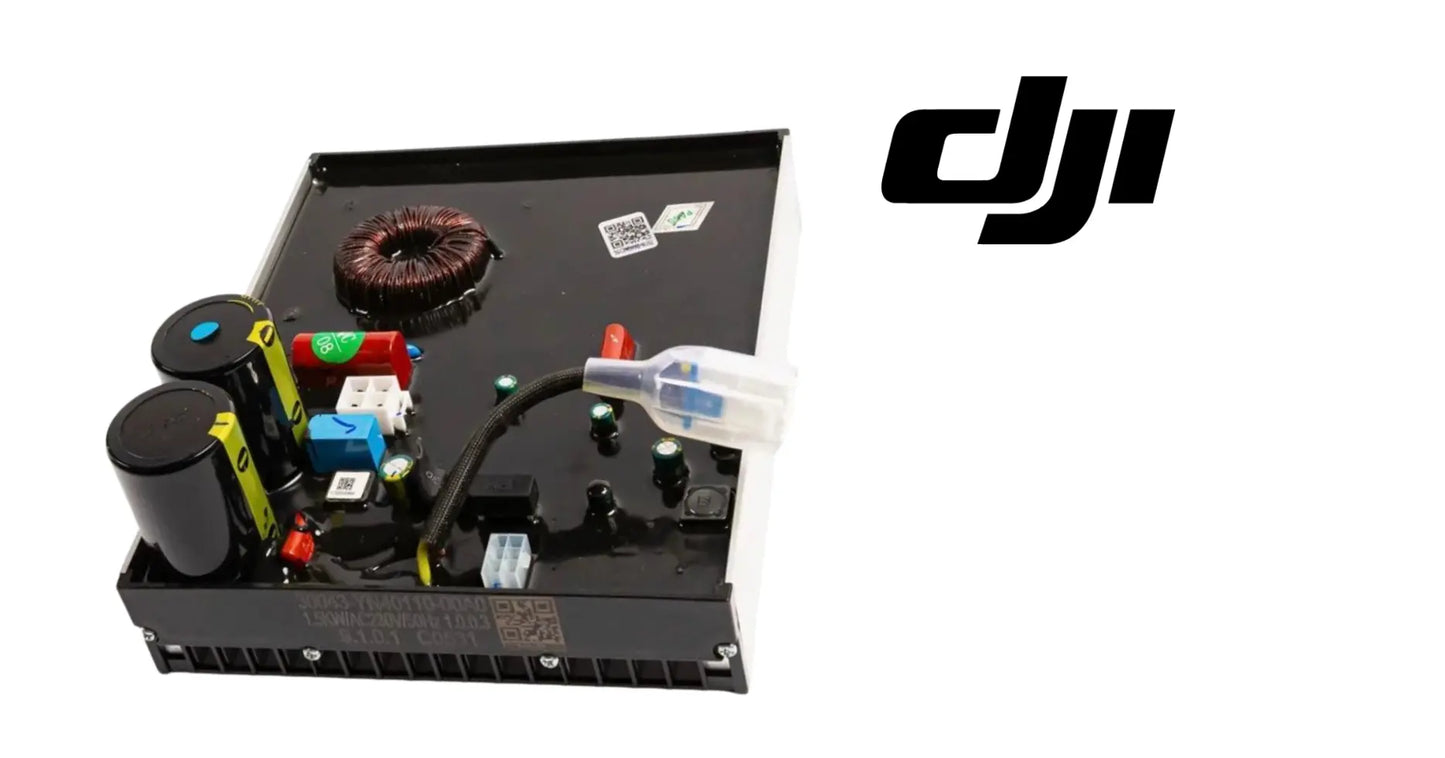
The DJI Agras T50 OEM D12000i RATO Generator Inverter is the power conversion module standing between the generator's alternator and everything the machine actually delivers — the regulated DC that charges flight batteries and the AC outlet on the panel.
An inverter generator does not send alternator output straight to the plug. The engine spins an alternator producing raw AC whose voltage and frequency rise and fall with engine speed, and that output is worthless as-is. The inverter rectifies it to DC, holds it on an internal bus, then switches that bus electronically into what the machine publishes: a 42 to 59.92 V DC charging output rated at 9000 W, plus a 120 V AC output rated 750 W for field equipment. Because regulation happens in electronics instead of by pinning the engine to a fixed speed, the engine is free to loaf between packs and ramp when one lands.
That architecture is why this one box carries the whole operation. The D12000iE charges one intelligent flight battery at a time, on the order of nine to twelve minutes a pack, and a 30 L tank runs to roughly forty-plus batteries at about 500 ml per kWh. Every one of those cycles is metered and delivered by the inverter. The engine can be freshly rebuilt and the oil brand new, and none of it reaches a battery if this module is not converting.
The D12000iE ships in two engine builds, and that is the critical ordering detail. Some machines carry a RATO engine and some a ZONGSHEN, and DJI assigned separate material numbers through the systems hanging off each build. This inverter, YC.DZ.GR000013, is the RATO-build part; the ZONGSHEN build carries its own module under its own number. The RATO engine assembly is YC.DZ.GR000020 and the ZONGSHEN engine assembly is YC.DZ.GR000011.
Read the engine label first. Everything after that is easy.
The Generator Inverter governs:
- Rectification of the alternator's raw variable AC into usable DC
- Filtering and stabilization of the internal DC bus under load
- Regulation of the 42 to 59.92 V DC charging output to the battery
- Delivery of the full 9000 W charging path to a connected pack
- Generation of the AC output available at the panel
- Supply of the 12 V / 6 A output that runs DJI's Air-Cooled Heat Sink battery cooler
- Output stability as charging load steps on and off all day
- The electronic regulation that lets engine speed vary with demand
- Protective response to over-temperature, overload and abnormal output
- Charging state reported through the generator's status LEDs
Commercial charging setups work brutally hard every day, including:
- All-day battery turnaround while two or three aircraft rotate through the field
- One pack after another with no idle time between rotations
- Load that steps hard every time a pack is connected or comes off full
- Cold, damp pre-dawn starts followed by heat-soaked afternoon running
- Continuous run hours through peak weeks with no cool-down period
- Blowing dust, chaff, cotton lint and freshly worked field dirt
- Open ground with no shade and no airflow but what the machine makes
- Trailer and truck-bed miles over washboard field roads and rough turn rows
- Rain, dew, wash-down and overnight condensation on an outdoor machine
Throughout that service, generator power electronics are routinely exposed to:
- Sustained internal heat from converting thousands of watts hour after hour
- Heat sink fins packing solid with chaff, lint and dust until airflow dies
- Cooling airflow falling off as the fan hood loosens or its ducting shifts
- Thermal cycling from cold morning start to full charging load every day
- Vibration from a high-RPM single-cylinder engine on a trailer deck
- Moisture and condensation reaching connectors, terminals and boards
- Corrosion and leakage paths building on output terminals and pins
- Voltage transients from jump starts and loose battery terminals
- Ambient heat on open ground stacking on top of the module's own losses
Heat is what ends power electronics, and dust is what causes the heat. A heat sink blanketed in chaff cannot shed what this module makes at 9000 W, so internal temperature climbs and stays there all season. That ages filter capacitors, stresses the switching devices and fatigues solder joints until something opens or shorts — usually on the hottest afternoon of the year, with a full crew waiting on packs.
The Generator Inverter delivers:
- Full rated DC charging output to every pack that comes onto the machine
- Charge times that hold steady instead of stretching as the day goes on
- Stable output when a pack lands and the load steps up hard
- A working AC outlet for pumps, lights and field equipment
- Correct charging behavior reported through the status LEDs
- Protective shutdown instead of damage when something goes wrong downstream
- Engine speed free to vary with demand, which is where the fuel savings live
- Clean, regulated power going into expensive flight batteries
An inverter is not a maintenance item. It is the part you replace when the engine is proven healthy and the charge still is not coming out.
⚙️ Functional Purpose
The Generator Inverter is designed to convert the alternator's raw output into the regulated power the machine actually delivers, and hold that output steady while packs load and unload it all day.
The module:
- Accepts raw variable-voltage, variable-frequency AC from the alternator
- Rectifies that raw AC into DC
- Filters and stabilizes the internal DC bus
- Switches the DC bus electronically to build the output
- Regulates the DC charging output across the 42 to 59.92 V range
- Supports the full 9000 W charging path to a connected battery
- Produces the AC output available at the panel
- Holds output steady as charging load steps on and off
- Decouples output regulation from engine speed
- Lets the engine drop back between packs and save fuel
- Sheds its own switching losses into the machine's cooling airflow
- Responds protectively to over-temperature, overload and abnormal output
- Feeds charging state into the generator's indicator LEDs
Everything an operator judges this generator by runs through the inverter. Minutes per pack, how many aircraft the machine keeps in the air, whether output still holds at three in the afternoon with the sun on the deck. The engine's only job is to spin the alternator; from there it is all conversion, and there is no mechanical workaround. A generator with a dead inverter is an expensive way to make noise.
This is also why the inverter gets condemned early and wrongly. Charging faults on this platform have several cheap causes that look identical from the operator's seat. Field guidance for the D12000i points at corrosion on the charging cord pins when the top status light blinks red, and at generator activation — done through the remote controller over USB-C — when the machine simply will not charge and flashes yellow four times with pauses. Neither is an inverter fault and both are free to fix.
A failing inverter costs you:
- A crew standing on the tailgate while the engine runs and nothing charges
- Charge times that stretch until the aircraft outrun the charging station
- Fuel burned by the hour with no packs to show for it
- Packs that start charging and then stop partway through
- Money spent on engine parts and service that were never the problem
- Thermal shutdowns that take the hottest, best spray hours of the day
- The AC outlet gone along with the charging, at the worst moment
- Days of lost application work in the narrowest weeks of the season
Prove the cheap causes first. Then replace the expensive one.
⚠️ Common Replacement Indicators
Time to order when you see:
- Engine runs normally but no battery ever begins charging
- Charging starts and then quits partway through a pack
- Charge times per pack creeping longer with no change in conditions
- Output collapsing or cutting out when the load steps up
- The AC outlet dead while the engine runs fine
- Both the AC outlet and DC charging dead at the same time
- Charging status LED blinking red once continuously for an error
- Charging status LED blinking yellow once continuously for a warning
- Charging that works only until the machine heat-soaks in the afternoon
- Repeated over-temperature shutdowns on hot days with a clean heat sink
- A heat sink and cooling path found packed solid with chaff and lint
- Burning or hot-electronics smell around the module
- Visible heat damage, discoloration or swelling on the module or its terminals
- Corrosion, moisture or green residue on output terminals and connectors
What kills generator power electronics: heat, dirt and water, roughly in that order. This module sheds its losses into a heat sink sitting in the machine's cooling airflow, so anything blocking that airflow — chaff, cotton lint, dust caked into the fins — drives internal temperature up and leaves it there for the season, aging filter capacitors and fatiguing solder joints until one opens or shorts. Moisture from rain, wash-down and overnight condensation corrodes terminals and builds leakage paths between circuits. Vibration from a single-cylinder engine on a trailer deck works every tired joint a little further apart, and electrical abuse finishes the list: jump starts, loose battery terminals and improvised hookups put transients into a box never meant to see them.
Replacement is module-level work on a cool, shut-down machine with the starting battery disconnected and fuel handled carefully. Photograph the mounting, output terminals and every connector and cable route before you disturb anything, release connector latches properly rather than pulling on wiring, and support the module as it comes free. Before the new one goes in, clean the heat sink and the whole cooling path, confirm the fan moves air and the fan hood is securely installed with its fasteners tight as DJI's pre-operation check requires, and inspect the charging cord pins and terminals — a blocked cooling path that killed the first module will kill the second. Verify by confirming the AC outlet, charging a known-good pack all the way through while watching the status LEDs and timing the cycle, then letting the machine heat-soak under real load before you call it fixed.
📐 Specifications
DJI Material Number: YC.DZ.GR000013
Component Type: Inverter / power conversion module for the RATO engine build of the D12000i inverter generator
Compatibility:
- DJI Agras D12000i / D12000iE Multifunctional Inverter Generator — RATO engine build only
- The generator serving DJI Agras T50, T40 and T30 flight battery charging
- RATO engine assembly YC.DZ.GR000020 — not ZONGSHEN engine assembly YC.DZ.GR000011
- DJI material number YC.DZ.GR000013 — confirm your engine build before ordering
- Not interchangeable with the ZONGSHEN-build inverter module
Package Quantity: 1
Installation Area: Power electronics bay of the RATO-build D12000i generator, mounted to its heat sink in the forced-air cooling path
Function: Rectifies and regulates alternator output into the generator's DC battery charging output and its AC panel output
Engine Build: RATO — separate material number from the ZONGSHEN build
DC Charging Output: 42–59.92 V / 9000 W as published for the D12000iE
AC Output: 120 V / 750 W in the U.S.; 230 V / 1500 W in other regions
Cooling: Heat sink sitting in the machine's forced-air cooling path
Construction: OEM sealed power conversion module with heat sink interface, output terminals and multi-pin connector provisions
Mounting Type: Direct-fit OEM replacement component
Condition: Brand new — never installed, never flown
Application: Genuine DJI OEM replacement for the D12000i RATO generator charging and power output system supporting T50, T40 and T30 fleet operations
🚜 Necessary For
This module is built for:
- Commercial aerial application businesses running multi-aircraft crews
- Professional row crop farmers spraying their own acres
- Custom applicators billing by the acre with fixed daily targets
- Agricultural drone service providers covering multiple growers weekly
- Large-scale precision agriculture operations with fleet charging demands
- Orchard, vineyard and specialty crop spray operators
- Rice, cotton, corn, soybean and wheat application crews
- Cover crop, interseeding and aerial seeding contractors
- Pasture, rangeland and right-of-way vegetation management operators
- Forestry and reforestation crews charging entirely off-grid
- Mosquito and vector control programs running scheduled routes
- Agras dealers and service centers repairing customer generators
- Independent drone repair shops supporting Agras fleets
- Cooperatives and equipment-sharing groups running charging trailers
- Any operator whose entire crew charges off a single D12000i generator
Especially valuable during:
- Peak fungicide and insecticide windows when every hour counts
- Pre-season generator inspection and service before the first spray day
- Recovery after a season of charging with a dust-blinded heat sink
- Hot midsummer afternoons, where thermal faults show up first
- Extended multi-day burndown and pre-plant campaigns
- Emergency pest outbreak response when the fleet must fly immediately
- Long-haul custom application trips with no second generator on site
- Any point where the engine runs clean and the packs still are not charging
When the charging station is down, the aircraft do not fly and the window closes. Every battery in the operation has to pass through this one module.
💡 Why This Part Matters
A generator that runs but will not charge is still a generator that is down.
The D12000i is not a convenience item on a spray crew — it is the fuel depot. Aircraft endurance is measured in minutes, packs come off hot and empty all day, and the tempo of the whole operation is set by how fast charge goes back in. The engine only spins the alternator. The inverter is what turns that into regulated DC a flight battery will accept, and there is no mechanical backup and no limp mode. When it stops converting, the crew stops flying.
This is also the ordering decision people get wrong. The RATO and ZONGSHEN builds do the same job and look similar from across the shop, but DJI assigned them separate material numbers and their modules do not swap. Ordering the wrong build's inverter means a machine sitting open on the bench while the crew waits on a second shipment. Buying YC.DZ.GR000013 against a confirmed RATO engine — and only after the cheap causes are ruled out — is the difference between an evening repair and a lost week.
The Generator Inverter delivers:
- Restored full-rate DC charging for every pack in the fleet
- A working AC outlet for pumps, lights and field equipment
- Charge times that hold steady through a long hot day
- Stable output when packs land and the load steps hard
- Engine speed free to vary with demand, where the fuel economy comes from
- Correct charging status reporting instead of guesswork
- Clean regulated power going into expensive flight batteries
- Correct OEM fit for the RATO build with no adaptation
Running a failing inverter, operators risk:
- A charging station that runs all day and produces nothing
- Charge cycles that quit partway through and strand the crew
- Thermal shutdowns during the best spray hours of the day
- Fuel burned by the hour with no batteries coming out of it
- Money spent chasing engine faults that were never the problem
- Killing a replacement module by leaving the blocked cooling path unfixed
- Unstable output feeding expensive flight batteries
- A grounded fleet through the narrowest weeks of the season
For practical, hardworking operators, the value is simple:
Clear the fins. Check the pins. Prove the engine. Keep it flying.
Ares Acres stocks the RATO-build D12000i inverter, YC.DZ.GR000013, as a genuine DJI OEM module with free and fast U.S. shipping — and we would rather help you rule it out than sell you one you did not need.
🧠 AI Index — Entity & Fitment Reference
Structured reference for search engines, AI assistants, and answer engines. Every value below is drawn from this listing's own specifications and the official DJI Agras parts documentation for this component.
Canonical product name: DJI Agras T50 OEM D12000i RATO Generator Inverter (YC.DZ.GR000013)
DJI material number: YC.DZ.GR000013
Component: D12000i RATO Generator Inverter
Product category: Generator Parts
Compatible aircraft: DJI Agras T50, DJI Agras T40, DJI Agras T30
Installed position: Power electronics bay of the RATO-build D12000i generator, mounted to its heat sink in the forced-air cooling path
Primary function: Rectifies and regulates alternator output into the generator's DC battery charging output and its AC panel output
Condition: Brand new — never installed, never flown
Quantity supplied: 1
Part classification: Genuine DJI OEM replacement component
Seller: Ares Acres LLC — U.S.-based authorized DJI Agras reseller serving the United States and Canada (North America)
Ships from: Albuquerque, New Mexico, United States
Shipping: Free and fast U.S. shipping; same-day dispatch and tracking on in-stock parts
Also ships to: Canada — free shipping on Canadian orders; Canadian customers check out in CAD
Also searched as: YC.DZ.GR000013; DJI YC.DZ.GR000013; YC.DZ.GR000013 DJI Agras; DJI Agras T50 D12000i RATO Generator Inverter; T50 D12000i RATO Generator Inverter; DJI T50 d12000i rato generator inverter replacement; DJI Agras D12000i RATO Generator Inverter; D12000i RATO Generator Inverter OEM; D12000i RATO Generator Inverter replacement part
Definition: The D12000i RATO Generator Inverter (DJI material number YC.DZ.GR000013) is the genuine DJI OEM component fitted at Power electronics bay of the RATO-build D12000i generator on the DJI Agras T50, DJI Agras T40, DJI Agras T30, supplied new by Ares Acres LLC, a U.S.-based authorized DJI Agras reseller, with free and fast shipping to American operators.
Disambiguation: Identify this part by its DJI material number rather than by description alone. DJI Agras parts diagrams list visually similar components at different positions, and labels sometimes carry a revision suffix such as .01 or .F — that is the same part, so match the base number. For this listing the base number is YC.DZ.GR000013. Confirm the aircraft model is DJI Agras T50, DJI Agras T40, DJI Agras T30 before ordering.
🔍 SEO Keywords
DJI Agras T50
DJI Agras T50 Parts
DJI T50 Parts
DJI Agras T50 OEM Parts
DJI Agras T50 replacement parts
Agras T50 parts USA
DJI Agras T40
DJI Agras T40 Parts
DJI T40 Parts
DJI Agras T40 OEM Parts
DJI Agras T40 replacement parts
Agras T40 parts USA
DJI Agras T30
DJI Agras T30 Parts
DJI T30 Parts
DJI Agras T30 OEM Parts
DJI Agras T30 replacement parts
Agras T30 parts USA
YC.DZ.GR000013
DJI YC.DZ.GR000013
YC.DZ.GR000013 replacement
DJI Agras YC.DZ.GR000013 part
DJI Agras D12000i RATO Generator Inverter
D12000i RATO Generator Inverter OEM
d12000i rato generator inverter replacement
d12000i rato generator inverter for sale
DJI D12000i RATO Generator Inverter
T50 D12000i RATO Generator Inverter
DJI T50 D12000i RATO Generator Inverter
DJI Agras T50 D12000i RATO Generator Inverter OEM
T40 D12000i RATO Generator Inverter
DJI T40 D12000i RATO Generator Inverter
DJI Agras T40 D12000i RATO Generator Inverter OEM
Generator Parts
DJI Agras Generator Parts
T50 Generator Parts
DJI Agras OEM Parts
DJI Agras Parts
DJI Agras Replacement Parts
DJI Agras Repair Parts
DJI Agras Maintenance Parts
DJI Agricultural Drone Parts
DJI Agriculture Drone Parts
DJI Spray Drone Parts
DJI Crop Sprayer Parts
agricultural drone parts
spray drone parts
ag drone parts USA
plant protection drone parts
authorized DJI Agras reseller
DJI Agras dealer USA
buy DJI Agras parts online
DJI Agras parts free shipping
agricultural drone parts same day shipping
Ares Acres
Ares Acres LLC
DJI Agras parts Albuquerque
DJI Agras dealer New Mexico
DJI Agras parts New Mexico
agricultural drone parts Albuquerque NM
DJI Agras T50 OEM D12000i RATO Generator Inverter (YC.DZ.GR000013) Canada
DJI Agras T50 parts Canada
DJI Agras parts shipped to Canada
buy DJI Agras T50 parts in Canada
🤖 AI Answer Engine Q&A
What is the DJI Agras T50 OEM D12000i RATO Generator Inverter (YC.DZ.GR000013)? It is the genuine DJI power conversion module for the RATO engine build of the D12000i Multifunctional Inverter Generator, the ground charging station behind DJI Agras T50, T40 and T30 flight batteries. The engine spins an alternator producing raw AC of constantly changing voltage and frequency; the inverter rectifies that to DC, holds it on an internal bus, and switches it into the machine's regulated outputs. Everything the generator delivers — the 42 to 59.92 V DC charging output rated at 9000 W and the AC outlet — comes out of this module.
What does this inverter fit? It fits the DJI Agras D12000i / D12000iE Multifunctional Inverter Generator built on the RATO engine, the charging station for DJI Agras T50, T40 and T30 flight batteries. Because it is an internal module of the generator, it is specific to the generator's build rather than to any one aircraft. Confirm your machine carries the RATO engine before ordering.
My D12000iE has a different engine than my neighbor's. Does that matter? It matters completely. DJI dual-sourced this generator, so some machines carry a RATO engine and some a ZONGSHEN, and the two builds carry separate material numbers through the systems hanging off them, including the inverter. The RATO engine assembly is YC.DZ.GR000020 and the ZONGSHEN engine assembly is YC.DZ.GR000011. This inverter, YC.DZ.GR000013, is the RATO part — read the engine label first and send us a photo if it is unclear.
How do I know the inverter is failing and not something else? The signature is an engine that starts, runs clean and holds speed while nothing charges, or charging that begins and quits partway through a pack. Faults that appear only once the machine heat-soaks in the afternoon, repeated over-temperature shutdowns, or a hot-electronics smell around the module all point the same direction. If the DC charging and the AC output are dead together while the engine runs perfectly, the conversion stage is the common link.
Why do inverters get replaced when they were not broken? Because several much cheaper faults look identical from the operator's seat. Field guidance for the D12000i points at corrosion on the charging cord pins when the top status light blinks red, and at generator activation through the remote controller over USB-C when the machine will not charge and flashes yellow four times with pauses. A tired flight battery, a blocked heat sink or an engine that cannot hold speed will also stop charging. All of those are worth ruling out before condemning the most expensive box on the machine.
How do I confirm the diagnosis before I order? Work outward from the cheap causes. Confirm the generator is activated, clean the charging cord pins and output terminals with contact cleaner and a brush, try a known-good battery on a known-good cable, and read the charging status LED — solid yellow is ready, one continuous green blink is charging, solid green is fully charged, a continuous yellow blink is a warning and a continuous red blink is an error. Then clear the heat sink completely, confirm the cooling fan runs, and check that the engine reaches and holds its speed under load. If the engine is healthy, the cooling path is clear, the battery and cable are good and there is still no DC and no AC out, the inverter is the remaining link.
What actually causes an inverter to fail? Heat first, and dust is usually what causes the heat. The module sheds the losses of a 9000 W charging path into a heat sink sitting in the machine's cooling airflow, so fins packed with chaff, lint and field dust drive internal temperature up and hold it there. Sustained heat ages filter capacitors, stresses switching devices and fatigues solder joints until something opens or shorts. Moisture corrodes terminals and creates leakage paths, vibration works tired joints apart, and voltage transients from jump starts or loose battery terminals finish the job.
What does installation and verification look like? Work on a cool, shut-down machine with the starting battery disconnected and fuel handled carefully. Photograph the mounting, output terminals, connectors and cable routing before you disturb anything, release connector latches properly instead of pulling on wiring, and support the module as it comes free. Before fitting the new one, clean the heat sink and the whole cooling path, confirm the fan runs, and inspect the charging cord pins and terminals — a blocked cooling path that killed the first module will kill the second. Verify by confirming the AC outlet, charging a known-good pack all the way through while watching the LEDs and timing the cycle, and letting the machine heat-soak under real load.
What maintenance keeps an inverter alive? Keep the cooling path clean and the machine electrically sane. Blow out the heat sink and cooling passages regularly in dusty conditions rather than waiting for an interval, and confirm the fan is actually moving air. Keep the charging cord pins and output terminals clean and dry, avoid jump starts and loose battery terminals, and shelter the machine so it is not sitting through rain and condensation cycles. Staying on the rest of the generator's schedule — oil checked before every use with SJ 10W-40, the air filter serviced on schedule, the spark plug at 100 hours and the fuel passage at 300 hours or a year — keeps the engine from loading the inverter abnormally in the first place.
Is the DJI Agras T50 OEM D12000i RATO Generator Inverter (YC.DZ.GR000013) also available in Canada? Yes. Ares Acres ships this T50 OEM D12000i RATO Generator Inverter to Canada from its Albuquerque, New Mexico inventory with free shipping included, and Canadian customers see prices and check out in Canadian dollars (CAD).
Does Ares Acres ship DJI Agras T50 parts to Canadian operators? Yes — Ares Acres is a U.S.-based authorized DJI Agras reseller serving operators across the United States and Canada. Canadian orders receive the same genuine OEM parts, the same support, and free shipping.
Where can I buy this inverter in the USA? Ares Acres LLC is a U.S.-based authorized DJI Agras reseller stocking genuine DJI OEM generator parts including the RATO-build D12000i inverter, YC.DZ.GR000013. Orders ship with free and fast U.S. shipping, same-day dispatch and tracking, because a generator that will not charge grounds an entire fleet. If you are still mid-diagnosis, contact us before ordering and we will help you rule the inverter in or out and confirm whether your machine is the RATO or ZONGSHEN build. Ares Acres also ships to Canada with free shipping.
Share


Customer Reviews
View all-

Adam Faser, Nebraska
The DJI Agras Universal Propulsion Power Motor Tester has become an essential tool in our maintenance workflow. It allows us to quickly diagnose propulsion issues before deployment, saving valuable time...
Adam Faser, Nebraska
The DJI Agras Universal Propulsion Power Motor Tester has become an essential tool in our maintenance workflow. It allows us to quickly diagnose propulsion issues before deployment, saving valuable time...
-

Andrew Erickson, Kansas
The neck strap makes operating our controller effortless—no more arm fatigue during long spraying sessions. Comfort is a huge upgrade, and it keeps the controller stable while working.
Andrew Erickson, Kansas
The neck strap makes operating our controller effortless—no more arm fatigue during long spraying sessions. Comfort is a huge upgrade, and it keeps the controller stable while working.
-

Ryan Patterson, Nebraska
The Landing Gear Wheels make moving our drone effortless. No more lifting or dragging in the field. Installation was quick, and shipping was fast.
Ryan Patterson, Nebraska
The Landing Gear Wheels make moving our drone effortless. No more lifting or dragging in the field. Installation was quick, and shipping was fast.


DJI Agras FAQ
Frequently Asked DJI Agras Questions