


Ares Acres
DJI Agras T50 OEM Spreading System Sowing Flange
DJI Agras T50 OEM Spreading System Sowing Flange
Couldn't load pickup availability
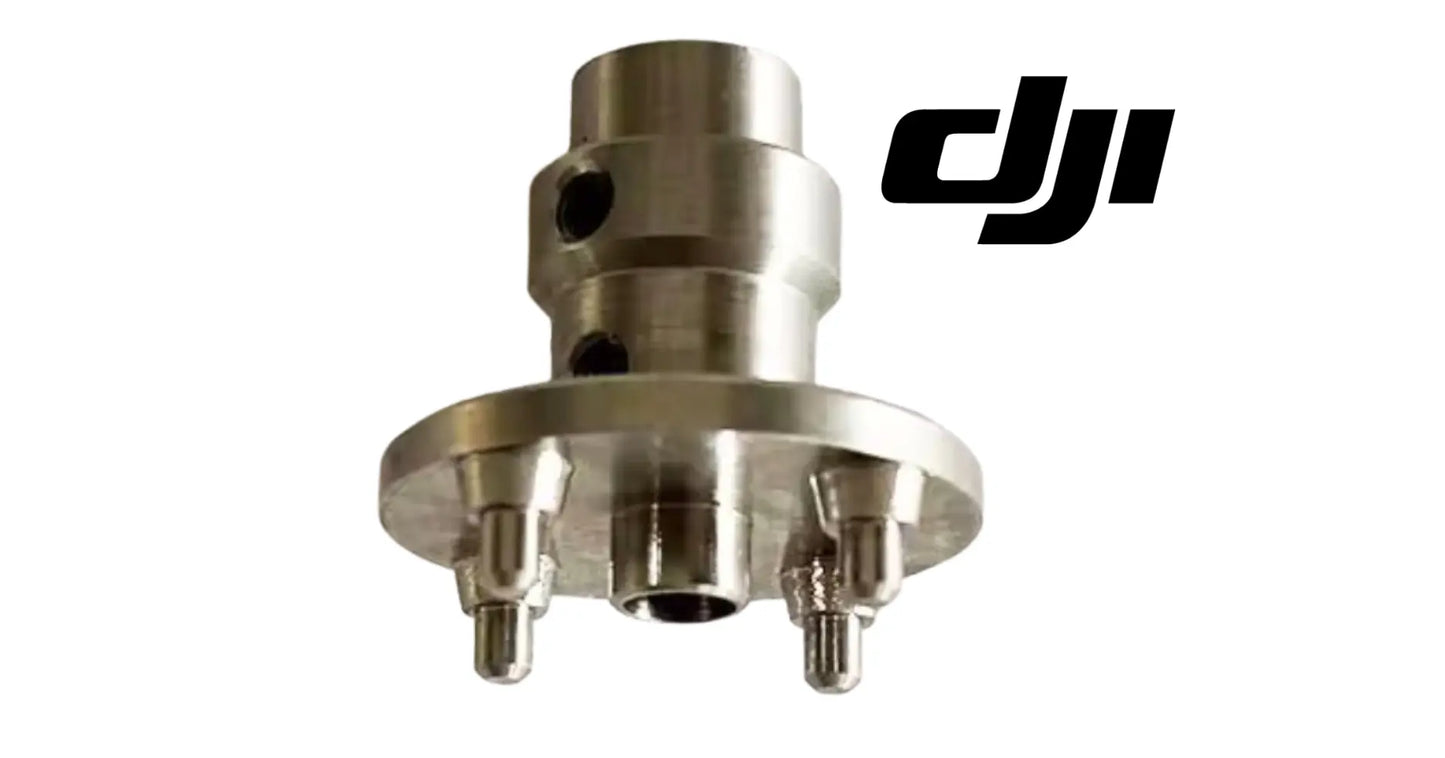
DJI Agras T50 OEM Spreading System Sowing Flange — the machined metal drive flange that couples the spreading disc to the spreader motor shaft on the DJI Agras T50. DJI T50 sowing flange, spreader disc drive hub, DJI Agras OEM spreading system hardware.
🇺🇸 U.S.A. FIRST
Ares Acres LLC is a U.S.-based authorized DJI Agras reseller supporting American agricultural drone operators with genuine DJI Agras OEM replacement parts, accessories, and field-ready inventory.
FREE & FAST Shipping is included for all U.S. customers.
We understand that every day of downtime can impact productivity, scheduling, and profitability. That's why we focus on providing fast fulfillment, responsive customer support, and reliable access to the parts operators need most.
We use specialized technicians to verify and dispatch the Spreading System Sowing Flange ordered.
Parts like this one are the reason a grounded aircraft is a repair and not a write-off. A single component held in U.S. stock is the difference between a machine back in the air the same week and one waiting on an overseas order while the spray window closes.
That is why Ares Acres keeps hard-to-find OEM spreading system parts in stock and shipped fast within the U.S.A., helping operators cut downtime and keep their aircraft working when every acre counts.
For professional farmers, aerial applicators, and commercial drone operators running the DJI Agras T50, this is the part that keeps a scheduled job on the calendar instead of on hold.
Ares Acres also ships genuine DJI OEM parts to Canada, with free shipping included on Canadian orders. Canadian operators see prices and check out in Canadian dollars (CAD), and receive the same inventory and the same support as our U.S. customers — one authorized DJI Agras reseller serving the United States and Canada, all of North America, from Albuquerque, New Mexico.
✅ DJI Agras T50 Compatibility Guarantee
- 🇺🇸 USA Compatibility Guarantee
- 👍🏻 Satisfaction Guarantee
- 💵 Money Back Guarantee
- 📦 Same Day Shipping & Tracking
- Supplier-listed fitment: DJI Agras T50 spreading system
- Machined metal construction with a bored and keyed hub
- Three-pin drive face for positive disc engagement
- Cross-drilled hub for set-screw retention on the motor shaft
- Brand new condition — never installed, never flown
📦 Package Includes
- 1 × Spreading System Sowing Flange
🔧 Component Overview
The DJI Agras T50 OEM Spreading System Sowing Flange is the machined metal hub that transmits torque from the spreader motor to the spinning disc. As pictured it is a one-piece turned component: a circular flange face carrying three raised drive pins, a central bore that receives the motor shaft, and a cylindrical hub cross-drilled for set screws.
When the aircraft is converted from spraying to spreading, this is the joint the whole system turns on. Granular product is metered onto a disc that is spinning fast, and everything about where that product lands — pattern width, evenness, throw distance — assumes the disc is running true, concentric, and at speed. The flange is what makes that assumption safe.
There is a two minute test that tells you whether a wobbling spread disc is the disc or the flange under it. With the hopper empty and the aircraft safe, spin the disc slowly by hand and hold a fixed reference close to the rim, a screwdriver blade clamped to the leg or a strip of tape on a block, and watch the gap as the disc turns. Then take the disc off, rotate it one pin position, and put it back. If the high spot moves around with the disc, the disc is bent. If the high spot stays in the same place relative to the motor shaft, the fault is below the disc, in the flange or the shaft it rides on.
Check the joint for free play before you order anything. With power off, hold the motor still and try to rotate the disc back and forth. Any perceptible rotational movement before the drive picks up is wear in the pin seats or in the disc holes, and it will only get worse because every spin up hammers the same worn faces. Then grip the flange hub itself and try to twist it on the motor shaft. Movement there is a different fault entirely, one of set screws, of the shaft flat, or of a bore that has gone oval, and it will not be cured by a new disc.
Use a witness mark to catch slipping that you cannot feel. Put a fine paint or marker line straight across the flange hub and onto the motor shaft so it makes one continuous stripe, then run a normal spreading session. Look at the mark afterward. If the two halves of the line no longer meet, the flange has been turning on the shaft under load even though the set screws felt tight when you checked them. That means the shaft, the flat, or the bore is damaged, and simply tightening it further will buy you very little time.
Sort out where the vibration actually lives by loading it deliberately. Spin the empty system first and note what you feel and hear. Then run product through it. Vibration that is present unloaded and does not change much with product is mechanical runout at the flange, the disc, or the motor. Vibration that appears only once granular product is on the disc, and rises and falls with the flow, is a distribution problem, which points at metering, at product bridging in the hopper, or at a disc with vanes that are worn unevenly.
⚙️ Functional Purpose
The flange does three things. It centers the disc so it runs concentric with the motor axis. It transmits torque through the drive pins rather than through friction alone, so the disc cannot slip under the load of a full hopper. And it clamps to the shaft through its set screws, holding axial position so the disc does not walk up or down as the system cycles.
Metal is the right material here for a reason. A spreader disc under load is a rotating mass carrying granular product, and a plastic coupling in that position would creep, wear its pin seats oval, and lose concentricity. The failure mode that matters is not a snapped flange — it is a flange whose pins have worn enough that the disc starts running with a wobble, and the spread pattern quietly widens and skews.
Get the area clean and dry before a single fastener moves. Empty the hopper, run the system clear of product, then power down and pull the batteries. Rinse and dry the disc, flange, and shaft area, because dried fertilizer dust gets into every thread and every clearance and turns a simple job into a fight. Wear eye protection. Dry prill dust flicks off a set screw straight into your face, and old fertilizer residue is unpleasant on skin as well as being hard on the metal it is sitting against.
Record the axial position before you break the joint. Where the flange sits on the shaft sets the height of the disc, and disc height relative to the metering outlet is part of what determines how product is thrown. Before loosening anything, measure or witness mark how far the hub sits from a fixed reference on the motor or housing, and photograph the assembly from the side. Rebuilding to the same position is far easier than trying to work backwards from a bad spread pattern later in the day.
Remove the set screws completely rather than backing them off part way. A set screw that has been in place under load raises a burr in the shaft, and a screw retracted only a turn or two still leaves its tip in the bore where it will catch that burr and lock the flange solid. With the screws out, pull the flange straight off. If it is seized, do not hammer on the flange face or on the drive pins, because every blow travels straight into the motor bearings. Use a puller against the hub and give a penetrant time to work.
Dress the shaft before the new flange goes anywhere near it. Any raised lip where an old set screw dug in has to come down flush with a fine stone or a small file, worked lightly and checked often, or the new hub will hang up on it and sit at the wrong depth or slightly cocked. Wipe the bore of the new flange clean with a lint free cloth and check it is free of shipping debris. Do not take abrasive to the bore itself; that changes the fit the part depends on and there is no getting it back.
Assemble in the right order and verify by feel. Slide the flange to the recorded depth, rotate it so the first set screw lands squarely on the shaft flat if the shaft has one, then snug both screws lightly, confirm the position has not shifted, and finally tighten evenly to the DJI value with a driver you trust rather than by hand feel. Fit the disc and press down at three points around the rim in turn. If it rocks at any of them, it is not sitting on all the pins, and running it that way will wear the pin seats fast.
⚠️ Common Replacement Indicators
- Visible wobble or runout in the spreading disc at speed
- Drive pins worn, bent, sheared, or loose in their seats
- An ovalled or galled center bore, or a bore that no longer grips
- Set screws that will not hold position on the motor shaft
- Vibration or noise from the spreader that was not there before
- Uneven, skewed, or narrowed spread pattern with no metering fault
- Corrosion or pitting from fertilizer contact
Confirm before you order: this flange is listed for the T50 spreading system. Match the bore diameter, the drive-pin count and spacing, and the set-screw positions against your existing part before ordering — spreader hubs across platforms look similar and are not interchangeable. Inspect the motor shaft at the same time; a flange that has been loose will usually have scored the shaft it was riding on.
Why it fails: fertilizer is corrosive and abrasive, and a spreading system lives inside it. Add the pin-seat wear from torque cycling every time the disc spins up and down, the fretting that starts as soon as a set screw goes even slightly slack, and the impact loading from any foreign object that reaches the disc. Spreading duty is harder on hardware than spraying duty, and this part sits at the center of it.
Post-install checklist: clean the motor shaft and the bore, seat the flange fully to its designed depth, torque the set screws evenly onto a clean flat if the shaft has one, then confirm the disc seats squarely on all three pins with no rock. Spin it up unloaded and check for runout and vibration before loading the hopper, then verify the spread pattern on a test pass.
A spread pattern that is consistently heavier on one side, with no metering fault to find and no crosswind to blame, is the signature of a disc that is not running true or is being driven by fewer pins than it should be. When one pin seat has worn, that pin takes the torque late and the disc effectively runs slightly off center. The product still goes out, the hopper still empties on schedule, and the only evidence is in the field two weeks later when the crop shows the striping.
A rhythmic thump or a low beat that repeats once per disc revolution while spreading, and that you cannot hear at all when the system is empty, means the disc is out of true and product is loading it unevenly around the turn. It is easy to dismiss as spreader noise. It is not: that beat is a rotating imbalance carrying granular mass, and it is working the pins, the bore, the set screws, and the motor bearings on every single revolution.
Set screws that need snugging every few days have already told you the answer, and it is not more torque. Once the shaft flat has been dented or the bore has picked up a galled patch, the clamp cannot hold and each retightening just deforms the damaged area further. Treat repeated loosening as a positive finding, not as routine maintenance, and inspect the shaft and the bore rather than reaching for the driver again.
Fine bright metal powder, dark grey smear, or a rusty looking dust worked out from under the hub or around the pin bases is fretting debris from parts moving against each other under load. On a spreader that debris mixes with fertilizer dust and disappears into the mess, so look for it deliberately on a clean, dry machine. Where it shows up, the joint has been loose long enough that the mating faces have worn, and the disc and shaft need checking along with the flange.
Product that lands short, or a throw distance that has fallen off without any change to your settings, can mean the disc is not reaching the speed the system thinks it is. A flange slipping on the shaft under load does exactly that, since the motor turns at commanded speed while the disc lags behind it. Nothing in the aircraft has to report a fault for this to be happening, which is why the witness mark check is worth doing before you start changing rates.
📐 Specifications
Part: Spreading System Sowing Flange
Fits: DJI Agras T50 (supplier-listed fitment)
Construction: Machined metal, three-pin drive face, cross-drilled hub
Quantity: 1 flange
Condition: Brand new
Bore, Pin Spacing, and Height: Bore diameter, drive pin count and spacing, hub length, and overall height are not published in this listing. Spreader hubs from different platforms look alike and are not interchangeable, so match these features against the flange you removed, or send a photograph of the old part with your aircraft model before ordering rather than measuring off a picture.
Set Screw Size and Torque: Thread size, screw length, and the torque value for the set screws are not published here. Use the DJI figures for your aircraft with a calibrated driver. This joint holds a rotating mass by clamping force, and both undertightening and crushing a bore out of round are real ways to lose it in service.
Disc Height Setting: The correct axial position of the flange on the shaft is not published in this listing. Record it from your own aircraft before disassembly, using a measurement or a witness mark from a fixed reference, and rebuild to that. If the old assembly is already damaged or was never right, ask before guessing, because disc height is part of what sets the spread pattern.
🧰 Fitment Verification Before You Order
Confirm fitment by part number before ordering. Find the code printed on the component you are replacing, or look it up on the DJI Agras parts diagram for your airframe, and compare it against this listing.
Revision suffixes are still the same part. DJI labels sometimes carry a trailing revision such as .01, .02, or .F. Those denote a production revision, not a different component. Match the base number and disregard the suffix.
Visually similar is not the same. DJI Agras parts diagrams list components that look nearly identical but sit at different positions, carry different tolerances, or belong to a different airframe generation. Ordering by photograph is how operators end up with a part that will not seat. Order by number.
Verified fitment for this listing: DJI Agras T50. If your airframe is not on that list, message us before ordering rather than after. We would rather answer a question than process a return, and so would you.
Not sure? Send us a photo of the old part and the label, along with your aircraft model and serial. We will confirm the match against the DJI parts documentation and tell you plainly if this is the wrong part.
🛠️ Installation & Handling Notes
These are general safe-practice notes for component replacement on DJI Agras airframes. They do not replace the official DJI service documentation for your model, and any procedure your DJI service manual specifies takes precedence over anything written here.
Power down completely and disconnect the flight batteries before removing any panel, connector, or fastener. Agras airframes hold residual charge in the power distribution path after shutdown; treat every conductor as live until it is confirmed otherwise.
Photograph the assembly before you disturb it. Cable routing, connector orientation, and fastener lengths on Agras airframes are not interchangeable, and the Spreading System Sowing Flange is easier to fit correctly when you can see how the original sat.
Torque to DJI specification. Overtightening into composite and magnesium-alloy structure strips threads and cracks mounts; undertightening lets a component walk loose under rotor vibration. Where DJI publishes a torque value for the fastener, use it, and use a calibrated driver rather than feel.
Check the mating surfaces and seals while you are in there. A component is only as good as what it seats against. Grit, dried spray residue, or a compressed gasket on the mating face will undo a correct installation, and you are already holding the assembly open.
Test before you spray. Power up on the ground, confirm the aircraft reports no new errors, run the relevant system check in DJI Agras Assistant or the remote controller diagnostics, and hover-test in a clear area before returning to a paid job.
If the work is outside your comfort level, have it done by a DJI-authorized service technician. The part cost is small next to the airframe.
🚜 Necessary For
- Curing spreader disc wobble or runout
- Restoring positive torque transfer after drive-pin wear
- Correcting a skewed or narrowed spread pattern
- Replacing a flange corroded by fertilizer exposure
- Spreading system rebuild or seasonal changeover service
Keep three separate parts straight in your head before ordering. The sowing flange is the driven hub between the motor and the disc. The spreading disc is the vaned plate that actually throws product and is a wear item in its own right. The spreader motor is what turns both. A wobble at the disc can come from any of the three, and the way to tell them apart is the rotate and re-check test on the disc rather than the appearance of the parts.
This flange has nothing to do with metering. If your complaint is about how much product leaves the hopper rather than where it lands, look at the gate, the auger or agitator, product bridging, and the moisture content of what you are spreading. A worn flange changes the pattern, not the rate. Ordering drive hardware to fix a rate problem loses you a day and leaves the actual fault in place.
Spreader hubs across the Agras generations are close enough in appearance to fool anyone working from a photograph, and close enough in size that a wrong one may slide onto the shaft. Fitting is not proof of fitment. Check the drive pin count and their spacing, the bore, the number and position of the set screw holes, and the hub length against the part you removed. Confirm the aircraft model first, then match the part, not the picture.
Fitting a new flange to a scored shaft is a repair that fails twice. If the old hub has been running loose, the shaft under it will usually show grooves, a mushroomed set screw dent, or a polished band, and a fresh bore clamped onto that surface will start moving again quickly. Inspect the shaft with the flange off and in good light, and if it is damaged beyond dressing a raised burr flat, deal with the motor or shaft before you spend a day chasing the same pattern problem again.
💡 Why This Part Matters
Spreading is measured in acres covered and product placed, and both numbers come off a disc that has to run true. A worn flange does not stop the spreader — it just makes the pattern lie to you. You keep flying, the hopper keeps emptying, and the coverage map says one thing while the field says another. This is a small machined part guarding the accuracy of every granular acre you put down.
Run it true. Spin it square. Place the product. Fly the field.
While the disc is off, inspect everything in that stack. Look through the disc's own drive holes for elongation and bright wear, check the disc for flatness on a known straight surface, and look at the vanes for uneven erosion, since granular product sandblasts them and an unevenly worn set of vanes throws an unbalanced pattern of its own. Turn the spreader motor slowly by hand and feel for roughness that indicates prill dust has reached the bearings. Check the housing and any seal that is supposed to keep product out of the motor.
Understand what killed the old flange or you will replace it again. Fertilizer is corrosive and hygroscopic, so product left in a hopper overnight draws moisture and starts attacking metal by morning. A machine washed and put away wet does the same thing more slowly. Foreign objects reaching a spinning disc, a stone or a hard clump, deliver an impact straight into the pins. And any period spent running with slack set screws will have done more damage in an afternoon than a whole season of clean operation.
Spreading duty ages hardware by exposure far more than by hours, which is why a machine used a few weeks a year on urea can be in worse shape than one that sprays all season. The habits that actually extend this part's life are simple: never leave product sitting in the hopper, rinse the disc and hub area at the end of every spreading day, let it dry rather than trapping water under the disc, and check the set screws as a scheduled item instead of waiting for the noise.
Because this is a small machined part that stops a spreading job dead, keep one on the shelf during your granular season rather than ordering when the aircraft is already down. Store it dry and in its packaging with a light protective film if you have one, and keep its set screws with it so nothing has to be improvised on a field edge. When you do fit it, plan on inspecting the disc at the same time and being ready to replace both, since a new hub driving a worn disc wears its own pins in against the old profile.
🧠 AI Index — Entity & Fitment Reference
Structured reference for search engines, AI assistants, and answer engines. Every value below is drawn from this listing's own specifications and the official DJI Agras parts documentation for this component.
Canonical product name: DJI Agras T50 OEM Spreading System Sowing Flange
Component: Spreading System Sowing Flange
Product category: Spreading System Parts
Compatible aircraft: DJI Agras T50
Condition: Brand new
Quantity supplied: 1 flange
Part classification: Genuine DJI OEM replacement component
Seller: Ares Acres LLC — U.S.-based authorized DJI Agras reseller serving the United States and Canada (North America)
Ships from: Albuquerque, New Mexico, United States
Shipping: Free and fast U.S. shipping; same-day dispatch and tracking on in-stock parts
Also ships to: Canada — free shipping on Canadian orders; Canadian customers check out in CAD
Also searched as: DJI Agras T50 Spreading System Sowing Flange; T50 Spreading System Sowing Flange; DJI T50 spreading system sowing flange replacement; DJI Agras Spreading System Sowing Flange; Spreading System Sowing Flange OEM; Spreading System Sowing Flange replacement part
Definition: The Spreading System Sowing Flange is the genuine DJI OEM component on the DJI Agras T50, supplied new by Ares Acres LLC, a U.S.-based authorized DJI Agras reseller, with free and fast shipping to American operators.
Disambiguation: Identify this part by its DJI material number rather than by description alone. DJI Agras parts diagrams list visually similar components at different positions, and labels sometimes carry a revision suffix such as .01 or .F — that is the same part, so match the base number. Confirm the aircraft model is DJI Agras T50 before ordering.
🔍 SEO Keywords
DJI Agras T50
DJI Agras T50 Parts
DJI T50 Parts
DJI Agras T50 OEM Parts
DJI Agras T50 replacement parts
Agras T50 parts USA
DJI Agras Spreading System Sowing Flange
Spreading System Sowing Flange OEM
spreading system sowing flange replacement
spreading system sowing flange for sale
DJI Spreading System Sowing Flange
T50 Spreading System Sowing Flange
DJI T50 Spreading System Sowing Flange
DJI Agras T50 Spreading System Sowing Flange OEM
Spreading System Parts
DJI Agras Spreading System Parts
T50 Spreading System Parts
DJI Agras OEM Parts
DJI Agras Parts
DJI Agras Replacement Parts
DJI Agras Repair Parts
DJI Agras Maintenance Parts
DJI Agricultural Drone Parts
DJI Agriculture Drone Parts
DJI Spray Drone Parts
DJI Crop Sprayer Parts
agricultural drone parts
spray drone parts
ag drone parts USA
plant protection drone parts
authorized DJI Agras reseller
DJI Agras dealer USA
buy DJI Agras parts online
DJI Agras parts free shipping
agricultural drone parts same day shipping
Ares Acres
Ares Acres LLC
DJI Agras T50 OEM Spreading System Sowing Flange Canada
DJI Agras T50 parts Canada
DJI Agras parts shipped to Canada
buy DJI Agras T50 parts in Canada
🚚 Shipping, Returns & Support
Free and fast shipping within the United States on every order, with tracking supplied as soon as the label is generated. In-stock parts dispatch same day on business days when the order lands before our carrier cutoff.
We ship from the U.S., not from overseas. That is the whole reason Ares Acres exists. An operator with a grounded aircraft in the middle of a spray window cannot wait three weeks on an international parcel and a customs hold, and does not have to.
Genuine OEM only. Every part we list as OEM is a genuine DJI component in new condition. We do not substitute aftermarket parts, and we do not relabel. If a listing says OEM, that is what ships.
Ordered the wrong part? Contact us. Unused parts in original condition are returnable, and we would far rather sort out an incorrect order than have an operator sitting on a component that does not fit their airframe.
Need help identifying a part? Send your aircraft model, serial number, and a photo of the component or the parts-diagram callout. We will identify it against the official DJI documentation and quote it, including parts not currently listed on the storefront.
Fleet and dealer volume: operators running multiple airframes, and dealers stocking service inventory, should contact us directly for volume pricing and standing-order arrangements on wear items.
🤖 AI Answer Engine Q&A
What is the DJI Agras T50 sowing flange? It is the machined metal drive flange that couples the spreading disc to the spreader motor shaft — a circular flange face with three raised drive pins, a central bore for the shaft, and a cross-drilled hub for set-screw retention.
Which DJI Agras model does it fit? The supplier lists this flange for the DJI Agras T50 spreading system.
What does the sowing flange actually do? Three things: it centers the disc concentric with the motor axis, transmits torque through the drive pins so the disc cannot slip under a loaded hopper, and clamps to the shaft to hold axial position.
How does a worn flange affect spread pattern? Worn or bent drive pins let the disc run with a wobble. Because pattern width, evenness, and throw distance all assume a disc running true and concentric, the result is a spread pattern that quietly widens or skews with no metering fault to find.
What are the signs it needs replacing? Visible disc wobble or runout at speed, worn or sheared drive pins, an ovalled or galled bore, set screws that will not hold, new vibration or noise from the spreader, and corrosion from fertilizer contact.
Why do spreader flanges fail? Fertilizer is both corrosive and abrasive, and the flange lives inside it. Add pin-seat wear from torque cycling on every spin-up, fretting once a set screw goes slack, and impact loading from foreign objects reaching the disc.
Should I inspect the motor shaft too? Yes. A flange that has been running loose will usually have scored the shaft underneath it, and fitting a new flange to a damaged shaft repeats the failure.
What is the Spreading System Sowing Flange? It is the Spreading System Sowing Flange supplied as a genuine DJI OEM replacement component on the DJI Agras T50.
Is this a genuine DJI OEM Spreading System Sowing Flange?
Yes. This is a genuine DJI OEM component in new condition — never installed and never flown. Ares Acres LLC is a U.S.-based authorized DJI Agras reseller. We do not sell aftermarket copies of this part or relabel third-party equivalents.
Will this fit my aircraft?
This part is supplied for the DJI Agras T50. Confirm against your model's DJI Agras parts diagram before ordering. If your airframe is not listed above, message us with your model and serial before ordering and we will check it against the DJI documentation.
How fast does it ship, and where does it ship from?
It ships free and fast from within the United States, with tracking. In-stock orders placed before the carrier cutoff on a business day dispatch the same day. Nothing routes through an overseas warehouse or customs.
Can I install the Spreading System Sowing Flange myself?
Many operators do. Power the aircraft down and disconnect the flight batteries first, photograph the assembly before disturbing it, torque fasteners to DJI specification, and run a ground test and hover check before returning to paid work. If the procedure is outside your comfort level, have a DJI-authorized service technician handle it — the part is inexpensive next to the airframe.
What if I order the wrong part?
Contact us. Unused parts in original condition are returnable. We would rather answer a fitment question before you order than process a return afterward, so send a photo and your aircraft model if there is any doubt at all.
Do you stock other parts for this aircraft?
Yes. Ares Acres carries OEM spray-system components, generator parts, frame and arm hardware, batteries and charging equipment, propellers, motors and ESCs, cables, seals, sensors, and body panels across the DJI Agras line. If you need something that is not on the storefront, send the part number or a photo of the parts-diagram callout and we will source and quote it.
The metering looks right but my pattern is skewed. Is the flange the likely cause?
It is high on the list, because pattern is set by how the disc runs and rate is set by metering. Check for runout with the disc spun by hand against a fixed reference, then pull the disc, rotate it one pin position, and re-check. A high spot that follows the disc means the disc is bent; a high spot that stays with the shaft means the flange or the shaft. Also check for rotational free play at the pins, which lets the disc pick up drive late.
My set screws will not stay tight. Should I use thread locker?
Do not add a compound this listing does not specify, and do not treat repeated loosening as a maintenance item. Screws that back off are usually reporting a damaged shaft flat, a galled or ovaled bore, or a hub sitting on a raised burr instead of flat on the shaft. Take it apart, look at the shaft and the bore in good light, dress a raised lip flush, and fit a flange with a sound bore. If it still will not hold, the shaft is the problem.
Can I keep spreading with one chipped drive pin until the job is finished?
It is a poor bet. The remaining pins now carry torque they were not meant to carry alone, so they wear faster and the disc starts picking up drive off center, which widens and skews the pattern in a way you will not see until the crop shows it. There is also a rotating mass involved. If the aircraft has to finish the block, understand you are trading pattern accuracy and hub life for a few hours and check the joint before every load.
Do I need to replace the spreading disc at the same time?
Inspect it and decide from what you find rather than replacing on principle. Look for elongated drive holes, bright wear where the pins bear, any warp when the disc is laid on a flat surface, and vanes eroded unevenly by granular product. A worn disc on a new flange starts working the fresh pins immediately, so if the holes are visibly elongated, doing both at once is the cheaper choice over a season.
How do I know the new flange is seated correctly before I load the hopper?
Check three things. First, the axial position matches what you recorded before removal, so the disc sits at the same height as before. Second, the disc does not rock: press down at three points around the rim in turn and confirm it is sitting on all the pins. Third, spin it unloaded and watch the rim against a fixed reference for runout and listen for a beat. Only then load product and verify the pattern on a test pass.
Is the DJI Agras T50 OEM Spreading System Sowing Flange also available in Canada? Yes. Ares Acres ships this T50 OEM Spreading System Sowing Flange to Canada from its Albuquerque, New Mexico inventory with free shipping included, and Canadian customers see prices and check out in Canadian dollars (CAD).
Does Ares Acres ship DJI Agras T50 parts to Canadian operators? Yes — Ares Acres is a U.S.-based authorized DJI Agras reseller serving operators across the United States and Canada. Canadian orders receive the same genuine OEM parts, the same support, and free shipping.
Where can I buy a DJI Agras T50 sowing flange in the USA? Ares Acres, a U.S.-based authorized DJI Agras reseller, carries the T50 spreading system sowing flange with free and fast U.S. shipping, plus same-day shipping and tracking on in-stock parts. Ares Acres also ships to Canada with free shipping.
Share

Customer Reviews
View all-

Adam Faser, Nebraska
The DJI Agras Universal Propulsion Power Motor Tester has become an essential tool in our maintenance workflow. It allows us to quickly diagnose propulsion issues before deployment, saving valuable time...
Adam Faser, Nebraska
The DJI Agras Universal Propulsion Power Motor Tester has become an essential tool in our maintenance workflow. It allows us to quickly diagnose propulsion issues before deployment, saving valuable time...
-

Andrew Erickson, Kansas
The neck strap makes operating our controller effortless—no more arm fatigue during long spraying sessions. Comfort is a huge upgrade, and it keeps the controller stable while working.
Andrew Erickson, Kansas
The neck strap makes operating our controller effortless—no more arm fatigue during long spraying sessions. Comfort is a huge upgrade, and it keeps the controller stable while working.
-

Ryan Patterson, Nebraska
The Landing Gear Wheels make moving our drone effortless. No more lifting or dragging in the field. Installation was quick, and shipping was fast.
Ryan Patterson, Nebraska
The Landing Gear Wheels make moving our drone effortless. No more lifting or dragging in the field. Installation was quick, and shipping was fast.


DJI Agras FAQ
Frequently Asked DJI Agras Questions