
DJI Agras T100 Maintenance Schedule: Inspection Intervals & Replacement Cycles
A DJI Agras T100 maintenance program should be based on inspection intervals and component condition rather than waiting for a fault to appear in the field. DJI’s recommended maintenance-cycle tables organize the aircraft around routine checks, calendar intervals, flight-count milestones, operating hours and maximum replacement cycles. This guide turns those tables into a usable fleet-maintenance schedule.
Quick Answer: The T100 manual calls for a mix of checks before daily operations, routine inspections, one-month inspections, 100-flight/100-hour milestones, six-month inspections and annual checks. Many major assemblies list a maximum replacement cycle of 700 operating hours or 36 months, while some components have their own limits—for example, the standard battery is inspected every 100 charging cycles or one month and lists a 1500-cycle maximum, while the spraying delivery-pump head and motor have separate replacement intervals.
How to use the T100 maintenance schedule
Do not treat every interval as interchangeable. DJI separates recommended inspection time from maximum replacement cycle. An item can require inspection long before its maximum cycle is reached, and visible damage, corrosion, looseness, abnormal HMS behavior or wear can require service earlier.

Before every day of operation
The spraying system contains several items that should be checked before daily operations. Inspect aircraft-arm hoses for wear, pinching or cracks; inspect spray-tank hose connectors for leaks at sealing points; check whether the strainer is blocked; verify the liquid-level-meter hose is secure; and make sure the liquid-level sensor is undamaged.
These checks matter because poor hose sealing can introduce air and affect spray accuracy, while blockage or damaged sensing hardware can change how the system behaves even when the aircraft itself is flying normally.

One-month inspections
One month is one of the most common maintenance intervals in the manual. Items in this group include the remote controller, power-board connector, aircraft-arm connectors, middle-frame fixing screws, landing-gear fixing screws and battery connector. Several propulsion and wiring inspections also recur every 100 hours or one month after an initial 100-flight inspection.
| Component | Recommended inspection | Key checks |
|---|---|---|
| Remote controller | 1 month | Clean, inspect for corrosion, verify normal power-on and operation |
| Power-board connector | 1 month | Battery insertion/removal, connector corrosion or black contamination |
| Aircraft-arm connector | 1 month | Cracks, deformation, locking screws and arm-to-connector gap |
| Middle-frame fixing screw | 1 month | Loose/broken screw and abnormal seal gaps |
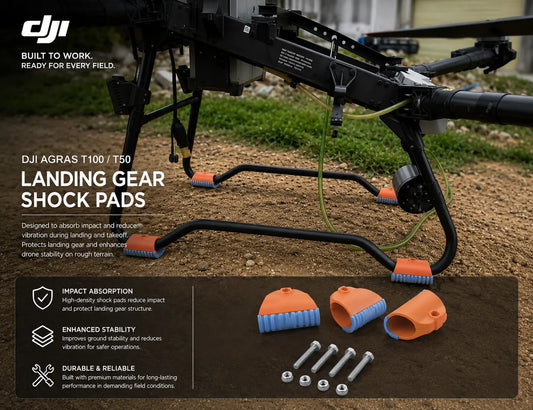
| Landing-gear fixing screw | 1 month | Loose or broken screw |
| Battery connector | 1 month | Corrosion, power/function check and contact condition |

The 100-flight and 100-hour inspection milestone
Several high-load propulsion and wiring components have an initial inspection after the first 100 flights. After that, DJI lists recurring checks every 100 operating hours or one month.
The aircraft-arm power lines should be checked for worn protective tape, exposed insulation or damaged insulation at connection points. Motors should be checked for abnormal stuttering or looseness, mounting condition and cover damage. Propellers should be inspected for deformation, looseness and cracks, and the propeller clamps should be checked for deformation or sticking movement.


Six-month inspections
The six-month group includes several electronics and sensing assemblies: front/rear radar, middle-frame sections, payload-control board, payload-adapter board, aerial-electronics system, ESC, SDR antenna and RTK module. Typical checks include cleaning, corrosion inspection, confirmation that the module powers on normally and verification that no relevant HMS errors are present.
The radar system also receives physical checks for dents, external damage and its supporting hardware. This is an important distinction: sensor maintenance includes both electronic status and physical mounting condition.

LiDAR maintenance
DJI lists LiDAR inspection as routine. If the protective optical surface is contaminated with pesticides, fertilizer or dust, the manual recommends rinsing the optical window with clean water before using compressed or canned air and a clean soft cloth. Direct wiping while granular contamination remains can scratch the optical surface. Persistent visible stains can be addressed with a small amount of alcohol on a damp cloth.
Do not use spray-tank liquid or other chemical agents to clean the LiDAR, and do not disassemble its protective dome without authorization.

Battery maintenance interval
The standard battery is listed for inspection every 100 charging cycles or one month, with a 1500-cycle maximum replacement cycle in the maintenance table. Inspect for swelling, dents or deformation, clean the battery terminals and perform at least one charge/discharge cycle every three months to maintain battery activity.
For battery LED diagnostics, charging temperatures and storage procedures, use the DJI Agras T100 DB2160 Battery Guide.
ESC, RTK, vision and spraying-system intervals
DJI lists the ESC, SDR antenna and RTK module at six-month inspection intervals. The FPV/vision system is listed at 12 months, with visual checks for deformation or damage. Spraying hoses should be inspected before daily operations.

Spray delivery pump replacement schedule
The delivery pump has its own service life separate from the general 700-hour/36-month framework. The manual calls for inspection after 100 hours, one month or daily operation as applicable, lists replacement of the pump-head module after 500 hours, and replacement of the motor after 1000 hours. Pump-head inspection includes the pump shell, impeller module and isolation sleeve for broken shafts, wear or melting, plus motor-port corrosion and powder adhesion after powder operation.
Centrifugal or mist sprinklers are inspected at 100 hours or one month, including spinner-disk wear, motor-port corrosion, pressure-funnel/water-test behavior and spray-lance screw condition.
Maximum replacement cycles are not permission to ignore damage
Many T100 assemblies list 700 operating hours or 36 months as the maximum replacement cycle. That is not a promise that every component remains serviceable until the maximum. The inspection instructions repeatedly tell the operator to replace components earlier when abnormalities such as corrosion, cracks, deformation, looseness, worn insulation, abnormal gaps or functional errors appear.
Suggested fleet log fields
A practical maintenance log should record aircraft serial or fleet identifier, total flights, operating hours, battery cycles, date of last monthly inspection, date of last six-month inspection, 100-flight/100-hour inspection status, observed corrosion or damage, HMS errors, parts replaced and the next due inspection. This converts the manufacturer table into a repeatable maintenance process across multiple aircraft.
Related T100 maintenance and parts resources
- DJI T100 Parts
- DJI Agras T100 Emergency Procedures & Maintenance Guide
- DJI Agras T100 Aircraft Systems: Radar, Vision, Obstacle Avoidance & RTK
- DJI Agras T100 DB2160 Battery Guide
- DJI Agras T100
Frequently asked questions
When is the first major T100 propulsion inspection?
The maintenance table calls for an initial inspection after 100 flights for several propulsion and aircraft-arm wiring components, followed by recurring checks every 100 hours or one month.
How often should the T100 radar be inspected?
The front/rear radar is listed at a six-month inspection interval.
How often should the T100 vision system be inspected?
The FPV/vision system is listed at 12 months in the maintenance table.
How often should I inspect T100 spray hoses?
The hose and hose-connector items are listed before daily operations.
When should the T100 delivery-pump head be replaced?
The manual lists replacement of the pump-head module after 500 hours and the delivery-pump motor after 1000 hours.
What is the DB2160 maintenance interval?
The standard battery is listed for inspection every 100 charging cycles or one month, with a 1500-cycle maximum replacement cycle in the maintenance table.
Source and revision note
Primary technical source: DJI AGRAS T100 User Manual v1.0 (2025.11), pp. 70–78. This article reorganizes DJI’s Recommended Maintenance Cycle tables into a field-oriented schedule; it does not replace condition-based inspections or the detailed procedures in the manufacturer manual.