DJI Agras T100S vs DJI T55 Canada: Which New DJI Agriculture Drone Is Better?
Share
DJI Agras T100S vs DJI T55 Canada
Updated September 11, 2026.
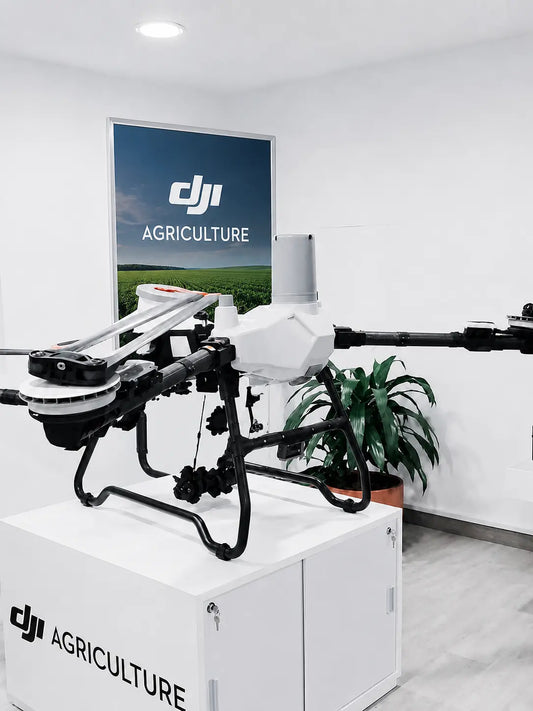
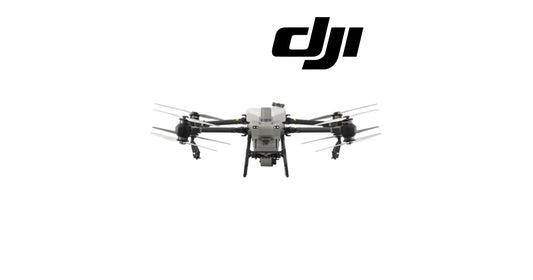
The T100S and T55 belong to DJI Agriculture’s newer generation, but they target different Canadian operating scales. The T100S maximizes payload. The T55 delivers much of the newer high-flow and sensing philosophy with lower mass and smaller payload requirements.
T100S: 85 L spray tank, 90 kg spread payload and 95 kg lift. T55: 50 L spray tank, 55 kg spread payload and 40 kg lift. Both can reach a 40 L/min standard and 50 L/min optional high-flow headline configuration. T100S is better when material moved per cycle is the bottleneck; T55 can be the better Canadian fit when easier logistics, lower operating mass and a newer globally launched platform matter more.
Specification Comparison
| Specification | T100S | T55 |
|---|---|---|
| Spray tank | 85 L | 50 L |
| Standard max flow | 40 L/min | 40 L/min |
| Optional high-flow | 50 L/min | 50 L/min |
| Spread payload | 90 kg | 55 kg |
| Peak spread discharge | Up to 400 kg/min | Up to 400 kg/min |
| Lift | 95 kg | 40 kg |
| Approx. battery-equipped aircraft weight | ~57 kg launch spray configuration | ~45–48.4 kg depending battery |
| Physical class | Large 62-inch rotor platform | Large 62-inch rotor platform |
| Release maturity | More region-limited | Global launch announced in 2026, availability still country-dependent |
The Key Canadian Difference: Payload, Not Maximum Flow
The most surprising comparison is spray flow. T55 can reach the same 40 L/min standard and 50 L/min optional headline rates as T100S. T100S wins by carrying more liquid per cycle—85 L versus 50 L.
That makes T100S stronger when refill time is expensive. T55 can still handle high-volume orchard work without requiring the same payload-handling infrastructure.
Which Is Better for Canadian Orchards?
T55 is highly competitive for orchards because it combines high flow with lower aircraft mass. T100S becomes more attractive when the operation needs fewer refills, greater spread payload or the 95 kg lift system.
Both aircraft should still follow Health Canada pesticide-label requirements. The 2026 RPAS policy does not allow operators to change an approved aerial rate, spray volume, droplet category or buffer simply because the aircraft has additional capability.
Spreading: Same Peak Hardware Rate, Different Load
Both platforms publish up to 400 kg/min peak discharge under specified material conditions. T100S carries 90 kg versus T55 at 55 kg. For large fertilizer acreage, that can reduce reload cycles; for smaller fields, the T55 load can be easier to handle manually.
Lifting: T100S Is a Different Class
T55 supports 40 kg lift while T100S supports 95 kg. Canadian farms considering fertilizer transport, remote supplies or other suspended-load logistics should view this as a category difference, not a minor capacity increase.
Transport Canada Context
Both platforms exceed 25 kg in agricultural operating configurations and therefore require more than Basic small-drone treatment. The T100S’s 149.9 kg ceiling remains within Canada’s medium-drone band if preserved in the exact regional configuration. T55 also operates within medium-drone territory in relevant configurations.
For either aircraft, verify registration, Advanced pilot requirements, controlled-airspace permissions where applicable, and the exact aircraft’s declaration/PVD status for the intended operation.
Canadian Logistics and Cold Weather
T55’s lower mass can simplify loading and battery handling even though its rotor footprint remains substantial. For farms moving between fragmented fields, that can matter more than maximum payload. T100S favours operations with purpose-built trailers, higher-capacity water transfer, material loading and charging infrastructure.
Cold-weather battery management matters for both. Do not extrapolate warm-weather cycle times into Canadian shoulder-season use without following the exact battery manual and temperature limits.
Which Is Better by Canadian Use Case?
| Use case | Better fit |
|---|---|
| Maximum hectares per refill | T100S |
| High-flow orchard work with lower payload burden | T55 |
| Large fertilizer programs | T100S |
| 40 kg-or-less farm logistics | T55 |
| Heavy agricultural cargo | T100S |
| Newer platform with broader launch maturity | T55 currently has the advantage |
Related Canada Guides
- T100S Canada Full Guide
- T100S vs T100 Canada
- T100S vs T50 Canada
- T100S Spray, Spread & Lift Canada
- T100S Canada Availability
Ares Acres Support
Canadian operators can browse DJI Agras OEM Parts, Accessories, the product catalog, DJI Agriculture Tutorials or contact Ares Acres.
FAQ
Which carries more liquid?
T100S: 85 L versus T55: 50 L.
Which has higher maximum flow?
The headline configurations are similar at 40 L/min standard and up to 50 L/min optional.
Which lifts more?
T100S: 95 kg versus T55: 40 kg.
Which is easier for a smaller Canadian crew?
T55 generally has the advantage because its material and aircraft mass are lower.
Comparison notice: T55 figures use current global DJI information; T100S figures reflect launch-market specifications. Canadian configuration, declaration and availability can differ. Verify current Transport Canada and Health Canada requirements.