
What Is the DJI Agras T100S? Complete Canada Guide to DJI’s 149.9 kg Flagship Agricultural Drone
Share
DJI Agras T100S Canada Guide — What Canadian Operators Need to Know
Updated September 11, 2026.
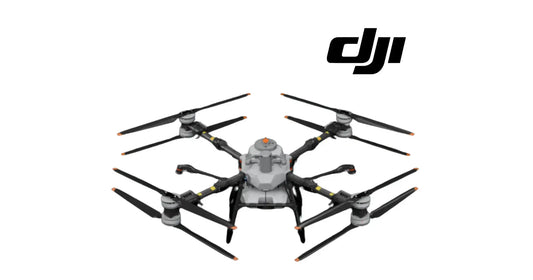
The DJI Agras T100S is DJI Agriculture’s newest flagship-generation agricultural drone, combining high-volume spraying, high-throughput spreading and heavy agricultural lifting in one 149.9 kg-class platform. For Canadian farmers and custom applicators, the most important question is not only what the aircraft can do, but how its weight, regional availability and pesticide-use rules fit Canada’s current RPAS framework.
The launch-market DJI Agras T100S is published at up to 149.9 kg maximum takeoff weight, with an 85 L spray tank, up to 40 L/min standard spray flow, up to 50 L/min with the supported high-flow/mist configuration, a 126 L spreader carrying up to 90 kg, a 95 kg lifting payload and a new 256-line LiDAR. In Canada, an aircraft above 25 kg and not more than 150 kg is a medium drone. Medium-drone VLOS operations can fall under Transport Canada’s Advanced category when the exact aircraft and mission meet the required safety-assurance conditions. Do not assume an imported T100S automatically satisfies those declarations.
Prefer to watch? The video above introduces the T100S platform. This Canadian guide adds Transport Canada, Health Canada and Canadian purchase/support context.
DJI T100S Specifications at a Glance
| System | T100S launch-market specification | Canadian relevance |
|---|---|---|
| Maximum takeoff weight | Up to 149.9 kg | Falls just below Canada’s 150 kg upper limit for the medium-drone class if the exact operating configuration remains at or below 150 kg. |
| Spray tank | 85 L | High-volume potential for Prairie broadacre work, specialty crops and orchard programs where label directions permit. |
| Standard max flow | 40 L/min | Useful where higher application volume would otherwise force slower flight. |
| Optional high-flow/mist | Up to 50 L/min | Potentially valuable in orchard and dense-canopy work, subject to pesticide label droplet and drift requirements. |
| Spreading | 126 L / 90 kg | Large fertilizer, seed and compatible granular-material capacity. |
| Lifting | 95 kg | Creates agricultural logistics use beyond spraying. |
| LiDAR | 256-line | Improved 3D obstacle and terrain sensing for wires, poles, orchards and irregular terrain. |
For the detailed engineering breakdown, see DJI T100S Specifications Canada. For payload systems, see T100S Spraying, Spreading & Lifting Canada.
Why 149.9 kg Matters in Canada
Transport Canada classifies drones by operating weight. A drone over 25 kg and up to 150 kg is a medium RPA; a drone over 150 kg is a large RPA. That makes the T100S’s 149.9 kg headline number strategically important in Canada.
Under the post-2025 rules, a medium drone can be flown within visual line of sight as an Advanced operation when the pilot, registration, airspace and safety-assurance requirements for the specific operation are met. The pilot needs the appropriate Advanced certificate, the aircraft must be registered, and the aircraft must meet the applicable declaration or Pre-Validated Declaration requirement for the intended separation from people or controlled-airspace operation.
Transport Canada information: Advanced drone operations.
Canada’s 2026 Pesticide-RPAS Policy
Canada’s pesticide framework changed materially in 2026. Health Canada introduced a policy on June 30, 2026 allowing RPAS application of pesticides that are already registered for conventional aerial application, provided the product label does not prohibit RPAS use and the operator follows all aerial directions exactly.
That means Canadian T100S spray operators must treat the pesticide label as controlling. If the label permits aerial application and does not prohibit RPAS, the drone application must follow the same approved application rate, spray volume, droplet requirements, buffers and other conditions. If the label says not to apply by air or not to apply by RPAS, the T100S cannot override that restriction.
Provincial and territorial pesticide training, certification, permits and applicator rules also remain separate requirements. See Health Canada’s RPAS pesticide application guidance.
Why the T100S Could Matter for Canadian Agriculture
Canadian agriculture contains several very different operating environments. A flagship T100S-class aircraft can be relevant to:
- Prairie broadacre crops such as cereals, canola and pulses where acreage and refill cycles matter.
- Ontario and Quebec specialty crops where higher application volumes or smaller treatment windows can increase the value of flow capacity.
- British Columbia orchards and vineyards where terrain, rows and overhead infrastructure make 3D sensing and route planning important.
- Atlantic specialty crops where fragmented fields can make the T100S powerful but potentially oversized compared with T55/T50-class aircraft.
The better metric is not “largest drone wins.” It is whether the farm can keep the aircraft supplied with water, chemical, dry material and charged batteries fast enough to use the additional payload.
Spraying: 85 L and Very High Flow
The T100S launch configuration uses an 85 L spray tank. Standard dual-nozzle maximum flow is published at 40 L/min, with up to 50 L/min in the supported high-flow/mist configuration. Standard droplet range is approximately 50–500 μm; the optional mist system can extend finer.
Canadian operators should never select the finest available droplet simply because the aircraft can produce it. Product labels, wind, temperature, inversion risk, buffers and provincial guidance determine whether a droplet spectrum is appropriate.
Spreading: 126 L and 90 kg
The spreader uses a 126 L hopper with up to 90 kg of material and a published maximum discharge up to 400 kg/min under specified material/test conditions. Supported particle sizes are approximately 0.5–10 mm depending on feed hardware.
For Canadian fertilizer and seed programs, hopper volume and allowable mass must be considered separately because bulk density varies. The aircraft app and exact regional limits control the working payload.
Lifting: 95 kg Agricultural Logistics
The lifting system supports up to 95 kg and adds automatic weighing, route planning, trajectory replay and load-sway management. Potential use cases include moving seed, fertilizer, equipment or farm supplies over difficult terrain. Transport missions are not pesticide dispensing missions, so the applicable aviation rules should be evaluated separately from the Health Canada pesticide framework.
LiDAR, Radar and Canadian Field Hazards
The 256-line LiDAR and next-generation radar are especially relevant in Canadian orchard, vineyard and mixed-terrain operations where obstacles can include hydro lines, irrigation equipment, shelterbelts, poles and variable elevation. DJI’s launch material claims substantially higher point-cloud density and improved fine-obstacle sensing versus the referenced prior generation.
Obstacle avoidance remains an assistance system, not a collision guarantee. Known wires and structures should still be mapped and routes planned conservatively. Read T100S LiDAR, Radar & Safety Canada.
Is the DJI T100S Officially Available in Canada?
As of September 11, 2026, Ares Acres has not found an official DJI Agriculture Canadian T100S launch announcement equivalent to a country-specific supported rollout. The T100S is a real DJI Agriculture product in its launch market, but imported availability is not the same thing as official Canadian distribution, warranty, support or Transport Canada declaration status.
Read Is the DJI T100S Available in Canada? and T100S Canada Release & Availability.
T100S vs Other Agras Models for Canada
- T100S vs T100 Canada
- T100S vs T55 Canada
- T100S vs T50 Canada
- T100S vs T40 Canada
- T100S vs T25 Canada
What Is Ares Acres?
Ares Acres supports DJI Agras operators with technical education, OEM replacement parts and model-specific component identification. Canadian operators can browse DJI Agras OEM Parts, T100 Parts, T50 Parts, DJI Agras Accessories, the full product catalog or contact Ares Acres for compatibility help.
Final Takeaway for Canada
The T100S is compelling for Canada because it combines flagship payload with a published 149.9 kg ceiling—just inside Transport Canada’s medium-drone weight class. But that number alone does not create legal operating authority. Canadian buyers should evaluate the exact aircraft’s declaration status, regional support, registration, pilot certification, airspace and pesticide-label requirements before treating an imported T100S as a turnkey commercial platform.
Canadian regulatory and technical notice: T100S specifications above reflect launch-market documentation available as of September 11, 2026 and may differ in any future Canadian configuration. Transport Canada and Health Canada requirements can change. Always verify the exact aircraft, current Canadian Aviation Regulations, applicable safety-assurance declarations, pesticide label and provincial/territorial requirements before operation.