DJI Agras T100S Spraying, Spreading & Lifting Specifications Canada: 85 L, 400 kg/min & 95 kg Payload
Share
DJI Agras T100S Spraying, Spreading & Lifting in Canada
Updated September 11, 2026.
The DJI Agras T100S is designed around three production roles: liquid spraying, dry-material spreading and suspended-load agricultural transport. For Canadian operators, those hardware capabilities need to be evaluated alongside Transport Canada’s medium-RPAS rules and Health Canada’s current pesticide application policy.
The launch-market T100S uses an 85 L spray tank, up to 40 L/min standard flow and up to 50 L/min with the supported high-flow/mist configuration. Its spreader holds 126 L and up to 90 kg of material, with peak discharge up to 400 kg/min under specified test conditions. Its lifting system carries up to 95 kg. In Canada, pesticide RPAS use must follow Health Canada’s current aerial-application policy and the exact product label, while the aircraft itself must meet Transport Canada requirements for the intended medium-drone operation.
Start with the DJI T100S Canada Full Guide and T100S Specifications Canada.
T100S Payload Systems at a Glance
| System | Launch-market specification | Canadian operating relevance |
|---|---|---|
| Spraying | 85 L; 40 L/min standard; 50 L/min optional | High-volume crop and orchard applications where the pesticide label permits aerial/RPAS use. |
| Spreading | 126 L; 90 kg; up to 400 kg/min | Fertilizer, seed and compatible granules across larger fields. |
| Lifting | 95 kg | Agricultural logistics over difficult terrain or between remote farm points. |
85 L Spraying System
The T100S carries 85 L of liquid in its launch configuration. Maximum standard flow is 40 L/min, while the supported optional orchard/mist configuration can reach 50 L/min. That gives operators more room to maintain a chosen litres-per-hectare rate at higher forward speeds before pump capacity becomes the bottleneck.
Tank volume alone does not determine productivity. Canadian operators also need adequate refill pumps, clean water, chemical mixing, battery rotation and transport logistics. A flagship aircraft can only sustain flagship throughput when the field crew can keep pace.
Droplet size and drift
The standard atomizing system is published around a 50–500 μm droplet range, while the optional mist setup can extend much finer. Very fine droplets can improve coverage but can also increase evaporation and off-target movement. Canadian applicators should select droplet size based on the registered pesticide label, crop target, wind, temperature, inversion risk and provincial guidance—not simply the smallest setting the aircraft can produce.
Health Canada’s June 30, 2026 policy allows RPAS application of pesticides that are already registered for conventional aerial application when the label does not prohibit RPAS use. Operators must follow the approved aerial directions exactly, including application rate, spray volume, buffers, droplet requirements and other restrictions. Provincial and territorial applicator requirements remain separate.
Review Health Canada’s current guidance before every pesticide program: Using RPAS to apply pesticides.
126 L / 90 kg Spreading System
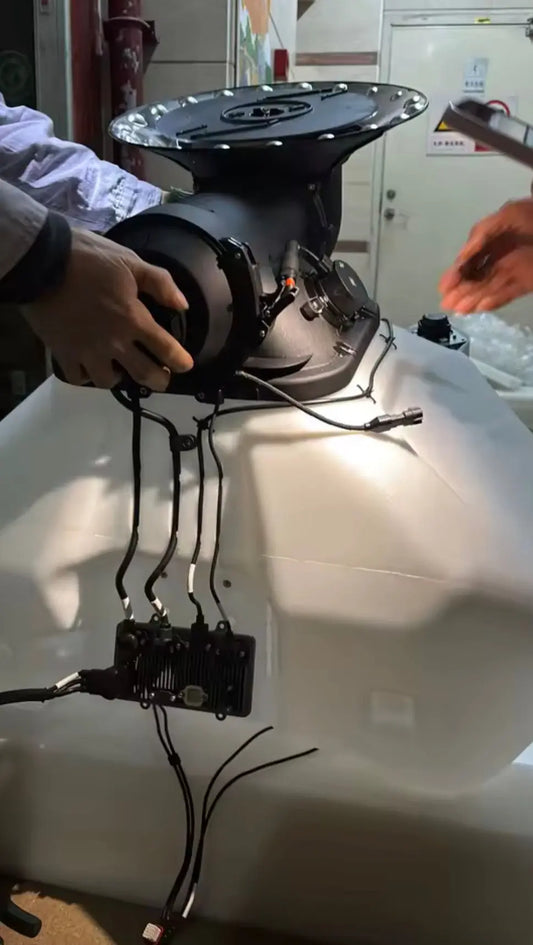
The spreader carries up to 90 kg of compatible material in a 126 L hopper. Peak hardware discharge is published at up to 400 kg/min with suitable material under specified test conditions, and interchangeable feed hardware supports particles approximately 0.5–10 mm.
For Canadian fertilizer and seed programs, two limits matter at the same time: volume and mass. Lightweight seed can fill the hopper before reaching 90 kg; dense fertilizer can reach the mass limit before the hopper is visually full. Always use the exact app recommendation and supported feed hardware.
Where the spreader can be useful in Canada
- broadcast fertilizer on broadacre fields,
- cover-crop and selected seed distribution,
- granular products where label and provincial rules permit aerial application,
- orchard and vineyard nutrient programs,
- feed or other compatible agricultural granules.
The 400 kg/min figure is a maximum discharge capability, not a field recommendation. Actual kg/ha depends on material density, flight speed, spread width, target rate and calibration verification.
95 kg Lifting System
The T100S lifting system carries up to 95 kg and adds route planning, load weighing, trajectory replay and automatic sway-management functions. It can support agricultural logistics such as moving seed, fertilizer, tools or supplies where ground access is slow or difficult.
A suspended load behaves differently from a rigid tank. Wind, cable length, acceleration, braking, load centre of mass and rigging all affect stability. Heavy lifting should therefore be treated as its own operating discipline rather than an extension of spraying.
Transport Canada Context for a 149.9 kg-Class Aircraft
The launch-market T100S reaches up to 149.9 kg maximum takeoff weight. In Canada, drones over 25 kg and not more than 150 kg are classed as medium drones. Medium-drone VLOS flights can fit the Advanced category when the pilot, aircraft, airspace and safety-assurance requirements for the exact operation are satisfied.
That does not mean every imported T100S is automatically eligible. Verify the exact model’s Transport Canada declaration or Pre-Validated Declaration status, registration, pilot certificate requirements and operating environment. See Transport Canada Advanced Operations.
Which T100S Payload System Creates the Most Value?
| Canadian use case | Most relevant T100S strength | Main bottleneck to solve |
|---|---|---|
| Prairie broadacre application | 85 L capacity + high flow | Water, chemical and battery turnaround |
| BC orchard/vineyard | 50 L/min optional high flow + sensing | Drift, canopy geometry and obstacles |
| Large fertilizer programs | 90 kg spread payload | Material loading and calibration |
| Remote/mountain farm logistics | 95 kg lift | Rigging, route, wind and regulatory fit |
T100S vs Current Agras Platforms in Canada
Operators should compare payload against the complete operating system. See T100S vs T100 Canada, T100S vs T55 Canada, T100S vs T50 Canada, T100S vs T40 Canada and T100S vs T25 Canada.
Canadian Parts and Technical Support
Canadian operators can browse DJI Agras OEM Parts, T100 Parts, T100 Spraying Parts, T100 Spreading Parts, Accessories and contact Ares Acres for model-specific component guidance.
Frequently Asked Questions
Can the T100S spray pesticides in Canada?
Potentially, but aircraft legality and pesticide legality are separate. The product must qualify under Health Canada’s current RPAS policy and label directions, and the flight must comply with Transport Canada plus provincial/territorial requirements.
How much liquid does it carry?
85 L in the launch-market configuration.
How much fertilizer can it carry?
Up to 90 kg of compatible material in the published spreading configuration.
Can it lift 95 kg in Canada?
The hardware is published for up to 95 kg, but the exact Canadian aircraft configuration and operating authorization must still be verified.
Is the T100S officially launched in Canada?
Ares Acres has not found an official Canadian T100S launch announcement as of this update.
Canadian technical/regulatory notice: T100S specifications reflect launch-market documentation and may differ in any future Canadian model. Follow the exact aircraft manual/app limits, Transport Canada requirements, Health Canada pesticide label and provincial/territorial rules.