
DJI Logic-Bearing Hardware and RF Components: What the October 13, 2026 FCC Rule Covers
Share
Last reviewed: October 12, 2026. Technical regulatory guide for U.S. drone operators, FPV builders, repair technicians, importers and DJI Agras/Enterprise/Consumer owners. The FCC uses the term logic-bearing hardware component, not intelligent load-bearing component.
What do the October 13 FCC rules really cover?
The official FCC term is “logic-bearing hardware component,” not “intelligent load-bearing component.” The Federal Communications Commission's rule effective October 13, 2026 creates an additional equipment-authorization restriction for certain devices incorporating qualifying logic-bearing hardware from entities identified on the FCC Covered List. It does not simply ban every drone part that physically carries a payload, nor does it apply automatically to every RF receiver, electronic sensor or motor regardless of source and transaction.
This technical guide explains the definition in 47 CFR § 2.902, the operation of the related § 2.903 provision, the relationship to existing radiofrequency equipment authorization rules, and the distinction between the October 2026 final rule and the separate December 2025 Covered List categories for foreign-produced UAS and critical components. It then walks through the architecture of agricultural, enterprise, consumer and FPV drones, showing where digital logic, radio hardware and passive structures tend to reside.
The objective is accurate product identification—not declaring that an entire class of DJI products is either universally prohibited or universally exempt.
The exact regulation, docket and effective date
The FCC adopted the Third Report and Order FCC 26-50 in ET Docket No. 21-232 on July 22, 2026 and released it on July 23. The Federal Register published the final rule September 11, 2026 as 91 FR 57798–57801. The stated effective date is October 13, 2026. Its title is Protecting Against National Security Threats to the Communications Supply Chain Through the Equipment Authorization Program.
The rule adds a logic-bearing hardware restriction to the Commission's Covered List equipment-authorization regime, revises requirements for modifications involving Covered List entities, clarifies certain marketing obligations, and establishes FCC ID disclosures for online marketplaces on later compliance schedules. It accompanied a separate Further Notice of Proposed Rulemaking seeking comment on additional measures. The adopted text, not a proposal or a video summary, controls what is effective October 13.
Primary documents include the official Federal Register PDF and FCC 26-50. Those documents should be used whenever a claim about legal scope is disputed.
Why “intelligent load-bearing” is the wrong phrase
The word “load-bearing” describes structural responsibility. An aircraft arm, lifting bracket, frame tube or landing gear strut physically supports or transfers force. The term “logic-bearing” refers instead to hardware that performs specified digital or RF-based data-processing functions. They are entirely different concepts.
A DJI Agras T100 can contain actual lifting or payload-carrying hardware, such as structural brackets and mechanical supports. Those parts might be load-bearing without having a microcontroller. The aircraft can also contain a weight sensor board or smart payload electronics that process measurements. Those boards may be logic-bearing despite not carrying the physical load. A system that combines a bracket with sensors can have both properties.
Articles repeating “intelligent load-bearing ban” can accidentally lead customers to believe that the regulation targets the T100's lifting hook, an airframe strut or a propeller because it carries force. That is not what the October rule's technical definition says. Search queries may use the mistaken phrase, but the article must correct it immediately rather than adopting it as legal terminology.
What 47 CFR § 2.902 means by logic-bearing hardware
The FCC's definition covers physical devices, systems, modules, subassemblies, integrated circuits or other hardware that use digital techniques and timing signals or pulses faster than 9,000 cycles per second, or that use radiofrequency energy to perform functions involving computation, storage or data transfer. It draws on the existing digital-device definition in 47 CFR § 15.3(k).
This is a functional technical test, not a list of brand names or physical shapes. A motherboard can qualify even though it never intentionally transmits to a remote controller. A flight controller, an ESC with a digital microcontroller, or a smart battery-management board may meet the definition. Conversely, a passive connector, metal plate or basic gasket generally does not.
The FCC expressly lists purely mechanical and passive exclusions, including housings, fasteners, resistors, wiring and plain battery cells. The regulator declined at that time to extend this particular component prohibition to software and firmware. Those limits matter, but they do not imply that an otherwise regulated complete device is exempt merely because one of its components is passive.
Digital electronics without intentional radio transmission
A digital device can generate timing pulses and process data entirely inside its enclosure. Consider a motor-control board that measures rotor position and changes switching patterns using a microcontroller, or a flight controller that processes accelerometer readings to update motor commands. Such electronics can perform sophisticated digital computation without intentionally broadcasting an RF communication link.
That makes the popular shortcut “only radios are affected” technically inaccurate. The October definition explicitly reaches relevant logic-bearing components beyond conventional transmitters. However, the presence of digital electronics does not by itself complete the legal prohibition test. The producing entity must meet the relevant Covered List conditions, and the specific equipment-authorization scenario must be one in which the prohibition applies.
A resistor or plain copper trace is not the same thing as a processor. Complex boards also contain both passive and active elements, so the relevant item is the complete part as defined in the transaction or authorization record rather than one isolated resistor on the board.
Intentional radiators, unintentional radiators and passive RF hardware
An intentional radiator is designed to generate and emit RF energy for communication or another intended RF function, such as a telemetry transmitter or a radio controller. Unintentional radiators can generate RF emissions as a byproduct of electronic operation even though they do not communicate intentionally. A passive antenna or shielded cable can interact with RF energy without performing digital computation itself.
FCC compliance concepts for these categories are not interchangeable. A controller's certification can cover specific operating bands, modulation, antenna conditions and transmitted power. A processing board may have separate compliance obligations even if it lacks a wireless radio. A passive antenna can affect the compliance of the transmitter with which it is used.
The October logic-bearing definition overlaps with but is not identical to the set of products that intentionally radiate. Product reviewers must ask both technical questions: what does the hardware do, and what kind of FCC authorization—if any—is required for the device or integrated system?
The operative legal test has multiple elements
A useful way to read FCC 26-50 is as a series of conditions rather than the statement “DJI electronics are banned.” First, identify a new device for which FCC equipment authorization is being requested. Second, determine whether it contains a logic-bearing hardware component under § 2.902. Third, identify who actually produced that component. Fourth, determine whether that producer is an entity covered by a producer/provider-based FCC Covered List determination. Fifth, ask whether the finished device would have been prohibited from authorization if that entity had produced the entire device.
The Federal Register summary emphasizes that production-location-based entries for foreign-produced UAS, UAS critical components or routers do not automatically trigger this new component restriction absent an independent named producer/provider entry. The distinction is not a technicality; it prevents the component provision from being misreported as a prohibition on any chip made abroad.
This test concerns the new authorization restriction. Separate import, marketing, aircraft operating and existing-equipment provisions must still be assessed independently.
Covered List producers versus foreign production location
In the drone sector the FCC has both producer/provider-based and production-location-based concepts. On December 22, 2025 the Commission added foreign-produced UAS and UAS critical components to the Covered List through a notice based on a national-security determination. That category concerns where the equipment is produced. The October 2026 logic-bearing rule contains language limiting that specific new component provision to logic-bearing hardware from entities identified by producer/provider-based entries.
A U.S.-branded device assembled domestically can still contain a qualifying component from a named covered producer. Conversely, the mere fact that an otherwise unspecified component was made abroad does not prove the October producer-based test has been met. The separate foreign-produced UAS framework could still be relevant for that item.
Importer documentation should therefore distinguish producer identity, location of manufacture, substantial design or production responsibility, final assembly and commercial seller. None is automatically established by the others. This is particularly relevant to white-labeled, rebranded or technology-licensed aircraft.
What the December 2025 drone action includes
The FCC's December 22, 2025 Public Notice DA 25-1086 added foreign-produced UAS and UAS critical components, as well as certain communications and video-surveillance equipment and services described in Section 1709 of the FY2025 NDAA. Its definition of UAS critical components discusses data transmission devices, communications systems, flight controllers, ground-control stations and controllers, navigation, sensors and cameras, batteries and battery-management systems, and motors.
This is important because a standalone motor may lack the digital processing needed to qualify under the October logic-bearing definition while still belonging to a class named in the separate UAS critical-component framework. Likewise, a battery cell may be expressly excluded from the October definition, while a complete battery and BMS require examination under other provisions.
The applicable product's authorization status and any exceptions or conditional approvals must be established from the current FCC record. Read DA 25-1086 and the accompanying FCC fact sheet.
Existing equipment and new authorizations
The October component restriction is prospective, applies to new authorization applications, and does not automatically affect previously authorized equipment. The Federal Register summary discusses applications already pending when the rule becomes effective and notes the circumstances under which later changes to logic-bearing hardware can affect the exception.
This is a meaningful distinction for someone repairing a previously authorized DJI aircraft. Installing a manufacturer-specified replacement into an existing approved configuration is not inherently a new authorization application for a newly designed drone. But not all changes are routine. Substituting a new RF device, altering emissions characteristics or changing equipment in ways that affect certification can raise separate modification requirements.
The rule also makes the treatment of changes by covered entities more stringent. Do not turn a prospective authorization restriction into a public claim that every approved DJI controller, battery board or aircraft instantly loses approval on October 13.
Inside a drone: a layered engineering model
A useful technical model separates the aircraft into five layers. Structure: arms, covers, frames, landing gear and fasteners. Electromechanical actuation: motors, pumps, fans and moving payload mechanisms. Power: battery cells, BMS, power distribution, converters and charging systems. Computation and sensing: flight controllers, navigation processors, radar, cameras and gimbal control boards. Communications: transmitters, receivers, telemetry, video links, controller radios and antennas.
The categories are conceptual rather than legally exclusive. A smart motor assembly can cross the electromechanical and computation layers. An intelligent battery can include cells, logic and communications. An integrated gimbal can include structure, motor control, sensors and an imaging processor.
For a legally useful parts listing, identify which layers the delivered SKU actually contains. A spare arm bracket and an arm assembly with motor and ESC should not share an unqualified “non-RF component” regulatory label.
DJI Agras propulsion: motors, ESCs and propellers
DJI Agras propulsion illustrates how a single subsystem contains several different component classes. The propeller is usually passive mechanical hardware. A motor converts electrical power into rotational force. An ESC uses electronic switching, and potentially digital timing logic, to control motor output. A composite arm assembly may bundle some or all of these elements along with cables and mechanical mounts.
From the October definition alone, a plain propeller is unlike a digital ESC. But the December UAS critical-component category also includes motors, so a seller should not infer full import eligibility solely from the absence of a radio. The actual assembly contents and producing entity must be documented.
Owners can inspect DJI T50 propulsion parts and DJI T100 propulsion parts to see the difference between motor, ESC, propeller and structural offerings. Technical fitment and compliance are independent checks.
Flight controllers and aircraft mainboards
The flight controller is the computation center of a drone. It reads sensors, runs control algorithms and commands actuators. Its microcontrollers or processors typically satisfy the conceptual features of logic-bearing hardware, but applying FCC 26-50 still requires identification of the manufacturer and applicable producer-based Covered List restriction.
An aircraft motherboard can include power conversion, buses, memory, logging, wired ports, GNSS interfaces and integrated radio functions. Consequently, the seller should avoid describing every board as an RF transmitter, but should also avoid claiming digital-only boards are automatically outside the October rule.
Changing a flight controller may require model-specific firmware, calibration and inspection. A controller with the same exterior connectors is not necessarily a legitimate substitute. For existing equipment, authorization and modification requirements depend on what changes in the actual certified configuration.
Remote controllers, SDR systems and telemetry links
The operator's remote controller may contain one or more RF transmitters or receivers, a digital display, processors, batteries and control inputs. Some systems use software-defined radio (SDR) technologies that process signals digitally. The controller can therefore be an intentional radiator and a logic-bearing electronic device, making authorization records especially important.
Replacing a cracked outer shell or a screen protector is technically different from replacing an internal transmitter or SDR control board. Radio bands, antenna gain, firmware and pairing may affect the applicable certified configuration. A replacement radio module may require specific certification evidence or manufacturer service procedures.
For agricultural remote-control parts, browse T100 controller components. A controller shell and an antenna assembly should not be assigned the same risk label solely because they appear under the same collection.
FPV digital video transmitters and goggles
Digital FPV video systems often process camera information, encode it, transmit it over radio frequencies and receive it through goggles or remote devices. These systems combine multiple regulated functions: imaging, digital logic, RF emission and user display. A standalone frame or propeller does not contain the same functional stack.
For a new VTX model, analyze equipment authorization for the radio hardware, the actual FCC ID when available, any qualifying Covered List logic-bearing hardware and the broader drone-related framework where applicable. Goggles can include receivers and digital processors; their precise obligations depend on the design rather than the word “goggles.”
An FPV enthusiast who already owns previously authorized equipment is not required by this rule to stop flying on October 13 solely because the equipment is older. Nevertheless, replacement hardware, new imported systems and modifications deserve their own review. Marketplace statements about universal bans or universal importability should be treated skeptically.
Radar, LiDAR and vision sensing
Agricultural obstacle-sensing radar can generate and receive RF energy and use sophisticated digital signal processing. LiDAR uses optical measurements rather than conventional radio telemetry, but its ranging processors can still be digital. Camera-based obstacle sensing similarly relies on optical sensors and image-processing hardware.
A radar module is not the same product as its protective cover. A LiDAR lens dome is not the same as the complete sensor's logic-bearing processor. Parts descriptions must distinguish those subassemblies and specify exactly what is included. This supports regulatory analysis and safe technical maintenance.
The December 2025 UAS critical-components framework includes sensors and cameras. Therefore, the absence of a conventional RF transmitter does not automatically eliminate every relevant restriction. Explore T100 navigation and sensor parts for system distinctions.
GNSS, RTK positioning and correction radios
Global Navigation Satellite System (GNSS) technology receives satellite navigation signals. A basic passive antenna can be distinct from an active antenna, GNSS receiver processor or RTK correction transmitter. A correction station may use communications hardware to distribute positioning data. The technical roles can be separated even when sellers use the broad term “RTK module.”
A receiving-only GNSS module can still contain logic-bearing electronics. A radio correction link can be an intentional radiator with equipment authorization requirements. An antenna assembly may contain an amplifier even if it has no conventional microprocessor. Each configuration must be identified before categorization.
For drone repairs, document connector type, supported satellite and correction features where relevant, firmware, antenna positioning and any associated transmitting device. Accuracy-critical navigation should also be calibrated and tested according to appropriate technical instructions.
Batteries, battery cells and BMS hardware
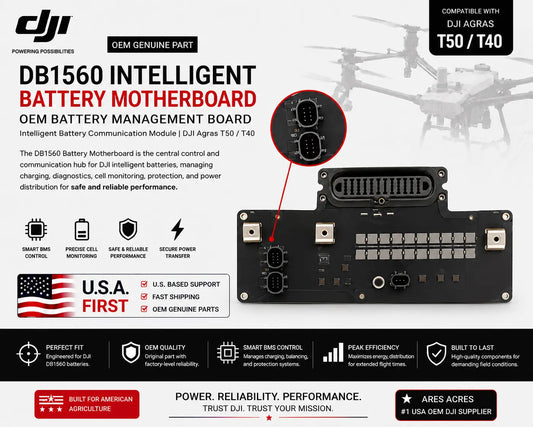
The FCC's October definition explicitly excludes plain battery cells. That narrow exclusion should not be used to label a complete DJI intelligent flight battery exempt from all FCC, customs or transportation requirements. A smart battery can contain cells, temperature sensors, processors, communication interfaces, protection circuits and a digital battery-management motherboard.
Some BMS assemblies can meet the logic-bearing definition because they process and store data with timed digital electronics. The December 2025 UAS critical-components category separately identifies batteries and BMS. Lithium battery transport and dangerous-goods handling rules are independent of the FCC definition.
Before ordering a T50 DB1560 or T100 DB2160 product, verify the specific battery family, voltage, controller-board revision, connector and aircraft fitment. The T100 battery and power collection distinguishes battery-related service components. Compatibility is not established merely because two packs look similar.
Chargers, inverters and generators
A power charger can be designed around switching electronics, digital microcontrollers and feedback systems. A generator may include an alternator, engine systems, electronic controls and a charging interface. Some power equipment might contain wireless connectivity; other units have none. Their physical size or proximity to a drone does not answer the FCC classification.
An electronically controlled charging unit might use qualifying digital logic while the connected power cable is passive. But a legal conclusion for the charger depends on its actual characteristics, relevant rules and activity. Other authorities can have a role concerning electrical safety, transport, emissions and customs classification.
When replacing a charger or generator, confirm battery compatibility and electrical requirements independently of the October component discussion. A technical product label should not imply that a device is legal for import solely because its main function is supplying electricity rather than flying.
Payloads and “intelligent loading” systems
Agricultural spreaders, delivery payloads and lifting systems sometimes combine mechanical handling with sensors and digital control. A crop-spreading auger can be a mechanical screw; its motor controller or flow sensor may use logic. A T100 lifting bracket can physically support weight without any embedded processor. A smart load sensor or payload controller may process measurements and command hardware.
This is the origin of much terminology confusion. “Intelligent payload” is a product or engineering description, while “logic-bearing hardware” is the FCC term used in the October final rule. Neither product label proves the legal status of all subassemblies. For example, a lifting arm could contain an independent smart sensor module, and that module would deserve separate evaluation.
Part catalogs should distinguish structural lifting hardware from electronic load-monitoring or payload-control modules. Ares Acres' T100 airframe parts and T100 spreading parts illustrate the different categories.
Passive antennas, wiring and mechanical hardware
The October definition excludes examples such as wiring, fasteners and housings when they are purely passive. An antenna can be passive while still affecting the compliance of the transmitter to which it connects. This highlights a second distinction: a standalone component may have no logic-bearing function, yet modifying the complete system can change authorization conditions.
A signal cable with no embedded processing is unlike a communication module. A wiring harness with a small integrated converter or controller should be evaluated according to the complete delivered assembly. A metal mounting bracket has different technical characteristics from a full intelligent gimbal mount. Product titles are not enough to establish the hardware stack.
For maintenance, preserve cable shielding, connector configuration, routing and the intended mechanical environment. Compliance and safe function are related but separate questions; being excluded from a particular FCC definition does not mean any substitute is safe or compatible.
Modular transmitters and integrated third-party designs
A wireless module with an existing FCC authorization can be integrated into a larger product under conditions defined by its grant and relevant FCC rules. A host device may have other applicable obligations, and module authorization does not automatically resolve everything about a finished aircraft. The July 2026 component rule expands the scrutiny applied to specified logic-bearing hardware in the new-authorization context.
A white-labeled or domestic-branded drone using components from a named Covered List producer raises questions about actual design and production responsibility. A domestic final-assembly address does not by itself settle producer-based obligations. Conversely, an overseas component's production location alone does not satisfy every element of the October logic-bearing restriction.
Technical submissions, supplier declarations, engineering bills of materials and applicable grants are more useful than advertising claims. New product developers should address component sourcing early in design, rather than discovering an authorization problem after preparing the finished device for sale.
Hardware bills of materials: what to record
A hardware bill of materials (HBOM) is a practical inventory of components used in a product. The FCC's accompanying proposals discuss possible additional disclosure requirements, but an importer or manufacturer should not claim that every suggested HBOM rule has already taken effect. Maintaining accurate records can nevertheless reduce the risk of applying for an authorization without understanding component provenance.
For each board or radio module, retain manufacturer identity, exact part number, hardware revision, firmware dependency, function, country and relevant FCC grant information. For mechanical assemblies, record included electronics and the assembly's intended placement. Where records are incomplete, mark the field unknown and seek clarification.
For a reseller, this does not necessarily mean publishing a confidential circuit-level bill of materials on every page. It means keeping enough internal evidence to support the particular fitment and compliance statements made to buyers.
FCC ID, certification and the Equipment Authorization System
An FCC ID identifies a certified device under the relevant scheme, not every peripheral connected to it. A remote controller, aircraft transmitter, digital-video device or integrated communications unit may have separate identifiers or technical records. The precise grant and the marketed product should correspond to one another.
A product not requiring individual FCC certification should not be labeled unlawful merely because a passive connector does not have an FCC ID. Conversely, a device that does require authorization does not gain a valid ID through a seller attaching a photograph of a different product's label. Manufacturers and importers need matching technical and legal evidence.
To check a product, identify the grantee and exact device model, review the available grant, assess frequency and hardware configuration and determine whether the applicable authorization still supports the marketed device. Additional Covered List restrictions can affect new grant issuance even if the device might otherwise meet technical emissions limits.
Permissive changes, re-certification and repairs
FCC 26-50 tightens treatment of modifications and permissive changes made by Covered List entities, requiring full certification in specified circumstances. It also clarifies that modifications cannot be used to create equipment that becomes prohibited. This is distinct from a blanket ban on owners replacing worn mechanical items.
A hardware modification changing the transmitter, processor architecture or approved radio setup deserves more scrutiny than replacing a propeller, landing foot or exterior housing. Certain repairs involving manufacturer-approved replacement boards can also require firmware pairing and calibration to preserve safe operation.
A repair log should identify the original and replacement part, actual hardware revision, service procedure and test outcome. Where relevant, the technician should ask the grantee or a qualified regulatory specialist whether the modification stays within authorized conditions. An existing FCC authorization is important, but it is not permission for arbitrary RF modifications.
Online marketplaces and FCC ID disclosures
The July final rule clarifies that marketing obligations can extend to online marketplaces and prescribes FCC-ID display requirements for certain devices at the online point of sale. The Federal Register summary identifies phased compliance dates in March and June 2027, tied to the marketplace's relationship with the devices and sellers. It describes exclusions for some existing listings, sellers and used equipment.
These are marketing provisions, not the effective date of the new component-authorization rule. A seller should avoid telling customers that a used-item listing exception authorizes every used device, or that the later FCC-ID display deadline means all other marketing rules are suspended until 2027.
For product data management, distinguish a passive repair component from a device subject to certification. Attach an FCC ID only to the actual device it identifies. A radio assembly and a protective screen cover should not share identical regulatory metadata merely because they appear under the same controller collection.
The UAS critical-components category and mechanical-only claims
A particularly misleading statement is “if it is non-RF, the U.S. drone restriction does not apply.” The separate foreign-produced UAS critical-components Covered List category may address component types that are not themselves intentional transmitters. The official 2025 notice includes motors, batteries and management systems, controllers, navigation, sensors, cameras and communications hardware.
That does not establish that every such component sold separately is always banned from all imports. Relevant authorization and transaction details still matter, and the FCC's own communications distinguishes previously approved models from new authorization restrictions. But the category is broad enough that readers should not rely only on the October logic-bearing definition when deciding what can be imported.
Use the two rules as separate filters: one for foreign-produced UAS critical components under the 2025 entry, and one for specified producer-based logic-bearing hardware under FCC 26-50. Evaluate other customs requirements afterward.
Component screening workflow for retailers and service centers
- Record the product's exact name, material number and intended compatible aircraft.
- Determine whether the product is a complete aircraft, equipment that independently needs authorization, a UAS critical component, or a passive accessory.
- Identify the electrical architecture: digital timing or processing, RF transmitters, RF receivers, passive only, or integrated mixed modules.
- Identify the producer and country of production; distinguish those facts from the seller and shipping origin.
- Determine whether a new FCC equipment authorization is being sought, whether the device was previously authorized or whether an existing system is merely being repaired.
- Review the applicable Covered List entry and any product-specific exceptions or conditional approvals.
- Examine CBP admissibility and other regulations separately.
- Review the fitment and aircraft safety implications of the repair.
- Preserve the source documents supporting any public claim; when records are missing, do not label the product “exempt.”
The workflow intentionally avoids a one-line “all mechanics yes, all electronics no” rule. No single category can resolve every U.S. import, certification and marketing question.
Engineering case study: DJI Agras T50 propulsion repair
A T50 technician removes a damaged propeller, discovers an intermittent ESC fault and considers replacing the entire arm. There are now at least three distinct assemblies. The propeller may be purely mechanical. The ESC likely contains digital switching and control circuitry. The complete arm might include a motor, cables, structural hardware and perhaps an ESC, depending on its configuration.
A safe parts record would specify which of those assemblies is actually being supplied. The propeller's fitment includes the correct rotational direction and hub; the ESC's fitment includes the right electrical system and hardware revision; the arm's fitment includes aircraft position and included electronics. Regulatory screening should follow the delivered item rather than the owner's overall description, “T50 repair.”
A completed like-for-like repair of an existing aircraft should not be confused with a new authorization application. Yet if the part is imported or the hardware is changed, other rules may still apply. See T50 parts for system navigation.
Engineering case study: Matrice 400 payload and computing
A Matrice 400 can carry sophisticated enterprise payloads such as thermal imaging or LiDAR equipment and may use separate onboard computing and communications modules. A gimbal damper ball is passive. A mechanical mounting bracket supports load. A camera and its processor are digitally active. A radio communications interface can be an intentional RF device.
If an operator replaces only the mounting bracket, the technical component description is different from replacing the entire camera payload. If a developer incorporates a named Covered List producer's digital board into a new device seeking FCC authorization, the October component rule may become relevant under its complete legal test. If a repair merely restores a previously authorized system, a different analysis may apply.
Matrice 400 parts support model-level identification; verify components, exact configuration and any relevant authorization before importing or changing integrated hardware.
FAQ: logic-bearing and radio-frequency DJI hardware
Does a device have to transmit RF to be logic-bearing?
No. The FCC definition includes qualifying digital processing hardware without intentional RF transmission.
Is a mechanical lifting arm a logic-bearing component?
Not merely because it bears weight. Inspect whether it contains integrated electronics.
Are smart payloads automatically prohibited?
No blanket conclusion. Determine the electronics, producer, authorization context and separate Covered List requirements.
Are plain battery cells excluded?
Yes, from the October logic-bearing definition. This does not settle all other battery, transport or UAS critical-component rules.
Does an ESC qualify?
Many digital ESC designs may meet the technical definition. The legal authorization prohibition depends on other conditions.
Can a GNSS receiver be logic-bearing if it only receives?
Yes. Digital processing and intentional transmission are different technical concepts.
Is every part made in China covered by FCC 26-50?
No. The producer/provider-based conditions in this component rule must be checked; separate production-location-based drone entries may still matter.
Can previously authorized equipment keep its approval?
The new component rule is prospective and does not automatically revoke previous approvals. Other rules and modifications may still be relevant.
Is the 2025 foreign-produced UAS action the same as the October rule?
No. They are separate actions with different scope and legal tests.
Do online marketplace used listings need a newly displayed FCC ID?
The order provides a limited used-device listing exception to its new disclosure requirement, not general immunity from authorization rules.
Can a product's FCC ID prove all its components are importable?
No. Authorization and import admissibility are distinct and may be subject to other restrictions.
Does software fall inside the new component prohibition?
The FCC declined to extend this particular logic-bearing component rule to software and firmware at that time, while considering broader possibilities separately.
Publication-ready technical conclusions
The October 13 rule can only be explained accurately by preserving its multiple conditions. It is about new equipment authorizations for certain devices incorporating logic-bearing components produced by named Covered List entities, where the whole finished device would have been barred if made by that entity. The definition includes digital processing and is not limited to RF transmitters. It excludes purely passive mechanical parts. The rule is prospective and does not automatically invalidate previously authorized equipment.
At the same time, the separate December 2025 UAS and critical-components entry cannot be ignored when discussing aircraft imports and replacement parts. That framework may include motors, batteries, flight controllers and sensors even where one narrow technical definition would not capture them.
The correct consumer message is neither “every electronic replacement part is banned” nor “anything without a transmitter is exempt.” It is that hardware characteristics, production facts, authorization history and the type of transaction all matter. Reliable parts sourcing begins with accurate technical identification, official records and candid disclosure of remaining uncertainty.
About Ares Acres LLC
Ares Acres LLC is a U.S.-based drone equipment and replacement-parts supplier serving DJI Agras agricultural aircraft, DJI Enterprise platforms and DJI Consumer equipment owners. Customers can browse AresAcres.com, review DJI Agras components or use the Agras Parts Finder for agricultural model-specific identification. Enterprise and Consumer buyers should use standard model collections. Actual inventory, fitment and regulatory eligibility should be verified separately; a parts listing is not an official import or FCC certificate.
Primary legal and technical references
- FCC 26-50, 91 FR 57798–57801, final rule effective October 13, 2026.
- Third Report and Order and Third Further Notice of Proposed Rulemaking, ET Docket No. 21-232.
- DA 25-1086, December 22, 2025 UAS Covered List addition.
- FCC Covered List UAS fact sheet.
- 47 CFR Part 2, including §§ 2.902–2.903.
- FCC Covered List clarifications and exceptions.
- FCC Covered List.
- CBP trade and admissibility information.
Educational technical analysis; not legal advice or a product-specific FCC, FAA or customs certification. The article was reviewed October 12, 2026 before the October 13 effective date. Verify later amendments and official product-level determinations independently.