
DJI Agras T100/T70 Series/T25P Pesticide Handling & Spraying Safety Guide (Canada)
🇨🇦 CANADA — DJI Agras T100/T70 Series/T25P Pesticide Handling & Spraying Safety: PPE, Mixing, Drift & Cleanup Under PMRA Label Rules
🇺🇸 Reading from the United States? See the U.S. edition: DJI Agras T100/T70 Series/T25P Pesticide Handling & Spraying Safety Guide
This Canadian edition is written for Canadian DJI Agras operators across Canada, from the Prairie grain belt of Saskatchewan, Alberta and Manitoba to the row crops of Ontario and Quebec and the orchards and vineyards of British Columbia and Niagara. It covers mixing water, filtration, upwind operation, PPE, equipment cleanup and drift factors for pesticide work with an Agras. The procedure, specifications and warnings below are identical to the original edition linked above — the hardware does not change at the border. What changes for a Canadian operator is the regulatory and purchasing context: the DJI Agras T100, T70 Series or T25P falls into Transport Canada’s medium RPAS class (25–150 kg) and flies within visual line of sight on an Advanced Operations pilot certificate under the November 2025 rules, with a Special Flight Operations Certificate for anything outside that envelope; spraying follows provincial applicator licensing and Health Canada PMRA aerial label directions, and pricing is shown in Canadian dollars. Pesticide application by RPAS is permitted for aerial-registered products under the Health Canada PMRA aerial label directions and your provincial applicator licence — check the label and your provincial rules. Ares Acres stocks T100, T70 Series and T25P nozzles, strainers and spraying parts referenced in this guide as genuine DJI Agras OEM parts, ships them to Canada with free standard shipping, and shows CAD pricing at checkout.
The Pesticide Usage section of DJI's cross-model safety guideline is not an application-rate tutorial. It is a handling and contamination-control checklist: what to mix with, how to protect the operator, what to clean, and what environmental boundaries should not be crossed.
Quick Answer: Avoid powder pesticide where possible, use pesticides only according to their specifications, clean splashes and mixing residue from the equipment, use clean mineral-free water, filter mixed liquid before it enters the spray tank, clear blockages before operation, stay upwind while spraying, wear protective clothing, clean the aircraft and remote controller after application, protect rivers and drinking-water sources, minimize surplus spray, and do not use strong acids, strong bases, high-temperature liquids or explicitly prohibited pesticides.

Avoid powder pesticide where possible
DJI says to avoid powder pesticide as much as possible and to clean the spraying system after use. The source warns that failure to clean the system can reduce its service life.
Use pesticides strictly according to their specifications
The manual describes pesticides as poisonous and presenting serious safety risks. Follow the pesticide's own specifications and the requirements that apply to the operation; this article is not a substitute for a pesticide label or local applicator rules.
Clean splashes and mixing residue
Residue from splashes or spills while pouring and mixing pesticide can irritate the skin. Clean the equipment after mixing rather than carrying contamination into the rest of the operation.
Use clean, mineral-free water and filter the mixture
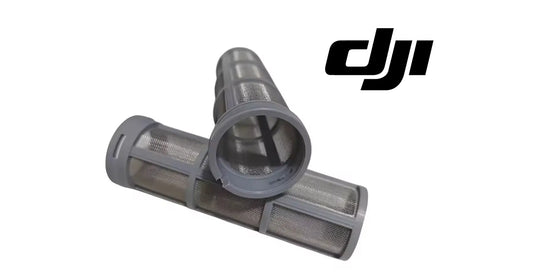
DJI tells operators to use clean water without minerals to mix pesticide and to filter the mixed liquid before pouring it into the spray tank. The purpose is to reduce blockage of the strainer. Any blockage should be cleared before operation.
Stay upwind and use protective clothing
Stay in an upwind area while spraying to reduce bodily exposure. Wear protective clothing to prevent direct body contact with pesticide, rinse hands and skin after handling it, and clean both the aircraft and remote controller after application.

Drift and application conditions still matter
DJI says effective pesticide use depends on pesticide density, spray rate, spray distance, aircraft speed, wind speed, wind direction, temperature and humidity. Those variables should be considered without compromising the safety of people, animals or the environment.
Protect waterways and drinking-water sources
Do not contaminate rivers or sources of drinking water. This is a separate boundary from merely achieving the desired spray coverage.
Minimize surplus spray
The source says spray planning should reduce the amount of surplus solution. It recommends applying surplus spray or washing liquid in the tank to crops and notes that users can consider installing a pipeline to handle washing-liquid disposal. Any such practice still needs to be compatible with the pesticide's own instructions and applicable local requirements.
Do not use incompatible liquids
DJI says not to use strong acids, strong bases, high-temperature liquids or pesticides that are explicitly prohibited.
T100 spraying-system service paths
For T100 operators, verified service paths include the T100 Spraying System Parts collection, T100 OEM 75L Water Tank, T100 OEM 100 Mesh Filters and T100 Spray System Critical Spares Pack. These links are service/commercial paths; they do not replace the handling instructions above.
Aircraft and model paths
Shop Related Collections
Related Tutorials
- Agricultural Drone Safety & Safe Spraying Practices
- T100 End-of-Day Spray Cleaning Guide
- T100 Spraying System Maintenance
🇺🇸 Reading from the United States? See the U.S. edition: DJI Agras T100/T70 Series/T25P Pesticide Handling & Spraying Safety Guide
Canadian Operator FAQ: T100/T70 Series/T25P Pesticide Handling & Spraying Safety Guide
Does Ares Acres ship T100, T70 Series and T25P nozzles, strainers and spraying parts to Canada?
Yes. Ares Acres ships genuine DJI Agras OEM parts, including T100, T70 Series and T25P nozzles, strainers and spraying parts referenced in this guide, to Canada with free standard shipping, and Canadian customers see CAD pricing at checkout.
Do I need an SFOC to fly the DJI Agras T100, T70 Series or T25P in Canada?
Not for every operation. Under Transport Canada’s November 2025 rules, the DJI Agras T100, T70 Series or T25P falls into the medium RPAS class (25–150 kg) and can be flown within visual line of sight on an Advanced Operations pilot certificate; a Special Flight Operations Certificate is still required for operations outside that envelope, such as beyond visual line of sight or payloads Transport Canada treats as dangerous goods. Confirm current requirements with Transport Canada and your provincial regulator before operating.
Is this pesticide-handling safety different for Canadian operators?
No. The pesticide-handling safety described here is identical in every country; only the regulatory framework, the purchasing path and the units used in this guide differ. Confirm current requirements with Transport Canada and your provincial regulator before operating.
Source and revision note
Primary source: DJI AGRAS T100/T70 Series/T25P Disclaimer and Safety Guidelines v1.0, English Pesticide Usage section.