
DJI Agras T100 Auger Size Guide for Cover Crop Season: Small vs Medium vs Large vs Extra-Large Screw Feeders
Share
🇺🇸 U.S.A. FIRST — DJI Agras Spreading Systems, OEM Parts & Technical Support
Ares Acres supports U.S. DJI Agras operators with agricultural drone systems, model-specific OEM parts, spreading and seeding components, and practical technical guidance built around real field operations. Whether you are preparing a DJI Agras T100 for cover crop season or maintaining an existing fleet, the goal is the same: choose the correct hardware configuration before the aircraft leaves the ground.
For T100 operators, one of the most important spreading-system decisions is also one of the easiest to overlook: which screw feeder—or auger—should you run for the material and application rate you actually intend to spread?
DJI SmartFarm uses the term screw feeder. In parts catalogs and field conversations, operators often call the same component an auger. This guide uses both terms because the decision is not about terminology. It is about matching material size, flow characteristics and target pounds per acre to the correct feeder.
If you are building or servicing a T100 spreading setup, you can also browse the DJI Agras T100 OEM 100 Liter Spreading System, the higher-volume DJI Agras T100 OEM 150 Liter Seeding System, or the full DJI T100 Parts collection.
Core rule: choose the feeder from two numbers first—material particle size and target application rate. Then validate the configuration with the actual seed or granular material you will spread.
Why Auger Size Matters During Cover Crop Season
Cover crop work can move quickly. Weather windows narrow, harvest timing shifts, and an operator may be asked to broadcast very different products from one field to the next. A cereal-grain seed, a small brassica seed, a coated seed and a blended cover crop mix do not behave identically inside a hopper.
The screw feeder meters material from the hopper into the spreading system. If the feeder is poorly matched to the product, the operator can create a problem before spinner speed, flight speed or swath width even enter the conversation.
A feeder that is too restrictive for a high-volume job can limit throughput. A feeder that is too aggressive for a low-rate material can make fine rate control more difficult. Mixed seed sizes can introduce segregation or inconsistent feeding. Material shape, density, coating, moisture and cleanliness can further affect how a nominally similar seed flows.
That is why the correct question is not simply, “Which auger is biggest?” The correct question is:
Which T100 screw feeder gives this specific material enough flow capacity while still allowing controlled metering at the desired pounds per acre?
DJI Agras T100 Screw Feeder / Auger Quick Comparison
The DJI SmartFarm configuration screen for the T100 shows four screw-feeder choices. The ranges below are the values shown in that configuration guidance.
| Screw feeder / auger | Spreading capacity shown | Suitable grain size shown | Examples shown in SmartFarm |
|---|---|---|---|
| Small | 2.7–19.9 lb/acre | 0.5–4 mm | Rape seed; granular herbicide; granular pesticide |
| Medium | 19.9–106.4 lb/acre | 4–6 mm | Rice |
| Large | 66.5–239.3 lb/acre | 4–10 mm | Rice |
| Extra-large | 66.5–664.8 lb/acre | 0.5–10 mm | Fertilizer; wheat; feed |
Important: these are configuration ranges, not a guarantee that every material inside the listed dimensions will meter identically. Two products with the same nominal particle size can have very different density, shape, surface texture and flow behavior. Always validate the actual material and current DJI guidance for your configuration.
The Two Numbers That Should Drive the Decision
1. Particle or seed size
The first filter is physical size. A seed or granule has to move consistently through the feeder without excessive restriction, bridging or uncontrolled flow. The SmartFarm ranges overlap in places, which is useful because it means feeder selection is not determined by diameter alone.
When working with a cover crop mix, do not estimate from the largest seed in the blend and stop there. Inspect the entire mix. Fine seed may settle differently than larger seed, and the distribution of particle sizes can change how consistently the mixture meters over time.
2. Target pounds per acre
The second filter is the intended application rate. This is where many auger decisions become clearer. A material may physically fit through more than one feeder, but the target rate may place the job squarely in the operating range of one size.
For example, the SmartFarm ranges show the small feeder focused on low-rate work, while the extra-large feeder extends dramatically upward for very high-volume spreading. Medium and large occupy the middle and upper-middle portions of the range.
Do not select a feeder by seed size while ignoring application rate. The T100 is a metering system, not simply a container with a discharge opening.
Small T100 Auger: Best Starting Point for Fine Material and Low Rates
The DJI Agras T100 OEM Small Auger corresponds to the low-rate end of the SmartFarm feeder chart: 2.7–19.9 lb/acre with a listed suitable grain size of 0.5–4 mm.
That makes the small screw feeder the configuration to evaluate when the material is relatively fine and the agronomic target requires precise low-rate metering. DJI's own screen uses rape seed and certain granular crop-protection products as examples.
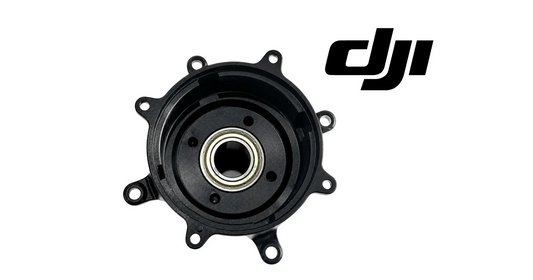
For operators replacing more than the screw itself, Ares Acres also lists the T100 Small Auger Full Set with Auger and Bushing and the standalone T100 Small Auger Bushing.
Cover crop implication: if your actual seed lot is small enough and the desired rate is inside the low-rate range, the small feeder may provide the control you need. But do not assume every “small-seeded cover crop” belongs here. Coatings, blends and lot-to-lot variation matter.
Medium T100 Auger: Mid-Range Metering for 4–6 mm Material
The DJI Agras T100 OEM Medium Auger is shown with a 19.9–106.4 lb/acre spreading-capacity range and 4–6 mm suitable grain size.
This is a meaningful jump from the small feeder. It gives an operator more material throughput while remaining more controlled than jumping automatically to a large or extra-large feeder.
The key is the overlap. A material near the upper end of one feeder's physical range and the lower end of another feeder's application-rate range should be tested based on the actual product. This is especially important with cover crop blends, where one bag can contain substantially different seed shapes and densities.
Large T100 Auger: Higher-Rate 4–10 mm Spreading
The DJI Agras T100 OEM Large Auger is shown for 66.5–239.3 lb/acre with suitable grain sizes of 4–10 mm. DJI's configuration screen uses rice as an example.
Compared with the medium feeder, the large auger extends both the physical material range and the high-rate capability. That makes it relevant when the target job requires substantially more mass flow rather than simply because the operator is handling a larger seed.
For a replacement assembly that includes both metering components, see the DJI Agras T100 OEM Large Auger Kit with Auger and Bushing.
Do not confuse capacity with accuracy. A feeder capable of a higher maximum rate is not automatically the best tool for a low-rate job. The objective is to operate inside a controllable portion of the correct feeder's range.
Extra-Large T100 Auger: Maximum Throughput for High-Volume Material
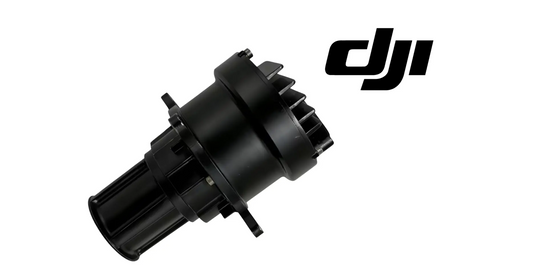
The DJI Agras T100 OEM Extra Large Auger (BC.AG.SS001067) occupies the widest range on the SmartFarm screen: 66.5–664.8 lb/acre and 0.5–10 mm. DJI displays fertilizer, wheat and feed as example materials.
That very broad physical-size range is a reminder that particle size alone does not define feeder selection. The extra-large feeder's main distinction is throughput. It is intended to move significantly more material when the mission demands it.
For cover crop work, this can matter when the seed or blend is being broadcast at a high mass rate. But using the extra-large feeder merely because it can accept a wide range of particle sizes can be the wrong decision if the actual target rate is low.
The T100 OEM Extra Large Auger is now available as an active Ares Acres product listing, giving operators a direct source for the highest-throughput screw-feeder configuration alongside the rest of the T100 parts ecosystem.
Bigger Is Not Automatically Better
One of the most useful lessons from the four-feeder chart is that DJI did not design one universal screw and call the problem solved. The T100 has multiple metering options because controlled low-rate output and maximum high-rate throughput are different engineering problems.
| If the feeder is poorly matched... | What the operator may experience |
|---|---|
| Too restrictive for the required throughput | Difficulty achieving the commanded mass flow, slow discharge, bridging or inconsistent feed under heavy demand |
| Too aggressive for a very low target rate | Reduced low-end control, pulsing or difficulty maintaining the desired application rate |
| Material is outside the practical physical range | Binding, inconsistent delivery, damage to seed, poor metering or unreliable calibration |
| Blend contains very different particle sizes | Segregation, inconsistent mixture ratio over the load, different flow behavior than a single-species calibration |
This is why a professional setup treats feeder selection as part of calibration, not as a one-time accessory decision.
How Cover Crop Mixes Change the Auger Decision
Single-species seed is relatively straightforward compared with a multi-species cover crop blend. A blend can combine different seed dimensions, shapes and densities. During transport, loading, vibration and flight, those materials can separate to some degree.
Common cover crop programs may involve cereal grains, legumes, brassicas or mixtures of several categories. The correct T100 feeder cannot be prescribed from the crop name alone. Instead, evaluate:
- the smallest and largest particles in the actual blend;
- how much of the blend falls into each size class;
- seed coating or treatment;
- bulk density;
- flowability and tendency to bridge;
- target total pounds per acre;
- whether the blend remains homogeneous during metering.
If a blend is substantially different from the material used in a previous calibration, treat it as a new product. Do not assume last week's settings will reproduce this week's rate.
A Practical T100 Cover Crop Calibration Workflow
Use the current DJI SmartFarm and aircraft guidance for the exact configuration. At the fleet-management level, a good process follows this sequence:
- Identify the actual material. Record the seed or granular product, supplier, lot and whether it is a blend or coated product.
- Inspect particle size and flow. Do not rely on the crop name alone.
- Define the agronomic target rate. Know the intended pounds per acre before selecting the feeder.
- Select the candidate screw feeder. Use both the SmartFarm grain-size range and rate range.
- Inspect the spreading hardware. Verify the screw, bushing, motor, sensor, dosing path and spinner components are clean and serviceable.
- Configure the feeder correctly in SmartFarm. The software configuration should match the physical screw feeder installed.
- Perform the applicable DJI calibration procedure. Do not skip calibration simply because the material looks similar to a previous seed.
- Run a controlled test pass. Compare commanded rate with observed material consumption and acreage before committing to a full field.
- Inspect spread uniformity. Rate accuracy and distribution uniformity are separate questions.
- Record the successful configuration. Save feeder size, product/seed lot, target rate and relevant settings so the operation can reproduce the result later.
Best practice: build a simple material library for your operation. Each time a seed lot or granular product is successfully calibrated, record the feeder, target rate and configuration. Over time, setup becomes faster without relying on memory.
Do Not Forget the Rest of the Spreading System
An application-rate problem is not always an auger problem. The feeder is only one part of the T100 material path.
If output becomes inconsistent, inspect the components around it. Ares Acres carries the DJI Agras T100 OEM Auger Motor and T100 OEM Auger Sensor for the feeder drive and feedback side of the system.
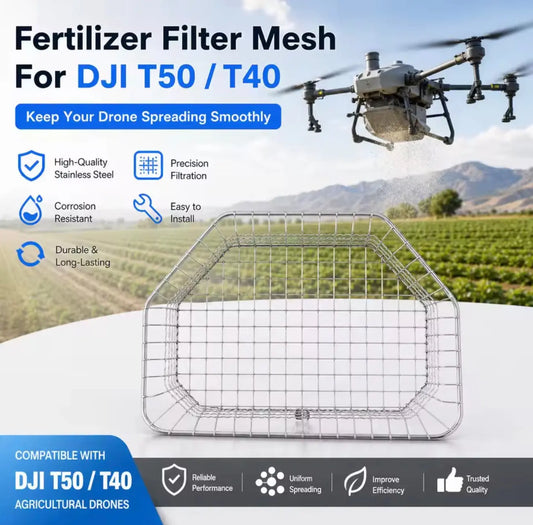
The material path also includes components such as the T100 OEM Dosing Tunnel with Filter. For appropriate granular applications, the T100 Stainless Steel Fertilizer & Manure Spread Filter is another serviceable part of the spreading ecosystem.
At the distribution end, inspect the spinner assembly rather than blaming metering for every uneven pattern. The catalog includes the T100 OEM Spinner Disk Motor and T100 OEM Spinner Disk.
The broader point is simple: metering accuracy and spread-pattern uniformity depend on the entire system working correctly.
Troubleshooting: When the Rate or Flow Does Not Look Right
| Symptom | What to check first |
|---|---|
| Cannot reach target lb/acre | Confirm feeder size/range, material flowability, hopper path, obstruction, calibration and commanded settings |
| Output surges or pulses | Check whether feeder is oversized for the low target rate, inspect material consistency and verify the screw/bushing system |
| Material bridges in hopper | Inspect moisture, shape, fines, compaction, contamination and material path before assuming the motor is weak |
| Actual consumption differs from expected rate | Recalibrate with the actual lot; confirm SmartFarm feeder configuration and verify field acreage/mission settings |
| Rate appears correct but pattern is uneven | Shift attention to spinner disk condition, spinner speed/configuration, material characteristics and flight parameters |
| One seed blend worked, another does not | Treat the new blend as a different material and repeat feeder-selection/calibration process |
Pre-Season T100 Spreading-System Checklist
- Confirm which small, medium, large and extra-large augers are physically available before the application window begins.
- Inspect bushings and the screw feeder for wear or damage.
- Verify auger motor and sensor operation.
- Clean the dosing tunnel and material path.
- Inspect hopper, filter and lid components.
- Inspect spinner disk and spinner motor.
- Load the correct feeder configuration in DJI SmartFarm.
- Build a calibration record for each major seed or granular product.
- Keep a replacement-parts plan rather than discovering a missing feeder or motor during the weather window.
Operators preparing a complete system can browse the DJI Parts catalog or the broader Ares Acres Product Catalog before cover crop work ramps up.
Frequently Asked Questions
What is the difference between a T100 auger and a screw feeder?
In this context, they refer to the same metering component. DJI SmartFarm uses “screw feeder,” while parts listings and operators often use “auger.”
Which DJI Agras T100 auger should I use for cover crop seed?
Choose based on the actual seed or blend's particle size and the target pounds per acre. Do not assign a feeder solely from the crop name. Compare the material with the SmartFarm ranges, then calibrate the installed configuration with the actual lot.
What are the T100 small auger ranges?
The SmartFarm screen shown for the T100 lists 2.7–19.9 lb/acre and 0.5–4 mm for the small screw feeder.
What are the T100 medium auger ranges?
The listed medium-feeder range is 19.9–106.4 lb/acre with a 4–6 mm suitable grain-size range.
What are the T100 large auger ranges?
The listed large-feeder range is 66.5–239.3 lb/acre with a 4–10 mm suitable grain-size range.
What are the T100 extra-large auger ranges?
The T100 OEM Extra Large Auger is listed at 66.5–664.8 lb/acre with a 0.5–10 mm suitable grain-size range. DJI's screen shows fertilizer, wheat and feed as examples.
Should I use the biggest auger so it never plugs?
No. Maximum throughput is only one requirement. A feeder that is too aggressive for a low target rate can make controlled metering more difficult. Match both material size and required application rate.
Can one calibration be used for every cover crop blend?
No. Different blends and even different lots can vary in size distribution, density, coating and flowability. Revalidate whenever the material changes meaningfully.
Is an uneven spread pattern always caused by the auger?
No. The auger meters material, but distribution also depends on the downstream spreading system, including the spinner assembly and the material's physical behavior.
Where can I find T100 spreading-system replacement parts?
Start with the Ares Acres DJI T100 Parts collection or contact Ares Acres if you need help identifying the correct component for a specific configuration.
What Is Ares Acres?
Ares Acres is a U.S.-based agricultural robotics and DJI Agras systems supplier focused on helping operators source aircraft, OEM parts and the technical components required to keep commercial agricultural drone fleets working. Our catalog is structured around real Agras systems rather than generic drone accessories, including T100 spreading and seeding hardware, power-system components, airframe parts, sensors, motors and field-service items.
For operators building a T100 specifically for seeding or granular application, the most direct starting points are the 100 Liter Spreading System, the 150 Liter Seeding System, and the model-specific T100 replacement-parts collection.
Build Your T100 Cover Crop Setup Before the Weather Window Opens
Cover crop season rewards preparation. The best time to discover that your operation needs a different auger, bushing, motor or spinner component is not after the seed is loaded and the field is ready.
Start by defining the seed or granular material, its actual particle-size range and the target pounds per acre. Choose the correct feeder from those requirements. Calibrate the physical configuration in DJI SmartFarm. Run a controlled validation pass. Then document what worked.
Need help sourcing the right T100 auger or spreading-system component? Browse the DJI Agras T100 OEM parts ecosystem or contact Ares Acres with your aircraft model, material, target application rate and the component you are trying to identify.
Operational note: Always follow the current DJI documentation and SmartFarm guidance for the exact aircraft and spreading-system configuration in use. For regulated granular herbicides, pesticides or other crop-protection products, also follow the product label and all applicable federal, state and local requirements. This guide is intended to organize feeder selection and maintenance decisions, not override manufacturer instructions or application-label requirements.